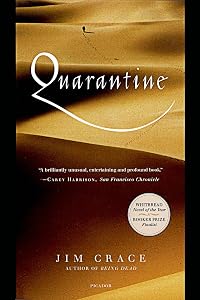
Quarantine
by Jim Crace
On This Page
Description
Retells the story of Jesus Christ's forty-day sojourn in the wilderness and its impact on a small group of individuals.Tags
Recommendations














Member Recommendations
by anonymous user
Member Reviews
To my knowledge there are few serious novelists who still take stories from the Bible and make it the centre piece of a novel, without sounding terribly religious. Jim Crace does, in this wonderful novel Quarantine.
Perhaps Quarantine should better be described as a historical novel. The mastery in the choice of the novelist is to find a character, a period and an event which appear "empty" on our minds before reading, the white spot on the map, the terra incognita for the explorer to discover and fill in. Crace's masterful choice is Jesus' forty days fast in the desert.
The novel is an obviously very free suggestion of what could have happened, told with dignity and sufficient mystery to keep even the non-religious reader in awe about show more the historical and religious figure of Jesus, the Galilean.
The story opens with the abandonment by a caravan of Musa, a rich merchant, and his wife Miri, left behind in the desert in his tent to die. It sets the scene in the heat of the harsh environment of the desert, where they soon run out of water. Miri digs his grave after Musa has died, but returning to the tent she finds him alive. A subtle measure of suspense, the scenes separated by about 30 pages, suggests that Musa's resurrection is a miracle performed by Jesus. Towards the end of the book, as Jesus' fast comes to an end, he is also believed dead and risen, a feat again surrounded by circumstance enough to blur perception and myth.
They are not alone in the desert. Musa believes Jesus came together with four other travellers, who have entered the desert to fast and pray. Musa seizes the opportunity to claim the land, and tell the travellers that the caves in which they have put up belong to him, and they should pay him to stay there. From the pit (Musa does not know it was to be his grave) wells water, which he tries to sell them. The picture of Musa is definitively not sympathetic. Could it be taken as a reference to the modern-day situation in Judea?
A very intriguing novel. show less
Perhaps Quarantine should better be described as a historical novel. The mastery in the choice of the novelist is to find a character, a period and an event which appear "empty" on our minds before reading, the white spot on the map, the terra incognita for the explorer to discover and fill in. Crace's masterful choice is Jesus' forty days fast in the desert.
The novel is an obviously very free suggestion of what could have happened, told with dignity and sufficient mystery to keep even the non-religious reader in awe about show more the historical and religious figure of Jesus, the Galilean.
The story opens with the abandonment by a caravan of Musa, a rich merchant, and his wife Miri, left behind in the desert in his tent to die. It sets the scene in the heat of the harsh environment of the desert, where they soon run out of water. Miri digs his grave after Musa has died, but returning to the tent she finds him alive. A subtle measure of suspense, the scenes separated by about 30 pages, suggests that Musa's resurrection is a miracle performed by Jesus. Towards the end of the book, as Jesus' fast comes to an end, he is also believed dead and risen, a feat again surrounded by circumstance enough to blur perception and myth.
They are not alone in the desert. Musa believes Jesus came together with four other travellers, who have entered the desert to fast and pray. Musa seizes the opportunity to claim the land, and tell the travellers that the caves in which they have put up belong to him, and they should pay him to stay there. From the pit (Musa does not know it was to be his grave) wells water, which he tries to sell them. The picture of Musa is definitively not sympathetic. Could it be taken as a reference to the modern-day situation in Judea?
A very intriguing novel. show less
Before the advent of the internet, I collected variations of Jesus' 40 days in the desert capped by the 3 great temptations, which everyone named differently. This version of the temptation of Jesus is elegant. Is it the writing? (Sentences one mouths for the sheer joy of hearing it?) Is it the imaginative variation on the theme, totally original? Is it the unexpectedness of it all? I love it; I look forward to rereading it. I am desperate to discuss it.
An interesting take on the forty days that Jesus spent fasting in the desert, with a cast of not-quite-storybook characters that you don't want to miss. Provocatively heretical and reverent all at once...my kind of Bible story.
A fascinating, richly textured, "alternative history"? It's difficult to classify this novel actually. 2000 years ago Judea is not a place I had ever thought much about aside from Biblical stories. This novel brings the time and place to life through real people-- very well done characters in fact. I especially appreciated the time spent on women's lives. Jesus is a minor character and I won't spoil the ending, but it is very thought provoking. I'd love to discuss this novel with a devout Christian.
“We are born. We die. Somewhere in between we live. And how we live is up to us. That’s it.”
― Steven Ramirez,
This novel offers an account of Christ's 40-day sojourn in the wilderness. Crace's Jesus is a young man from Galilee, who is seen as too-pious habits by his parents, He has deserted the paternal carpenter's shop and run away to the Judean wilderness in search of God. He arrives with four other quarantineers, each independently and looking to be closer to God, to live for 40 days in a cave, with what food and water they bring or can find. On arrival at the caves they discover a merchant called Musa, who is seriously ill and has been abandoned by his travelling companions, and his oppressed and pregnant wife Miri. Jesus show more chooses the least accessible cave and means to go without food or water for the whole period.
Musa makes a miraculous recovery who then sets out to cheat the quarantiners, by charging them rent for their cave accommodations and selling them food and water whilst offering protection, exploiting fake piety. In contrast Jesus chooses the least accessible cave of all and intendss to go without food or water for the whole period.
The wilderness setting is beautifully rendered in almost obsessive detail: the geography and geology of the area, its birds and animals, insects and plants, its folk beliefs and superstitions using almost lyrical language employing some interesting, inventive metaphors and similes.
Musa has a vague vision of a resurrected Jesus yet this rapist, bully and swindler alone recognizes a healer who will later argue that it is just such people He has come to heal.
This is an interesting take on novel/fable and a very enjoyable one, although perhaps not for the truly religious amongst us. I particularly liked the character of Musa who despite being a thoroughly immoral individual was probably the most 'honest' amongst the group. show less
― Steven Ramirez,
This novel offers an account of Christ's 40-day sojourn in the wilderness. Crace's Jesus is a young man from Galilee, who is seen as too-pious habits by his parents, He has deserted the paternal carpenter's shop and run away to the Judean wilderness in search of God. He arrives with four other quarantineers, each independently and looking to be closer to God, to live for 40 days in a cave, with what food and water they bring or can find. On arrival at the caves they discover a merchant called Musa, who is seriously ill and has been abandoned by his travelling companions, and his oppressed and pregnant wife Miri. Jesus show more chooses the least accessible cave and means to go without food or water for the whole period.
Musa makes a miraculous recovery who then sets out to cheat the quarantiners, by charging them rent for their cave accommodations and selling them food and water whilst offering protection, exploiting fake piety. In contrast Jesus chooses the least accessible cave of all and intendss to go without food or water for the whole period.
The wilderness setting is beautifully rendered in almost obsessive detail: the geography and geology of the area, its birds and animals, insects and plants, its folk beliefs and superstitions using almost lyrical language employing some interesting, inventive metaphors and similes.
Musa has a vague vision of a resurrected Jesus yet this rapist, bully and swindler alone recognizes a healer who will later argue that it is just such people He has come to heal.
This is an interesting take on novel/fable and a very enjoyable one, although perhaps not for the truly religious amongst us. I particularly liked the character of Musa who despite being a thoroughly immoral individual was probably the most 'honest' amongst the group. show less
Crace, as always, is a master of the English language and through his prose deposits the reader into the Judean desert of 2000 years ago. A group of travelers - an aging Jew, a barren woman, a proud Greek and an African native called a badu (Badu is a traditional Ghanian name for the 10th-born son) - are seeking to spend forty days and nights in the desert, fasting from dawn to dusk, each searching for a different form of enlightenment. They come across a traveling trader and his pregnant wife. The trader has just been healed by Jesus and shows his demeanor by conspiring to take every last coin the travelers have; he convinces them he owns the land and the caves and charges them rent and board.
Crace takes the familiar story of Jesus's show more fast in the desert, where he was tempted by the devil to betray God, and turns it on its head. The trader tempts Jesus, but Jesus himself, an overly devout young man, begins to doubt his faith.
The reader will feel the scorching daytime heat, the chilling cold wind at night and will thirst for the slightest drop of water. While not a strict interpretation of the biblical story, it is an altogether different variation on the tale, where the hopes of the faithful may or may not be granted in ways unexpected. show less
Crace takes the familiar story of Jesus's show more fast in the desert, where he was tempted by the devil to betray God, and turns it on its head. The trader tempts Jesus, but Jesus himself, an overly devout young man, begins to doubt his faith.
The reader will feel the scorching daytime heat, the chilling cold wind at night and will thirst for the slightest drop of water. While not a strict interpretation of the biblical story, it is an altogether different variation on the tale, where the hopes of the faithful may or may not be granted in ways unexpected. show less
A moving and fascinating novel that gradually hooked me. This is an alternate fictional account of the 40 days in the desert of Jesus (although the name is never used in the text). The story reorients received views about the ancient Middle East, biblical stories and daily life. In the process it can sensitise non-historians to the cosy fictions we too often live with.
Members
- Recently Added By
Published Reviews
ThingScore 100
Kann ein Autor am Ende des 20. Jahrhunderts einen Roman über körperlich-geistige Selbstkasteiung und das Mysterium des christlichen Mensch-Gottes schreiben, ohne sich lächerlich zu machen? Ja, der "altmodische Schriftsteller" Jim Crace kann das - und zwar meisterhaft.
added by Indy133
Lists

The Guardian's 1000 Novels Everyone Must Read
1,005 works; 551 members

Booker Prize
491 works; 62 members
Booker Prize Shortlist: Titles Read
103 works; 10 members

International IMPAC Dublin Literary Award
179 works; 6 members

Five star books
1,767 works; 110 members

TML 200 Best Books 1950-1999
202 works; 10 members

Man Booker Prize Longlist 1997
6 works; 2 members

BBC Radio 4 Bookclub
341 works; 13 members

The Modern Library (The Two Hundred Best Novels....
202 works; 1 member
Author Information

21+ Works 7,542 Members
British author Jim Crace has won the 2015 International IMPAC Dublin Literary Award for his novel Harvest (Picador). The ¿100,000 (A$205,140) award is presented annually for a novel written in English or translated into English, and is chosen by judges from a selection of titles nominated by libraries across the world. (Bowker Author Biography)
Awards and Honors
Common Knowledge
- Original publication date
- 1997
- People/Characters
- Jesus
- First words
- Miri's husband was shouting in his sleep, not words that she could recognize but simple, blurting fanfares of distress.
- Last words
- (Click to show. Warning: May contain spoilers.)Nor could he contemplate the endless movements on the trading road, the floods, the rifts, the troops, the ever-caravans, the evening peace that's brokered not by a god but by the rocks and clays themselves, shalom, salaam, the one-time, all time truces of the land.
- Blurbers
- Updike, John; Eder, Richard; Bawer, Bruce
- Original language
- English
Classifications
Statistics
- Members
- 1,318
- Popularity
- 18,306
- Reviews
- 37
- Rating
- (3.65)
- Languages
- English, German, Spanish
- Media
- Paper, Audiobook, Ebook
- ISBNs
- 25
- ASINs
- 7