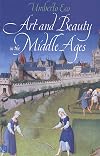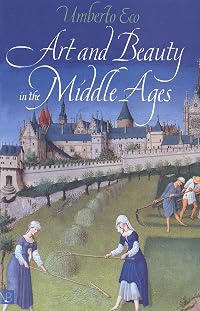
Art and Beauty in the Middle Ages
by Umberto Eco
On This Page
Description
In this authoritative, lively book, the celebrated Italian novelist and philosopher Umberto Eco presents a learned summary of medieval aesthetic ideas. Juxtaposing theology and science, poetry and mysticism, Eco explores the relationship that existed between the aesthetic theories and the artistic experience and practice of medieval culture. -- Publisher's website.Tags
Recommendations








Member Reviews
Topic: Medieval aesthetics
Question: Was there a theory of aesthetics in the Middle Ages, and what was it?
Thesis: Medieval people did have a theory of aesthetics, which is so different from ours that many modern scholars haven't been able to see it. This theory can tell us a lot about the medieval world, and help us understand modern aesthetics better.
Argument: Traces the development of medieval theories of aesthetics as expressed by philosophers throughout the Middle Ages. Philosophy didn't quite keep up with what was actually happening. All in all, medieval aesthetics were concerned with the didactic and formal aspects of art, and only late in the Middle Ages did philosophy catch up with the ideas of artistic inspiration and the power show more of the artist that were already present in poetry and beginning to be seen in visual art. Medieval aesthetics were very different from modern aesthetics, but that doesn't mean that we should discount them: just because we don't think allegory is beautiful doesn't mean that we should think any less of them because they did find allegory beautiful. Medievals valued intellectual achievements over material ones, so artist themselves weren't particularly valued in the Middle Ages. They saw external beauty as a reflection of internal beauty, and ultimately saw art as a reflection of God's goodness.
Evidence: primarily philosophical writing, with some references to medieval works of art
Bias/Stance: surprisingly Annalist - looking at the long duree and the history of a mentalitee; taking the Middle Ages on its own terms instead of judging the Middle Ages by modern standards
Critique: any time a book this short covers a period so long, there are going to be quibbles
State of the Question: This must have been a turning point, and Eco's approach is very sensitive for the time. It is still considered a classic, and must be a big influence on people like Camille.
Personal reaction: I'm really not a philosopher, so a lot of the philosophical intricacies were lost on me. Still, very readable and very enjoyable and enlightening. show less
Question: Was there a theory of aesthetics in the Middle Ages, and what was it?
Thesis: Medieval people did have a theory of aesthetics, which is so different from ours that many modern scholars haven't been able to see it. This theory can tell us a lot about the medieval world, and help us understand modern aesthetics better.
Argument: Traces the development of medieval theories of aesthetics as expressed by philosophers throughout the Middle Ages. Philosophy didn't quite keep up with what was actually happening. All in all, medieval aesthetics were concerned with the didactic and formal aspects of art, and only late in the Middle Ages did philosophy catch up with the ideas of artistic inspiration and the power show more of the artist that were already present in poetry and beginning to be seen in visual art. Medieval aesthetics were very different from modern aesthetics, but that doesn't mean that we should discount them: just because we don't think allegory is beautiful doesn't mean that we should think any less of them because they did find allegory beautiful. Medievals valued intellectual achievements over material ones, so artist themselves weren't particularly valued in the Middle Ages. They saw external beauty as a reflection of internal beauty, and ultimately saw art as a reflection of God's goodness.
Evidence: primarily philosophical writing, with some references to medieval works of art
Bias/Stance: surprisingly Annalist - looking at the long duree and the history of a mentalitee; taking the Middle Ages on its own terms instead of judging the Middle Ages by modern standards
Critique: any time a book this short covers a period so long, there are going to be quibbles
State of the Question: This must have been a turning point, and Eco's approach is very sensitive for the time. It is still considered a classic, and must be a big influence on people like Camille.
Personal reaction: I'm really not a philosopher, so a lot of the philosophical intricacies were lost on me. Still, very readable and very enjoyable and enlightening. show less
art, history, medieval
vorzügliche Quellenangaben
Světoznámý autor Jména růže je i autorem filosofických a umělecko-historických esejů. Umění a krása ve středověké estetice patří k nejzdařilejším a nejinspirativnějším z nich. Eco v něm výstižně zachytil dějiny středověké estetiky, teologického i lidového vnímání nástěnných a deskových obrazů, hudby i architektury s důrazem na alegorický obsah a transcendentální dosah středověkého umění, jež nelze bez znalostí dobových estetických představ nikdy pochopit.
Sep 13, 2021Slovak
"Arte y belleza en la estética medieval" de Umberto Eco, un libro sumamente interesante si partimos de la idea (errónea) preconcebida de que en la Edad Media no pasó nada, fue una época oscura, todo (actividades, conocimientos, etc.) giraba alrededor de la religión. Pero, siguiendo a Eco, en la Edad Media, hubieron diferentes formas de entender arte, belleza, apreciación de obra artística, arte y moral, que va desde San Agustín a Santo Tomás pasando por Duns Escoto, Guillermo de Occam, Boecio, Grosseteste.
Sep 20, 2009Spanish
Ratings
Members
- Recently Added By
Author Information

501+ Works 115,267 Members
Umberto Eco was born in Alessandria, Italy on January 5, 1932. He received a doctorate of philosophy from the University of Turin in 1954. His first book, Il Problema Estetico in San Tommaso, was an extension of his doctoral thesis on St. Thomas Aquinas and was published in 1956. His first novel, The Name of the Rose, was published in 1980 and won show more the Premio Strega and the Premio Anghiar awards in 1981. In 1986, it was adapted into a movie starring Sean Connery. His other works include Foucault's Pendulum, The Island of the Day Before, Baudolino, The Prague Cemetery, and Numero Zero. He also wrote children's books and more than 20 nonfiction books including Serendipities: Language and Lunacy. He taught philosophy and then semiotics at the University of Bologna. He also wrote weekly columns on popular culture and politics for L'Espresso. He died from cancer on February 19, 2016 at the age of 84. (Bowker Author Biography) show less
Common Knowledge
- Original title
- Sviluppo dell'estetica medievale
- Original publication date
- 1987, Gruppo Editoriale Fabbri, Bompiani
- First words
- 1. Most of the aesthetic issues that were discussed in the Middle Ages were inherited from Classical Antiquity.
- Last words
- (Click to show. Warning: May contain spoilers.)Indeed, anyone at all who tries to interpret it sensitively can learn something: not because it is the expression of a civilization better than any other, but because this this the value of any civilization and any doctrine of the past, when we seek to discover its lessons for the present.
- Original language*
- Italian
*Some information comes from Common Knowledge in other languages. Click "Edit" for more information.
Classifications
Statistics
- Members
- 974
- Popularity
- 26,987
- Reviews
- 6
- Rating
- (4.04)
- Languages
- 15 — Catalan, Czech, Danish, Dutch, English, French, German, Hungarian, Italian, Polish, Portuguese, Russian, Slovak, Spanish, Turkish
- Media
- Paper, Ebook
- ISBNs
- 39
- ASINs
- 10