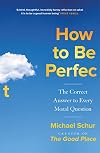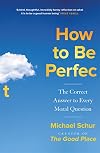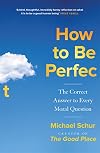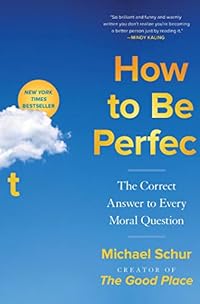
How to Be Perfect: The Correct Answer to Every Moral Question
by Michael Schur
On This Page
Description
From the creator of The Good Place and the cocreator of Parks and Recreation, a hilarious, thought-provoking guide to living an ethical life, drawing on 2,400 years of deep thinking from around the world.Most people think of themselves as "good," but it's not always easy to determine what's "good" or "bad"—especially in a world filled with complicated choices and pitfalls and booby traps and bad advice. Fortunately, many smart philosophers have been pondering this conundrum for millennia show more and they have guidance for us. With bright wit and deep insight, How to Be Perfect explains concepts like deontology, utilitarianism, existentialism, ubuntu, and more so we can sound cool at parties and become better people.
Schur starts off with easy ethical questions like "Should I punch my friend in the face for no reason?" (No.) and works his way up to the most complex moral issues we all face. Such as: Can I still enjoy great art if it was created by terrible people? How much money should I give to charity? Why bother being good at all when there are no consequences for being bad? And much more. By the time the book is done, we'll know exactly how to act in every conceivable situation, so as to produce a verifiably maximal amount of moral good. We will be perfect, and all our friends will be jealous. OK, not quite. Instead, we'll gain fresh, funny, inspiring wisdom on the toughest issues we face every day. show less
Tags
Recommendations







Member Reviews
In many ways, How to Be Perfect is a distillation of what Michael Schur read and talked about while working on the TV show The Good Place—if you've already watched the show, many of the thinkers discussed here will be at least familiar as names mentioned on the show.
This makes the book a quick primer to philosophy (with a focus mostly on various strands of Western philosophy) and what it can tell us about what it means to be a good person. The tongue-in-cheek title is a clue to the wry approach—with a heavy sprinkle of Dad jokes—that Schur takes here, approached from what seems to be broadly a secular humanist approach. Schur's not trying to be comprehensive or definitive here, just to get the reader to think more and to be aware show more of the complexity of ethical dilemmas, and in that respect I think the book works very well. (Also because let's be honest: I am never going to read Kant.) show less
This makes the book a quick primer to philosophy (with a focus mostly on various strands of Western philosophy) and what it can tell us about what it means to be a good person. The tongue-in-cheek title is a clue to the wry approach—with a heavy sprinkle of Dad jokes—that Schur takes here, approached from what seems to be broadly a secular humanist approach. Schur's not trying to be comprehensive or definitive here, just to get the reader to think more and to be aware show more of the complexity of ethical dilemmas, and in that respect I think the book works very well. (Also because let's be honest: I am never going to read Kant.) show less
Wow, truth in titling! I read this book, effortlessly absorbed the lessons Michael Schur so skillfully boiled down from thousands of years of philosophical writings, and now I'm morally perfect!
Ha ha ha ha, but seriously. Schur pulls off something quite difficult here. He's written a primer on moral philosophy that is deeply meaningful and compassionate, engagingly and intelligently written, and laugh out loud funny on many occasions. There is more insight here than you can shake a stick at -- and more jokes! Five stars from me!
Ha ha ha ha, but seriously. Schur pulls off something quite difficult here. He's written a primer on moral philosophy that is deeply meaningful and compassionate, engagingly and intelligently written, and laugh out loud funny on many occasions. There is more insight here than you can shake a stick at -- and more jokes! Five stars from me!
The television show The Good Place led its cast and crew to new places intellectually. A situation comedy about eternal damnation based on moral philosophy and ethics requires new and different smarts. Thinking is required, not just gags. Chief among the team was Michael Schur, its creator and comedy writer par excellence (Saturday Night Live, The Office (US), Parks & Recreation, ...). He has assembled what he has researched and learned in How to be Perfect. Which is not. Thus making it perfect.
Schur has set himself a difficult task, recapping the top lines of various philosophers and philosophies from Aristotle, who everyone knows from 2500 years ago, to today's philosophers, who nobody knows at all. To make the trip bearable, he acts show more as his own worst enemy, adding comments normally reserved for a sidekick who just doesn't get it. Or he'll make up a totally absurd quote, and just to be sure you don't believe it, adds an endnote admitting the fraud (Thus assuming people read endnotes, to which all I can say is Ha! But these are often funny and worthwhile. Even the Acknowledgements attempt to be humorous).
He likes his fictional examples to be absolutely clear: “Damon never used deodorant, and clipped his toenails on the dining room table, and cleaned the Cheeto dust off his fingers by wiping them on my cat.” He really tries to ease the pain of having readers wade through what amounts to a Philosophy 101 textbook if not for the humor and the casual style he employs so well here.
It does get tiresome though, as every philosophy can be destroyed by simply taking it to its logical conclusion. Making everyone and everything equal is not possible, nor even desirable. Things change too quickly, as do external circumstances and societal standards. Laws that once worked are useless now. (Or as George Carlin pointed out when Catholics were finally allowed meat on Fridays: "But I bet there's a bunch of guys doing eternity on a meat rap.") Following every rule there is must eventually lead to mass murder and/or suicide. Everyone cannot be happy all the time. Looking out only for yourself leads to dystopia. Thinking of others first and foremost leads to bankruptcy and poverty if you think there's still another dollar you could donate to a good cause. Every single philosophy ends up being impossible to implement. Which makes most of the chapters rather predictable.
But the ideas are interesting.
Take luck for example. Schur is clear he has it in spades. He lists nearly two dozen times his life and career jumped the queue, vaulting him into the top echelons of Hollywood. He knows he is lucky, and that his luck has the staying power of a Jenga tower, ready to collapse at any time. This has the perverse effect of making him worry when he wins money in casinos. He'd rather lose some just to show he's ready to, as long as it's not everything.
But he doesn't cite Daniel Dennett, the reigning world champion philosopher of our time, who had the temerity to claim that luck simply evens out over a lifetime, so it's not worth bothering over. (Tell that to a child with terminal cancer, DD. Or to Warren Buffett, who never fails to credit luck as his primary source of success. Just sayin' since Schur doesn't.)
It's also made easier by Schur's allusions, just when thing are getting too academic: "Humans are better than other creatures because we can think and reason and philosophize. Those arguments make sense until you see a bunch of kids on a speedboat during spring break chugging vodka from an ice luge shaped like a shotgun, and then you start to think maybe like otters and butterflies have it more figured out than we do."
Then it turns out he was inspired as a child by Woody Allen's Sleeper, followed immediately by Allen's first three books. The rest might be history for Schur, but his hero turned out to be, shall we say, a dirty old man. What does Schur do about following such a reprehensible character, all the way to total success? He's embarrassed. This is how philosophies crater. What was sacred turned out to be profane. Fooled ya.
He invents the concept of moral exhaustion, the impossible situation of weighing doing the best good. Is this charity bona fide? Do they deploy more of their donations than this other one? Do they publish a success ratio? Should we not buy frivolous things that make us happy for a moment, when we could be donating cash to save actual lives? How much joy are we allowed when people are suffering elsewhere? Again, bankruptcy and poverty are there to guide your decisions on doing the most possible good.
There are references that will be familiar to fans of The Good Place. And if if they aren't familiar, they will still cause a smile to crack: "Several times over the course of The Good Place we had someone say, to Chidi, 'This is why everyone hates moral philosophers.' I never truly understood why that's funny until I began writing this book."
Schur says the whole concept for the show began from his guilt-ridden obsession of tipping at his local Starbucks, by dumping the change from his $1.73 coffee into the tip jar, first making sure the barista noticed. Did he want credit for tipping? Is 27 cents from a rich Hollywood writer/producer the road to salvation for his soul? And on and on, just like early Woody Allen, in fact.
One terrific waste of time are philosophic thought experiments. There are a zillion of them, dreamed up by academics to torture students. A trolley's brakes fail, and it will kill five men working on the track ahead, unless you throw a switch which will divert it to another track where it will kill one person innocently standing there. Which do you choose? The what-ifs are endless, making the whole exercise pointless, proving once again no one's philosophy works in every situation (Interestingly, though unmentioned in the book, this has become a real life problem as self-driving vehicles need to be programmed with a decision, one way or the other).
Whole chapters are devoted to burning issues like Should I punch my best friend in the face? and Should I praise my co-worker's ugly shirt? Should I always return the shopping cart to the collection area? The what-ifs take over, expanding to encompass the universe. I remember from school a what-if that went: What if the child you sponsored and saved from starvation and imminent death grew up to join the army, became a general, overthrew the government, had hundreds of thousands killed, tens of thousands more tortured and jailed for life, raided the country's reserves so he could be a billionaire, and thereby forced the whole nation into abject poverty (and all for just pennies per day! Give now!). This is how philosophy self destructs before your eyes.
But, Schur can also clarify things well: "Consider for a second his (Descarte's) famous Enlightenment formulation Cogito, ergo sum—the aforementioned 'I think, therefore I am'—which, again, is one of the very foundations of Western thought. When we place it next to this ubuntu formulation—'I am, because we are'—well, man oh man, that’s a pretty big difference. Descartes saw his own singular consciousness as proof of existence. Practitioners of ubuntu see our existence as conditional on others’ existence. Someone could write a very interesting book on the sorts of civilizations and laws and citizens that emerge from each of these two utterances. Not me, though—it sounds really hard. But someone."
One of the highlights for me came in an unpromising chapter on apologizing. It seemed mainly aimed at his children's difficulty overcoming their pride and making apologies to each other. But there is a lovely segment dedicated to America's First Child, Senator Ted Cruz, who called Congresswoman Alexandria Ocasio-Cortez a "f***ing bitch" right on the Capitol steps. In his very public non-apology, he cited the media's misreporting of the incident, the fact he has a wife and two daughters, and that he not only never said those words but if he did he was sorry if anyone took offense. In a line by line deconstruction, Schur points out all the ways this was not an apology, and how to look out for any such tactics from anyone claiming to apologize. Delightful.
In the end, it turns out he wrote the book for his two children, now preteens, to assure himself they would be on the right track. But the only way that would work is if they don't follow his train of thought into the moral morass of every philosophy and religion in the world.
It all boils down to Everything In Moderation, because that's all we know that works. Mostly.
David Wineberg show less
Schur has set himself a difficult task, recapping the top lines of various philosophers and philosophies from Aristotle, who everyone knows from 2500 years ago, to today's philosophers, who nobody knows at all. To make the trip bearable, he acts show more as his own worst enemy, adding comments normally reserved for a sidekick who just doesn't get it. Or he'll make up a totally absurd quote, and just to be sure you don't believe it, adds an endnote admitting the fraud (Thus assuming people read endnotes, to which all I can say is Ha! But these are often funny and worthwhile. Even the Acknowledgements attempt to be humorous).
He likes his fictional examples to be absolutely clear: “Damon never used deodorant, and clipped his toenails on the dining room table, and cleaned the Cheeto dust off his fingers by wiping them on my cat.” He really tries to ease the pain of having readers wade through what amounts to a Philosophy 101 textbook if not for the humor and the casual style he employs so well here.
It does get tiresome though, as every philosophy can be destroyed by simply taking it to its logical conclusion. Making everyone and everything equal is not possible, nor even desirable. Things change too quickly, as do external circumstances and societal standards. Laws that once worked are useless now. (Or as George Carlin pointed out when Catholics were finally allowed meat on Fridays: "But I bet there's a bunch of guys doing eternity on a meat rap.") Following every rule there is must eventually lead to mass murder and/or suicide. Everyone cannot be happy all the time. Looking out only for yourself leads to dystopia. Thinking of others first and foremost leads to bankruptcy and poverty if you think there's still another dollar you could donate to a good cause. Every single philosophy ends up being impossible to implement. Which makes most of the chapters rather predictable.
But the ideas are interesting.
Take luck for example. Schur is clear he has it in spades. He lists nearly two dozen times his life and career jumped the queue, vaulting him into the top echelons of Hollywood. He knows he is lucky, and that his luck has the staying power of a Jenga tower, ready to collapse at any time. This has the perverse effect of making him worry when he wins money in casinos. He'd rather lose some just to show he's ready to, as long as it's not everything.
But he doesn't cite Daniel Dennett, the reigning world champion philosopher of our time, who had the temerity to claim that luck simply evens out over a lifetime, so it's not worth bothering over. (Tell that to a child with terminal cancer, DD. Or to Warren Buffett, who never fails to credit luck as his primary source of success. Just sayin' since Schur doesn't.)
It's also made easier by Schur's allusions, just when thing are getting too academic: "Humans are better than other creatures because we can think and reason and philosophize. Those arguments make sense until you see a bunch of kids on a speedboat during spring break chugging vodka from an ice luge shaped like a shotgun, and then you start to think maybe like otters and butterflies have it more figured out than we do."
Then it turns out he was inspired as a child by Woody Allen's Sleeper, followed immediately by Allen's first three books. The rest might be history for Schur, but his hero turned out to be, shall we say, a dirty old man. What does Schur do about following such a reprehensible character, all the way to total success? He's embarrassed. This is how philosophies crater. What was sacred turned out to be profane. Fooled ya.
He invents the concept of moral exhaustion, the impossible situation of weighing doing the best good. Is this charity bona fide? Do they deploy more of their donations than this other one? Do they publish a success ratio? Should we not buy frivolous things that make us happy for a moment, when we could be donating cash to save actual lives? How much joy are we allowed when people are suffering elsewhere? Again, bankruptcy and poverty are there to guide your decisions on doing the most possible good.
There are references that will be familiar to fans of The Good Place. And if if they aren't familiar, they will still cause a smile to crack: "Several times over the course of The Good Place we had someone say, to Chidi, 'This is why everyone hates moral philosophers.' I never truly understood why that's funny until I began writing this book."
Schur says the whole concept for the show began from his guilt-ridden obsession of tipping at his local Starbucks, by dumping the change from his $1.73 coffee into the tip jar, first making sure the barista noticed. Did he want credit for tipping? Is 27 cents from a rich Hollywood writer/producer the road to salvation for his soul? And on and on, just like early Woody Allen, in fact.
One terrific waste of time are philosophic thought experiments. There are a zillion of them, dreamed up by academics to torture students. A trolley's brakes fail, and it will kill five men working on the track ahead, unless you throw a switch which will divert it to another track where it will kill one person innocently standing there. Which do you choose? The what-ifs are endless, making the whole exercise pointless, proving once again no one's philosophy works in every situation (Interestingly, though unmentioned in the book, this has become a real life problem as self-driving vehicles need to be programmed with a decision, one way or the other).
Whole chapters are devoted to burning issues like Should I punch my best friend in the face? and Should I praise my co-worker's ugly shirt? Should I always return the shopping cart to the collection area? The what-ifs take over, expanding to encompass the universe. I remember from school a what-if that went: What if the child you sponsored and saved from starvation and imminent death grew up to join the army, became a general, overthrew the government, had hundreds of thousands killed, tens of thousands more tortured and jailed for life, raided the country's reserves so he could be a billionaire, and thereby forced the whole nation into abject poverty (and all for just pennies per day! Give now!). This is how philosophy self destructs before your eyes.
But, Schur can also clarify things well: "Consider for a second his (Descarte's) famous Enlightenment formulation Cogito, ergo sum—the aforementioned 'I think, therefore I am'—which, again, is one of the very foundations of Western thought. When we place it next to this ubuntu formulation—'I am, because we are'—well, man oh man, that’s a pretty big difference. Descartes saw his own singular consciousness as proof of existence. Practitioners of ubuntu see our existence as conditional on others’ existence. Someone could write a very interesting book on the sorts of civilizations and laws and citizens that emerge from each of these two utterances. Not me, though—it sounds really hard. But someone."
One of the highlights for me came in an unpromising chapter on apologizing. It seemed mainly aimed at his children's difficulty overcoming their pride and making apologies to each other. But there is a lovely segment dedicated to America's First Child, Senator Ted Cruz, who called Congresswoman Alexandria Ocasio-Cortez a "f***ing bitch" right on the Capitol steps. In his very public non-apology, he cited the media's misreporting of the incident, the fact he has a wife and two daughters, and that he not only never said those words but if he did he was sorry if anyone took offense. In a line by line deconstruction, Schur points out all the ways this was not an apology, and how to look out for any such tactics from anyone claiming to apologize. Delightful.
In the end, it turns out he wrote the book for his two children, now preteens, to assure himself they would be on the right track. But the only way that would work is if they don't follow his train of thought into the moral morass of every philosophy and religion in the world.
It all boils down to Everything In Moderation, because that's all we know that works. Mostly.
David Wineberg show less
Michael Shur is the creator of The Good Place, a fantastic TV show, and almost certainly the world's only sitcom about moral philosophy. Unsurprisingly, this is a topic Shur himself is fascinated with, and in this volume he takes us through various approaches philosophers over the millennia have had to the questions of how humans should behave towards each other, what it means to be a good person, and whether you really need to put your shopping cart back where it belongs. Although it should probably be noted that a) it's hardly a comprehensive overview of the entire field of philosophy, b) he concentrates entirely on secular, rather than religious philosophy, and c) the emphasis is on Western philosophy, despite brief discussions of show more particular Buddhist philosopher and of the African concept of Ubuntu.
The approach here is simple and casual, taking ideas from people who wrote huge, dense, largely unreadable tomes, paring them down to some of their basics, and seeing what seems useful for us ordinary schmoes as we try to navigate this stupid and complicated thing called life without being complete jerks. Shur sees some merit in almost all of the philosophies he considers (Ayn Rand aside) and seems to regard them all as possible tools to pick and choose from in whatever situations they seem most appropriate in. His writing is clear, breezy, humorous, and pleasant, and much more interested in mulling over the questions than trying to dictate any hard and fast answers. I don't think I agreed one hundred percent with all his personal takes, but I find his approach in general very simpatico.
It's worth pointing out, by the way, just in case it's not clear, that the title is very tongue in cheek. This book will not only not teach you how to be perfect and get the answer to every moral question right, it's not even remotely going to try, because Shur recognizes that that's completely impossible, and not really the point, anyway.
Also worth noting is that although he does reference characters and ideas from The Good Place, because that show embodied a lot of the ideas he's discussing here, you don't need to have seen it to read the book. He also manages not to spoil anything from it, either, in case you want to go and watch it afterward. Fans of the show, though, will probably find it especially interesting and a nice little add-on to their viewing experience. If nothing else, having read the sections on Kant, I now completely understand why Chidi has a stomachache all the time. show less
The approach here is simple and casual, taking ideas from people who wrote huge, dense, largely unreadable tomes, paring them down to some of their basics, and seeing what seems useful for us ordinary schmoes as we try to navigate this stupid and complicated thing called life without being complete jerks. Shur sees some merit in almost all of the philosophies he considers (Ayn Rand aside) and seems to regard them all as possible tools to pick and choose from in whatever situations they seem most appropriate in. His writing is clear, breezy, humorous, and pleasant, and much more interested in mulling over the questions than trying to dictate any hard and fast answers. I don't think I agreed one hundred percent with all his personal takes, but I find his approach in general very simpatico.
It's worth pointing out, by the way, just in case it's not clear, that the title is very tongue in cheek. This book will not only not teach you how to be perfect and get the answer to every moral question right, it's not even remotely going to try, because Shur recognizes that that's completely impossible, and not really the point, anyway.
Also worth noting is that although he does reference characters and ideas from The Good Place, because that show embodied a lot of the ideas he's discussing here, you don't need to have seen it to read the book. He also manages not to spoil anything from it, either, in case you want to go and watch it afterward. Fans of the show, though, will probably find it especially interesting and a nice little add-on to their viewing experience. If nothing else, having read the sections on Kant, I now completely understand why Chidi has a stomachache all the time. show less
I had just finished watching The Good Place, which is an excellent show. Then I remembered this guy had just written a book that made the Goodreads nominees. So yes, I will pick it up.
If you read one book about moral philosophy in your lifetime, let it be this one. Basically, everything he learned from writing The Good Place, about philosophy and how we should act in ethical situations, is condensed into this volume. It’s a laymen’s guide to a very complicated topic, translating so us mere mortals can understand it. Plus humor. There aren’t footnotes on every single word. No “we have to define what ‘things’ are”.
It goes over various philosophical quandaries like the “trolley problem“, the “violinist“, being a show more “happiness pump” and so on. how each of the three major schools of philosophy would tell you how react to moral dilemmas–Aristotlean, kantism, and utilitarianism. Some philosophy purists might say he needs to condense certain parts or expand certain parts. But I think that is not his intended audience. His audience is people like me, who will never pick up a book of German abstract expressionism or a book without a picture on the cover. He’s trying to reach the Eleanor Shellstrops of the world before they get hit by a shopping cart.
I especially loved the chapter on how we can reconcile problematic artists from their art (e.g. Louis C.K., Woody Allen, Dave Chapelle, etc.). Fun fact: he came to the same conclusion that I did, which is that you essentially have to decide for yourself. If you owned the Harry Potter books before Rowling became a TERF, that’s not on the same level of “bad” as going to Harry Potter World and putting more money in J.K. Rowling’s pocket, which is not the same level as being a J.K. Rowling apologist.
Even if the information here wasn’t about an interesting and thick topic, I’d recommend it because this guy is a top-notch writer. He’s worked on three of my favorite recent TV shows (Parks and Rec, Brooklyn 99, The Good Place) and demonstrates he’s not just a yutz in a writer’s room. He thinks about stuff. He’s in this for more than the money–he wants to see humanity thrive. And philosophy is one of those things where A) everyone who came up with these ideas are dead and gone and have no idea how their rules should apply in a world where I have the sum total of human knowledge in my pocket B) has no right answer or even an answer that everyone can agree on. It’s like religion without the mythology. And these are the conclusions Schur provides–counter to the book’s title, no one expects us to be perfect. Just do the best you can. Fail better. show less
If you read one book about moral philosophy in your lifetime, let it be this one. Basically, everything he learned from writing The Good Place, about philosophy and how we should act in ethical situations, is condensed into this volume. It’s a laymen’s guide to a very complicated topic, translating so us mere mortals can understand it. Plus humor. There aren’t footnotes on every single word. No “we have to define what ‘things’ are”.
It goes over various philosophical quandaries like the “trolley problem“, the “violinist“, being a show more “happiness pump” and so on. how each of the three major schools of philosophy would tell you how react to moral dilemmas–Aristotlean, kantism, and utilitarianism. Some philosophy purists might say he needs to condense certain parts or expand certain parts. But I think that is not his intended audience. His audience is people like me, who will never pick up a book of German abstract expressionism or a book without a picture on the cover. He’s trying to reach the Eleanor Shellstrops of the world before they get hit by a shopping cart.
I especially loved the chapter on how we can reconcile problematic artists from their art (e.g. Louis C.K., Woody Allen, Dave Chapelle, etc.). Fun fact: he came to the same conclusion that I did, which is that you essentially have to decide for yourself. If you owned the Harry Potter books before Rowling became a TERF, that’s not on the same level of “bad” as going to Harry Potter World and putting more money in J.K. Rowling’s pocket, which is not the same level as being a J.K. Rowling apologist.
Even if the information here wasn’t about an interesting and thick topic, I’d recommend it because this guy is a top-notch writer. He’s worked on three of my favorite recent TV shows (Parks and Rec, Brooklyn 99, The Good Place) and demonstrates he’s not just a yutz in a writer’s room. He thinks about stuff. He’s in this for more than the money–he wants to see humanity thrive. And philosophy is one of those things where A) everyone who came up with these ideas are dead and gone and have no idea how their rules should apply in a world where I have the sum total of human knowledge in my pocket B) has no right answer or even an answer that everyone can agree on. It’s like religion without the mythology. And these are the conclusions Schur provides–counter to the book’s title, no one expects us to be perfect. Just do the best you can. Fail better. show less
I received an advance copy of this book via NetGalley. Note that quotes within my review may be changed in the final edition.
Michael Schur is the creator behind the brilliant TV series The Good Place, the rare show that put philosophy and the afterlife in a whimsical yet educational light. He does much the same with How to Be Perfect. He readily admits he's no expert, but has gone to the pros for help. The book explores philosophy and what it means to be human among other humans, and does so in a way that is accessible, funny, and also incredibly deep.
This is by no means an exhaustive overview of philosophers across the ages, but he discusses several major voices and brings in modern, personal dilemmas. The Trolley Problem is a subject, show more of course (as it was on The Good Place) but he also brings up things like putting away the shopping cart at a grocery store. Through the perspective of Ubuntu, the answer for this is simple: putting the cart away helps other people, as we are only people through other people.
This is very much a book of 2022 as it discusses the pandemic and masking. As the book notes, the pandemic is "an ideal scenario to illustrate contractualism--what we owe to each other in this case is both easy to identify and infinitesimally small, and the benefits are astronomically huge."
Some of the funniest bits in the book are the footnotes. Later in the book, one observes, "Bet you didn't think when you bought this book on philosophy and got to the chapter on existentialism you were gonna get a Rush lyric thrown at you, huh? Well, too bad. It happened." There's also a chapter that bears the incredibly long title of, "I Gave a Twenty-Seven Cent Tip to My Barista, and Now Everyone's Yelling at Me on Twitter, Just Because I'm a Billionaire! I Can't Even Enjoy the Soft-Shell Crab Rolls That My Sushi Chef Made for My Private Dirigible Trip to the Dutch Antilles! How Is That Fair?!"
Really, nothing about life is fair, and this book makes that grim injustice something amusing. I laughed aloud a few times, but the read made me smile throughout, plus I learned something in the process. show less
Michael Schur is the creator behind the brilliant TV series The Good Place, the rare show that put philosophy and the afterlife in a whimsical yet educational light. He does much the same with How to Be Perfect. He readily admits he's no expert, but has gone to the pros for help. The book explores philosophy and what it means to be human among other humans, and does so in a way that is accessible, funny, and also incredibly deep.
This is by no means an exhaustive overview of philosophers across the ages, but he discusses several major voices and brings in modern, personal dilemmas. The Trolley Problem is a subject, show more of course (as it was on The Good Place) but he also brings up things like putting away the shopping cart at a grocery store. Through the perspective of Ubuntu, the answer for this is simple: putting the cart away helps other people, as we are only people through other people.
This is very much a book of 2022 as it discusses the pandemic and masking. As the book notes, the pandemic is "an ideal scenario to illustrate contractualism--what we owe to each other in this case is both easy to identify and infinitesimally small, and the benefits are astronomically huge."
Some of the funniest bits in the book are the footnotes. Later in the book, one observes, "Bet you didn't think when you bought this book on philosophy and got to the chapter on existentialism you were gonna get a Rush lyric thrown at you, huh? Well, too bad. It happened." There's also a chapter that bears the incredibly long title of, "I Gave a Twenty-Seven Cent Tip to My Barista, and Now Everyone's Yelling at Me on Twitter, Just Because I'm a Billionaire! I Can't Even Enjoy the Soft-Shell Crab Rolls That My Sushi Chef Made for My Private Dirigible Trip to the Dutch Antilles! How Is That Fair?!"
Really, nothing about life is fair, and this book makes that grim injustice something amusing. I laughed aloud a few times, but the read made me smile throughout, plus I learned something in the process. show less
Written by the creator of "The Good Place", one of the boldest and smartest sitcoms of the 21st century, "How to Be Perfect" explores ethics and morality through the teachings of some of history's most esteemed philosophers...and the warped lens of a gifted comedy writer who realizes that, for many of us, humor is a powerful mechanism for learning.
From Aristotle to Kant to John Stuart Mill to Ayn Rand (ick) to Sartre & Camus, Schur takes us through treatises and teachings of prominent philosophies with a sense of playfulness and curiosity. He posits classic philosophical conundrums (The Trolley Problem, Jean Valjean stealing bread to feed his family, white lies to keep from hurting loved ones' feelings, etc) with the array of ways we show more might attempt to resolve them. There are many, many asides (a.k.a. footnotes) that are read by cast members of "The Good Place" on the audiobook (which I highly recommend).
In the final third of the book, Schur turns his attention to how we bring prudent philosophy to current sociopolitical situations (billionaires' spending in a time of abject poverty, making purchases from companies that have policies or politics to which we are morally opposed, environmental ethics, etc). From a couple of reviews I read, this ruffled some feathers with more conservative readers, even though I found Schur to be open-minded and even-handed in how he framed examples and issues.
Another objection I read was that some people found all of the asides and "interruptions" to be, well, disruptive. Again, this is a book driven by two engines: philosophy and humor. Most of these footnotes are for the sake of a brief, salient joke. I'd recommend a straight-up philosophy overview if you're not reading this book with the intent of laughing as you learn.
In the end, I listened to the audiobook, but also borrowed an e-book copy from my library so I could go through and capture some of the terms and philosophers who flew past me too quickly to retain. Either way - the book or audio experience - you're in for an entertaining take on ethics. I highly recommend "How to be Perfect". show less
From Aristotle to Kant to John Stuart Mill to Ayn Rand (ick) to Sartre & Camus, Schur takes us through treatises and teachings of prominent philosophies with a sense of playfulness and curiosity. He posits classic philosophical conundrums (The Trolley Problem, Jean Valjean stealing bread to feed his family, white lies to keep from hurting loved ones' feelings, etc) with the array of ways we show more might attempt to resolve them. There are many, many asides (a.k.a. footnotes) that are read by cast members of "The Good Place" on the audiobook (which I highly recommend).
In the final third of the book, Schur turns his attention to how we bring prudent philosophy to current sociopolitical situations (billionaires' spending in a time of abject poverty, making purchases from companies that have policies or politics to which we are morally opposed, environmental ethics, etc). From a couple of reviews I read, this ruffled some feathers with more conservative readers, even though I found Schur to be open-minded and even-handed in how he framed examples and issues.
Another objection I read was that some people found all of the asides and "interruptions" to be, well, disruptive. Again, this is a book driven by two engines: philosophy and humor. Most of these footnotes are for the sake of a brief, salient joke. I'd recommend a straight-up philosophy overview if you're not reading this book with the intent of laughing as you learn.
In the end, I listened to the audiobook, but also borrowed an e-book copy from my library so I could go through and capture some of the terms and philosophers who flew past me too quickly to retain. Either way - the book or audio experience - you're in for an entertaining take on ethics. I highly recommend "How to be Perfect". show less
Members
- Recently Added By
Lists

Simon & Schuster
136 works; 4 members

READ IN 2022
206 works; 2 members

Books Read in 2023
5,547 works; 145 members

Philosophy
5 works; 1 member
Author Information

50+ Works 1,534 Members
Some Editions
Awards and Honors
Common Knowledge
- Original publication date
- 2022
- Epigraph
- This business is everybody's business. -Albert Camus, The Plague
Do the best you can until you know better. Then when you know better, do better. -Maya Angelou - First words
- Today, you've decided to be a good person. -Introduction
- Last words
- (Click to show. Warning: May contain spoilers.)Keep trying. Love, Dad
- Canonical DDC/MDS
- 818.602
- Canonical LCC
- PN6231.C6142
Classifications
Statistics
- Members
- 851
- Popularity
- 31,978
- Reviews
- 37
- Rating
- (4.06)
- Languages
- 5 — Dutch, English, German, Portuguese, Serbian
- Media
- Paper, Audiobook, Ebook
- ISBNs
- 14
- ASINs
- 5