On This Page
Description
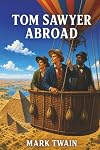
Tom Sawyer Abroad sees Tom, Huck Finn and Jim board a futuristic hot air balloon bound for Africa, in a parody of the popular science fiction/travel adventure stories of the time. In Africa they encounter wild animals and immense man-made wonders. The novel is narrated by Huck Finn..
Tags
Recommendations





















Member Reviews
Did you guys know that there are four books in the Tom Sawyer/Huck Finn saga? Well, five, if you count the unfinished story….
I think that most people have read The Adventures of Huckleberry Finn here in the States, because it’s a pretty common required reading in high school English. Pop culture (and Disney World) itself made me well aware of Tom Sawyer and his fence-painting, treasure-seeking shenanigans. But I wasn’t aware of Tom Sawyer Abroad or the fourth book, Tom Sawyer, Detective, until earlier this year, and as a general fan of Mark Twain, I was in.
Tom Sawyer Abroad brings the trio back together again after The Adventures of Huckleberry Finn. Driven with interest to see a marvellous travelling balloon, the three find show more themselves essentially kidnapped as they’re the last ones off the craft, and whisked away into the skies. The balloon is easy enough to handle for the ever-adventurous Tom and after a few mishaps, they sit back and enjoy the skies.
Atmospherically, I really liked this book and I think it stands up well against the travelling sense of Huckleberry Finn, and the general feel of a lazy adventure. Tom, Huck, and Jim end up flying over the Sahara Desert and learning to enjoy it. There’s a lot of philosophical conversation/argument between Tom and Jim. Now, in the hands of many authors it would be easy for this to become supremely racist and given the time when this book was written, my shields were up. However, as usually… Mark Twain was pretty tasteful, especially for the climate of his era. And I mean this both toward Jim as well as to the Muslims they see in caravans from above.
The conversation does turn a bit theological, keeping in line with the character Twain created in Jim. What I did appreciate is that if one was keeping score, the disagreements between the characters left them all pretty even. There was no “Tom is smarter” even though Tom obviously thinks he’s smarter… but come now… that’s just Tom Sawyer. He thinks he’s smarter than everyone. The theological conversation is not preachy in the least – Twain’s skepticism on the topic is pretty well known – but it’s something to be aware of and having a bit of a religious background and knowing what Jim was talking about certainly helped when it came to their flight over Egypt.
Fortunately, what I like about Twain is his writing style and thought provoking conversations. If you’re looking for a strong action plot, you’re not going to find it here. Honestly, I never felt there was a strong action plot in Huckleberry Finn, so the way that Tom Sawyer Abroad rambled came as no surprise to me? The directionlessness can be frustrating for those looking for most of a story and less of a diversion, so that’s something worth mentioning.
Honestly, I thought this was pretty enjoyable. It was a good distration, and the audiobook narrator was honestly fantastic! This isn’t one of Twain’s strongest pieces, but it’s not a waste of time either and if you enjoy the trio, Tom Sawyer Abroad is worth either a read or a listen. show less
I think that most people have read The Adventures of Huckleberry Finn here in the States, because it’s a pretty common required reading in high school English. Pop culture (and Disney World) itself made me well aware of Tom Sawyer and his fence-painting, treasure-seeking shenanigans. But I wasn’t aware of Tom Sawyer Abroad or the fourth book, Tom Sawyer, Detective, until earlier this year, and as a general fan of Mark Twain, I was in.
Tom Sawyer Abroad brings the trio back together again after The Adventures of Huckleberry Finn. Driven with interest to see a marvellous travelling balloon, the three find show more themselves essentially kidnapped as they’re the last ones off the craft, and whisked away into the skies. The balloon is easy enough to handle for the ever-adventurous Tom and after a few mishaps, they sit back and enjoy the skies.
Atmospherically, I really liked this book and I think it stands up well against the travelling sense of Huckleberry Finn, and the general feel of a lazy adventure. Tom, Huck, and Jim end up flying over the Sahara Desert and learning to enjoy it. There’s a lot of philosophical conversation/argument between Tom and Jim. Now, in the hands of many authors it would be easy for this to become supremely racist and given the time when this book was written, my shields were up. However, as usually… Mark Twain was pretty tasteful, especially for the climate of his era. And I mean this both toward Jim as well as to the Muslims they see in caravans from above.
The conversation does turn a bit theological, keeping in line with the character Twain created in Jim. What I did appreciate is that if one was keeping score, the disagreements between the characters left them all pretty even. There was no “Tom is smarter” even though Tom obviously thinks he’s smarter… but come now… that’s just Tom Sawyer. He thinks he’s smarter than everyone. The theological conversation is not preachy in the least – Twain’s skepticism on the topic is pretty well known – but it’s something to be aware of and having a bit of a religious background and knowing what Jim was talking about certainly helped when it came to their flight over Egypt.
Fortunately, what I like about Twain is his writing style and thought provoking conversations. If you’re looking for a strong action plot, you’re not going to find it here. Honestly, I never felt there was a strong action plot in Huckleberry Finn, so the way that Tom Sawyer Abroad rambled came as no surprise to me? The directionlessness can be frustrating for those looking for most of a story and less of a diversion, so that’s something worth mentioning.
Honestly, I thought this was pretty enjoyable. It was a good distration, and the audiobook narrator was honestly fantastic! This isn’t one of Twain’s strongest pieces, but it’s not a waste of time either and if you enjoy the trio, Tom Sawyer Abroad is worth either a read or a listen. show less
Published in 1894, this book is a sequel to "The Adventures of Tom Sawyer" (1876) and "The Adventures of Huckleberry Finn" (1884). It was written as a parody of adventure stories like those of Jules Verne. Nevertheless, it is a peculiar and clumsy work that shows none of the humor or brilliance of its predecessors. According to the plot, Tom, Huck, and slave Jim travel by hot air balloon across the Atlantic to Africa, where they observe the Sahara Desert, the Egyptian pyramids, and the Sphinx. In a running theme, Tom snottily tries to explain things to his ignorant traveling companions (like why the US states they pass over aren't different colors, as in the schoolbook maps); and they scoff and refuse to accept his explanations. The show more author's presentation of Jim presents the old racialist stereotypes. Twain attempt to sought to satirize Jules Verne falls flat-- it lacks humor, entertainment value, and depth, and fails to capture the interest of the reader. The author seems to have found his own work boring and tiresome, as he ends the book abruptly with a nonsensical finish. Little wonder that this book has so few reviews here and at Amazon and is scarcely remembered except by Twain scholars. "Tom Sawyer Abroad" is a failure and an embarrassment, and deserves to remain in obscurity. show less
This book was, unfortunately, the antithesis of The Adventures of Tom Sawyer. What was magical about Adventures was the childhood imagination of free range children. It was rooted in reality. Tom Sawyer Abroad was just too out there for me. Some of the scenarios were clever but the overall scenario was ridiculous. Twain jumped the shark with this one.
Before I encountered this in my favorite grimy thrift shop, I had no idea that Twain had written other Sawyer books. I was puzzled that I hadn't ever heard of this continuation.
After reading it, its obscurity becomes much more understandable.
After Tom, Huck, and Jim return from The Adventures of Huckleberry Finn, they are kidnapped by an inventor with a giant flying balloon. And they end up flying across the Sahara Desert. Nothing of note really happens beyond the kidnapping. Most of the book is just the trio peering over the side of their airborne basket and commenting on the exciting sand beneath them. And then the book just ends by trailing off...
In short, it doesn't have the pleasure of The Adventures of Tom Sawyer or the importance show more of Huckleberry Finn. It exists simply as an embarrassing footnote. show less
After reading it, its obscurity becomes much more understandable.
After Tom, Huck, and Jim return from The Adventures of Huckleberry Finn, they are kidnapped by an inventor with a giant flying balloon. And they end up flying across the Sahara Desert. Nothing of note really happens beyond the kidnapping. Most of the book is just the trio peering over the side of their airborne basket and commenting on the exciting sand beneath them. And then the book just ends by trailing off...
In short, it doesn't have the pleasure of The Adventures of Tom Sawyer or the importance show more of Huckleberry Finn. It exists simply as an embarrassing footnote. show less
This book was both a surprise and a disappointment. I had assumed that Tom and Huck would be adults, and had expected the book to be longer. Instead the book is quite short, and the story takes place not too long after the events of Huckleberry Finn.
The plot is so ridiculously impossible that the reader needs to suspend their disbelief quite a degree. However, it's still an interesting story, and the idea of flying off in a balloon is an engaging one.
Unfortunately Twain dumbed down his characters, I'm assuming for humorous effect. Some of the things Huck and Jim believed begged belief. I don't remember either character being so stupid in the previous books, and this characterisation spoiled the story for me. Twain also devoted a lot show more of the story to silly debates between Tom, Huck and Jim. These debates grew painful after a while.
I can see why this story has never been as successful as the previous two books in the series. But I still think it's worth reading. Parents of younger readers might like to discuss the book's racial issues with their kids, as attitudes have obviously changed since it was penned. show less
The plot is so ridiculously impossible that the reader needs to suspend their disbelief quite a degree. However, it's still an interesting story, and the idea of flying off in a balloon is an engaging one.
Unfortunately Twain dumbed down his characters, I'm assuming for humorous effect. Some of the things Huck and Jim believed begged belief. I don't remember either character being so stupid in the previous books, and this characterisation spoiled the story for me. Twain also devoted a lot show more of the story to silly debates between Tom, Huck and Jim. These debates grew painful after a while.
I can see why this story has never been as successful as the previous two books in the series. But I still think it's worth reading. Parents of younger readers might like to discuss the book's racial issues with their kids, as attitudes have obviously changed since it was penned. show less
This was surprisingly good. Mark Twain manages to keep the writing, tone, explorative sense, and wonder from the first two books of the series and continues it here. Everything found there still resides here and is fresh to boot. I recommend this for any who like his classics, or those interested in American literature.
4 stars!
4 stars!
This is the Tom Sawyer book people have not heard of. With good reason!
Tom Sawyer is a wonderful story of life in the 19th Century deep south of America, with an engaging protaganist.
Huck Finn is a classic of American literature, taking the setting of Tom Sawyer, adding a raft trip and plenty of issues over slavery, justice and other such wieghty matter in an engaging story.
Tom Sawyer abroad takes those characters, sticks them in a balloon with Jim, the freed slave, sends them on an unbelievable journey across the world, and for me breaks the spell. Books create a kind of contract with the reader. Huck Finn says "believe in me - this is how it was". Tom Sawyer abroad breaks that contract.
On the other hand, if it were a standalone book show more with different characters it would be a good "boy's own adventure" I think.
There were some good points though. Mark Twain has a trademark humour, which still shines through in this work. Poor Huck Finn keeps complaining about the map being a liar because states are not the colour they are shown on the map, and lines of longitude cannot actually be found on the earth!
And there is more of the philosophy wrapped in an engagingly young understanding of the world in, for instance, the discussion of the Holy Land.
Whether the book is worth reading or not is hard to say. It is still a book with merit - it just messes up the Tom Sawyer canon a little, sadly. show less
Tom Sawyer is a wonderful story of life in the 19th Century deep south of America, with an engaging protaganist.
Huck Finn is a classic of American literature, taking the setting of Tom Sawyer, adding a raft trip and plenty of issues over slavery, justice and other such wieghty matter in an engaging story.
Tom Sawyer abroad takes those characters, sticks them in a balloon with Jim, the freed slave, sends them on an unbelievable journey across the world, and for me breaks the spell. Books create a kind of contract with the reader. Huck Finn says "believe in me - this is how it was". Tom Sawyer abroad breaks that contract.
On the other hand, if it were a standalone book show more with different characters it would be a good "boy's own adventure" I think.
There were some good points though. Mark Twain has a trademark humour, which still shines through in this work. Poor Huck Finn keeps complaining about the map being a liar because states are not the colour they are shown on the map, and lines of longitude cannot actually be found on the earth!
And there is more of the philosophy wrapped in an engagingly young understanding of the world in, for instance, the discussion of the Holy Land.
Whether the book is worth reading or not is hard to say. It is still a book with merit - it just messes up the Tom Sawyer canon a little, sadly. show less
Members
- Recently Added By
Author Information

2,748+ Works 208,575 Members
Mark Twain was born Samuel L. Clemens in Florida, Missouri on November 30, 1835. He worked as a printer, and then became a steamboat pilot. He traveled throughout the West, writing humorous sketches for newspapers. In 1865, he wrote the short story, The Celebrated Jumping Frog of Calaveras County, which was very well received. He then began a show more career as a humorous travel writer and lecturer, publishing The Innocents Abroad in 1869, Roughing It in 1872, and, Gilded Age in 1873, which was co-authored with Charles Dudley Warner. His best-known works are The Adventures of Tom Sawyer, Mississippi Writing: Life on the Mississippi, and The Adventures of Huckleberry Finn. He died of a heart attack on April 21, 1910. (Bowker Author Biography) show less

Mark Twain has a Legacy Library. Legacy libraries are the personal libraries of famous readers, entered by LibraryThing members from the Legacy Libraries group.
Series

Belongs to Publisher Series
Work Relationships
Is contained in
Has as a reference guide/companion
Common Knowledge
- Canonical title*
- Tom Sawyer vierailla mailla
- Original publication date
- 1894
*Some information comes from Common Knowledge in other languages. Click "Edit" for more information.
Classifications
Statistics
- Members
- 964
- Popularity
- 27,358
- Reviews
- 20
- Rating
- (3.00)
- Languages
- 9 — Dutch, English, Finnish, German, Hungarian, Italian, Portuguese, Spanish, Swedish
- Media
- Paper, Audiobook, Ebook
- ISBNs
- 153
- ASINs
- 64