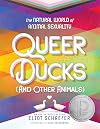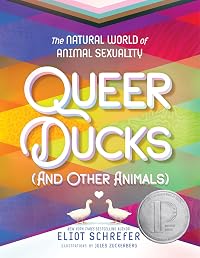
Queer Ducks and Other Animals: The Natural World of Animal Sexuality
by Eliot Schrefer
On This Page
Description
NPR's "All Things Considered," calls Queer Ducks "teenager-friendly. It's a Printz Honor young adult book filled with comics and humor and accessible science, and it's filled with research on the diversity of sexual behavior in the animal world."This groundbreaking illustrated YA nonfiction title from two-time National Book Award finalist and New York Times bestselling author Eliot Schrefer is a well-researched and teen-friendly exploration of the gamut of queer behaviors observed in show more animals.
A quiet revolution has been underway in recent years, with study after study revealing substantial same-sex sexual behavior in animals. Join celebrated author Eliot Schrefer on an exploration of queer behavior in the animal world—from albatrosses to bonobos to clownfish to doodlebugs.
In sharp and witty prose—aided by humorous comics from artist Jules Zuckerberg—Schrefer uses science, history, anthropology, and sociology to illustrate the diversity of sexual behavior in the animal world. Interviews with researchers in the field offer additional insights for readers and aspiring scientists.
Queer behavior in animals is as diverse and complex—and as natural—as it is in our own species. It doesn't set us apart from animals—it bonds us even closer to our animal selves.
. show less
Tags
Recommendations



























Member Reviews
This is another book I'm going to recommend for every queer person's library. Eliot Schrefer did a fantastic job talking about queerness in nature while also warning against human biases on either side swaying our opinions or scientific studies. He reminds us of this quite often which some might dislike, but I think it keeps us curious and open to questioning things as science progresses.
I loved reading about all the animals in their queer diversity. I only hope there's a second book in the works going over animals not mentioned such as maned lionesses and hyenas as those are two prominent ones I was surprised weren't mentioned. Even things like seahorses weren't gone over in as much detail as I expected. But for its length and teen show more target audience, I appreciated it for what it was.
I actually think this worked perfectly as a teen's book as the humorous and accessible approach might make it easier to read for those who aren't queer. I also appreciated the humor balancing the scientific details of animal sex as sex itself is already a taboo enough topic, let alone when it's about animals. If you can be mature and stomach the awkwardness of it, Schrefer takes readers on a fascinating journey. I especially enjoyed as a demi-bisexual person that there were also mentions of queer partnerships in nature that didn't involve sex. I also enjoyed all the various reasons animals might be queer or specifically bi from an evolutionary perspective, even if
it isn't for survival.
The only things I didn't like were that I wanted more animal examples than what we got, and that the one scientist Beans (which is a great name by the way) made the claim that they believe gender/sexuality labels are political in nature. Everyone is entitled to their opinion, but I disagree and think that's a harmful rhetoric for potential allies or young/newly-realized queer folks to read about. I understand why we may avoid labeling animals or their behaviour, but it's not inherently political to have terms for humans that give a sense of belonging and identity if they choose one. But that was only one short chapter where it probably was not even the focus and might have been a side comment that readers don't have tonal context for.
Overall though, this was a very healing read for me as someone who grew up in a religious household, reminding similar readers that there is nothing unnatural about being queer or trans, because nature refuses to be bound to one narrow way of being. I really hope to see a sequel to this and look forward to diving into the sources cited to learn more regardless. I recommend this book to anybody who loves animals, especially queer folks, any age after they've already had "the talk" who might be curious how some relationships work in nature. I also recommend it to any queer folks like me who have ever been told they're "unnatural" who want to be reminded there is nothing wrong with you. I would especially recommend this book to allies and parents of queer kids who want to challenge their world view. show less
I loved reading about all the animals in their queer diversity. I only hope there's a second book in the works going over animals not mentioned such as maned lionesses and hyenas as those are two prominent ones I was surprised weren't mentioned. Even things like seahorses weren't gone over in as much detail as I expected. But for its length and teen show more target audience, I appreciated it for what it was.
I actually think this worked perfectly as a teen's book as the humorous and accessible approach might make it easier to read for those who aren't queer. I also appreciated the humor balancing the scientific details of animal sex as sex itself is already a taboo enough topic, let alone when it's about animals. If you can be mature and stomach the awkwardness of it, Schrefer takes readers on a fascinating journey. I especially enjoyed as a demi-bisexual person that there were also mentions of queer partnerships in nature that didn't involve sex. I also enjoyed all the various reasons animals might be queer or specifically bi from an evolutionary perspective, even if
it isn't for survival.
The only things I didn't like were that I wanted more animal examples than what we got, and that the one scientist Beans (which is a great name by the way) made the claim that they believe gender/sexuality labels are political in nature. Everyone is entitled to their opinion, but I disagree and think that's a harmful rhetoric for potential allies or young/newly-realized queer folks to read about. I understand why we may avoid labeling animals or their behaviour, but it's not inherently political to have terms for humans that give a sense of belonging and identity if they choose one. But that was only one short chapter where it probably was not even the focus and might have been a side comment that readers don't have tonal context for.
Overall though, this was a very healing read for me as someone who grew up in a religious household, reminding similar readers that there is nothing unnatural about being queer or trans, because nature refuses to be bound to one narrow way of being. I really hope to see a sequel to this and look forward to diving into the sources cited to learn more regardless. I recommend this book to anybody who loves animals, especially queer folks, any age after they've already had "the talk" who might be curious how some relationships work in nature. I also recommend it to any queer folks like me who have ever been told they're "unnatural" who want to be reminded there is nothing wrong with you. I would especially recommend this book to allies and parents of queer kids who want to challenge their world view. show less
This taught me a ton that I didn't know about the non-heteronormative, spectrum-like, diverse nature of other species. It was incredibly informational and, although I can't be certain, seemed comprehensive. As a queer person, it means a lot to see someone do the work to bring LGBTQIA+ natural history alive.
My biggest beef with this was the tone. I know it was written for a teen audience, but I work with teens every day, and this is not the tone they like. It was very infantilizing, especially in the way the animals were made to have (often silly) dialogue in the beginning of every chapter. It was weird. Also, the author kept using "it's completely normal" as an argument, and even went as far as to address any arguments regarding that show more perspective, but that doesn't change the fact that, just because something is "normal" for animals, does not mean it should be normalized in human behavior. The author could have simply used a different argument, such as, "If the range of animal sexuality is so vast, why do we assume human sexual behavior should be any different?" Because saying a straightforward, "Animals do it, therefore it's normal when humans do it," is wildly problematic when you take two minutes to look at some of the things animals do regularly. show less
My biggest beef with this was the tone. I know it was written for a teen audience, but I work with teens every day, and this is not the tone they like. It was very infantilizing, especially in the way the animals were made to have (often silly) dialogue in the beginning of every chapter. It was weird. Also, the author kept using "it's completely normal" as an argument, and even went as far as to address any arguments regarding that show more perspective, but that doesn't change the fact that, just because something is "normal" for animals, does not mean it should be normalized in human behavior. The author could have simply used a different argument, such as, "If the range of animal sexuality is so vast, why do we assume human sexual behavior should be any different?" Because saying a straightforward, "Animals do it, therefore it's normal when humans do it," is wildly problematic when you take two minutes to look at some of the things animals do regularly. show less
We’re taught the natural order means male-female pairs for each animal on Earth. Darwin’s theory of natural selection only seems to confirm it—aren’t heterosexual pairings the best way forward for any species? But there’s more to the story than most of us know.
A quiet revolution has been underway in recent years, with study after study revealing substantial same-sex sexual behavior in animals. Join celebrated author Eliot Schrefer on an exploration of queer behavior in the animal world—from albatrosses to bonobos to clownfish to doodlebugs.
In sharp and witty prose—aided by humorous comics from artist Jules Zuckerberg—Schrefer uses science, history, anthropology, and sociology to illustrate the diversity of sexual show more behavior in the animal world. Interviews with researchers in the field offer additional insights for readers and aspiring scientists. show less
A quiet revolution has been underway in recent years, with study after study revealing substantial same-sex sexual behavior in animals. Join celebrated author Eliot Schrefer on an exploration of queer behavior in the animal world—from albatrosses to bonobos to clownfish to doodlebugs.
In sharp and witty prose—aided by humorous comics from artist Jules Zuckerberg—Schrefer uses science, history, anthropology, and sociology to illustrate the diversity of sexual show more behavior in the animal world. Interviews with researchers in the field offer additional insights for readers and aspiring scientists. show less
Honestly not the most riveting book, but vastly comforting in challenging the narrative that casts anything other than heterosexual sexuality as abnormal. I love that this book presents a well rounded argument, with evidence, for how we as a species bring our biases into science and are blinded by them. Well done in changing that conversation.
Good science. Good back matter. Not sure how the audio of the 'graphic novel episodes' would work, though, and all the other minor illustrations, which are all delightful and entertaining.
The whole thing is a joy to read. The cover art & design are perfect: colorful, vibrant, accessible, just like the text. Definitely YA friendly, but rich enough for adults, too.
"Any article that tries to establish absolute reasons for an animal's partner choice will soon be met by another article disproving it. ... that's precisely what healthy science looks like."
'"The chimpanzee resolves sexual issues with power; the bonobo resolves power issues with sex."' author:Frans de Waal|112082]
Anthropodenial to counter anthropomorphism.
Freud wrote, " if you show more want to know more about femininity, inquire about your own experiences of life, or turn to poets, or wait until science can give you deeper and more coherent information."
" evolutionary biologists often rightly roll their eyes about these compelling but unproven just-so stories of why something evolved. Evolution is often more complicated than any simple explanation."
For example, lots of times a set of genes for something will also happen to make something else get expressed in the phenotype. Or, sometimes the explanation is simpler than 'traditional' biologists would have us believe: queer sex might not have anything to do with dominance or scarcity of a gender or whatever... critters might engage in it simply because sex feels good, and the more of it one engages in, the more likely they will, in midst of all that fun, have reproductive success.
The point is, we don't know, because until very recently almost nobody was prepared to do the research. Without a diversity of scientists, there has been a lack of diversity of questions asked. The wonderful interviews included in this book show us what is happening to help us learn more by opening up these new avenues of research.
Highly recommended to age 12 up, or younger if they have a particular interest and a supportive family. show less
The whole thing is a joy to read. The cover art & design are perfect: colorful, vibrant, accessible, just like the text. Definitely YA friendly, but rich enough for adults, too.
"Any article that tries to establish absolute reasons for an animal's partner choice will soon be met by another article disproving it. ... that's precisely what healthy science looks like."
'"The chimpanzee resolves sexual issues with power; the bonobo resolves power issues with sex."' author:Frans de Waal|112082]
Anthropodenial to counter anthropomorphism.
Freud wrote, " if you show more want to know more about femininity, inquire about your own experiences of life, or turn to poets, or wait until science can give you deeper and more coherent information."
" evolutionary biologists often rightly roll their eyes about these compelling but unproven just-so stories of why something evolved. Evolution is often more complicated than any simple explanation."
For example, lots of times a set of genes for something will also happen to make something else get expressed in the phenotype. Or, sometimes the explanation is simpler than 'traditional' biologists would have us believe: queer sex might not have anything to do with dominance or scarcity of a gender or whatever... critters might engage in it simply because sex feels good, and the more of it one engages in, the more likely they will, in midst of all that fun, have reproductive success.
The point is, we don't know, because until very recently almost nobody was prepared to do the research. Without a diversity of scientists, there has been a lack of diversity of questions asked. The wonderful interviews included in this book show us what is happening to help us learn more by opening up these new avenues of research.
Highly recommended to age 12 up, or younger if they have a particular interest and a supportive family. show less
This was not in my normal realm of books to read, but it came up a year ago when it was discussed as possibly being inappropriate reading for a school library. I didn't read it then, just didn't seem that interesting. But now it has been brouight up as part of a removal process for a local school, so I thought I should know what they're talking about. I found it informative, easy to read, and thought provoking. Maybe something we should all read. It would maybe slightly dull for the average kid. But if one were looking to understand their own differences, then yes it might be just the thing.
I was somewhat blown away with the implication of scientific research being aware of queer animal behavior and not including it in research papers, show more with the suggestion that no one would support such research then. show less
I was somewhat blown away with the implication of scientific research being aware of queer animal behavior and not including it in research papers, show more with the suggestion that no one would support such research then. show less
I learned a lot reading this book and feel like I added so many animal facts to my personal knowledge. I hadn't really considered animal sexuality previously. The book focuses on a different animal and behaviors in each chapter. Between chapters are interviews with practicing scientists. Each chapter begins with a comic page about the chapter ahead.
In addition to zoology, marine biology, and other sciences, connections are drawn with history and human behavior. Cleverly constructed, informative, and thought provoking.
In addition to zoology, marine biology, and other sciences, connections are drawn with history and human behavior. Cleverly constructed, informative, and thought provoking.
Members
- Recently Added By
Lists

Books Mentioned in the A+ Autostraddle Pop Up Discords Nov 2022 & Dec 2022
223 works; 3 members

Favorite Animal Non-Fiction
293 works; 144 members

Books Read in 2024
4,727 works; 128 members

Top Five Books of 2024
795 works; 264 members

Books That Changed Our Perspective
423 works; 168 members

The Best LGBTQ Nonfiction
218 works; 70 members
Author Information

34+ Works 4,367 Members
Eliot Schrefer is a notable, best-selling young adult author. Schrefer attended Harvard University, where he graduated with High Honors in French and American literature. Schrefer's first novel, Glamorous Disasters, was a somewhat autobiographical tale of a young man living in Harlem and paying off college debt while tutoring Fifth-Avenue show more families. After writing another novel for adults, he turned to young adult fiction with The School for Dangerous Girls, about a boarding school for criminal young ladies. That book was selected as a "Best of the Teen Age" by the New York Public Library, and his next novel, The Deadly Sister, earned a starred review from School Library Journal. Schrefer's fifth novel Endangered, about a girl surviving wartime in Congo with an orphan bonobo ape, was a finalist for the National Book Award in Young People's Literature, one of NPR's "Best of 2012," and an editor's choice in The New York Times. ELIOT SCHREFER is also the author of Threatened, a finalist for the National Book Award in Young People's Literature in 2014, about a boy surviving in the jungles of Gabon alongside chimpanzees and Rise and Fall, the sixth book in the Spirit Animals Series. Schrefer's works have been translated into many languages including German, Russian, Polish, Taiwanese, Bulgarian, and Japanese. (Bowker Author Biography) show less
All Editions
Some Editions
Awards and Honors
Awards
Distinctions
Notable Lists
Common Knowledge
- Canonical title
- Queer Ducks and Other Animals: The Natural World of Animal Sexuality
- Original title
- Queer Ducks and Other Animals: The Natural World of Animal Sexuality
- Alternate titles
- Queer Ducks (and Other Animals) (and Other Animals)
- Original publication date
- 2023-06-06
- People/Characters
- Eliot Schrefer; Christine Webb; Sidney Woodruff; Mounica Kota; Beans Velocci; Max Lambert (show all 9); Logan Weyand; Dylan Sanborn; Charles Darwin
- Important places
- Noah's Ark
- Important events
- The Flood; Theory of Evolution
- Dedication
- For Kathi, Teddy, and Roy
- First words
- The Edinburgh Zoo has long been proud of its penguins.
- Last words
- (Click to show. Warning: May contain spoilers.)We get to make new ones of our own.
- Blurbers
- Montgomery, Sy; Heiligman, Deborah; Burns, Loree Griffin
- Original language
- English
Classifications
Statistics
- Members
- 216
- Popularity
- 151,512
- Reviews
- 10
- Rating
- (4.21)
- Languages
- English
- Media
- Paper, Audiobook, Ebook
- ISBNs
- 8
- ASINs
- 1