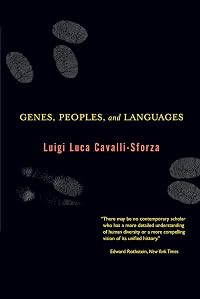
Genes, Peoples, and Languages
by Luigi Luca Cavalli-Sforza
On This Page
Description
"Luigi Luca Cavalli-Sforza was among the first to ask whether the genes of modern populations contain a historical record of the human species. Cavalli-Sforza and others have answered this question - anticipated by Darwin - with a decisive yes. Genes, Peoples, and Languages comprises five lectures that serve as a summation of the author's work over several decades, the goal of which has been nothing less than tracking the past 100,000 years of human evolution."--Jacket.Tags
Recommendations






Member Reviews
This is the second time around that I am reading this work. While the entire subject is a fascinating one, and I came with great expectations that this authoritative scholar of the field would throw light on many often tangled, usually controversial, questions, I cannot say that I am much better informed. Unfortunately, I feel that neither of the two facets - genetics and historical linguistics - have been given enough space. In some places, there seems to be an odd lapse into an almost Lamarckian mode of speech when talking of similarities between genetic and cultural evolution: "Culture resembles the genome in the sense that each one accumulates useful information from generation to generation" (page 176). Of course he is not really show more suggesting that genomes adapt according to the lived experience, but an unwary reader may fall into this sort of fallacious thinking. As a person from South Asia, I am obviously much taken up with the 'Aryan migration theory' (AMT, if you would like to capitalize), and the copy-book juxtaposition of genetics with ethnicity (racial types) and language(s), and I wish he had explored this case in more detail. One will have to look into more recent works on this subject. Finally, the book comes to a rather abrupt ending, leaving the reader a bit flummoxed about how to sysnthesize all the matter. show less
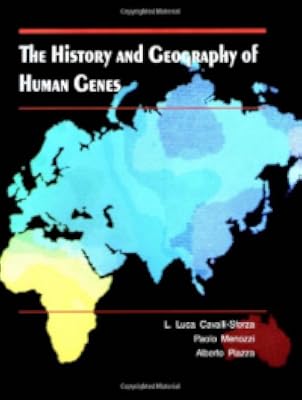
It’s not clear who comprises the intended audience for this book. It seems to have been intended as a more popular version of Luigi Luca Cavalli-Sforza’s magnum opus, the encyclopedic, fascinating, and unfortunately very expensive The History and Geography of Human Genes. It doesn’t succeed there; while, in the introduction, Cavalli-Sforza says
“I have tried to restrict my use of jargon to a minimum, and I have attempted to explain terms and methods unknown to the general public.”
he doesn’t get very far before he’s deep in eigenvalues and allele frequencies and principal component analysis. (To be fair, my graduate work was heavily dependent on PCA and a related technique called detrended correspondence analysis, and it’s show more all still something of a black box to me.) What’s more, this is a case where a picture or map is worth 1000 words, but Cavalli-Sforza only includes one PCA map (of Europe) and resorts to verbal descriptions of PCA for other continents.
Another drawback is the book was written from a series of lectures, and it shows. Individual chapters are self-contained and there’s no real flow through the book.
Nevertheless, there’s interesting stuff here. If you can’t afford The History and Geography of Human Genes or get it at a library, this may suffice if you read carefully. The first five principal components of human gene frequencies for Europe display quite nicely:
*The spread of agriculture from the Middle East
*Northward migration after the last glacial retreat (hmmm. You’d think that would be more important than agriculture, but maybe it has to do with the fact that agriculture allows for larger populations).
*The introduction of the horse - or, more correctly, the introduction of genes from horse nomads - spreading west from central Asia.
*Greek colonization around the Mediterranean, and
*The Basques versus everybody else.
Work like this is, of course, easily prone to charges of “racism”, so Cavalli-Sforza devotes a lot of time to saying nope, no races here, just human “groups” or “populations” with “genetic distance” between them. He almost protests too much. There are plenty of charts of “genetic distance” between (say) inhabitants of northeast Asia and central Africa that might make the politically correct reader sit up and take notice.
The whole last half of the book is about languages and their comparison with genetic data. This is interesting stuff, too, but most of it is over my head. I did learn that the oldest reconstructed word (I’m not at all sure how the reconstruction was done) is tik, meaning “finger” or “one”, and that most ancient words relate to counting and human body parts. One interesting exception is the word “lice”, which is also very old and, strangely, doesn’t figure very often in romance novels set in the Neolithic.
Three stars, I think. Jared Diamond’s Guns, Germs and Steel is more accessible and covers much the same ground. show less
“I have tried to restrict my use of jargon to a minimum, and I have attempted to explain terms and methods unknown to the general public.”
he doesn’t get very far before he’s deep in eigenvalues and allele frequencies and principal component analysis. (To be fair, my graduate work was heavily dependent on PCA and a related technique called detrended correspondence analysis, and it’s show more all still something of a black box to me.) What’s more, this is a case where a picture or map is worth 1000 words, but Cavalli-Sforza only includes one PCA map (of Europe) and resorts to verbal descriptions of PCA for other continents.
Another drawback is the book was written from a series of lectures, and it shows. Individual chapters are self-contained and there’s no real flow through the book.
Nevertheless, there’s interesting stuff here. If you can’t afford The History and Geography of Human Genes or get it at a library, this may suffice if you read carefully. The first five principal components of human gene frequencies for Europe display quite nicely:
*The spread of agriculture from the Middle East
*Northward migration after the last glacial retreat (hmmm. You’d think that would be more important than agriculture, but maybe it has to do with the fact that agriculture allows for larger populations).
*The introduction of the horse - or, more correctly, the introduction of genes from horse nomads - spreading west from central Asia.
*Greek colonization around the Mediterranean, and
*The Basques versus everybody else.
Work like this is, of course, easily prone to charges of “racism”, so Cavalli-Sforza devotes a lot of time to saying nope, no races here, just human “groups” or “populations” with “genetic distance” between them. He almost protests too much. There are plenty of charts of “genetic distance” between (say) inhabitants of northeast Asia and central Africa that might make the politically correct reader sit up and take notice.
The whole last half of the book is about languages and their comparison with genetic data. This is interesting stuff, too, but most of it is over my head. I did learn that the oldest reconstructed word (I’m not at all sure how the reconstruction was done) is tik, meaning “finger” or “one”, and that most ancient words relate to counting and human body parts. One interesting exception is the word “lice”, which is also very old and, strangely, doesn’t figure very often in romance novels set in the Neolithic.
Three stars, I think. Jared Diamond’s Guns, Germs and Steel is more accessible and covers much the same ground. show less
This book is an easy-to-read well-craft tale written by an authoritative geneticist. The author shows how we can discover details of our shared pre-history – the time before writing. It is certainly fascinating to delve into the unknown. Evidence abounds because the past has imprinted itself upon the present. Thus one route is certainly through scant palaeological records. Yet our minds and bodies are themselves hosts to alternative windows on the past. Thus clues to our past are buried in our genes, our languages, our anatomy, our physiology and our cultures. This book takes us through the inferences we can draw from each strand of evidence. Indeed we can even calculate the statistical reliability of many individual conclusions. show more Naturally all conclusions hold speculations. Nonetheless the consistency of evidence from a range of independent sources gives us confidence in the generalities of the emerging picture.
As one might expect, this story has many lessons for the present and our anticipated future. Thus Cavelli-Svorza contextualizes the superficiality of race, the impacts of technological innovation, the progress of cultural interactions, and the tragedy of ignorance. show less
As one might expect, this story has many lessons for the present and our anticipated future. Thus Cavelli-Svorza contextualizes the superficiality of race, the impacts of technological innovation, the progress of cultural interactions, and the tragedy of ignorance. show less
A good introductory reading on a fascinating subject by the world's leading population geneticist, summarizing in very-easy-to-follow narrative main findings of his research in the last four decades confirming the hypothesis that the human species is not divided into color-coded races. From the genetic point of view, the concept of different races is unscientific, the outward or physical differences exhibited by various ethnic groups are mere outward adaptation to different climates. He argues and attempts to show that there is a linkage between the evolution of genes and development of languages and cultures. Cavalli-Sforza introduces a lot of information, but only skims the surface which i found disappointing. He also tries too much show more to "laymanize" some concepts, which i felt perhaps lost a bit of scientific rigor. It does, however, point the reader to other sources, including his own more technical and comprehensive publications. show less
Very well researched and insightful, except for the language section which embraces all kinds of proposed superfamilies roundly rejected by the majority of linguists.
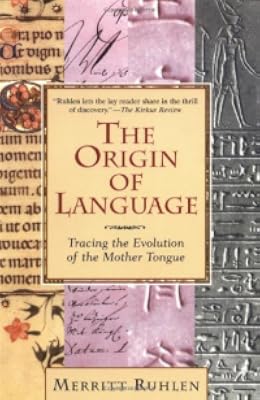
The standard Cavalli-Sforza story as covered in his The history and geography of human genes (and Merritt Ruhlen's book The Origin of Language).
I'd hoped there was something new here, but not yet.
I'm still waiting for a decent book written in the last year or two and bringing me up to date on what genetics, linguistics and archeology have learned in the past few years.
I'd hoped there was something new here, but not yet.
I'm still waiting for a decent book written in the last year or two and bringing me up to date on what genetics, linguistics and archeology have learned in the past few years.
Poorly written or poorly translated.
Members
- Recently Added By
Lists

Biggest Disappointments
606 works; 168 members
Author Information
33+ Works 1,567 Members
Some Editions
Series
Belongs to Publisher Series
Common Knowledge
- Original publication date
- 1996
Classifications
- Genres
- Anthropology, Science & Nature, Nonfiction, General Nonfiction, History
- DDC/MDS
- 599.938 — Natural sciences & mathematics Animals Mammals Homo sapiens Genetics, sex and age characteristics, evolution Evolution
- LCC
- GN281 .C385 — Geography, Anthropology and Recreation Anthropology Anthropology Physical anthropology. Somatology Human evolution
- BISAC
Statistics
- Members
- 732
- Popularity
- 38,772
- Reviews
- 7
- Rating
- (3.84)
- Languages
- 8 — Catalan, English, French, German, Hungarian, Italian, Portuguese, Spanish
- Media
- Paper
- ISBNs
- 17
- ASINs
- 1