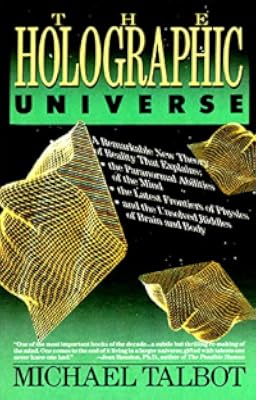
The Holographic Universe
by Michael Talbot
On This Page
Description
Nearly everyone is familiar with holograms-three-dimensional images projected into space with the aid of a laser. Two of the world's most eminent thinkers believe that the universe itself may be a giant hologram, quite literally a kind of image or construct created, at least in part, by the human mind. University of London physicist David Bohm, a protégé of Einstein and one of the world's most respected quantum physicists, and Stanford neurophysiologist Karl Pribram, an architect of our show more modern understanding of the brain, have developed a remarkable new way of looking at the universe. Their theory explains not only many of the unsolved puzzles of physics but also such mysterious occurrences as telepathy, out-of-body and near-death experiences, lucid dreams, and even religious and mystical experiences, such as feelings of cosmic unity and miraculous healings. Now featuring a foreword by Lynne McTaggart, The Holographic Universe is a landmark work with exciting conclusions that continue to be proven true by today's most advanced physics, cosmology, and string theory. show lessTags
Recommendations









Member Recommendations

Member Reviews
This book was a huge disappointment to me, and a rare instance of a book I did not finish. It dates from 1991, so I expected it not to represent the latest thinking on the subject; but I'm afraid that I found it increasingly rejecting any sort of serious science from about a third of the way in.
The idea of the holographic universe - that what we experience as 'reality' is actually a consensual illusion that we construct on a minute-by-minute basis - is a controversial idea for which there continues to be evidence found and new interpretations offered. So far, so good. And the idea is sufficiently strange that it might indeed explain much that is currently unexplainable. Talbot starts off reasonably well, outlining the careers of David show more Bohm (a physicist) and Karl Pribram (a neurophysiologist) and their thinking on the question of the nature of physical reality. These first chapters are fairly sound (though it has to be said that an internet search does not turn up much on either scientist that could be considered controversial).
After which, Talbot begins to look at "the brain as hologram", taking as a starting point the fact that our senses are interpreted only within the brain and what we think of as an external reality is actually an internal construction. Again, so far, so good; and the arguments are backed up with what appears to be reasonable expositions of the work of published scientists.
But as the book progresses, the discussion veers further away from science and down the path of anecdote. Michael Talbot has written a number of works on psychic experiences, and he dips more and more into that territory than into verifiable or reasoned scientific discussion. Any further discussion on cosmological matters disappears and we concentrate entirely on psychology and (increasingly) parapsychology. When we got onto regression into past lives, auras and chakras, my patience began to give out. And from about half-way through the book, the style turned into pure Readers' Digest and Talbot began to cite his own psychic experiences. At which point, I gave up, exasperated.
The concept of the holographic universe is important and fascinating. This book should not be your entry point to discussion of the subject. show less
The idea of the holographic universe - that what we experience as 'reality' is actually a consensual illusion that we construct on a minute-by-minute basis - is a controversial idea for which there continues to be evidence found and new interpretations offered. So far, so good. And the idea is sufficiently strange that it might indeed explain much that is currently unexplainable. Talbot starts off reasonably well, outlining the careers of David show more Bohm (a physicist) and Karl Pribram (a neurophysiologist) and their thinking on the question of the nature of physical reality. These first chapters are fairly sound (though it has to be said that an internet search does not turn up much on either scientist that could be considered controversial).
After which, Talbot begins to look at "the brain as hologram", taking as a starting point the fact that our senses are interpreted only within the brain and what we think of as an external reality is actually an internal construction. Again, so far, so good; and the arguments are backed up with what appears to be reasonable expositions of the work of published scientists.
But as the book progresses, the discussion veers further away from science and down the path of anecdote. Michael Talbot has written a number of works on psychic experiences, and he dips more and more into that territory than into verifiable or reasoned scientific discussion. Any further discussion on cosmological matters disappears and we concentrate entirely on psychology and (increasingly) parapsychology. When we got onto regression into past lives, auras and chakras, my patience began to give out. And from about half-way through the book, the style turned into pure Readers' Digest and Talbot began to cite his own psychic experiences. At which point, I gave up, exasperated.
The concept of the holographic universe is important and fascinating. This book should not be your entry point to discussion of the subject. show less
I know intellectually that quantum physics is the domain of some of the strangest phenomena imaginable. I know it may be possible to create a sub-atomic particle merely by searching for it, and that two particles separated by many miles can apparently influence each others behavior in ways that suggest either faster-than-light interaction or that the apparent separation between them is not real. I have read that space as we know it may be illusory, that time as a linear process may also be an illusion. All of these things fascinate me, and books like 'The Dancing Wu-Li Masters,' The Tao of Physics,' and 'The Holographic Universe' by Michael Talbot feed that fascination. These works are challenging, exciting and, by their extraordinary show more nature, suspect.
We know this era as one of hard-edged rationalism, linear thinking and cynicism. These traits are normal and easy to share because they are so prevalent, and because, really, no socially-engaged human wants to be regarded as a 'loon' (per another reviewer's dismissive remarks). So on one hand, my responsibility as a modern rational human is to dismiss the ideas of writers like Talbot, who take cutting edge physics as a point of departure and spin it into parallel universes, telepathic and clairvoyant explanations, and into all manner of strange and wonderful possibilities. Like other similar books, 'The Holographic Universe' suggests that mysticism and spirituality may provide useful metaphors for phenomena that scientific investigation is only beginning to sense the existence of . . . and will quite probably experience difficulty describing objectively. Predictably, these suggestions remain largely ignored by mainstream science. It is not comfortable or productive for a professional to publicly hold them.
But on the other hand, there is something both intriguing and intuitively truthful about the idea that mind may determine its reality. Talbot's observations about the way in which quantum particles appear to behave according to how the observer thinks about them certainly provokes some thought. Such 'quantum entanglement' has apparently been observed on the molecular level , as well. Is it possible that perception and creation are two sides of one coin? Are we so in charge of our world that it is exactly as we have judged? Perhaps our thinking is too 'hard' at times. Perhaps James Randi's skeptical challenge to 'prove it,' in fact insures the very outcome that he expects. I wonder.
There is in cosmology a kind of dividing line, which separates individuals by the way they choose to think about reality. Either 1) we populate a mechanistic universe in which consciousness has arisen out of the chaos of matter, or 2) the universe as we know it is a property of mind, and matter has arisen from consciousness. So . . . which of these is the fundamental property of reality? Unfortunately, it seems unprovable, one way or the other. As an adult, I have tended to oscillate back and forth on that question.
So, in order to accept the possibility of alternate dimensions, 'higher realms,' or the validity of near-death experiences, a rational thinker must make a decision to accept an argument which is based on circumstantial evidence. That kind of argument is the real stock-in-trade of 'The Holographic Universe,' if not most calls for acceptance of the numinous. Talbot cites volumes of near-death accounts in which the experiencer corroborates exact operating room procedures; countless telepathic and clairvoyant 'coincidences'; accounts of past-lives remembered under hypnosis in which buildings and geographical layouts are later supported by visits to actual locations. Investigating the sheer volume of notes and references Talbot cites causes that evidence to become weighty indeed. But is it sufficient?
Finally, one must decide for oneself. And continue the search. Good luck! show less
We know this era as one of hard-edged rationalism, linear thinking and cynicism. These traits are normal and easy to share because they are so prevalent, and because, really, no socially-engaged human wants to be regarded as a 'loon' (per another reviewer's dismissive remarks). So on one hand, my responsibility as a modern rational human is to dismiss the ideas of writers like Talbot, who take cutting edge physics as a point of departure and spin it into parallel universes, telepathic and clairvoyant explanations, and into all manner of strange and wonderful possibilities. Like other similar books, 'The Holographic Universe' suggests that mysticism and spirituality may provide useful metaphors for phenomena that scientific investigation is only beginning to sense the existence of . . . and will quite probably experience difficulty describing objectively. Predictably, these suggestions remain largely ignored by mainstream science. It is not comfortable or productive for a professional to publicly hold them.
But on the other hand, there is something both intriguing and intuitively truthful about the idea that mind may determine its reality. Talbot's observations about the way in which quantum particles appear to behave according to how the observer thinks about them certainly provokes some thought. Such 'quantum entanglement' has apparently been observed on the molecular level , as well. Is it possible that perception and creation are two sides of one coin? Are we so in charge of our world that it is exactly as we have judged? Perhaps our thinking is too 'hard' at times. Perhaps James Randi's skeptical challenge to 'prove it,' in fact insures the very outcome that he expects. I wonder.
There is in cosmology a kind of dividing line, which separates individuals by the way they choose to think about reality. Either 1) we populate a mechanistic universe in which consciousness has arisen out of the chaos of matter, or 2) the universe as we know it is a property of mind, and matter has arisen from consciousness. So . . . which of these is the fundamental property of reality? Unfortunately, it seems unprovable, one way or the other. As an adult, I have tended to oscillate back and forth on that question.
So, in order to accept the possibility of alternate dimensions, 'higher realms,' or the validity of near-death experiences, a rational thinker must make a decision to accept an argument which is based on circumstantial evidence. That kind of argument is the real stock-in-trade of 'The Holographic Universe,' if not most calls for acceptance of the numinous. Talbot cites volumes of near-death accounts in which the experiencer corroborates exact operating room procedures; countless telepathic and clairvoyant 'coincidences'; accounts of past-lives remembered under hypnosis in which buildings and geographical layouts are later supported by visits to actual locations. Investigating the sheer volume of notes and references Talbot cites causes that evidence to become weighty indeed. But is it sufficient?
Finally, one must decide for oneself. And continue the search. Good luck! show less
This book has revealed answers to the questions that have been on my mind for a while now, and it has answered them brilliantly.
This book bridges spirituality and science succinctly and opens your mind to realms that you wondered about but didn't know where to look for answers.
Subjects such as past life regressions, psychic abilities, psychokinesis, other worlds, spiritual realms, near-death experiences/out-of-body experiences, space and time travel, telepathy, and more are explained scientifically.
What was insightful was the knowledge that scientists are not as orthodox as most would have you believe, and that there are real experiments and researches carried out to explain phenomena that cannot be explained conventionally.
Highly show more recommended that you read this book! show less
This book bridges spirituality and science succinctly and opens your mind to realms that you wondered about but didn't know where to look for answers.
Subjects such as past life regressions, psychic abilities, psychokinesis, other worlds, spiritual realms, near-death experiences/out-of-body experiences, space and time travel, telepathy, and more are explained scientifically.
What was insightful was the knowledge that scientists are not as orthodox as most would have you believe, and that there are real experiments and researches carried out to explain phenomena that cannot be explained conventionally.
Highly show more recommended that you read this book! show less
This book is a tour-de-force of information on the cutting edge of research in quantum physics, neurology, parapsychology, psychology, and new age spirituality. There is information on OBEs (Out of Body Experiences), NDEs (Near Death Experiences), miracles, psychic healing, remote viewing, telepathy, telekinesis, and more. This book is not mere speculation, it contains over a 1000 detailed footnotes to books, scientific journals, and even private correspondences with the various researchers. The author's thesis is in the title to the book. But the implications of his thesis are truly mind-blowing. I can not do it justice with a summary here.
On a personal note, it has taken me many many months to get through this book. It is not because show more the book is long, it is only 300 pages. It was not because the book is filled with impenetrable or arcane knowledge; for the most part, I was familiar with the material presented. I did find it annoying that the author's vocabulary exceeded my own, causing me to, far too frequently, to pause and ponder the meaning of some unfamiliar terms. While I was reading this, I took a "break" and read a 500 page SciFi novel, among several other books.
The reason I found this book so hard to get through is simply the fact that my mind was resisting the truth the author was exposing. I would read a chapter, figuratively shake my head, and put the book down so I could mentally process what the author was saying. When I temporarily recovered from having my worldview destroyed, I would pick the book back up and undergo the process again with the next chapter. My (ego) mind did not want to accept the author's view of reality, in spite of his encyclopedic breadth of knowledge and his well documented, decades worth of research to come to the conclusions that he has reached. This is an advanced book for the truth seeker. Well worth a read if you are ready for it. show less
On a personal note, it has taken me many many months to get through this book. It is not because show more the book is long, it is only 300 pages. It was not because the book is filled with impenetrable or arcane knowledge; for the most part, I was familiar with the material presented. I did find it annoying that the author's vocabulary exceeded my own, causing me to, far too frequently, to pause and ponder the meaning of some unfamiliar terms. While I was reading this, I took a "break" and read a 500 page SciFi novel, among several other books.
The reason I found this book so hard to get through is simply the fact that my mind was resisting the truth the author was exposing. I would read a chapter, figuratively shake my head, and put the book down so I could mentally process what the author was saying. When I temporarily recovered from having my worldview destroyed, I would pick the book back up and undergo the process again with the next chapter. My (ego) mind did not want to accept the author's view of reality, in spite of his encyclopedic breadth of knowledge and his well documented, decades worth of research to come to the conclusions that he has reached. This is an advanced book for the truth seeker. Well worth a read if you are ready for it. show less
This must be one of the most fascinating, if not the most fascinating book I have ever read, and it is a must-read for anyone who is even remotely curious about who and what we really are or who wants to see spirituality meeting science. The claims that are made are backed up by numerous scientific studies, but it doesn't blow you away with scientific jargon. It's written in an easy-to-read style and the different chapters are split up into subsections, which also helps. Michael Talbot explains what a hologram is and then goes on to argue that the holographic model can be used to explain multiple personality disorders (extraordinary! - if you know nothing about MPD, then you absolutely must read this section), psychokinesis, miracles, show more the human energy field (or energy bodies), past/present/future existing seemlessly together, near death experiences (NDEs), UFO sightings and much more. Whether you accept the holographic theory or not, just reading the results of the various scientific studies mentioned in the book is fascinating and for me, personally, as a poet and author, it was also inspiring. The idea that everything is interconnected in this holographic universe of ours and is part of the same continuum inspired me, for example, to write a poem called 'My Life' to try and make sense of it ('...all that I see and don't see, hear and don't hear, touch and don't touch, smell and don't smell, taste and don't taste I am - I am the eternal energy of everything...'), whilst the story of the woman in the NDE chapter who said that 'she hadn't danced enough yet', making the being of light she was talking to laugh heartily and enabling her to return to physical life, gave me an idea for a children's story. In short, I found the book riveting and inspirational - jam-packed full of extraordinary scientific fact way more mind-blowing and thrilling than any science fiction I've ever read - and I am now reading it for a second time and will probably read it a third and fourth time as well! show less
This is a fascinating and frustrating book. The author has some genuinely interesting ideas about the nature of reality. On the other hand, there is also a great deal of weird paranormal stuff, including a passage about how the author was able to conjure cold spaghetti out of thin air, that almost made me throw the book away. The book is still worth reading, though, because of its many interesting ideas and insights - just read it with a grain of salt.
Some say there exists only one interpretation of quantum mechanics, and that is the many-worlds interpretation. But there exists another explanation as described by Michael Talbot in his book “Holographic Universe”; here is an excerpt where he writes of Karl Pribram a neurophysiologist at Stanford:
'... Pribam realised that the objective world does not exist, at least not in the way we are accustomed to believing. What is 'out there' is a vast ocean of waves and frequencies and reality looks concrete to us only because our brains are able to take this holographic blur and convert it into sticks and stones and other familiar objects that make up our world...'
'...In other words, the smoothness of a piece of fine china and the feel of show more beach sand beneath our feet are really just elaborate versions of the phantom limb syndrome (when amputees 'feel' a limb long after it has been removed)..'
'According to Pribram, this does not mean there aren't china cups and grains of sand out there. It simply means that a china cup has two very different aspects to its reality. When it is filtered through the lens of our brains it manifests as a cup. But if we could get rid of our lenses, we'd experience it as an interference pattern. Which is real and which is illusion? "Both are real to me," says Pribham, "or, if you want to say, neither of them are real".
Also look up the research by Russian biophysicist Pjotr Garjajev, and his colleagues known as the phantom DNA effect. The Russian scientists irradiated DNA samples with laser light, on screen, a typical wave pattern was formed. When they removed the DNA sample, the wave pattern did not disappear, it remained. Many control experiments showed that the pattern still came from the removed sample, whose energy field apparently remained by itself.
Also see their work known as wave genetics, they found that living DNA will always react to language-modulated laser rays, and even to radio waves, if the proper frequencies are used. They succeeded in repairing chromosomes damaged by X-rays, they even captured information patterns of a particular DNA and transmitted it onto another, so reprogramming cells to another genome. They successfully transformed for example, frog embryos to salamander embryos simply by transmitting the DNA information patterns. This way the entire information was transmitted without any of the side effects involved when western researchers cut out and insert DNA.
If you fall into a black hole, nothing happens to you, by the equivalence principle you cannot know you are falling into a black hole. You carry on happy as Larry. To us outside, looking at you falling into a black hole, you slow down, your time seen by us gets slower and slower and slower and you never fall into the hole. You get stuck at the horizon. (look at the Penrose diagram, the event horizon can never be in an outside observer's past) But, eons later, you come back out by hawking radiation and say hi! I was in a black hole! We say, no you weren't; you got close then you were radiated back out. Who's right? Smeared over the surface, or inside, it's the same, it's just your point of view. As a member of the general public that is exactly how I feel now. I feel smeared! There are too many theories describing the universe and many of them seem to be correct. There is still no universal equation combining all four forces. Is the physics we know correct, or is it only sufficient approximation to satisfy our senses? Will our intelligence ever allow us to understand it or are we just fooking dumb? We do not have a vantage point to be objective on that matter. Cosmic man. But whoosh. I'm blown away that there are people who genuinely understand this Holographic and Black Hole stuff. Respect. show less
'... Pribam realised that the objective world does not exist, at least not in the way we are accustomed to believing. What is 'out there' is a vast ocean of waves and frequencies and reality looks concrete to us only because our brains are able to take this holographic blur and convert it into sticks and stones and other familiar objects that make up our world...'
'...In other words, the smoothness of a piece of fine china and the feel of show more beach sand beneath our feet are really just elaborate versions of the phantom limb syndrome (when amputees 'feel' a limb long after it has been removed)..'
'According to Pribram, this does not mean there aren't china cups and grains of sand out there. It simply means that a china cup has two very different aspects to its reality. When it is filtered through the lens of our brains it manifests as a cup. But if we could get rid of our lenses, we'd experience it as an interference pattern. Which is real and which is illusion? "Both are real to me," says Pribham, "or, if you want to say, neither of them are real".
Also look up the research by Russian biophysicist Pjotr Garjajev, and his colleagues known as the phantom DNA effect. The Russian scientists irradiated DNA samples with laser light, on screen, a typical wave pattern was formed. When they removed the DNA sample, the wave pattern did not disappear, it remained. Many control experiments showed that the pattern still came from the removed sample, whose energy field apparently remained by itself.
Also see their work known as wave genetics, they found that living DNA will always react to language-modulated laser rays, and even to radio waves, if the proper frequencies are used. They succeeded in repairing chromosomes damaged by X-rays, they even captured information patterns of a particular DNA and transmitted it onto another, so reprogramming cells to another genome. They successfully transformed for example, frog embryos to salamander embryos simply by transmitting the DNA information patterns. This way the entire information was transmitted without any of the side effects involved when western researchers cut out and insert DNA.
If you fall into a black hole, nothing happens to you, by the equivalence principle you cannot know you are falling into a black hole. You carry on happy as Larry. To us outside, looking at you falling into a black hole, you slow down, your time seen by us gets slower and slower and slower and you never fall into the hole. You get stuck at the horizon. (look at the Penrose diagram, the event horizon can never be in an outside observer's past) But, eons later, you come back out by hawking radiation and say hi! I was in a black hole! We say, no you weren't; you got close then you were radiated back out. Who's right? Smeared over the surface, or inside, it's the same, it's just your point of view. As a member of the general public that is exactly how I feel now. I feel smeared! There are too many theories describing the universe and many of them seem to be correct. There is still no universal equation combining all four forces. Is the physics we know correct, or is it only sufficient approximation to satisfy our senses? Will our intelligence ever allow us to understand it or are we just fooking dumb? We do not have a vantage point to be objective on that matter. Cosmic man. But whoosh. I'm blown away that there are people who genuinely understand this Holographic and Black Hole stuff. Respect. show less
Members
- Recently Added By
Lists

Nonordinary States of Consciousness
184 works; 7 members
Author Information

9+ Works 2,473 Members
Common Knowledge
- Canonical title
- The Holographic Universe
- Original title
- The Holographic Universe
- Original publication date
- 1991
- Important places
- Universe
- Epigraph
- The new data are of such far-reaching relevance that they could revolutionize our understanding of the human psyche, of psychopathology, and of the therapeutic process. Some of the observations transcend in their significance... (show all) the framework of psychology and psychiatry and represent a serious challenge to the current Newtonian-Cartesian paradigm of Western science. They could change drastiscally our image of human nature, of culture and history, and of reality. - Dr. Stanislav Grof on holographic phenomena in The Adventure of Self-Discovery
- Dedication
- For Alexandra, Chad, Ryan, Larry Joe, and Shawn, with love
- First words
- In the movie Star Wars, Luke Skywalker's adventure begins when a beam of light shoots out of the robot Artoo Detoo and projects a miniature three-dimensional image of Princess Leia.
- Last words
- (Click to show. Warning: May contain spoilers.)We are, as the aborigines say, just learning how to survive in infinity.
- Original language
- English
Classifications
Statistics
- Members
- 1,672
- Popularity
- 13,395
- Reviews
- 26
- Rating
- (3.87)
- Languages
- 8 — English, French, German, Italian, Russian, Spanish, Turkish, Portuguese (Portugal)
- Media
- Paper, Audiobook
- ISBNs
- 19
- UPCs
- 1
- ASINs
- 10