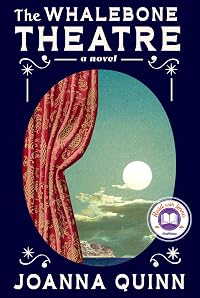
The Whalebone Theatre
by Joanna Quinn
On This Page
Description
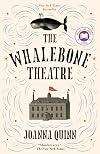
NEW YORK TIMES BEST SELLER * A TODAY SHOW #ReadWithJenna BOOK CLUB PICK * A transporting, irresistible debut novel that takes its heroine, Cristabel Seagrave, from a theatre made of whalebones to covert operations during World War II--a story of love, family, bravery, lost innocence, and self-transformation. "The Whalebone Theatre is absolute aces...Quinn's imagination and adventuresome spirit are a pleasure to behold." --The New York Times "Utterly heartbreaking and joyous...I just show more disappeared into The Whalebone Theatre and didn't want to leave." --Jo Baker, author of Longbourn One blustery night in 1928, a whale washes up on the shores of the English Channel. By law, it belongs to the King, but twelve-year-old orphan Cristabel Seagrave has other plans. She and the rest of the household--her sister, Flossie; her brother, Digby, long-awaited heir to Chilcombe manor; Maudie Kitcat, kitchen maid; Taras, visiting artist--build a theatre from the beast's skeletal rib cage. Within the Whalebone Theatre, Cristabel can escape her feckless stepparents and brisk governesses, and her imagination comes to life. As Cristabel grows into a headstrong young woman, World War II rears its head. She and Digby become British secret agents on separate missions in Nazi-occupied France--a more dangerous kind of playacting, it turns out, and one that threatens to tear the family apart. show lessTags
Recommendations








Member Reviews
This riveting, multigenerational saga has at its center a very dysfunctional wealthy English family. From the beginning pages, when a husband marries a woman he does not love in order to bear a son, to three half-siblings being raised among the family's bohemian artist proteges, to the war that rips them all apart and changes everything, this novel's characters ache for something they don't have.
At the heart of all of this is Christabel. She's the unwanted daughter who escapes her French nanny to run wild. She's the director of the plays at the makeshift theater during their bohemian summers, striding around with a toy sword, giving orders. Then she becomes the girl with the real gun and cyanide capsules undercover in occupied France, show more thanks to her perfect French pronunciation.
After the war takes its toll, the remaining characters gather at their large manor house to discuss the future of the family property that no longer feels like home.
This is a slow-paced, family drama where the feelings sneak up on you. These characters suffer, making the reader suffer too. It's a story about nostalgia, loss, grief and moving on.
Thank you to NetGalley and the publisher for the advance review copy of this book in exchange for an honest review. show less
At the heart of all of this is Christabel. She's the unwanted daughter who escapes her French nanny to run wild. She's the director of the plays at the makeshift theater during their bohemian summers, striding around with a toy sword, giving orders. Then she becomes the girl with the real gun and cyanide capsules undercover in occupied France, show more thanks to her perfect French pronunciation.
After the war takes its toll, the remaining characters gather at their large manor house to discuss the future of the family property that no longer feels like home.
This is a slow-paced, family drama where the feelings sneak up on you. These characters suffer, making the reader suffer too. It's a story about nostalgia, loss, grief and moving on.
Thank you to NetGalley and the publisher for the advance review copy of this book in exchange for an honest review. show less
The Whalebone Theatre - J.Quinn
Audio performance by Olivia Vinall
4.5 stars
The story begins in the years following WW1 and continues through WW2. Cristabel Seagrave is the neglected child of England’s crumbling monied aristocracy. She is the imaginative leader of the three children in her unusually blended family. It was a new perspective for a book about the ‘Lost generation’. This book explores the consequences of being the child of the lost. Cristabel’s twelve year old imagination is obsessively captivated by the carcass of a whale that washes up on the beach of her family estate. As the years go by, with only the massive bones remaining, she is inspired to organize an amateur theater group to perform within the rib cage. show more
Cristabel is only one of the quirky, unconventional characters who populate this book. There’s a cohort of actors, artists, poets, musicians, and various alcoholic risk takers. Cristabel and her siblings are raised erratically by adults who were emotionally damaged in the first war. Life challenges them again when they face the second war as adults. The book fragments into several storylines as WW2 scatters characters in all directions.
In some ways, this book isn’t too different from most war stories. There’s sacrifice and suffering. The difference in this book is with the cadre of characters. Cristabel and her siblings were raised with little adult affection, but the war highlights their intense emotional ties to each other. Some of the characters benefit from the changes in gender roles and the loosening of class distinctions. It was interesting to follow the different story lines as war work changed things on the home front. Cristobel and her brother/cousin head to France. With the liberation of Paris, Cristobel returns home, emotionally shattered by her experiences. The book ends with her slow revival of The Whalebone Theater. It made me think of the traveling symphony from Station Eleven.
Survival is not enough. show less
Audio performance by Olivia Vinall
4.5 stars
The story begins in the years following WW1 and continues through WW2. Cristabel Seagrave is the neglected child of England’s crumbling monied aristocracy. She is the imaginative leader of the three children in her unusually blended family. It was a new perspective for a book about the ‘Lost generation’. This book explores the consequences of being the child of the lost. Cristabel’s twelve year old imagination is obsessively captivated by the carcass of a whale that washes up on the beach of her family estate. As the years go by, with only the massive bones remaining, she is inspired to organize an amateur theater group to perform within the rib cage. show more
Cristabel is only one of the quirky, unconventional characters who populate this book. There’s a cohort of actors, artists, poets, musicians, and various alcoholic risk takers. Cristabel and her siblings are raised erratically by adults who were emotionally damaged in the first war. Life challenges them again when they face the second war as adults. The book fragments into several storylines as WW2 scatters characters in all directions.
In some ways, this book isn’t too different from most war stories. There’s sacrifice and suffering. The difference in this book is with the cadre of characters. Cristabel and her siblings were raised with little adult affection, but the war highlights their intense emotional ties to each other. Some of the characters benefit from the changes in gender roles and the loosening of class distinctions. It was interesting to follow the different story lines as war work changed things on the home front. Cristobel and her brother/cousin head to France. With the liberation of Paris, Cristobel returns home, emotionally shattered by her experiences. The book ends with her slow revival of The Whalebone Theater. It made me think of the traveling symphony from Station Eleven.
Survival is not enough. show less
I chose this book because it was written by a new author to me and it was a "debut". I enjoy adding new writers to my list in hopes they will become permanent. I have found such an author. Ms. Quinn stunned me from page 1. She reminds me of Amor Towles in her prose and insightfulness. I was told one or two quotes from the book should be included in any review. It was difficult to find only one or two. There were so many perceptive and discerning comments throughout this novel. But I shall try. "The crisp displays of October, all its smart oranges and yellows, have been spoiled and scattered about as November rushes in, dragging winter behind it like a trail of rattling cans."
It is a novel written in five acts. One is automatically show more drawn into the lives of these people, caring about what happens to them: crying with them, suffering loss with them, laughing out loud with them, living life with them. The novel is over five hundred pages long, but you do not notice because it is so engrossing. You do not want it to end but it has to. Read it and enjoy! show less
It is a novel written in five acts. One is automatically show more drawn into the lives of these people, caring about what happens to them: crying with them, suffering loss with them, laughing out loud with them, living life with them. The novel is over five hundred pages long, but you do not notice because it is so engrossing. You do not want it to end but it has to. Read it and enjoy! show less
A whale of a book. Tremendous, wonderful, a pleasure to read.
It is an outstanding intricate and complete saga of a dysfunctional wealthy English family, a highly believable tale in an accurate framework of history.
Following the uncared for children with self-centred parents through to their involvement with daring escapades in WWII.
The well painted characters and relationships became alive to me, I shed a tear as one of the children perished near the end.
I was interleaving my reading with 'Between Silk and Cyanide' by Leo Marks, describing the workings of British espionage during WWII. It was pleasing to see how close to history the book was.
JQ has exciting descriptions full of sights and sounds, an amazing way with words. I had to stop show more and capture many descriptions on the way.
"The crisp displays of October, all its smart oranges and yellows, have been spoilt and scattered about as November rushes in, dragging winter behind it like a trial of rattling cans" p246. show less
It is an outstanding intricate and complete saga of a dysfunctional wealthy English family, a highly believable tale in an accurate framework of history.
Following the uncared for children with self-centred parents through to their involvement with daring escapades in WWII.
The well painted characters and relationships became alive to me, I shed a tear as one of the children perished near the end.
I was interleaving my reading with 'Between Silk and Cyanide' by Leo Marks, describing the workings of British espionage during WWII. It was pleasing to see how close to history the book was.
JQ has exciting descriptions full of sights and sounds, an amazing way with words. I had to stop show more and capture many descriptions on the way.
"The crisp displays of October, all its smart oranges and yellows, have been spoilt and scattered about as November rushes in, dragging winter behind it like a trial of rattling cans" p246. show less
4.5 A really enthralling saga about the Seagrave family and their estate from the span of 1915 to 1945. A little Downton Abbey-ish in the struggle for the gentry to remain solvent and relevant after two world wars, but also a testament to the power of art and the changing roles of women. There were several points when I didn't know which way the story would go and was pleasantly surprised each time. The initial question mark was Act One: an unlikely bride, Rosalind, (young, pretty, society-focused) comes to Chilcomb estate in Dorset, far from London on the arm of her new husband Jasper who lost his first wife in childbirth. There is a daughter, 4-yr-old Christabel who is basically feral, having been raised by servants, and ignored by show more her father. Rosalind can't be bothered either - her role is to produce an heir, which she is not eager to do, having absolutely no attraction to Jasper. Enter Jasper's younger brother, Willoughby, a hero fresh home from the war and things begin to get interesting. Act 2 speeds through the Roaring 20s, Chilcombe now transformed to be a socialite center - as people come out to see the amateur theatre productions put on by Christabel and her siblings, and the whole household, under the direction of artist-in-residence (and freeloader) Monsieur Taras Kovalsky, a Russian ex-pat painter. It's all rather bohemian. Act 3-5 involve WWII - Christabel is now old enough to take an active role and she isn't one to play a minor part. Interesting point of view from the British side, especially the monied British side. It's hard to give specifics without giving spoilers, but the family remains as captivating as ever - to the reader as well as the other characters in the book. The title refers to a true theater made of whale bones - when Christabel was about 8, a dead whale washed up on the estate's beach and she claimed it, flag and all. A decade later, its skeleton forms the on-site theatre entrance. The best and most unique feature of the book is the multi-genre approach where we get some of the narration from letters, news clippings, itemized lists, diary entries, which makes for both an interesting change of view point and a way to encapsulate years of action without drawn-out explanation. Excellent writing and characterization make this a worthwhile undertaking. show less
The Whalebone Theatre was one of those books: I wanted to read and read but also to savor this story. Three children grow up on the edge of the sea and make a theatre from the skeleton of a whale. Their Bohemian world allows them freedom and creativity that carries them into their adulthood even as World War II takes them from each other. What a fabulous, sprawling story with joy and grief and pleasure and pain, all together just as life presents itself.
My third attempt at a review and this time I’ll leave details of the story to others. There’s plenty will do a better job of that than me. I loved this book! The outside world stopped whenever I started to read it and it took me back to those happy times when as a kid, I’d be nestled in my hidey-hole with a special book and the cat. The Whalebone Theatre is a big family saga that grabbed me by the hand and pulled me in from the first page. Set 1919 through to 1945 mostly in Dorset England, with three exceptionally drawn main characters, Christabel, Flossy and Digby - siblings. Two share the same father, two the same mother and take a few moments to nut that one out. The story involves a dead whale, hence the title. There’s a show more small, home theatre which eventually becomes quite famous. A big country house where lavish parties seem to run from one to the other with doors opening and closing in the wee small hours of the night. Misplaced love is sad but love lost is sadder still. With the start of WW2 the story really picked up for me. Flossy joins the Land Army and The House is taken over by the Army for rehabilitation of the wounded. The Special Forces Agents were very real and played a vital part in the war. Involved mainly in espionage their assignments were dangerous and clandestine. Having recently read another book about the training of these agents and their covert trips into France, I was able to appreciate the extremes of danger involved for Christa and Digby. I can’t praise this book highly enough! It’s one of MY BEST EVER reads. 5+ stars! show less
Members
- Recently Added By
Lists

Top Five Books of 2022
736 works; 272 members

Books published and read in 2022
82 works; 5 members

Books Read in 2023
5,638 works; 147 members

Library "dead tree" current reads, past loans/reads and TBR
25 works; 1 member

Books Read in 2022
5,226 works; 115 members

Maybe This Year? Books to Look Forward To
412 works; 9 members

Top Ten Books of 2022
10 works; 1 member

Queen Camilla's Reading Room
65 works; 6 members

Top Five Books of 2023
767 works; 317 members

Read with Jenna
91 works; 2 members
Author Information

3 Works 962 Members
Awards and Honors
Awards
Distinctions
Common Knowledge
- Canonical title
- The Whalebone Theatre
- Original publication date
- 2022
- People/Characters
- Cristabel Elizabeth Sylvia Seagrave; Jasper Seagrave; Rosalind Elliot Seagrave; Willoughby Seagrave; Maudie Kitcat; Betty Bemrose Brewer (show all 27); Annabel Agnew Seagrave; Florence “Flossie” Louisa Rose Seagrave aka The Veg; Ada Hardcastle; Digby Seagrave; Bill Brewer; Ernestine Aubert; Taras Grigorevich Kovalsky; Myrtle van der Werff; Peregrine “Perry” Aubrey Blomefield Drake; Leon Kovalsky; Philippa “Philly” Fenwick; Hillary “Hilly” Vaughan Kovalsky; Hans Krause; Sam Groves; Rufus Hendricks; Sophie Leray; Édouard; Wanda; Lieselotte de Brienne; Jean-Marc; George
- Important places
- Dorset, England, UK; Chilcombe manor house; London, England, UK; France; Paris, France
- Epigraph
- What cares these roarers for the name of king?
William Shakespeare, The Tempest - Dedication
- For Nancy and Abi
- First words
- Cristabel picks up the stick.
- Quotations
- Somewhere along the diminishing coastline lies his home. His ancient home containing a wife he doesn’t love and a child he doesn’t know how to love and an empty space where his love used to be.
If you find a way to give people what they want, they let you in, thinks Cristabel. If you make a creature to hide inside, they open the doors and pull you through.
The crisp displays of October, all its smart oranges and yellows, have spoiled and scattered about as November rushes in, dragging winter behind it like a trail of rattling cans. - Last words
- (Click to show. Warning: May contain spoilers.)Ten jumping through the hatch into nothing, and the wind and the parachute opening, lifting me up, up, up.
- Blurbers
- Spufford, Francis; Winman, Sarah; Liardet, Frances; Baker, Jo; Day, Elizabeth; Elderkin, Susan (show all 7); Stott, Rebecca
Classifications
Statistics
- Members
- 854
- Popularity
- 32,073
- Reviews
- 25
- Rating
- (3.99)
- Languages
- 6 — Dutch, English, German, Hungarian, Italian, Swedish
- Media
- Paper, Audiobook, Ebook
- ISBNs
- 21
- ASINs
- 8