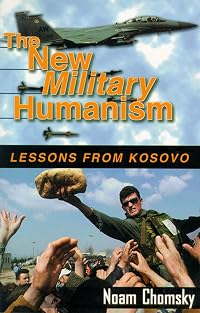
The New Military Humanism: Lessons From Kosovo
by Noam Chomsky
213 Members (3.50)
On This Page
Description
'A powerful and convincing alternative framework for understanding the NATO war on Yugoslavia.' Edward S. Herman'Thank God for Noam Chomsky ... Ruthless in his analysis of Nato's lies, relentless in his emphasis on the parallels between Kosovo, Central America and Turkey, he believes that this year's bombardment of Serbia undermines what is left of international law.' Robert Fisk, The IndependentThe crisis in Kosovo has excited passion and visionary exaltation of a kind rarely witnessed. The show more events have been portrayed as a 'New Humanism', timed fortuitously with a new millennium, which will displace the crass and narrow interest politics of a mean-spirited past.But is this New Humanism guided by power interests or by humanitarian concern? Is the resort to force undertaken 'in the name of principles and values'‚ as professed? Or are we witnessing something more crass and familiar?The New Military Humanism is Chomsky at his best: a brilliant and revealing analysis, offering lessons for us all and sounding a clear alarm which none should ignore. show lessTags
Recommendations





















Member Reviews
Members
- Recently Added By
Author Information

579+ Works 47,506 Members
Noam Chomsky was born in Philadelphia, Pennsylvania on December 7, 1928. Son of a Russian emigrant who was a Hebrew scholar, Chomsky was exposed at a young age to the study of language and principles of grammar. During the 1940s, he began developing socialist political leanings through his encounters with the New York Jewish intellectual show more community. Chomsky received his Ph.D. from the University of Pennsylvania, where he studied linguistics, mathematics, and philosophy. He conducted much of his research at Harvard University. In 1955, he began teaching at MIT, eventually holding the Ferrari P. Ward Chair of Modern Language and Linguistics. Today Chomsky is highly regarded as both one of America's most prominent linguists and most notorious social critics and political activists. His academic reputation began with the publication of Syntactic Structures in 1957. Within a decade, he became known as an outspoken intellectual opponent of the Vietnam War. Chomsky has written many books on the links between language, human creativity, and intelligence, including Language and Mind (1967) and Knowledge of Language: Its Nature, Origin, and Use (1985). He also has written dozens of political analyses, including Manufacturing Consent: The Political Economy of the Mass Media (1988), Chronicles of Dissent (1992), and The Prosperous Few and the Restless Many (1993). (Bowker Author Biography) show less
Common Knowledge
Classifications
- Genres
- Nonfiction, General Nonfiction, History, Politics and Government
- DDC/MDS
- 949.71 — History & geography History of Europe Greece, Albania, Yugoslavia, Serbia, Romania, Bulgaria Former Yugoslavia (Bosnia and Herzegovina ∙ Croatia ∙ Kosovo ∙ Montenegro ∙ Macedonia ∙ Serbia ∙ Slovenia) [formerly also Bulgaria] Serbia; Kosovo
- LCC
- DR2087 .C48 — History of Europe, Asia, Africa and Oceania Balkan Peninsula History of Balkan Peninsula Yugoslavia Local history and description Serbia Kosovo
- BISAC
Statistics
- Members
- 213
- Popularity
- 153,247
- Rating
- (3.50)
- Languages
- 9 — English, Finnish, French, German, Italian, Portuguese, Serbian, Croatian, Spanish
- Media
- Paper, Ebook
- ISBNs
- 13