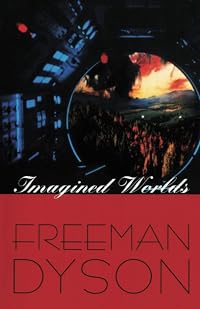
Imagined Worlds
by Freeman Dyson
On This Page
Description
Chapters have such headings as: Stories, Science, Technology, Evolution, and Ethics.Tags
Recommendations











Member Reviews
I have known about Freeman Dyson for a long time - I was a physics undergrad at Princeton; he was next door, at the Institute. He is a top-notch physicist and visionary. This really gives him license for all sorts of self indulgent speculation etc. This is a great book because, while it is surely speculative, it is not self-indulgent. He provides us with wonderful frameworks to think along with him. In many cases I don't see things the way he does, but what splendid generosity it is for him to invite us to look through his telescope!
Dyson sees that resource constraints will really be pinching us in the 21st Century. But he doesn't seem to recognize the extent to which that will impact the practices of the sciences. He tells us on pg. show more 198 that, "The main social benefit provided by pure science in esoteric fields is to serve as a welfare program for scientists and engineers." This is already a huge insight. But what is going to happen to science and engineering when the funding dries up? He can see, on pg 201, that, "If technology continues along its present course, ignoring the needs of the poor and showering benefits upon the rich, the poor will sooner or later rebel against the tyranny of technology and turn to irrational and violent remedies." Of course, who is rich and who is poor? The present instability of so many facets of our system of living, from politics and finance to farms and fisheries, is likely to topple many now standing tall. Dyson surely sits in the quintessential ivory tower. He does a wonderful job of trying to look beyond its confines, but doesn't seem ready to see that the tower itself is as liable to tumble as any other institution.
Dyson assumes that space travel is inevitable, along with the other tremendous directions of technological advancement such as computers and genetic engineering. He envisions life spreading through the galaxy over the next million years. But think: on a cosmic time scale, a million years is practically nothing. If life can spread through the galaxy in a million years, it has already done so. As Sun Ra observed, "It's after the end of the world, don't you know that yet?" It could well have happened that life came to earth, has come to earth repeatedly, on board comets or meteorites etc. A galaxy filled with life might be experienced by its inhabitants... just like this!
This is a short book, easy to read, filled with insights. Dyson helps us to think for ourselves on his scale, which is a profound service, however one feels about his particular thoughts on this or that topic. show less
Dyson sees that resource constraints will really be pinching us in the 21st Century. But he doesn't seem to recognize the extent to which that will impact the practices of the sciences. He tells us on pg. show more 198 that, "The main social benefit provided by pure science in esoteric fields is to serve as a welfare program for scientists and engineers." This is already a huge insight. But what is going to happen to science and engineering when the funding dries up? He can see, on pg 201, that, "If technology continues along its present course, ignoring the needs of the poor and showering benefits upon the rich, the poor will sooner or later rebel against the tyranny of technology and turn to irrational and violent remedies." Of course, who is rich and who is poor? The present instability of so many facets of our system of living, from politics and finance to farms and fisheries, is likely to topple many now standing tall. Dyson surely sits in the quintessential ivory tower. He does a wonderful job of trying to look beyond its confines, but doesn't seem ready to see that the tower itself is as liable to tumble as any other institution.
Dyson assumes that space travel is inevitable, along with the other tremendous directions of technological advancement such as computers and genetic engineering. He envisions life spreading through the galaxy over the next million years. But think: on a cosmic time scale, a million years is practically nothing. If life can spread through the galaxy in a million years, it has already done so. As Sun Ra observed, "It's after the end of the world, don't you know that yet?" It could well have happened that life came to earth, has come to earth repeatedly, on board comets or meteorites etc. A galaxy filled with life might be experienced by its inhabitants... just like this!
This is a short book, easy to read, filled with insights. Dyson helps us to think for ourselves on his scale, which is a profound service, however one feels about his particular thoughts on this or that topic. show less
always enjoy Freeman Dyson's books and essays, mostly because he is always willing to tackle the big questions in science and society. Not for him the pedestrian, the cynical, or the immediate--always the long view, with a certain passionate feeling for the possibilities of progress. His writing is refreshing and mind-expanding.
I especially enjoyed his discussion of early aviation, and the account he gives of the engineer, Nevil Shute Norway, one of my favorite authors of all time. The Darwinian perspective of the evolution of an artifact, the airplane, is right on, and one is tempted to see the phenomenon in other developing technologies as well.
The book is short, and is easy to read, especially considering the lofty ideas it contains.
I especially enjoyed his discussion of early aviation, and the account he gives of the engineer, Nevil Shute Norway, one of my favorite authors of all time. The Darwinian perspective of the evolution of an artifact, the airplane, is right on, and one is tempted to see the phenomenon in other developing technologies as well.
The book is short, and is easy to read, especially considering the lofty ideas it contains.
Best quote: G.H. Hardy, mathematician: "A science is said to be useful if its development tends to accentuate the existing inequalities in the distribution of wealth, or more directly promotes the destruction of human life."
Ratings
Members
- Recently Added By
Author Information

47+ Works 3,133 Members
Freeman Dyson, editor, professor emeritus at the Institute for Advanced Study in Princeton, has contributed to the fields of mathematics, physics, astronomy, and biology. He is the author of numerous books, including Weapons and Hope, which won the National Book Critics Circle Award in 1984.
Series
Belongs to Publisher Series
Jerusalem-Harvard Lectures (1997)
Common Knowledge
- Canonical title
- Imagined Worlds
Classifications
- Genres
- Nonfiction, Science & Nature, General Nonfiction, Technology, Philosophy, History, Literature Studies and Criticism
- DDC/MDS
- 081 — Computer science, information & general works Anthologies and Quotations General collections in American English
- LCC
- AC8 .D97 — General Works Collections. Series. Collected works Collections. Series. Collected works Collections of monographs, essays, etc. American and English
- BISAC
Statistics
- Members
- 226
- Popularity
- 144,850
- Reviews
- 4
- Rating
- (4.10)
- Languages
- English, Italian, Portuguese
- Media
- Paper
- ISBNs
- 6
- UPCs
- 1
- ASINs
- 1