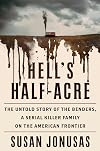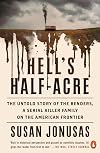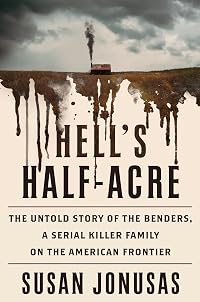
Hell's Half-Acre: The Untold Story of the Benders, a Serial Killer Family on the American Frontier
by Susan Jonusas
On This Page
Description
One of NPR's "Books We Love"New York Times Book Review's "The Best True Crime of 2022"
"Rich in historical perspective and graced by novelistic touches, grips the reader from first to last.”—Wall Street Journal
A suspense filled tale of murder on the American frontier—shedding new light on a family of serial killers in Kansas, whose horrifying crimes gripped the attention of a nation still reeling from war.
In 1873 the people of Labette County, Kansas made a grisly discovery. Buried show more by a trailside cabin beneath an orchard of young apple trees were the remains of countless bodies. Below the cabin itself was a cellar stained with blood. The Benders, the family of four who once resided on the property were nowhere to be found. The discovery sent the local community and national newspapers into a frenzy that continued for decades, sparking an epic manhunt for the Benders.
The idea that a family of seemingly respectable homesteaders—one among the thousands relocating farther west in search of land and opportunity after the Civil War—were capable of operating "a human slaughter pen" appalled and fascinated the nation. But who the Benders really were, why they committed such a vicious killing spree and whether justice ever caught up to them is a mystery that remains unsolved to this day. Set against the backdrop of postbellum America, Hell’s Half-Acre explores the environment capable of allowing such horrors to take place. Drawing on extensive original archival material, Susan Jonusas introduces us to a fascinating cast of characters, many of whom have been previously missing from the story. Among them are the families of the victims, the hapless detectives who lost the trail, and the fugitives that helped the murderers escape.
Hell’s Half-Acre is a journey into the turbulent heart of nineteenth century America, a place where modernity stalks across the landscape, violently displacing existing populations and building new ones. It is a world where folklore can quickly become fact and an entire family of criminals can slip through a community’s fingers, only to reappear in the most unexpected of places. show less
Tags
Recommendations




Member Reviews
In Hell's Half-Acre, Susan Jonusas tries to bring together what's known about one of the most notorious true crime cases in American history—that of "the Bloody Benders", a group of gruesome serial killers who evaded justice and vanished into modern myth—and the times in which they lived—Kansas in the 1870s, when Native Americans were being rapidly dispossessed in the name of white settler colonialism. It's to Jonusas' credit that she tries to pay attention to how race and gender shaped how the Benders were seen. None of the families of newly emancipated Black people moving into Kansas at around the same would have been able to get away with so much for so long.
It's just that Jonusas doesn't approach her task with a great deal of show more grace or much evident skill with primary source analysis. The narrative voice lurches between staid academese and potted biographies of people only tangentially related to the case, and thriller-ish imaginings of various encounters and what people "must have" felt, thought, or said in that moment. It often wasn't clear to me why she gave some sources credence and dismissed others. There's probably enough known material and/or myth about the Benders to make for one decent New Yorker article or one likely-hammy novel—Jonusas opted for neither, and Hell's Half-Acre is the worst for it. show less
It's just that Jonusas doesn't approach her task with a great deal of show more grace or much evident skill with primary source analysis. The narrative voice lurches between staid academese and potted biographies of people only tangentially related to the case, and thriller-ish imaginings of various encounters and what people "must have" felt, thought, or said in that moment. It often wasn't clear to me why she gave some sources credence and dismissed others. There's probably enough known material and/or myth about the Benders to make for one decent New Yorker article or one likely-hammy novel—Jonusas opted for neither, and Hell's Half-Acre is the worst for it. show less
3.5 stars
The Benders were a group of four people, an older couple known simply as Ma and Pa, and a younger couple. No one knows if the younger were siblings or married. They moved to a plot of land in Kansas in the 1870s and stayed for a few years. The younger woman, Kate, called herself a “spiritualist”. They sold groceries (or had a sign out to do so, anyway), and attracted travellers with food and a place to stay. Unfortunately for some of those travellers, the Benders were also serial killers. When some of the locals were suspicious when the local doctor went missing, the Benders up and ran. No one ever found them. As the locals started looking around, the bodies were piling up on the homestead. There were at least 11 people show more killed, mostly men, mostly travellers, but one 18 month-old baby buried with her dad (they think the baby was buried alive).
I read a shorter account of this somewhere, I’d like to say not long ago, but it may be longer than I’m thinking. This was an expanded version of the story. Only about the first 1/3 of the book told of them coming to the area until they ran. The next bit of the book followed them to the wilds of Texas, where there were a lot more outlaws and places to hide, and people to help them hide. Beyond that, no one knows where they ended up. The last bit of the book was when, 16 years later, someone thought they’d found Ma and Kate; there were trials to determine if they really were the Benders or not. There is an extensive note section at the end, as well.
I thought the start and end were the more interesting. The middle part, as the Benders made their escape, was less interesting as we focused on a few of the other criminal element who helped them along their way (one of these people talked to police while he was in jail later on, so that’s how some of this is known). Overall, I’d say this was good. Certainly a lot of research went into it. show less
The Benders were a group of four people, an older couple known simply as Ma and Pa, and a younger couple. No one knows if the younger were siblings or married. They moved to a plot of land in Kansas in the 1870s and stayed for a few years. The younger woman, Kate, called herself a “spiritualist”. They sold groceries (or had a sign out to do so, anyway), and attracted travellers with food and a place to stay. Unfortunately for some of those travellers, the Benders were also serial killers. When some of the locals were suspicious when the local doctor went missing, the Benders up and ran. No one ever found them. As the locals started looking around, the bodies were piling up on the homestead. There were at least 11 people show more killed, mostly men, mostly travellers, but one 18 month-old baby buried with her dad (they think the baby was buried alive).
I read a shorter account of this somewhere, I’d like to say not long ago, but it may be longer than I’m thinking. This was an expanded version of the story. Only about the first 1/3 of the book told of them coming to the area until they ran. The next bit of the book followed them to the wilds of Texas, where there were a lot more outlaws and places to hide, and people to help them hide. Beyond that, no one knows where they ended up. The last bit of the book was when, 16 years later, someone thought they’d found Ma and Kate; there were trials to determine if they really were the Benders or not. There is an extensive note section at the end, as well.
I thought the start and end were the more interesting. The middle part, as the Benders made their escape, was less interesting as we focused on a few of the other criminal element who helped them along their way (one of these people talked to police while he was in jail later on, so that’s how some of this is known). Overall, I’d say this was good. Certainly a lot of research went into it. show less
Tells the story of a family named the Benders, who murdered travelers for their belongings to sell. Goes deep into the history of Kansas (specifically the southeast corner) at this time. If you aren't interested in the frontier history this could be a long read for you. Overall, I found it an interesting read, that was very well written.
I really enjoyed reading this well-researched, and intriguing account of an unusual/dark/murderous family who took advantage of those enthralled with the westward expansion. There were so many people looking to stake a claim as territories came open, and because there was little, if any, method to track them, other than sightings at typical stopping points, letters sent to those waiting at home, (i.e. "I have arrived!") to small encounters here and there with well-intentioned people, it's a wonder this didn't happen more often.
Somewhere toward the end I was thinking, okay, when are they going to figure out where the Benders went? And when do I get to see them get their comeuppance?
Then, I remembered, oh, wait, "a mystery that remains show more unsolved to this day."
When you read of what they did, you wish somehow, someway, someone had found them and served justice. Even as the narrative moved forward, and different individuals who may (or may not) have known the family were introduced, frustratingly, they would not meet expectations of what they knew, or would embellish what they knew, and eventually disappear into the sunset, so to speak.
Because they were never found, and their motives were never known, this adds even more to the mystery of what happened to them, and how they were able to get away with killing eleven (what's known) people. There was one particular victim - less than two years of age - buried alive with her murdered father. I found that part of this story the most horrific and tragic of all, even though the entire account is not for the tenderhearted. show less
Somewhere toward the end I was thinking, okay, when are they going to figure out where the Benders went? And when do I get to see them get their comeuppance?
Then, I remembered, oh, wait, "a mystery that remains show more unsolved to this day."
When you read of what they did, you wish somehow, someway, someone had found them and served justice. Even as the narrative moved forward, and different individuals who may (or may not) have known the family were introduced, frustratingly, they would not meet expectations of what they knew, or would embellish what they knew, and eventually disappear into the sunset, so to speak.
Because they were never found, and their motives were never known, this adds even more to the mystery of what happened to them, and how they were able to get away with killing eleven (what's known) people. There was one particular victim - less than two years of age - buried alive with her murdered father. I found that part of this story the most horrific and tragic of all, even though the entire account is not for the tenderhearted. show less
Horrific but interesting story of a family in LaBette County, Kansas in the late 1800's. The Benders were strange - Ma and Pa, daughter Kate, and maybe son John. The Benders opened a sort of grocery store that people in the area and those traveling stopped by. Individuals begin to strangely disappear in this county. William York was a member of a highly though of family; he disappeared. A father and his 18 month old daughter disappeared, a local farmer was found dead in a nearby creek. People soon became afraid and the authorities were finally encouraged to look into the disappearances.
The narrative then follows the Bender family and the families of those that disappeared and the search that follows. Many threads are followed. I did show more question the use of dialogue at times - how accurate it is, yet there are lots of sources, etc. However, whatever the accuracy, it is an interesting story especially in light of living near the area. The life of the frontier at that time is certainly believable as times were hard. Interesting! show less
The narrative then follows the Bender family and the families of those that disappeared and the search that follows. Many threads are followed. I did show more question the use of dialogue at times - how accurate it is, yet there are lots of sources, etc. However, whatever the accuracy, it is an interesting story especially in light of living near the area. The life of the frontier at that time is certainly believable as times were hard. Interesting! show less
Choosing a rating for this is hard.
-Wonderful, engaging writing: Five stars
-Making up information out of whole cloth, including private conversations among the Benders, themselves, when no one could’ve heard them: Zero stars (we in the know call this “fiction”)
-Useless “references” that are just narrative lists of citations not connected in any way to the text they supposedly support so that anyone who wanted to follow up would have to track down and read a dozen or more primary sources to find the origin of a single fact or quote: Zero stars
-Asserting that settlers to Kansas territory were met with “plentiful forests” (p. 5): Negative a million stars; she claims to have actually visited Kansas. I can only assume that show more this is also fiction. show less
-Wonderful, engaging writing: Five stars
-Making up information out of whole cloth, including private conversations among the Benders, themselves, when no one could’ve heard them: Zero stars (we in the know call this “fiction”)
-Useless “references” that are just narrative lists of citations not connected in any way to the text they supposedly support so that anyone who wanted to follow up would have to track down and read a dozen or more primary sources to find the origin of a single fact or quote: Zero stars
-Asserting that settlers to Kansas territory were met with “plentiful forests” (p. 5): Negative a million stars; she claims to have actually visited Kansas. I can only assume that show more this is also fiction. show less
Ratings
Members
- Recently Added By
Lists

Weirdo Nonfiction
138 works; 3 members
Author Information

1 Work 287 Members
Awards and Honors
Distinctions
Common Knowledge
- Original publication date
- 2022-03-01
- People/Characters
- James Montgomery; William Quantrill; John Gebhardt; John Bender; Jack Reed; Leroy Dick (show all 47); Kate Bender; Fannie Allyne; G.W. Gabriel; James Roach; Matilda Talbott; Susanna Abell; Jim Abell; Father Paul Ponziglione; Martha Jones; William Jones; R.M. Bennett; Henry McKenzie; J.H. Sperry; William McCrotty; John Phipps; George Longcor; John Handley; Alexander Miner York; Dr. William York; Samuel Pomeroy; W.W. Ross; John J. Ingalls; Edward Clark; Susanna Tyack; Edward York; Thomas Beers; Jim Buster; Lyman Humphrey; Billy Tole; Leroy Dick; Rudolph Brockman; Albert Owens; Frank McPherson; Gottlieb Koozer; Floyd Slimp; Sam Merrick; Agent Nathan J. Pierce; James Sullivan; Alfred Campbell; Sarah Monroe Davis; Almira Monroe
- Important places
- Fort Scott, Kansas, USA; Lawrence, Kansas, USA; Cherryvale, Kansas, USA; Ladore, Kansas, USA; Big Hill Creek, Kansas, USA; Osage Mission Trail, Kansas, USA (show all 13); Onion Creek, Kansas, USA; Harmony Grove, Kansas, USA; Denison, Texas, USA; Parsons, Kansas, USA; Red River Station, Texas, USA; Niles, Michigan, USA; Oswego, Kansas, USA
- Important events
- Kansas-Nebraska Act (1854); Black Codes (1865 | 1866); Red River War (1874 | 1875); Medicine Lodge Treaty (1867)
- Epigraph
- Evil is unspectacular and always human,
And shares our bed and eats at our own table. -W.H. Auden - Dedication
- For the victims
James Feerick, William Jones, Henry McKenzie, Benjamin Brown, Willian McCrotty, Johnny Boyle, George Longcor, Mary Ann Longcor, John Phipps, William York
and those who remain unknown - First words
- In the history of the American West, few historical figures have captured the public imagination like the outlaw.
In a valley fourteen miles east of Independence, a party of seventy-five men on horseback pick their way through the mud. - Last words
- (Click to show. Warning: May contain spoilers.)But it must have been strange for Ed, then in his seventies, to watch as the world he had grown up in was rebuilt around him, a Hollywood facsimile of an age born of blood and division.
(Click to show. Warning: May contain spoilers.)The family themselves are ghosts in their own narrative, patched together through the voices of those who knew them, those who lost loves ones to their crimes, and those who continue to tell stories passed down through the generations. These are the voices, both new and old, to whom this story truly belongs. -Epilogue - Blurbers
- Guinn, Jeff; Jones, Dan
- Original language
- English
- Canonical DDC/MDS
- 364.152320978196
- Canonical LCC
- HV6533.K3
Classifications
- Genres
- General Nonfiction, History, Nonfiction
- DDC/MDS
- 364.152320978196 — Society, government, & culture Social problems and social services Crime Criminal offenses Offenses against the person Homicide Murder Serial killers
- LCC
- HV6533 .K3 — Social sciences Social pathology. Social and public welfare. Criminology Social pathology. Social and public welfare. Criminology Crimes and offenses
- BISAC
Statistics
- Members
- 288
- Popularity
- 111,539
- Reviews
- 6
- Rating
- (3.51)
- Languages
- English
- Media
- Paper, Audiobook, Ebook
- ISBNs
- 9
- ASINs
- 3