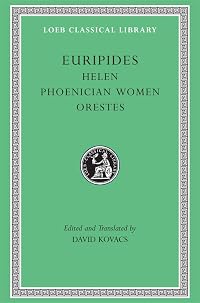
3 Plays: Helen / Orestes / Phoenician Women
by Euripides
On This Page
Description
Euripides (c. 485-406 BCE) has been prized in every age for his emotional and intellectual drama. Eighteen of his ninety or so plays survive complete, including Medea, Hippolytus, and Bacchae, one of the great masterpieces of the tragic genre. Fragments of his lost plays also survive.Tags
Recommendations

Member Reviews
These updates by translator David Kovacs to the Loeb Classical Library renditions of Euripides' Helen, The Phoenician Women and Orestes read very well. I haven't read the versions they replaced, but somewhere on the 'Tubes I recall reading something to the effect that the A. S. Way Euripides translations were fairly dire, and something the Loebs needed to supplant ASAP.
Apologies to Mr. Way if that's an overstatement. Anyhoo, the LCL has done a good job here. I had no particular reason for starting with Volume 5, apart from the fact that I'd heard ages ago that Orestes was a pretty messed-up play, and 'messed-up' is a surefire descriptor to pique ol' Peerts's interest.
I did not find Orestes to be _particularly_ aberrant -- though it was show more intriguing that other characters in this play treat Orestes' visions of the Erinyes/Eumenides as just that -- visions, rather than actual entities. Apparently the play constructs its own vivid and peculiar version of the events succeeding Orestes' slaying of his mother and Aegisthus -- perhaps this is what puts it in the 'messed up' slot.
Greek tragedy is not an area where I claim any expertise. I've read a number of the familiar plays: Oedipus, the Oresteia, etc., The Bacchae. The three plays in this volume are interesting for the myths they relate or just kind of make up. I found The Phoenician Women particularly enjoyable, since it filled in some of the holes in my knowledge of the story of Antigone. Good notes and introductions. show less
Apologies to Mr. Way if that's an overstatement. Anyhoo, the LCL has done a good job here. I had no particular reason for starting with Volume 5, apart from the fact that I'd heard ages ago that Orestes was a pretty messed-up play, and 'messed-up' is a surefire descriptor to pique ol' Peerts's interest.
I did not find Orestes to be _particularly_ aberrant -- though it was show more intriguing that other characters in this play treat Orestes' visions of the Erinyes/Eumenides as just that -- visions, rather than actual entities. Apparently the play constructs its own vivid and peculiar version of the events succeeding Orestes' slaying of his mother and Aegisthus -- perhaps this is what puts it in the 'messed up' slot.
Greek tragedy is not an area where I claim any expertise. I've read a number of the familiar plays: Oedipus, the Oresteia, etc., The Bacchae. The three plays in this volume are interesting for the myths they relate or just kind of make up. I found The Phoenician Women particularly enjoyable, since it filled in some of the holes in my knowledge of the story of Antigone. Good notes and introductions. show less
Ratings
Members
- Recently Added By
Author Information

1,345+ Works 34,154 Members
Euripides was born in Attica, Greece probably in 480 B.C. He was the youngest of the three principal fifth-century tragic poets. In his youth he cultivated gymnastic pursuits and studied philosophy and rhetoric. Soon after he received recognition for a play that he had written, Euripides left Athens for the court of Archelaus, king of Macedonia. show more Fragments of about fifty-five plays survive. Among his best-known plays are Alcestis, Medea and Philoctetes, Electra, Iphigenia in Tauris, The Trojan Women, and Iphigenia in Aulis Iphigenia. He died in Athens in 406 B.C. (Bowker Author Biography) show less
Series
Belongs to Publisher Series
Loeb Classical Library (11N)
Common Knowledge
- Canonical title
- 3 Plays: Helen / Orestes / Phoenician Women
Classifications
- Genre
- Fiction and Literature
- DDC/MDS
- 882.01 — Literature & rhetoric Classical & modern Greek literatures Classical Greek dramatic poetry and drama standard subdivisions; collections; history, description, critical appraisal; Specific periods Ancient period to ca. 499
- LCC
- PA3975 .A2 — Language and Literature Greek language and literature. Latin language and literature Greek literature Individual authors Euripedes
- BISAC
Statistics
- Members
- 71
- Popularity
- 441,918
- Reviews
- 1
- Rating
- (3.88)
- Languages
- English, Greek (Ancient)
- Media
- Paper, Ebook
- ISBNs
- 2