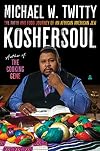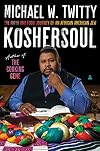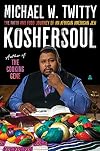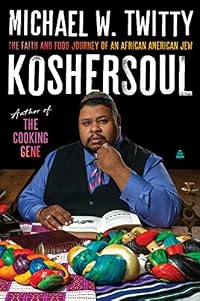
Koshersoul: The Faith and Food Journey of an African American Jew
by Michael W. Twitty
On This Page
Description
"The James Beard award-winning author of the acclaimed The Cooking Gene explores the cultural crossroads of Jewish and African diaspora cuisine and issues of memory, identity, and food. In Koshersoul, Michael W. Twitty considers the marriage of two of the most distinctive culinary cultures in the world today: the foods and traditions of the African Atlantic and the global Jewish diaspora. To Twitty, the creation of African-Jewish cooking is a conversation of migrations and a dialogue of show more diasporas offering a rich background for inventive recipes and the people who create them. The question that most intrigues him is not just who makes the food, but how the food makes the people. Jews of Color are not outliers, Twitty contends, but significant and meaningful cultural creators in both Black and Jewish civilizations. Koshersoul also explores how food has shaped the journeys of numerous cooks, including Twitty's own passage to and within Judaism. As intimate, thought-provoking, and profound as The Cooking Gene, this remarkable book teases the senses as it offers sustenance for the soul. Koshersoul includes 48-50 recipes"-- show lessTags
Recommendations
















Member Reviews
Michael W. Twitty, author of The Cooking Gene, turns his attention from Southern cooking and genealogy to his experience as an African American Jew and how his experience cooking has been a fusion of his identities.
It's really hard to describe Twitty's work because he takes all sorts of elements - food, history, identity, culture, his experiences as an African American, his experiences as a converted Jew, and his experiences as an African American Jew - and blends it into a memoir as unique as the food on his table. When I reviewed The Cooking Gene, I said, "it's sprawling, dense, thoughtful and chock full of information. I enjoyed it and was challenged by it in equal measure." Koshersoul is similar, while focusing more on Twitty's show more faith and conversations he's had with other Jews. In fact, Twitty includes not just conversations he's had but other people's experiences and stories, too. Instead of a single person's memoir, you get a multifaceted picture of the intersection of identities many African American Jews experience - and, of course, the food they eat. As a non-Jew myself, I found it a really fascinating window into the culture, and would love to some day pull up a chair and sit at Twitty's table. show less
It's really hard to describe Twitty's work because he takes all sorts of elements - food, history, identity, culture, his experiences as an African American, his experiences as a converted Jew, and his experiences as an African American Jew - and blends it into a memoir as unique as the food on his table. When I reviewed The Cooking Gene, I said, "it's sprawling, dense, thoughtful and chock full of information. I enjoyed it and was challenged by it in equal measure." Koshersoul is similar, while focusing more on Twitty's show more faith and conversations he's had with other Jews. In fact, Twitty includes not just conversations he's had but other people's experiences and stories, too. Instead of a single person's memoir, you get a multifaceted picture of the intersection of identities many African American Jews experience - and, of course, the food they eat. As a non-Jew myself, I found it a really fascinating window into the culture, and would love to some day pull up a chair and sit at Twitty's table. show less
I found this book fascinating in its discussion of the intersection of Black and Jewish cultures. As the author notes, Blacks are a minority of the Jewish population, but my knowledge of them has been taken from different circumstances. I especially loved that the author had once lived near where I live now in Montgomery County, Maryland, so I recognized names of people I knew in the dedication of this book! That gave him so much credibility in my view in addition to his vast knowledge of Judaism which he shared both in his writing and in being a Hebrew school teacher.
I liked hearing about the Black-Jewish relationship from this Black author rather than from the Jewish point of view, with which I am familiar.
The chapter about radio show more personality Marc Steiner’s reminiscences of growing up in Jewish-Black 1950s Baltimore as segregation was trying to end held a special fascination for me because that was my hometown at that time. His descriptions of that place at that time were spot on.
The chapter called “Katie - ‘I Feel Like Me’” made me cry. It was about a Hebrew school student of the author’s who finally felt like her true self when presenting a school project about Jews of Japan. She herself was the daughter of a Jewish Japanese American mom and an Ashkenazi Jewish dad. After making her presentation, she told her teacher, the author of this book, “I feel like me...the whole me.”
One thing that especially touched me deeply is that Twitty writes with such love for Judaism. As a born Jew, I never want to take my religion for granted, but as the author was a convert, my respect for him deepens as that which is so meaningful to me is just as meaningful to him.
The one thing in this book I didn’t like was the author saying he was not a fan of shakshuka, poached eggs in a highly spiced tomato sauce dish. How can that be?! :)
The second half of the book about the intersection of African American and typical Jewish food had some absolutely great cooking ideas which I can’t wait to try. Using smoked turkey necks or Liquid Smoke for flavoring beans or soup sounds fabulous. I also can’t wait to try making fake crab cakes!
To me, this was a fabulous book and quite a special treat to read. show less
I liked hearing about the Black-Jewish relationship from this Black author rather than from the Jewish point of view, with which I am familiar.
The chapter about radio show more personality Marc Steiner’s reminiscences of growing up in Jewish-Black 1950s Baltimore as segregation was trying to end held a special fascination for me because that was my hometown at that time. His descriptions of that place at that time were spot on.
The chapter called “Katie - ‘I Feel Like Me’” made me cry. It was about a Hebrew school student of the author’s who finally felt like her true self when presenting a school project about Jews of Japan. She herself was the daughter of a Jewish Japanese American mom and an Ashkenazi Jewish dad. After making her presentation, she told her teacher, the author of this book, “I feel like me...the whole me.”
One thing that especially touched me deeply is that Twitty writes with such love for Judaism. As a born Jew, I never want to take my religion for granted, but as the author was a convert, my respect for him deepens as that which is so meaningful to me is just as meaningful to him.
The one thing in this book I didn’t like was the author saying he was not a fan of shakshuka, poached eggs in a highly spiced tomato sauce dish. How can that be?! :)
The second half of the book about the intersection of African American and typical Jewish food had some absolutely great cooking ideas which I can’t wait to try. Using smoked turkey necks or Liquid Smoke for flavoring beans or soup sounds fabulous. I also can’t wait to try making fake crab cakes!
To me, this was a fabulous book and quite a special treat to read. show less
****.5
I found his previous book interesting but a bit dry, in this one his passion really comes through. It's a lot more personal, but also manages to say a lot about the intersection of Judaism and Black culture. All approached through the lens of food, of course.
On the negative side, it's a bit rambling at times, and he careens between informal anecdotes and scholarly exegesis which makes it hard to follow at times. He also uses a lot of Yiddish words without defining them, which is both obnoxious and made it seem like he was trying too hard.
I found his previous book interesting but a bit dry, in this one his passion really comes through. It's a lot more personal, but also manages to say a lot about the intersection of Judaism and Black culture. All approached through the lens of food, of course.
On the negative side, it's a bit rambling at times, and he careens between informal anecdotes and scholarly exegesis which makes it hard to follow at times. He also uses a lot of Yiddish words without defining them, which is both obnoxious and made it seem like he was trying too hard.
The only reason I didn’t give 5 stars is because there were no pictures of the food. I really enjoyed reading this book and look forward to trying some of the recipes. I am not Jewish but my great great grandmother and great great grandfather were Russian Jews who fled Europe and settled in GA. My family has always made sure we knew our Jewish heritage and about their culture even though my grandparents became Christian’s. Judaism has a very special place in my heart. Soul food is our everyday food in the south and I was intrigued with how the two very different cuisines could be combined. I feel like Mr. Twitty is my brother and relate to him on many levels while respecting and admiring our differences. Food really can bring people show more together and Mr. Twitty does an amazing job at showing that in this book show less
Ratings
Members
- Recently Added By
Lists

Food
133 works; 2 members

Bitter Southerner Summer Reading Roundup
198 works; 8 members
Author Information

5+ Works 1,206 Members
Awards and Honors
Awards
Distinctions
Common Knowledge
- Original publication date
- 2022
- Quotations
- One day, after having a million conversations and seeing millions of faces and sharing enmity and joy with one another, it hit me that this is why we cook for one another, share food and talk about food and beyond—we just w... (show all)ant to be family to one another.
We have a history, and we are still piecing it together. We just don’t want to always give our origin stories before our names.
In 1855, Rabbi David Einhorn, a Bavarian Jew, was appointed to Har Sinai, the oldest synagogue associated with the Reform movement, but he was run out of town in 1861 after delivering a fiery sermon in German against the inst... (show all)itution of slavery.
The German Jews lived around Druid Lake Drive and Eutaw Place.
Baltimore’s Jewish community in the 1950s, when I was a kid, was a middle-class community. A lot of people had Black women working in their homes. We went to segregated schools. My elementary school wasn’t just all white ... (show all)but 90 percent Jewish. Your neighborhood was where you were. It was who you were. (Marc Steiner)
True to the season of Passover, spring collards are increasing in bitterness while winter collards mellow and sweeten. They were once endemic to the gardens of enclaves African Americans, a replacement for the many leafy gree... (show all)ns our ancestors ate in West and Central Africa.
Honestly, it’s exhausting. It’s something on the other side of peace. I crave acceptance even as I worry that around the next corner is rejection. The marketplace has its consequences for those of us kippa’ed whi... (show all)le Black, and I’m not the only one.
But there were also people who would aid and abet my one-man yeshiva, and because they believed in me, I am a proud autodidact, and not a victim of suicide.
When you have confidence in the journey, you don’t feel like you’ve failed; you feel like the challenge is to conquer your failings.
Koshersoul is my self-coined term for our vantage point, not a group affinity, tend, or even tradition. It’s another word for kinfolk.
…the Chocolate Chosen, our people within a people, Jews of African descent.
Mendel, a serious foodie with African American Jewish and Egyptian Jewish heritage, said not only does he miss bacon, but he misses crab from his nonkosher foray: “I am from Baltimore!”
Classifications
- Genres
- Food & Cooking, Nonfiction, Biography & Memoir, General Nonfiction, Religion & Spirituality, History
- DDC/MDS
- 641.5 — Applied Science & Technology Home economics & family management Food, Cooking & Recipes / Meals, Picnics Cooking; cookbooks
- LCC
- TX724 .T85 — Technology Home economics Home economics Cooking
- BISAC
Statistics
- Members
- 166
- Popularity
- 194,206
- Reviews
- 4
- Rating
- (4.00)
- Languages
- English
- Media
- Paper, Audiobook, Ebook
- ISBNs
- 8
- ASINs
- 2