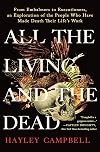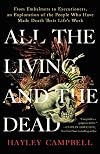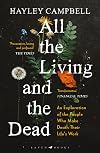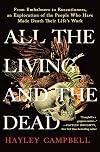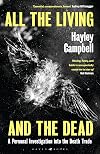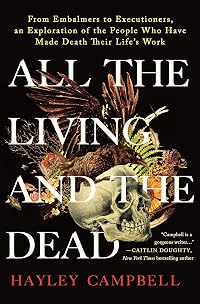
All the Living and the Dead: From Embalmers to Executioners, an Exploration of the People Who Have Made Death Their Life's Work
by Hayley Campbell
On This Page
Description
"A deeply compelling exploration of the death industry and the people-morticians, detectives, crime scene cleaners, embalmers, executioners-who work in it and what led them there. We are surrounded by death. It is in our news, our nursery rhymes, our true-crime podcasts. Yet from a young age, we are told that death is something to be feared. How are we supposed to know what we're so afraid of, when we are never given the chance to look? Fueled by a childhood fascination with death, show more journalist Hayley Campbell searches for answers in the people who make a living by working with the dead. Along the way, she encounters mass fatality investigators, embalmers, and a former executioner who is responsible for ending sixty-two lives. She meets gravediggers who have already dug their own graves, visits a cryonics facility in Michigan, goes for late-night Chinese with a homicide detective, and questions a man whose job it is to make crime scenes disappear. Through Campbell's incisive and candid interviews with these people who see death every day, she asks: Why would someone choose this kind of life? Does it change you as a person? And are we missing something vital by letting death remain hidden? A dazzling work of cultural criticism, All the Living and the Dead weaves together reportage with memoir, history, and philosophy, to offer readers a fascinating look into the psychology of Western death"-- show lessTags
Recommendations



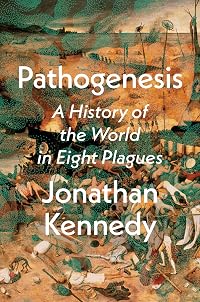
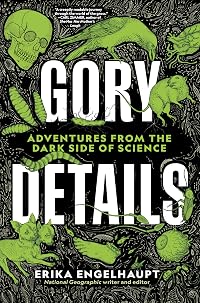
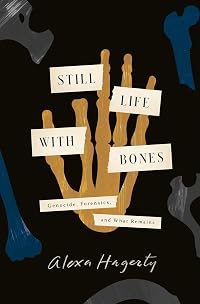
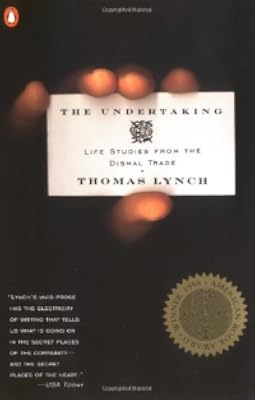



Member Recommendations

Member Reviews
Author Haley Campbell shadows various workers in death as they perform their work, describing the finer details of the processes and her own emotional reactions to them. Campbell argues that our society is too far removed from death, and that the taboo against visual or tactile contact with our dead does us harm. I read this book shortly after Anil Press’ Dirty Work, where he writes about jobs that we pretend don’t exist in order to avoid our own moral culpability. Here, Campbell reveals a world from which we remove ourselves in order insulate us from the reality of our own fragility.. By turns nauseating, poetic, heartbreaking, and strangely uplifting, All the Living and the Dead is written with bravery and vulnerability. Highly show more recommended.
I received this Advance Reader Copy in exchange for an honest review. show less
I received this Advance Reader Copy in exchange for an honest review. show less
The author admits right in the introduction that she has been fascinated with death since she was a small child; her father was the artist who illustrated Alan Moore’s graphic novel about Jack the Ripper, so she was used to seeing pretty gruesome images. So it’s not a big surprise that she eventually decided to interview people who’s careers are dealing with the dead.
A journalist by trade, Campbell has experience doing interviews, so she visits a number of death workers at their places of work. Several let her have a ‘hands on’ experience; she holds a brain; watches a body being embalmed and then made up for viewing; visits a crime scene when it’s going to be cleaned up; visits a hospital unit where still born babies are show more warmed up and prettied up so they look like they are sleeping, so that their parents can hold them before they are taken away; visits a cemetery while the gravediggers prepare a grave for burial; sees a cryonic storage site; and more. She enquires why and how the people ended up in their jobs. She asks about how the public sees their services. She includes how these visits made her, personally, feel. She asks how their jobs make the workers feel; how does it feel to be a state executioner who has ended 62 lives? What about crime scene cleanup- how does the obvious violence that had occurred make them feel?
I found the book very interesting; some chapters more so than others, for instance I found the chapter about funeral direction less interesting than that about bodies donated to science (a surprisingly large number get rejected). If you’ve any interest in the subject of death and how it’s handled today (at least in the UK), read this book. Don’t worry; there are no illustrations. show less
A journalist by trade, Campbell has experience doing interviews, so she visits a number of death workers at their places of work. Several let her have a ‘hands on’ experience; she holds a brain; watches a body being embalmed and then made up for viewing; visits a crime scene when it’s going to be cleaned up; visits a hospital unit where still born babies are show more warmed up and prettied up so they look like they are sleeping, so that their parents can hold them before they are taken away; visits a cemetery while the gravediggers prepare a grave for burial; sees a cryonic storage site; and more. She enquires why and how the people ended up in their jobs. She asks about how the public sees their services. She includes how these visits made her, personally, feel. She asks how their jobs make the workers feel; how does it feel to be a state executioner who has ended 62 lives? What about crime scene cleanup- how does the obvious violence that had occurred make them feel?
I found the book very interesting; some chapters more so than others, for instance I found the chapter about funeral direction less interesting than that about bodies donated to science (a surprisingly large number get rejected). If you’ve any interest in the subject of death and how it’s handled today (at least in the UK), read this book. Don’t worry; there are no illustrations. show less
Rating: 4.5* of five
The Publisher Says: A deeply compelling exploration of the death industry and the people—morticians, detectives, crime scene cleaners, embalmers, executioners—who work in it and what led them there.
We are surrounded by death. It is in our news, our nursery rhymes, our true-crime podcasts. Yet from a young age, we are told that death is something to be feared. How are we supposed to know what we’re so afraid of, when we are never given the chance to look?
Fueled by a childhood fascination with death, journalist Hayley Campbell searches for answers in the people who make a living by working with the dead. Along the way, she encounters mass fatality investigators, embalmers, and a former executioner who is show more responsible for ending sixty-two lives. She meets gravediggers who have already dug their own graves, visits a cryonics facility in Michigan, goes for late-night Chinese with a homicide detective, and questions a man whose job it is to make crime scenes disappear.
Through Campbell’s incisive and candid interviews with these people who see death every day, she asks: Why would someone choose this kind of life? Does it change you as a person? And are we missing something vital by letting death remain hidden? A dazzling work of cultural criticism, All the Living and the Dead weaves together reportage with memoir, history, and philosophy, to offer readers a fascinating look into the psychology of Western death.
I RECEIVED A DRC FROM THE PUBLISHER VIA NETGALLEY. THANK YOU.
My Review: A book with a truly tragic genesis, the author losing a baby at birth; but it led her to look for her grief to be assuaged in discovering the connective tissue in our society's death industry. She made a terrible tragedy into a very interesting study and came away with the kind of book that many of us read with squeamishness as we're utterly disconnected from death.
No one doesn't think about death, and dying; and, as we've professionalized and medicalized every part of the process, we're going to the bookshelf for our answers. Luckily there are those among us who like learning things and then explaining them. (As long as they're not men, they're lauded for it.) Author Hayley Campbell did a major research project in this book's genesis. It comes across more in the endnotes...they're extensive. I realize I'm very much in the minority here, but I prefer endnotes with spiffy little superscript numbers that, in ebooks, function as hyperlinks; I'm perfectly willing to navigate away from the page when I want to know something's source. But la, the wishes and the wants of one not the author, or the editor, are mere wing-flappings of the tiniest of midges. (I'm waxing lyrical. Send help!) Encountering, for example, the saline hydrocremation process was something I wanted to know more about right then and there...but you can bet your sweet bippy I've bookmarked the UK WIRED Magazine story for future discovery.
A less delightful thing that somewhat tarnished my reading experience, and is the source of the missing half-star on the rating about, was the lived experience of her tragic loss of a baby. It was very, very present in the text. It is a loss second to none in the world for painful permanence. As such it felt, to be honest, overused as a rhetorical device. This is a subjective measure, and I freely acknowledge that a recently bereaved parent might find this inclusion unobtrusive, or positively helpful. I did not.
The other side of that coin, however, was my discovery that there are certain souls, who if there is a god deserve a total and complete remission from their sins, who specialize in bereavement midwifery. How very, very beautiful a soul those people must possess. How vast their reserves of kindness and empathy must be. And how deeply glad I am that they do this job.
Executioners, on the utterly other hand, aren't people I think should be employed. I have this wacky idea that killing people is wrong. Killing them as a profession is not one iota different in my own eyes to being a serial killer. And that, mes vieux, is that. (The executioner interview was interesting, I will admit, but changed my opinion not one jot.)
While I'm sure others might feel triggered at a frank discussion of the process of one's body's cessation of function, it fascinated me. It is a sad truth that most people in today's Western, privileged society have little or nothing to do with their dying fellow beings. They're the ones most in need of this book's honesty. I fear they won't pick it up and I truly advise you, should you be so unfortunate as to face your own mortality in an imminent way, to read and gift this fascinating story of what dealing with death truly entails.
I will always advocate for the "it's better to know than to wonder and fear" end of the information-reading spectrum. Author Hayley makes the process of educating yourself about the aftermath of dying as painless and as compelling as is, for example, one of the mysteries or thrillers that so many of us devour. show less
The Publisher Says: A deeply compelling exploration of the death industry and the people—morticians, detectives, crime scene cleaners, embalmers, executioners—who work in it and what led them there.
We are surrounded by death. It is in our news, our nursery rhymes, our true-crime podcasts. Yet from a young age, we are told that death is something to be feared. How are we supposed to know what we’re so afraid of, when we are never given the chance to look?
Fueled by a childhood fascination with death, journalist Hayley Campbell searches for answers in the people who make a living by working with the dead. Along the way, she encounters mass fatality investigators, embalmers, and a former executioner who is show more responsible for ending sixty-two lives. She meets gravediggers who have already dug their own graves, visits a cryonics facility in Michigan, goes for late-night Chinese with a homicide detective, and questions a man whose job it is to make crime scenes disappear.
Through Campbell’s incisive and candid interviews with these people who see death every day, she asks: Why would someone choose this kind of life? Does it change you as a person? And are we missing something vital by letting death remain hidden? A dazzling work of cultural criticism, All the Living and the Dead weaves together reportage with memoir, history, and philosophy, to offer readers a fascinating look into the psychology of Western death.
I RECEIVED A DRC FROM THE PUBLISHER VIA NETGALLEY. THANK YOU.
My Review: A book with a truly tragic genesis, the author losing a baby at birth; but it led her to look for her grief to be assuaged in discovering the connective tissue in our society's death industry. She made a terrible tragedy into a very interesting study and came away with the kind of book that many of us read with squeamishness as we're utterly disconnected from death.
No one doesn't think about death, and dying; and, as we've professionalized and medicalized every part of the process, we're going to the bookshelf for our answers. Luckily there are those among us who like learning things and then explaining them. (As long as they're not men, they're lauded for it.) Author Hayley Campbell did a major research project in this book's genesis. It comes across more in the endnotes...they're extensive. I realize I'm very much in the minority here, but I prefer endnotes with spiffy little superscript numbers that, in ebooks, function as hyperlinks; I'm perfectly willing to navigate away from the page when I want to know something's source. But la, the wishes and the wants of one not the author, or the editor, are mere wing-flappings of the tiniest of midges. (I'm waxing lyrical. Send help!) Encountering, for example, the saline hydrocremation process was something I wanted to know more about right then and there...but you can bet your sweet bippy I've bookmarked the UK WIRED Magazine story for future discovery.
A less delightful thing that somewhat tarnished my reading experience, and is the source of the missing half-star on the rating about, was the lived experience of her tragic loss of a baby. It was very, very present in the text. It is a loss second to none in the world for painful permanence. As such it felt, to be honest, overused as a rhetorical device. This is a subjective measure, and I freely acknowledge that a recently bereaved parent might find this inclusion unobtrusive, or positively helpful. I did not.
The other side of that coin, however, was my discovery that there are certain souls, who if there is a god deserve a total and complete remission from their sins, who specialize in bereavement midwifery. How very, very beautiful a soul those people must possess. How vast their reserves of kindness and empathy must be. And how deeply glad I am that they do this job.
Executioners, on the utterly other hand, aren't people I think should be employed. I have this wacky idea that killing people is wrong. Killing them as a profession is not one iota different in my own eyes to being a serial killer. And that, mes vieux, is that. (The executioner interview was interesting, I will admit, but changed my opinion not one jot.)
While I'm sure others might feel triggered at a frank discussion of the process of one's body's cessation of function, it fascinated me. It is a sad truth that most people in today's Western, privileged society have little or nothing to do with their dying fellow beings. They're the ones most in need of this book's honesty. I fear they won't pick it up and I truly advise you, should you be so unfortunate as to face your own mortality in an imminent way, to read and gift this fascinating story of what dealing with death truly entails.
I will always advocate for the "it's better to know than to wonder and fear" end of the information-reading spectrum. Author Hayley makes the process of educating yourself about the aftermath of dying as painless and as compelling as is, for example, one of the mysteries or thrillers that so many of us devour. show less
Death is an interesting topic and one we will all eventually come to know first hand. It's a taboo topic in some circles, and too painful to discuss in others but like Hayley Campbell, it's always been of interest to me. As a kid, I remember a photograph I saw in a book of an adult who had died in their armchair as a result of spontaneous combustion. The idea that a body could catch fire or burst into flames at any moment was a frightening discovery and probably the first time I'd seen a photo of a dead body.
In our everyday lives, we're regularly shielded from death and that's something Hayley Campbell wants to change. In an attempt to understand how workers in the death industry cope with the demands of their job and why they chose show more their vocation in the first place, Hayley Campbell met a range of interviewees in order to produce All the Living and the Dead: A Personal Investigation Into the Death Trade.
In her book, Campbell interviews a funeral director, director of anatomical services, death mask sculptor, disaster victim identification, crime scene cleaner, executioner, embalmer, anatomical pathology technologist, bereavement midwife, gravedigger, crematorium operator and an employee from the Cryonics Institute. The variety of people and jobs was well rounded and each employee provided a new aspect to consider.
"I have met funeral directors who tell me they could not handle the gore of an autopsy, a crematorium worker who could not dress a dead man because it is too personal, and a gravedigger who can stand neck-deep in his own grave in the day but is scared of the cemetery at night. I have met APTs in the autopsy room who can weigh a human heart but will not read the suicide note in the coroner's report. We all have our blinkers on, but what we block out is personal to us." Page 230
In her research, Campbell accompanied staff on their duties and began to experience moments that would stick with her for the rest of her life. While trying to understand how staff manage to cope with the trauma that comes along with their chosen careers, the author found herself accumulating instances that would later qualify as giving her PTSD. As she discusses the most disturbing account of her time - assisting in an autopsy of a baby - Campbell realises that she has immersed herself so deep into the research that she is now processing the kind of trauma that regular staff in the industry have to deal with.
After reading the chapter about the crime scene cleaner, I was tempted to suss out his instagram profile after Campbell's descriptions of his posts there. I quickly fell into a deep dark social media hole for 20 mins until my levels of fear, disgust, repulsion, sorrow, compassion, sympathy and frustration at much of the needless carnage were depleted. I definitely don't recommend it and yet it confirmed I'm unsuitable for that job.
Just as Campbell felt weighed down by what she learned and experienced, I too began to feel heavy and had to set this book down for a few weeks before returning to it. The overuse of hyphens throughout the writing also slowed me down a little.
On a lighter note, there was much to inspire the reader, and when I returned to the book I enjoyed this passage in particular:
"Thinking about death and the passage of time is part of tending a garden. You put things in the ground knowing they might fail. You grow things knowing they will die with the frosts six months from now. An acceptance of an end and a celebration of a short, beautiful life is all tucked up in this one at. People say gardening is therapeutic, that putting your hands in soil and effecting change on the world makes you feel alive and present, like something you do matters even if it's only in this one terracotta pot. But the therapy runs deeper than physicality: from the start of spring, every month is a countdown to an end. Every year, the gardener accepts, plans for and even celebrates death in the crisping seed heads that sparkle with ice in winter: a visible reminder of both an end and a beginning." Page 237
I enjoyed All the Living and the Dead by Hayley Campbell, however most telling were probably the number of books from the further reading section that I’ve read on this subject over the years:
- Necropolis: London and Its Dead by Catharine Arnold
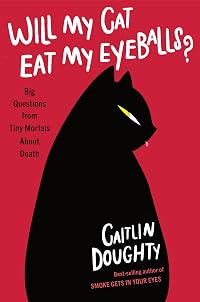
- Not Smoke Gets In Your Eyes, but I have read Will My Cat Eat My Eyeballs? by Caitlin Doughty
- Ghosts of the Tsunami by Richard Lloyd Parry
- Stiff by Mary Roach
- Frankenstein by Mary Shelley
In conclusion, I admire Hayley Campbell's courage to shine a light on the often unknown world of death workers and the death industry. It's not until we face a natural disaster ourselves that we'd ever learn of the existence of Kenyon, or undergo problems with a pregnancy to be introduced to a bereavement midwife. I think it's important to better understand and appreciate the death workers within our community and thank them for the very important work that they do.
* Copy courtesy of Bloomsbury * show less
In our everyday lives, we're regularly shielded from death and that's something Hayley Campbell wants to change. In an attempt to understand how workers in the death industry cope with the demands of their job and why they chose show more their vocation in the first place, Hayley Campbell met a range of interviewees in order to produce All the Living and the Dead: A Personal Investigation Into the Death Trade.
In her book, Campbell interviews a funeral director, director of anatomical services, death mask sculptor, disaster victim identification, crime scene cleaner, executioner, embalmer, anatomical pathology technologist, bereavement midwife, gravedigger, crematorium operator and an employee from the Cryonics Institute. The variety of people and jobs was well rounded and each employee provided a new aspect to consider.
"I have met funeral directors who tell me they could not handle the gore of an autopsy, a crematorium worker who could not dress a dead man because it is too personal, and a gravedigger who can stand neck-deep in his own grave in the day but is scared of the cemetery at night. I have met APTs in the autopsy room who can weigh a human heart but will not read the suicide note in the coroner's report. We all have our blinkers on, but what we block out is personal to us." Page 230
In her research, Campbell accompanied staff on their duties and began to experience moments that would stick with her for the rest of her life. While trying to understand how staff manage to cope with the trauma that comes along with their chosen careers, the author found herself accumulating instances that would later qualify as giving her PTSD. As she discusses the most disturbing account of her time - assisting in an autopsy of a baby - Campbell realises that she has immersed herself so deep into the research that she is now processing the kind of trauma that regular staff in the industry have to deal with.
After reading the chapter about the crime scene cleaner, I was tempted to suss out his instagram profile after Campbell's descriptions of his posts there. I quickly fell into a deep dark social media hole for 20 mins until my levels of fear, disgust, repulsion, sorrow, compassion, sympathy and frustration at much of the needless carnage were depleted. I definitely don't recommend it and yet it confirmed I'm unsuitable for that job.
Just as Campbell felt weighed down by what she learned and experienced, I too began to feel heavy and had to set this book down for a few weeks before returning to it. The overuse of hyphens throughout the writing also slowed me down a little.
On a lighter note, there was much to inspire the reader, and when I returned to the book I enjoyed this passage in particular:
"Thinking about death and the passage of time is part of tending a garden. You put things in the ground knowing they might fail. You grow things knowing they will die with the frosts six months from now. An acceptance of an end and a celebration of a short, beautiful life is all tucked up in this one at. People say gardening is therapeutic, that putting your hands in soil and effecting change on the world makes you feel alive and present, like something you do matters even if it's only in this one terracotta pot. But the therapy runs deeper than physicality: from the start of spring, every month is a countdown to an end. Every year, the gardener accepts, plans for and even celebrates death in the crisping seed heads that sparkle with ice in winter: a visible reminder of both an end and a beginning." Page 237
I enjoyed All the Living and the Dead by Hayley Campbell, however most telling were probably the number of books from the further reading section that I’ve read on this subject over the years:
- Necropolis: London and Its Dead by Catharine Arnold
- Not Smoke Gets In Your Eyes, but I have read Will My Cat Eat My Eyeballs? by Caitlin Doughty
- Ghosts of the Tsunami by Richard Lloyd Parry
- Stiff by Mary Roach
- Frankenstein by Mary Shelley
In conclusion, I admire Hayley Campbell's courage to shine a light on the often unknown world of death workers and the death industry. It's not until we face a natural disaster ourselves that we'd ever learn of the existence of Kenyon, or undergo problems with a pregnancy to be introduced to a bereavement midwife. I think it's important to better understand and appreciate the death workers within our community and thank them for the very important work that they do.
* Copy courtesy of Bloomsbury * show less
This was a rather heart wrenching book all about those who deal with the dead (bodies that is—not spirits). The author interviews amazing people who do mind blowing work from death clean ups to baby autopsies to state executioners, and her compassion toward them all is utterly honest and gutting; I cried while listening to much of this (note I’m very close to the anniversary of my own dad’s death). It was beautiful and informative, and it’s going to make me think about all of our times and our afters when we’re no longer there except as bodies.
Superb nonfiction that will make you examine everything you think about death.
I don't read a lot of nonfiction, but usually find one or two books a year that entice me and I was quite surprised to have found this. The timing is spot on as the world enters a sort of recovery post Covid pandemic and during this period as there are new and looming threats to our health and well-being.
I'm no stranger to death. As an RN for over for over 40 years, I've seen quite enough of it, but honestly never thought too much about what happens after I have cared for the deceased or escorted them to the morgue. I've nursed the dying at work and at home. I've attended far too many funerals and grieved losses. I must say, however, that I never peered show more behind the curtain or had any conversations with the workers that the author interviewed for this book.
Not sure if this exploration is for everyone, but the stories and the thought-provoking detail will linger in my psyche for a long time. The discussions and research were both fascinating and disturbing though I was left with a larger understanding as I learned about the reasons why some have a calling to do the jobs they do.
A memorable quote: "Show me the manner in which a nation cares for its dead and I will measure with mathematical exactness, the tender mercy of its people, their respect for the law of the land and their loyalty to high ideals." William Gladstone (1809-1898)
Thank you to NetGalley and St. Martin's Press for this e-book to read, review, and recommend. show less
I don't read a lot of nonfiction, but usually find one or two books a year that entice me and I was quite surprised to have found this. The timing is spot on as the world enters a sort of recovery post Covid pandemic and during this period as there are new and looming threats to our health and well-being.
I'm no stranger to death. As an RN for over for over 40 years, I've seen quite enough of it, but honestly never thought too much about what happens after I have cared for the deceased or escorted them to the morgue. I've nursed the dying at work and at home. I've attended far too many funerals and grieved losses. I must say, however, that I never peered show more behind the curtain or had any conversations with the workers that the author interviewed for this book.
Not sure if this exploration is for everyone, but the stories and the thought-provoking detail will linger in my psyche for a long time. The discussions and research were both fascinating and disturbing though I was left with a larger understanding as I learned about the reasons why some have a calling to do the jobs they do.
A memorable quote: "Show me the manner in which a nation cares for its dead and I will measure with mathematical exactness, the tender mercy of its people, their respect for the law of the land and their loyalty to high ideals." William Gladstone (1809-1898)
Thank you to NetGalley and St. Martin's Press for this e-book to read, review, and recommend. show less
Reading All the Living and the Dead by Hayley Campbell was one of the most engrossing reading experiences I’ve had in a long time. I’ve read a lot in this genre, from Caitlin Doughty to Atul Gawande, and I’ll admit I went into this book a little skeptical. I wasn't sure whether it would bring anything new to the table, but it surprised me in the best way.
Campbell dives into the lives of people whose jobs revolve around death, from embalmers and morticians to the people called in after airline disasters and even one guy who sculpts death masks. This book is comprehensive, smart, and unflinchingly honest, but what really stood out to me was how deeply empathetic it was. The way Campbell connects with her subjects brings humanity to show more every chapter. It’s not just about the work; it’s about the people doing the work and the emotional weight they carry.
Please note that the sensory details here are VIVID. The descriptions are visceral and downright squishy. Campbell doesn’t shy away from showing the gritty reality of these jobs, but she does so with respect and care.
Campbell’s hands-on approach is something else I loved about this book. She doesn’t just write about these professions from a distance—she immerses herself in them, sharing her emotional reactions and questions along the way. This made the book feel deeply personal and relatable, even when the subject matter was thoroughly uncomfortable. There are chapters that go into the death of babies and children, and wow, those were hard to read.
I also appreciated the balance she struck between clinical detail and emotional insight. It’s a tough line to walk, but she did it beautifully. The result is a book that’s both intellectually engaging and emotionally impactful. By the time I finished, I had a new level of respect for everyone involved in the death industry.
Overall, this book is a thoughtful, modern reflection on mortality, wrapped in investigative journalism with a big heart. In short, I loved it. It made me think, it made me feel, and it made me grateful for the people who do the hard, unseen work of handling death so the rest of us can focus on saying goodbye to our loved ones in peace. show less
Campbell dives into the lives of people whose jobs revolve around death, from embalmers and morticians to the people called in after airline disasters and even one guy who sculpts death masks. This book is comprehensive, smart, and unflinchingly honest, but what really stood out to me was how deeply empathetic it was. The way Campbell connects with her subjects brings humanity to show more every chapter. It’s not just about the work; it’s about the people doing the work and the emotional weight they carry.
Please note that the sensory details here are VIVID. The descriptions are visceral and downright squishy. Campbell doesn’t shy away from showing the gritty reality of these jobs, but she does so with respect and care.
Campbell’s hands-on approach is something else I loved about this book. She doesn’t just write about these professions from a distance—she immerses herself in them, sharing her emotional reactions and questions along the way. This made the book feel deeply personal and relatable, even when the subject matter was thoroughly uncomfortable. There are chapters that go into the death of babies and children, and wow, those were hard to read.
I also appreciated the balance she struck between clinical detail and emotional insight. It’s a tough line to walk, but she did it beautifully. The result is a book that’s both intellectually engaging and emotionally impactful. By the time I finished, I had a new level of respect for everyone involved in the death industry.
Overall, this book is a thoughtful, modern reflection on mortality, wrapped in investigative journalism with a big heart. In short, I loved it. It made me think, it made me feel, and it made me grateful for the people who do the hard, unseen work of handling death so the rest of us can focus on saying goodbye to our loved ones in peace. show less
Members
- Recently Added By
Lists

Books Read in 2023
5,638 works; 147 members

At the Library
217 works; 1 member

Top Five Books of 2023
767 works; 317 members

Club Read's Recommended Nonfiction Written by Women
618 works; 30 members

Books That Made Us Cry
278 works; 145 members
Author Information

4 Works 946 Members
Hayley Campbell was born in England and lived in Australia for twenty years before moving to London, where she writes for the New Statesman, The Comics Journal, and McSweeney's. She is working on her first novel and can often be found committing terrible acts of amateur taxidermy.
Awards and Honors
Awards
Distinctions
Common Knowledge
- Original publication date
- 2022-08-16
- Epigraph
- Life is tragic simply because the earth turns, and the sun inexorably rises and sets, and one day, for each of us, the sun will go down for the last, last time. Perhaps the whole root of our trouble, the human trouble, is tha... (show all)t we will sacrifice all the beauty of our lives, will imprison ourselves in totems, taboos, crosses, blood sacrifices, steeples, mosques, races, armies, flags, nations, in order to deny the fact of death, which is the only fact we have.
--James Baldwin, The Fire Next Time - First words
- You aren't born knowing you will die. (Introduction)
'The first dead body you see should not be someone you love,' she said. - Last words
- (Click to show. Warning: May contain spoilers.)The remaining houses stand frozen and alone, among the ghosts.
(Click to show. Warning: May contain spoilers.)We will have to move the furniture of our minds to accommodate this newly visible guest. (Afterword) - Blurbers
- Doughty, Caitlin; Niffenegger, Audrey; Gaiman, Neil; Fitzharris, Lindsey; Gilmour, Charlie; Troyer, John
- Original language
- English
Classifications
- Genres
- General Nonfiction, Science & Nature, Nonfiction, History, Biography & Memoir
- DDC/MDS
- 363.7 — Society, government, & culture Social problems and social services Public Safety - Police, Crime Investigation Environmental Issues - Pollution, Recycling, Global Warming
- LCC
- HD9999 .U52 .C36 — Social sciences Industries. Land use. Labor Industries. Land use. Labor Special industries and trades Miscellaneous industries and trades
- BISAC
Statistics
- Members
- 530
- Popularity
- 56,536
- Reviews
- 13
- Rating
- (4.23)
- Languages
- English, Finnish
- Media
- Paper, Audiobook, Ebook
- ISBNs
- 12
- ASINs
- 4