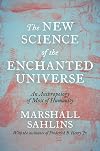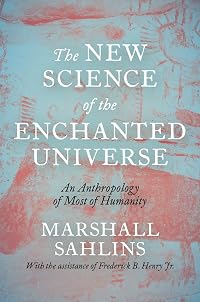
The New Science of the Enchanted Universe: An Anthropology of Most of Humanity
by Marshall Sahlins
On This Page
Description
"The vast majority of human societies known to us have been organized along "immanentist" lines. In such societies, as Marshall Sahlins argues, everything we associate with religion, gods and spirits of every sort is part of the daily, embodied (immanent) lives of people. Plants and animals have souls and the same essential attributes as other persons, and supposedly long-dead ancestors continue to live among people, communicate with them, and have sway over the course of events. In this show more "enchanted" type of society, there is no strict separation between economics, politics, religion, philosophy, and culture. Some 2,500 years ago, at the dawn of the so-called Axial Age, a radical transformation in human societies began when civilizations spread around the globe from their origins in Greece, the Near East, northern India, and China. These civilizations effected a cultural revolution, creating a new type of society in which the things we typically associate with religion move from immanent infrastructure to transcendent superstructure. Only in a transcendentalist society does it make sense to speak of a god or God, and of a heaven, "out there," "above us," or in a separate realm entirely. And only in such a society do we have a division of labour separating out an economic sphere from a political sphere and a sphere of culture. Transcendentalist worldviews and modes of life are, of course, pervasive today. They are so much a part of who we are that when we attempt to understand the nature and workings of immanentist societies, we often misdescribe them in transcendentalist terms. This confusion, observes Sahlins, has long bedeviled the social sciences and consequently has impeded our understanding of many Indigenous religions and worldviews past and present. Sahlins, drawing on a vast array of recent and older ethnographic and historical research, offers this book as both diagnosis of these ills and a call to correction-to develop a "new science" that would be better positioned to grasp the realities of immanentist societies, and to take seriously the cultures of others"-- "One of the world's preeminent cultural anthropologists leaves a last work that fundamentally reconfigures how we study most other cultures. From the perspective of Western modernity, humanity inhabits a disenchanted cosmos. Gods, spirits, and ancestors have left us for a transcendent beyond, no longer living in our midst and being involved in all matters of everyday life from the trivial to the dire. Yet the vast majority of cultures throughout human history treat spirits as very real persons, members of a cosmic society who interact with humans and control their fate. In most cultures, even today, people are but a small part of an enchanted universe misconstrued by the transcendent categories of "religion" and the "supernatural." The New Science of the Enchanted Universe shows how anthropologists and other social scientists must rethink these cultures of immanence and study them by their own lights.In this, his last, revelatory book, Marshall Sahlins announces a new method and sets an exciting agenda for the field. He takes readers around the world, from Inuit of the Arctic Circle to pastoral Dinka of East Africa, from Araweté swidden gardeners of Amazonia to Trobriand Island horticulturalists. In the process, Sahlins sheds new light on classical and contemporary ethnographies that describe these cultures of immanence and reveals how even the apparently mundane, all-too-human spheres of "economics" and "politics" emerge as people negotiate with, and ultimately usurp, the powers of the gods.The New Science of the Enchanted Universe offers a road map for a new practice of anthropology that takes seriously the enchanted universe and its transformations from ancient Mesopotamia to contemporary America"-- show lessTags
Recommendations

























Member Recommendations
waitingtoderail Sahlins's description of humans' relations with the gods in immanent societies sounds a lot like Jaynes's descriptions of the bicameral mind.
Member Reviews
Members
- Recently Added By
Lists

Works cited in The New Science of the Enchanted Universe by Marshall Sahlin
141 works; 1 member
Author Information

45+ Works 2,044 Members
Marshall David Sahlins was an American anthropologist and political activist, born in Chicago, Illinois on December 27, 1930. He graduated from the University of Michigan (1951) with a degree in anthropology and earned his Ph.D. from Columbia (1954). In 1957, he became an assistant professor at the University of Michigan. In 1973, he joined the show more University of Chicago. Professor Sahlins political activism began in the 1960s and was expressed throughout his career. An example is his anti-Vietnam war stance. He and several professors came up with the idea of having a teach-in, following the example of the civil rights movement. Instead of teaching what was in their syllabuses, they lectured about American foreign policy, politics, and history. In May 1965, he led a national teach-in in Washington that received international media coverage. He wrote 15 books and dozens of articles and continued his political activism. Some of his books include Evolution and Culture (1960), Culture and Practical Reason (1976), Islands of History (1985), Anahulu (1992), How 'Natives' Think: About Captain Cook, for Example (1995), Culture in Practice (2000), What Kinship Is-and Is Not (2013), and On Kings (2017) written with David Graeber. His awards and honors include winning two J. Gordon Laing Prizes for his books, Culture and Practical Reason, and How 'Natives' Think. He was awarded the J. I. Staley Prize for Anahulu. The French Ministry of Culture awarded him Chevalier des Arts et des Lettres (Knight in the Order of Arts and Letters). In 2001, he received an honorary degree from the University of Michigan. He also received honorary doctorates from the Sorbonne and the London School of Economics. Marshall D. Sahlins died at his home in Chicago on April 5, 2021. He was 90. (Bowker Author Biography) show less
Awards and Honors
Notable Lists
Classifications
- Genres
- Anthropology, Nonfiction, Religion & Spirituality, History, General Nonfiction
- DDC/MDS
- 306.6 — Society, government, & culture Social sciences, sociology & anthropology Social Behavior - Dating, Marriage, Divorce Religious institutions
- LCC
- GN470 .S25 — Geography, Anthropology and Recreation Anthropology Anthropology Ethnology. Social and cultural anthropology Cultural traits, customs, and institutions Intellectual life
- BISAC
Statistics
- Members
- 76
- Popularity
- 416,775
- Rating
- (4.38)
- Languages
- English
- Media
- Paper, Audiobook, Ebook
- ISBNs
- 4
- ASINs
- 2