On This Page
Description
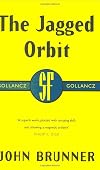
Nebula Award Finalist:Mankind has been reduced to slavery by technology and surveillance, in this near-future novel from the author of Stand on Zanzibar. In The Jagged Orbit, Brunner, writing at the peak of form that allowed him to create Stand on Zanzibar, takes a long, hard, disturbing, and hilarious look at the near and not-so-distant future. Catastrophic changes due to rampant drug abuse, uncontrolled violence, high-level government corruption, inhumane treatment of the too-readily show more defined "insane," and the accompanying collapse of the social order are wreaking havoc on the world we recognize and turning it into a reality we must fear and hope to avoid. Brunner tells a spine-chilling tale of where the world could possibly go that is all too believable and real for our comfort. "For each generation, there is a writer meant to bend the rules of what we know. Hugo Award winner (Best Novel, Stand on Zanzibar) and British science fiction master John Brunner remains one of the most influential and respected authors of all time, and now many of his classic works are being reintroduced. For readers familiar with his vision, it is a chance to reexamine his thoughtful worlds and words. For new readers, Brunner's work proves itself the very definition of timeless. show lessTags
Recommendations



















Member Reviews
First published in 1969, [b:The Jagged Orbit|470186|The Jagged Orbit|John Brunner|https://i.gr-assets.com/images/S/compressed.photo.goodreads.com/books/1175028806l/470186._SY75_.jpg|2202667] is set in 2013. It's always slightly surreal to read scifi set in a future that is now the past, but I'm getting used to it. The novel deals with a remarkable number of 21st century American problems, among them loss of social trust, racism, mass shootings, waiting for tech support to fix your work computer, neo-Puritans, journalism being overtaken by advertising, militarisation of the police, and awkward zoom calls. The linguistic worldbuilding is pretty dense at first and takes some getting used to, e.g knees & blanks = black & white people. Once show more you become familiar with it, though, it adds a lot to the atmosphere.
I did not find [b:The Jagged Orbit|470186|The Jagged Orbit|John Brunner|https://i.gr-assets.com/images/S/compressed.photo.goodreads.com/books/1175028806l/470186._SY75_.jpg|2202667] as powerful Brunner's [b:The Sheep Look Up|41074|The Sheep Look Up|John Brunner|https://i.gr-assets.com/images/S/compressed.photo.goodreads.com/books/1386924437l/41074._SY75_.jpg|900514] or [b:Stand on Zanzibar|41069|Stand on Zanzibar|John Brunner|https://i.gr-assets.com/images/S/compressed.photo.goodreads.com/books/1360613921l/41069._SY75_.jpg|2184253], but like both of them it manages a large cast of characters (almost all men) very deftly. Brunner is notably excellent at this and I missed it in [b:The Shockwave Rider|41070|The Shockwave Rider|John Brunner|https://i.gr-assets.com/images/S/compressed.photo.goodreads.com/books/1386921650l/41070._SY75_.jpg|868164], which only had one main protagonist. A wider range of characters makes for more interesting examination of big themes, I tend to find. The variety of settings was also notable - they include a psychiatric hospital, upmarket and downmarket New York homes, several workplaces, a presidential press conference, and the worst party in a flat with no toilet. Brunner employs his trick of including extended quotations and little editorial comments as mini-chapters, which I enjoyed so much in [b:Stand on Zanzibar|41069|Stand on Zanzibar|John Brunner|https://i.gr-assets.com/images/S/compressed.photo.goodreads.com/books/1360613921l/41069._SY75_.jpg|2184253].
The plot is complicated, so I won't attempt to summarise it. The scenes of Lyla the Pythoness tripping are a highlight, as they are intensely vivid and strange. I also liked the ending, which is surprisingly hopeful and full of irony.An AI given the task of maximising profits for a weapons manufacturer self-destructs in the face of a paradox: continually provoking conflict to drive up sales will destroy the human race, resulting in zero sales.
[b:The Jagged Orbit|470186|The Jagged Orbit|John Brunner|https://i.gr-assets.com/images/S/compressed.photo.goodreads.com/books/1175028806l/470186._SY75_.jpg|2202667] definitely feels like a 1960s, sliding into the cynical 1970s, type of novel. It is densely imagined and cleverly plotted, with strident points to make on many different topics. As ever, Brunner is not very interested in female characters, although his handling of race has aged better than I expected. I think [b:The Jagged Orbit|470186|The Jagged Orbit|John Brunner|https://i.gr-assets.com/images/S/compressed.photo.goodreads.com/books/1175028806l/470186._SY75_.jpg|2202667] remains involving and thought-provoking to read ten years after it is set, providing insight into how social concerns both have and haven't changed in the last 54 years. show less
I did not find [b:The Jagged Orbit|470186|The Jagged Orbit|John Brunner|https://i.gr-assets.com/images/S/compressed.photo.goodreads.com/books/1175028806l/470186._SY75_.jpg|2202667] as powerful Brunner's [b:The Sheep Look Up|41074|The Sheep Look Up|John Brunner|https://i.gr-assets.com/images/S/compressed.photo.goodreads.com/books/1386924437l/41074._SY75_.jpg|900514] or [b:Stand on Zanzibar|41069|Stand on Zanzibar|John Brunner|https://i.gr-assets.com/images/S/compressed.photo.goodreads.com/books/1360613921l/41069._SY75_.jpg|2184253], but like both of them it manages a large cast of characters (almost all men) very deftly. Brunner is notably excellent at this and I missed it in [b:The Shockwave Rider|41070|The Shockwave Rider|John Brunner|https://i.gr-assets.com/images/S/compressed.photo.goodreads.com/books/1386921650l/41070._SY75_.jpg|868164], which only had one main protagonist. A wider range of characters makes for more interesting examination of big themes, I tend to find. The variety of settings was also notable - they include a psychiatric hospital, upmarket and downmarket New York homes, several workplaces, a presidential press conference, and the worst party in a flat with no toilet. Brunner employs his trick of including extended quotations and little editorial comments as mini-chapters, which I enjoyed so much in [b:Stand on Zanzibar|41069|Stand on Zanzibar|John Brunner|https://i.gr-assets.com/images/S/compressed.photo.goodreads.com/books/1360613921l/41069._SY75_.jpg|2184253].
The plot is complicated, so I won't attempt to summarise it. The scenes of Lyla the Pythoness tripping are a highlight, as they are intensely vivid and strange. I also liked the ending, which is surprisingly hopeful and full of irony.
[b:The Jagged Orbit|470186|The Jagged Orbit|John Brunner|https://i.gr-assets.com/images/S/compressed.photo.goodreads.com/books/1175028806l/470186._SY75_.jpg|2202667] definitely feels like a 1960s, sliding into the cynical 1970s, type of novel. It is densely imagined and cleverly plotted, with strident points to make on many different topics. As ever, Brunner is not very interested in female characters, although his handling of race has aged better than I expected. I think [b:The Jagged Orbit|470186|The Jagged Orbit|John Brunner|https://i.gr-assets.com/images/S/compressed.photo.goodreads.com/books/1175028806l/470186._SY75_.jpg|2202667] remains involving and thought-provoking to read ten years after it is set, providing insight into how social concerns both have and haven't changed in the last 54 years. show less
Set in a 2014 USA crippled by intense racial segregation, paranoid gun violence, and corporate exploitation by the Gottschalk cartel. The societal collapse via Matthew Flamen, a spoolpigeon journalist, investigates the corrupt psychiatric industry and crumbling social order.
The US is divided into isolated city-states, with racial tensions at a breaking point, largely driven by weapon manufacturers.
The US is divided into isolated city-states, with racial tensions at a breaking point, largely driven by weapon manufacturers.
Read the first couple of pages before you commit to this book.
That's all you need to tell you whether it'll work for you or not. If a 60's psychodelic style of prose combined with a bizarre state of affairs the characters think is perfectly normal sounds good to you, this book is right up your alley.
On the other hand if Perry Mason endings don't turn your crank, you'll feel let down by this one. It's no co-incidence the title is explained in the last two pages - most of the book operates that way.
It's no action novel - for a book that talks about violence endlessly, it's only got one 'in camera' violent scene, and another around the results of an off stage episode. The plot is driven completely by dialog. That's not a negative, but it show more does drag in some places, then zoom along in others.
The backdrop is occasionally terrifyingly believeable. The authour uses race relations to stand in for all kinds of human conflict groups, and the over the top results are both horrible and plausible.
Cute little quotes pop up here and there like '...the idol of the computer, in which the less imaginative now tend to invest their surplus of otherwise valueless faith' about religion and government. If your personal values aren't open to rational discussion, you'll probably get offended by something somewhere in this book.
At the end of the day to me it was just too much work wading through the style of it all to make it worthwhile. show less
That's all you need to tell you whether it'll work for you or not. If a 60's psychodelic style of prose combined with a bizarre state of affairs the characters think is perfectly normal sounds good to you, this book is right up your alley.
On the other hand if Perry Mason endings don't turn your crank, you'll feel let down by this one. It's no co-incidence the title is explained in the last two pages - most of the book operates that way.
It's no action novel - for a book that talks about violence endlessly, it's only got one 'in camera' violent scene, and another around the results of an off stage episode. The plot is driven completely by dialog. That's not a negative, but it show more does drag in some places, then zoom along in others.
The backdrop is occasionally terrifyingly believeable. The authour uses race relations to stand in for all kinds of human conflict groups, and the over the top results are both horrible and plausible.
Cute little quotes pop up here and there like '...the idol of the computer, in which the less imaginative now tend to invest their surplus of otherwise valueless faith' about religion and government. If your personal values aren't open to rational discussion, you'll probably get offended by something somewhere in this book.
At the end of the day to me it was just too much work wading through the style of it all to make it worthwhile. show less
review of
John Brunner's The Jagged Orbit
by tENTATIVELY, a cONVENIENCE - March 31, 2014
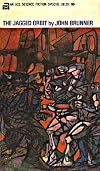
[sidenote: the actual edition I read is Ace's paperback version also from 1969 & NOT the hardcover bookclub edition - nonetheless, the cover's almost identical & the publisher & date are the same so it's not worth the trouble to create a new edition here - the paperback page count is 397 (not including the ads in the back).]
ALSO, 'of course', my review is "5727 characters" too long so the full review is here: https://www.goodreads.com/story/show/362701-the-jagged-o-r-bit
Whew! Another beaut from Brunner. In his intro to a 2003 edition of Brunner's 1972 The Sheep Look Up, author David Brin calls Sheep a "self-preventing prophes[y]" wch I think is an show more excellent way of looking at The Jagged Orbit (1969) too. As w/ Sheep, Brunner apparently bases his pessimistic projections on relevant mass media articles - in Jagged's case, ones written about racial unrest in the US in 1968. Brunner interweaves a pessimistic prediction of racism escalated, psychotherapy used as a mass control tool, & arms sales feeding off of carefully cultivated fear.
Regarding the latter, I think of when the G20 was in Pittsburgh in 2009. Some elements of the mass media spread a lurid image of any & all protesters as armed terrorists. (See my parody of this, made jointly w/ Rich Pell, entitled "TV 'News' Commits Suicide" here: https://www.youtube.com/watch?v=hU-_aL7kKBI ) One friend of mine told me that people where he worked were gathering their armaments, fortifying their homes (that were nowhere near where the protests were going to be), & even planning to flee to even more distant outskirts in precaution. All of this fear was completely unjustified. W/in a wk after the G20 ended there was a giant arms dealer event at the local convention center. Gee, I wonder if that was just coincidence (I'm dripping w/ sarcasm here in case the reader didn't notice).
An example of Brunner's imagined 2014 weaponry is something that can:
"(a) Energetic: in actual field trials a skilled operator reduced a sample group of 25 Reference Accomodation Blocks (12 stories reinforced concrete) to Unihabitable condition in 3.3 minutes, 12 being demolished and the remainder set ablaze." - p 347
Nice, huh?! During the 2009 G20 the City of Pittsburgh wasted huge amts of money on buying 2 sound cannons for dispelling protesters w/ the threat of inducing deafness. Pittsburgh 'needed' those like a hole in the head. Literally (& figuratively).
"SEVENTY-ONE
REPRINTED FROM THE LONDON OBSERVER OF 10TH MARCH 1968
"Colour—The Age-Old Conflict by Colin Legun
"Having recently spent several months in the United States, I came away sharing the view of those Americans who think that, short of two miracles—and early end to the Vietnam war, and a vast commitment to the public expenditure on the home front—the US is on the point of moving into a period of harsh repression by whites of blacks that could shake its political system to its very foundations."
[..]
"Voluntary separation—even separation into different bits of territory—is not always necessarily retrogressive. Although it is suspect to liberal minds—because of the horrors of twentieth-century racialism—liberals were the champions of all the nineteenth-century separatists who wanted independence from the Habsburg and Ottoman Empires and still today react sympathetically to the claims of Scots or of Welsh." - pp 244-245
I find the last-quoted paragraph a little misleading in its comparisons. The Scots & the Welsh (& the unmentioned Irish - who might've been 'too hot to handle' by the OBSERVER at the time), at least as I understand it, were on their own turf when they were colonized by the British. As such, they just wanted the colonialists to release them from their imperialistic hold. 'Black' separatists, on the other hand, were mostly forcibly brought to the US as slaves, they're not even on the land they were kidnapped from - any separatism means creating a new homeland rather than a reversion to an older one. Nonetheless, Black Panther claims that police in their neighborhoods are basically just occupying colonial troops strike me as accurate.
White Supremacists were/are big promoters of separatism. At least one such group proposed making the Northwest coast of the US be for 'whites' only - w/ Florida being for 'blacks' only. Such an idea is a throwback to the 'separate but equal' Jim Crow laws that certainly didn't insure any equality at all. It's all too easy to imagine white supremacists taking advantage of this geographical 'caging' by bombing black-Florida if such a separation were ever to take place.
"SEVENTY-NINE
REPRINTED FROM THE MANCHESTER GUARDIAN OF 13TH MARCH 1968
"Seven burned to death
"Mr David Lumsden, aged 26, stood outside his burning home in Toronto and screamed at passing motorists to stop and help as his wife and sex children were burned to death. All the drivers ignored his calls." - p 294
"EIGHTY
ASSUMPTION CONCERNING THE FOREGOING MADE FOR THE PURPOSES OF THIS STORY
"It would have been even worse if they'd stopped to watch the fun." - p 295
Coincidentally, as I was reading this, I was installing an exhibit on race for one of my jobs & spending some time w/ a person in the process of having a mental breakdown - both very relevant to this bk. But what made The Jagged Orbit particularly poignant to read now is that it's set in 2014, the actual yr in wch I've read it.
The back cover blurbs are by authors Philip K. Dick, Robert Bloch, & Thomas M. Disch. Dick goes so far as to say that "It is an superb work, plotted with amazing skill, and showing a magnetic artistry much above anything Brunner has previously shown." Disch then ups the ante w/ "Enough new ideas to fill a novel each by Dick, Farmer and Pohl." High praise indeed. It appears that this was a breakthru work for Brunner.
The dedication inside reads:
"FOR CHIP
"—the only person I know who really can fly a jagged orbit." - p 5
I assume/deduce that the "CHIP" in question is the great Samuel R. Delaney - gay, 'black', SF (& otherwise) writer whose work I have profound respect for. Why do I put the word "black" in single quotation marks? B/c I am so damned sick of the destructiveness of the simple-minded divisiveness of humans classified into 'black' & 'white', etc, etc.. Why not African-Americans then? B/c I'm also sick of humans categorized in terms of so-called (ancestral) origin. People ask me: 'Where is your family from? What nationality are they?' & I reply: 'I'm a BalTimOrean.' In other words, I'm from where I was born - not from some nation I may've never even been to. Some people claim that all humans originated in Africa & spread from there - are those who ended up in 'America' all African-Americans then? I prefer to think of people as individuals, not as representatives of some dubiously united 'ethnicity'. I certainly don't represent all so-called 'white' people, why shd I think that any 'black' person wd represent all so-called 'blacks'?!
Chapter ONE, entitled "PUT YOURSELF IN MY PLACE", sets a mildly experimental formal tone by consisting of only "I —" followed by Chapter TWO's "-solationism" on the verso. 1st person singular in isolation: this appears to set the mood for a critique of people living in so much fear of each other that no solidarity is likely or easy.
As w/ most novels about the future (now, for me, the present) there's lingo used extrapolated from the time of writing: "Meanwhile, continuing: something big brewing among the X Patriots. The routine reading carried him straight back to the Gottschalks and the superficial verdict that they were once more fomenting discontent among knee extremists to ensure good sales for their latest product among frightened blanks." (pp 12-13) Think "Malcolm X" in connection w/ "the X Patriots".
&, of course, along w/ the lingo there're the prophesies of technology: "They hadn't had a vuset in the apt before—only an ancient non-holographic TV which offered nothing more interesting than the three surviving 2-D satellite transmissions insisted on by the PCC. Since those were beamed primarily at India, Africa and Latin America, and she and Dan spoke neither Hindi, Swahili, nor more than a smattering of Spanish, they had seldom bothered to switch on unless they were orbiting." (p 16)
"Flamen's ingratiating voice said, "In this world which is so often terrifying, aren't you envious of the security people feel when they've installed Guardian traps at their doors and windows? You can't buy better, and you'd be a fool to buy anything less good."
"He vanished. A tall scowling kneeblank marched forward in his place, and before Lyla had time to react—she was still not awake enough to have convinced herself that the three-dimensional full-color image was going to stay buried in the screen—spiked metal bands had clamped on him at neck-, waist-, and knee-height. Blood began to ooze from the points where the cruel metal prongs had sunk in. He looked briefly bewildered, then sunk unconscious.
""Guardian!" sang an eldritch castrato voice. "Guar—dee—ann!"" - pp 17-18
"She moved to the door and began to strain against the handle of the winch to lift clear the hundred-kilo deadfall block that closed it against intruders overnight.
""Put your yash on," Dan said, stepping into a pair of green breeches and bleting them tight around his waist.
""Hell, I'm only going to the comweb!"
""Put it on, I said. You're insured for a quarter-million tealeaves and it says in the policy that you have to."" - p 19
There we have the technology, the paranoia, & the lingo all neatly rolled in one. My own prediction is that capitalism is aiming toward a society in wch people own as little as possible & rent as much as possible. Streaming is a big step in this direction. That seems to be the case in Brunner's 2014: ""But you're supposed to do duty to the Lar first, aren't you?" / "We only have it on seven-day appro," (p 18) "["]Got anything less revealing?" / "I don't think so. All my February clothes have expired["]." (p 19) "replacing the Lar in its niche, distantly aware that if she had indeed thrown it away there would have been a hell of a fight with Dan. The seven-day appro was up tomorrow and if they couldn't return it they would be billed two thousand tealeaves." (pp 151-152)
Brunner foresees junk mail w/ the greatest imagination. Junk Mail, Spam E-Mails, & Telemarketers have been among the banes of my existence. ""Practically all satches, same as usual. I do hate saturation mail! It clogs the comweb same as garbage does the drains, and I swear ninety percent of it goes straight into the drains without being read. . . .["]" / "She pantomimed tearing them across, but they were reinforced against that; they could only be torn along the line which would liberate the chemicals powering their in-built speakers. Satch mailing campaigns were too expensive to let illiterates escape." (p 27)
"Meantime, Dan had ripped along the sealing strip of the one from Lares & Penates Inc., and at once the room was full of a familiar high thin voice.
""You can't afford to be without a cult tailored to your private needs in this age of the individual. Consult Lares & Penates for the finest specialized—"
"It took him that long to locate the power-capsule driving the speaker and break it between finger and thumb. Promptly, he dropped the envelope with a yelp, shaking his hand.
""It burned me! That's a new one! They must have got wise to people cracking the capsules."" - p 28
For my own modest take on one aspect of our increasing branding as consumer-slaves, witness my "North Deface" movie here: http://youtu.be/r8Dre9tTEyE
& The Jagged Orbit anticipates The Sheep Look Up as self-preventing prophesy in glimpses of environmental concerns: "Humidity index in New York in excess of previous high for the current date, a factor ascribed by officials to the effect of the city's five and a half million air-conditioners. The insurrection probability index slipping ahead of schedule into what is nicknamed "the sweaty season downturn"" (p 31)
One of the main characters is a "spoolpigeon", an exposé TV show host. The network he works for is called Holocosmic: "if you dig into the private lives of the Holocosmic directorate you'd come up with material for another Hundred and Twenty Days without the need to plagiarize" (p 46) That's the Marquis de Sade's One Hundred and Twenty Days of Sodom being referenced. & this spoolpigeon, hypothetically an investigative reporter watchdog guarding society from corruption & hypocrisy is that to a small extent - but using Manufactured Consent means (to paraphrase Noam Chomsky) to create the damning 'evidence':
""Very well then. Let's find out what stock we have available for Uys. I don't have to ask about Mayor Black; he's vain, and we have tape on him we could lasso the moon with." Flamen moved to a computer on the wall at right angles to the first one.
"More or less what I thought," he muttered when the data were screened in response to his question. "Practically nothing! Black-and-white 2-D material and that's it. Well, we can make do with that. This is a recent one, comparatively speaking." The screen blurred, cleared, showed Uys coming down the steps from a plane door, presumably at home in South Africa, being greeted by his family and gesturing away a group of reporters.
""Let's have color . . . holographic depth . . . yes, that's better . . . good . . . we can abstract from that and blend it with Mayor Black and let's see now . . . American location and b.g., better have some macoots . . . Ah, that's not bad for a start, is it?"" - pp 186-187
"He struck some codes on the keyboard. "Voices—we're bound to have something on tape, I guess, even for Uys, and even if we haven't the machines will fake a South African accent. Characteristic phrase-weighting—let's spice it with a few choice Afrikaner slogans . . . And here we go."" - p 187
Now, apartheid, the racist legally imposed separatism in South Africa was in full force in 1969 when The Jagged Orbit was published. As such, it's no wonder that one of the villains here is an Afrikaner, one of the 'whites' who maintains, enforces, & benefits from South African racism. I'd like to hope that such self-preventing prophesy on the part of creative anti-racists was one of the factors that led to the downfall of apartheid in 1994. Good riddance.
I'm sure that Brunner had fun envisaging the fashion 45 yrs in the future but, alas, such extravagances are few & far in between in the actual 2014: "Conroy hesitated, looking over the array of students and taking especial note of the girls. About a quarter of them were in street yashes, like Alice who had just spoken; the remainder wore a fantastic galaxy of costumes ranging from a height-of-last-year-fashion oversuit with inflated bosom and buttocks to a waist-length orange wig and a pair of shabby Nix." (p 58)
In Brunner's 2014, racism is an undiluted or even more intensified version of what he saw in 1968. 'Black' & 'white' people seen together are at risk just for the association. Racist profiling by the police is the norm. &, alas, racist 'white' cops have far from disappeared in the actual 2014. Look at the case of the police beating the innocent Jordan Miles in Pittsburgh & getting away w/ it. &, of course, similar instances are abundant. Perhaps the main difference between 2014 & 1968 is that at least Miles cd get a civil suit settlement of $119,000 even tho the cops went free on the "excessive force" charges. Anyone who's seen pictures of Miles's face after the cops beat him will know that excessive force was used - beating a person's face until it's swollen almost beyond recognition is hardly 'necessary' force - esp considering that the person being beaten was innocent in the 1st place. On the brighter side, 'blacks' & 'whites' seen together these days is considerably less likely to elicit a massive racist outburst than it was 45 yrs ago.
""What thin partitions sense from thought divide," she murmured as she came abreast of the watchful police at the head of the escalator.
""Talking to yourself, hm?" said one of them with a harsh laugh. "Watch it, darl, or you'll be booked for a one-way ride to the Ginsberg!"
""Here comes a knee," said one of his companions. "Let's work him over, huh? We didn't get anyone yet today, but there's always a chance. You! You kneeblank there!"
"On the firm ground, Lyla turned to look, and yes it was Harry Madison they'd chosen to drag aside and search: five tall policemen so armored and masked that one could not have told whether they themselves were light- or dark-skinned, with helmets and body-shields and pistols and lasers and gas-grenades. But there was no future in arguing. It would only make things worse if she said she and Madison were together." - pp 228-229
Harry Madison, perhaps the most sympathetic character in the novel, is a "kneeblank", a 'black' soldier who was put in the "Ginsberg" mental institution & kept there apparently overlong for unclear reasons. Why did Brunner call it the "Ginsberg"? What doing so evokes for me is Allen Ginsberg's poem "Kaddish" in wch he expresses his responses to his mother's 'schizophrenia' & its broader implications.
"What did they put you in there for, anyway—if you don't mind my asking?"
""For too many questions," Madison said. "That kind of question you just asked. They put a gun in my hand and said go kill that naked savage with a stone spear, he's the enemy, and I said why is he the enemy and they said because he's been got at by communists and I said does he even have a word in his language for 'communism' and they said if you don't kill him you'll be under arrest. So they arrested me. I went on asking questions and I never got an answer, and I didn't feel inclined to stop until I did. So, they discharged me and put me in the Ginsberg["]" - pp 241-242
For the complete review, go here: https://www.goodreads.com/story/show/362701-the-jagged-o-r-bit show less
John Brunner's The Jagged Orbit
by tENTATIVELY, a cONVENIENCE - March 31, 2014
[sidenote: the actual edition I read is Ace's paperback version also from 1969 & NOT the hardcover bookclub edition - nonetheless, the cover's almost identical & the publisher & date are the same so it's not worth the trouble to create a new edition here - the paperback page count is 397 (not including the ads in the back).]
ALSO, 'of course', my review is "5727 characters" too long so the full review is here: https://www.goodreads.com/story/show/362701-the-jagged-o-r-bit
Whew! Another beaut from Brunner. In his intro to a 2003 edition of Brunner's 1972 The Sheep Look Up, author David Brin calls Sheep a "self-preventing prophes[y]" wch I think is an show more excellent way of looking at The Jagged Orbit (1969) too. As w/ Sheep, Brunner apparently bases his pessimistic projections on relevant mass media articles - in Jagged's case, ones written about racial unrest in the US in 1968. Brunner interweaves a pessimistic prediction of racism escalated, psychotherapy used as a mass control tool, & arms sales feeding off of carefully cultivated fear.
Regarding the latter, I think of when the G20 was in Pittsburgh in 2009. Some elements of the mass media spread a lurid image of any & all protesters as armed terrorists. (See my parody of this, made jointly w/ Rich Pell, entitled "TV 'News' Commits Suicide" here: https://www.youtube.com/watch?v=hU-_aL7kKBI ) One friend of mine told me that people where he worked were gathering their armaments, fortifying their homes (that were nowhere near where the protests were going to be), & even planning to flee to even more distant outskirts in precaution. All of this fear was completely unjustified. W/in a wk after the G20 ended there was a giant arms dealer event at the local convention center. Gee, I wonder if that was just coincidence (I'm dripping w/ sarcasm here in case the reader didn't notice).
An example of Brunner's imagined 2014 weaponry is something that can:
"(a) Energetic: in actual field trials a skilled operator reduced a sample group of 25 Reference Accomodation Blocks (12 stories reinforced concrete) to Unihabitable condition in 3.3 minutes, 12 being demolished and the remainder set ablaze." - p 347
Nice, huh?! During the 2009 G20 the City of Pittsburgh wasted huge amts of money on buying 2 sound cannons for dispelling protesters w/ the threat of inducing deafness. Pittsburgh 'needed' those like a hole in the head. Literally (& figuratively).
"SEVENTY-ONE
REPRINTED FROM THE LONDON OBSERVER OF 10TH MARCH 1968
"Colour—The Age-Old Conflict by Colin Legun
"Having recently spent several months in the United States, I came away sharing the view of those Americans who think that, short of two miracles—and early end to the Vietnam war, and a vast commitment to the public expenditure on the home front—the US is on the point of moving into a period of harsh repression by whites of blacks that could shake its political system to its very foundations."
[..]
"Voluntary separation—even separation into different bits of territory—is not always necessarily retrogressive. Although it is suspect to liberal minds—because of the horrors of twentieth-century racialism—liberals were the champions of all the nineteenth-century separatists who wanted independence from the Habsburg and Ottoman Empires and still today react sympathetically to the claims of Scots or of Welsh." - pp 244-245
I find the last-quoted paragraph a little misleading in its comparisons. The Scots & the Welsh (& the unmentioned Irish - who might've been 'too hot to handle' by the OBSERVER at the time), at least as I understand it, were on their own turf when they were colonized by the British. As such, they just wanted the colonialists to release them from their imperialistic hold. 'Black' separatists, on the other hand, were mostly forcibly brought to the US as slaves, they're not even on the land they were kidnapped from - any separatism means creating a new homeland rather than a reversion to an older one. Nonetheless, Black Panther claims that police in their neighborhoods are basically just occupying colonial troops strike me as accurate.
White Supremacists were/are big promoters of separatism. At least one such group proposed making the Northwest coast of the US be for 'whites' only - w/ Florida being for 'blacks' only. Such an idea is a throwback to the 'separate but equal' Jim Crow laws that certainly didn't insure any equality at all. It's all too easy to imagine white supremacists taking advantage of this geographical 'caging' by bombing black-Florida if such a separation were ever to take place.
"SEVENTY-NINE
REPRINTED FROM THE MANCHESTER GUARDIAN OF 13TH MARCH 1968
"Seven burned to death
"Mr David Lumsden, aged 26, stood outside his burning home in Toronto and screamed at passing motorists to stop and help as his wife and sex children were burned to death. All the drivers ignored his calls." - p 294
"EIGHTY
ASSUMPTION CONCERNING THE FOREGOING MADE FOR THE PURPOSES OF THIS STORY
"It would have been even worse if they'd stopped to watch the fun." - p 295
Coincidentally, as I was reading this, I was installing an exhibit on race for one of my jobs & spending some time w/ a person in the process of having a mental breakdown - both very relevant to this bk. But what made The Jagged Orbit particularly poignant to read now is that it's set in 2014, the actual yr in wch I've read it.
The back cover blurbs are by authors Philip K. Dick, Robert Bloch, & Thomas M. Disch. Dick goes so far as to say that "It is an superb work, plotted with amazing skill, and showing a magnetic artistry much above anything Brunner has previously shown." Disch then ups the ante w/ "Enough new ideas to fill a novel each by Dick, Farmer and Pohl." High praise indeed. It appears that this was a breakthru work for Brunner.
The dedication inside reads:
"FOR CHIP
"—the only person I know who really can fly a jagged orbit." - p 5
I assume/deduce that the "CHIP" in question is the great Samuel R. Delaney - gay, 'black', SF (& otherwise) writer whose work I have profound respect for. Why do I put the word "black" in single quotation marks? B/c I am so damned sick of the destructiveness of the simple-minded divisiveness of humans classified into 'black' & 'white', etc, etc.. Why not African-Americans then? B/c I'm also sick of humans categorized in terms of so-called (ancestral) origin. People ask me: 'Where is your family from? What nationality are they?' & I reply: 'I'm a BalTimOrean.' In other words, I'm from where I was born - not from some nation I may've never even been to. Some people claim that all humans originated in Africa & spread from there - are those who ended up in 'America' all African-Americans then? I prefer to think of people as individuals, not as representatives of some dubiously united 'ethnicity'. I certainly don't represent all so-called 'white' people, why shd I think that any 'black' person wd represent all so-called 'blacks'?!
Chapter ONE, entitled "PUT YOURSELF IN MY PLACE", sets a mildly experimental formal tone by consisting of only "I —" followed by Chapter TWO's "-solationism" on the verso. 1st person singular in isolation: this appears to set the mood for a critique of people living in so much fear of each other that no solidarity is likely or easy.
As w/ most novels about the future (now, for me, the present) there's lingo used extrapolated from the time of writing: "Meanwhile, continuing: something big brewing among the X Patriots. The routine reading carried him straight back to the Gottschalks and the superficial verdict that they were once more fomenting discontent among knee extremists to ensure good sales for their latest product among frightened blanks." (pp 12-13) Think "Malcolm X" in connection w/ "the X Patriots".
&, of course, along w/ the lingo there're the prophesies of technology: "They hadn't had a vuset in the apt before—only an ancient non-holographic TV which offered nothing more interesting than the three surviving 2-D satellite transmissions insisted on by the PCC. Since those were beamed primarily at India, Africa and Latin America, and she and Dan spoke neither Hindi, Swahili, nor more than a smattering of Spanish, they had seldom bothered to switch on unless they were orbiting." (p 16)
"Flamen's ingratiating voice said, "In this world which is so often terrifying, aren't you envious of the security people feel when they've installed Guardian traps at their doors and windows? You can't buy better, and you'd be a fool to buy anything less good."
"He vanished. A tall scowling kneeblank marched forward in his place, and before Lyla had time to react—she was still not awake enough to have convinced herself that the three-dimensional full-color image was going to stay buried in the screen—spiked metal bands had clamped on him at neck-, waist-, and knee-height. Blood began to ooze from the points where the cruel metal prongs had sunk in. He looked briefly bewildered, then sunk unconscious.
""Guardian!" sang an eldritch castrato voice. "Guar—dee—ann!"" - pp 17-18
"She moved to the door and began to strain against the handle of the winch to lift clear the hundred-kilo deadfall block that closed it against intruders overnight.
""Put your yash on," Dan said, stepping into a pair of green breeches and bleting them tight around his waist.
""Hell, I'm only going to the comweb!"
""Put it on, I said. You're insured for a quarter-million tealeaves and it says in the policy that you have to."" - p 19
There we have the technology, the paranoia, & the lingo all neatly rolled in one. My own prediction is that capitalism is aiming toward a society in wch people own as little as possible & rent as much as possible. Streaming is a big step in this direction. That seems to be the case in Brunner's 2014: ""But you're supposed to do duty to the Lar first, aren't you?" / "We only have it on seven-day appro," (p 18) "["]Got anything less revealing?" / "I don't think so. All my February clothes have expired["]." (p 19) "replacing the Lar in its niche, distantly aware that if she had indeed thrown it away there would have been a hell of a fight with Dan. The seven-day appro was up tomorrow and if they couldn't return it they would be billed two thousand tealeaves." (pp 151-152)
Brunner foresees junk mail w/ the greatest imagination. Junk Mail, Spam E-Mails, & Telemarketers have been among the banes of my existence. ""Practically all satches, same as usual. I do hate saturation mail! It clogs the comweb same as garbage does the drains, and I swear ninety percent of it goes straight into the drains without being read. . . .["]" / "She pantomimed tearing them across, but they were reinforced against that; they could only be torn along the line which would liberate the chemicals powering their in-built speakers. Satch mailing campaigns were too expensive to let illiterates escape." (p 27)
"Meantime, Dan had ripped along the sealing strip of the one from Lares & Penates Inc., and at once the room was full of a familiar high thin voice.
""You can't afford to be without a cult tailored to your private needs in this age of the individual. Consult Lares & Penates for the finest specialized—"
"It took him that long to locate the power-capsule driving the speaker and break it between finger and thumb. Promptly, he dropped the envelope with a yelp, shaking his hand.
""It burned me! That's a new one! They must have got wise to people cracking the capsules."" - p 28
For my own modest take on one aspect of our increasing branding as consumer-slaves, witness my "North Deface" movie here: http://youtu.be/r8Dre9tTEyE
& The Jagged Orbit anticipates The Sheep Look Up as self-preventing prophesy in glimpses of environmental concerns: "Humidity index in New York in excess of previous high for the current date, a factor ascribed by officials to the effect of the city's five and a half million air-conditioners. The insurrection probability index slipping ahead of schedule into what is nicknamed "the sweaty season downturn"" (p 31)
One of the main characters is a "spoolpigeon", an exposé TV show host. The network he works for is called Holocosmic: "if you dig into the private lives of the Holocosmic directorate you'd come up with material for another Hundred and Twenty Days without the need to plagiarize" (p 46) That's the Marquis de Sade's One Hundred and Twenty Days of Sodom being referenced. & this spoolpigeon, hypothetically an investigative reporter watchdog guarding society from corruption & hypocrisy is that to a small extent - but using Manufactured Consent means (to paraphrase Noam Chomsky) to create the damning 'evidence':
""Very well then. Let's find out what stock we have available for Uys. I don't have to ask about Mayor Black; he's vain, and we have tape on him we could lasso the moon with." Flamen moved to a computer on the wall at right angles to the first one.
"More or less what I thought," he muttered when the data were screened in response to his question. "Practically nothing! Black-and-white 2-D material and that's it. Well, we can make do with that. This is a recent one, comparatively speaking." The screen blurred, cleared, showed Uys coming down the steps from a plane door, presumably at home in South Africa, being greeted by his family and gesturing away a group of reporters.
""Let's have color . . . holographic depth . . . yes, that's better . . . good . . . we can abstract from that and blend it with Mayor Black and let's see now . . . American location and b.g., better have some macoots . . . Ah, that's not bad for a start, is it?"" - pp 186-187
"He struck some codes on the keyboard. "Voices—we're bound to have something on tape, I guess, even for Uys, and even if we haven't the machines will fake a South African accent. Characteristic phrase-weighting—let's spice it with a few choice Afrikaner slogans . . . And here we go."" - p 187
Now, apartheid, the racist legally imposed separatism in South Africa was in full force in 1969 when The Jagged Orbit was published. As such, it's no wonder that one of the villains here is an Afrikaner, one of the 'whites' who maintains, enforces, & benefits from South African racism. I'd like to hope that such self-preventing prophesy on the part of creative anti-racists was one of the factors that led to the downfall of apartheid in 1994. Good riddance.
I'm sure that Brunner had fun envisaging the fashion 45 yrs in the future but, alas, such extravagances are few & far in between in the actual 2014: "Conroy hesitated, looking over the array of students and taking especial note of the girls. About a quarter of them were in street yashes, like Alice who had just spoken; the remainder wore a fantastic galaxy of costumes ranging from a height-of-last-year-fashion oversuit with inflated bosom and buttocks to a waist-length orange wig and a pair of shabby Nix." (p 58)
In Brunner's 2014, racism is an undiluted or even more intensified version of what he saw in 1968. 'Black' & 'white' people seen together are at risk just for the association. Racist profiling by the police is the norm. &, alas, racist 'white' cops have far from disappeared in the actual 2014. Look at the case of the police beating the innocent Jordan Miles in Pittsburgh & getting away w/ it. &, of course, similar instances are abundant. Perhaps the main difference between 2014 & 1968 is that at least Miles cd get a civil suit settlement of $119,000 even tho the cops went free on the "excessive force" charges. Anyone who's seen pictures of Miles's face after the cops beat him will know that excessive force was used - beating a person's face until it's swollen almost beyond recognition is hardly 'necessary' force - esp considering that the person being beaten was innocent in the 1st place. On the brighter side, 'blacks' & 'whites' seen together these days is considerably less likely to elicit a massive racist outburst than it was 45 yrs ago.
""What thin partitions sense from thought divide," she murmured as she came abreast of the watchful police at the head of the escalator.
""Talking to yourself, hm?" said one of them with a harsh laugh. "Watch it, darl, or you'll be booked for a one-way ride to the Ginsberg!"
""Here comes a knee," said one of his companions. "Let's work him over, huh? We didn't get anyone yet today, but there's always a chance. You! You kneeblank there!"
"On the firm ground, Lyla turned to look, and yes it was Harry Madison they'd chosen to drag aside and search: five tall policemen so armored and masked that one could not have told whether they themselves were light- or dark-skinned, with helmets and body-shields and pistols and lasers and gas-grenades. But there was no future in arguing. It would only make things worse if she said she and Madison were together." - pp 228-229
Harry Madison, perhaps the most sympathetic character in the novel, is a "kneeblank", a 'black' soldier who was put in the "Ginsberg" mental institution & kept there apparently overlong for unclear reasons. Why did Brunner call it the "Ginsberg"? What doing so evokes for me is Allen Ginsberg's poem "Kaddish" in wch he expresses his responses to his mother's 'schizophrenia' & its broader implications.
"What did they put you in there for, anyway—if you don't mind my asking?"
""For too many questions," Madison said. "That kind of question you just asked. They put a gun in my hand and said go kill that naked savage with a stone spear, he's the enemy, and I said why is he the enemy and they said because he's been got at by communists and I said does he even have a word in his language for 'communism' and they said if you don't kill him you'll be under arrest. So they arrested me. I went on asking questions and I never got an answer, and I didn't feel inclined to stop until I did. So, they discharged me and put me in the Ginsberg["]" - pp 241-242
For the complete review, go here: https://www.goodreads.com/story/show/362701-the-jagged-o-r-bit show less
This, to me, is one of Brunner's 4 great novels - the others being 'The Sheep Look Up','The Shockwave Rider' and 'Stand on Zanzibar.' I've never understood why each is so different from everything else he has written (much of which I find disappointing.)
The Jagged Orbit is set in a near-future USA in which racial tension and arms sales have grown out of all proportion. It's told via the exploits of Matthew Flamen, an investigative reporter (spoolpigeon in Brunner's terminology) who's looking for a hot exclusive in order to keep his job.
This allows Brunner to bring in many other themes, including recreational drug use and dubious practices in mental health care, and the result is a complex near-future dystopia. As in his other novels of show more this type, chapters of the book are interspersed with real newspaper cuttings from about the time he was writing. They are intended to give the message "this stuff isn't as unlikely as you think - it's already begun."
I first tried to read this book shortly after publication, when I must have been about 12. I couldn't handle it then - in particular, I wasn't able to take in a book whose entire first chapter consists of the text "I-", and one where many of the chapter titles do more to convey information than the contents do. But returning to it some years later, I was gripped.
Don't read this book as a description of a future which is now already past; simply as an exploration of ideas and as a warning of what might be and might have been. show less
The Jagged Orbit is set in a near-future USA in which racial tension and arms sales have grown out of all proportion. It's told via the exploits of Matthew Flamen, an investigative reporter (spoolpigeon in Brunner's terminology) who's looking for a hot exclusive in order to keep his job.
This allows Brunner to bring in many other themes, including recreational drug use and dubious practices in mental health care, and the result is a complex near-future dystopia. As in his other novels of show more this type, chapters of the book are interspersed with real newspaper cuttings from about the time he was writing. They are intended to give the message "this stuff isn't as unlikely as you think - it's already begun."
I first tried to read this book shortly after publication, when I must have been about 12. I couldn't handle it then - in particular, I wasn't able to take in a book whose entire first chapter consists of the text "I-", and one where many of the chapter titles do more to convey information than the contents do. But returning to it some years later, I was gripped.
Don't read this book as a description of a future which is now already past; simply as an exploration of ideas and as a warning of what might be and might have been. show less
This is a book with one foot squarely focused on the military industrial complex and race riots issues of the Vietnam era and the other looking forward with a decent amount of insight into what the world would look like 45 years later. Unfortunately, it suffers from too big a cast a characters, none of which prove to be particularly convincing or empathetic. Overall, perhaps the most relevant but least compelling of the ten Brunner novels that I have read to date.
Read the Sheep Look Up by John Brunner and be thankful. Get the tattoo. If you don't know what I mean don't worry about it. If you love the shit out of it be very careful which of his books you try to read next. a lot of his novels tend to be very difficult to become familiar with. The Jagged orbit though is a great place to go afterward. It has the same dark feeling as the sheep look it up. The setting is dreary and apacolyptic and not to mention bad ass. Im not done yet so who knows where it will go but so far. hell ya.
Members
- Recently Added By
Lists

Les 100 principaux titres de la science-fiction (1981)
126 works; 3 members
Books I Read Before The Invention Of The Internet.
144 works; 1 member

Favorite Science Fiction
456 works; 218 members
Author Information

290+ Works 24,560 Members
Legendary science fiction author John Brunner was the winner of the Hugo award and two-time winner of the British Science Fiction Award. He was perhaps the first science fiction author to predict the Internet and coined the term "worm" to descibe computer viruses. Mr. Brunner died in 1995
Some Editions
Awards and Honors
Series

Belongs to Publisher Series
Présence du futur (137-138-139)
Artefakty (27)
Work Relationships
Common Knowledge
- Canonical title
- The Jagged Orbit
- Original title
- The Jagged Orbit
- Alternate titles*
- Ein irrer Orbit; Morgen geht die Welt aus den Angeln
- Original publication date
- 1969
- People/Characters*
- Matthew Flamen; Lyla Clay; Dan Kazer; Harry Madison; Dr. James Redeeth; Dr. Xavier Conroy (show all 24); Dr. Elias Mogshack; Fredrick Campbell; Lionel Prior; Michaela Baxendale; Eugene Voigt; Pedro Diablo; Hermann Uys; Dr. Ariadne Spoelstra; Celia Prior Flamen; Morton Lenigo; Nora Prior; Gordon K. Lorimer; Anthony Gottschalk; Präsident Samtheinrich; Berry; Dr. Barrie Ellison; Mehmet abd' Allah; Jones W. Jones
- Important places*
- New York, New York, USA
- Dedication
- Chip (for Chip - the only person I know who really can fly a jagged orbit)
- First words
- I-
- Quotations
- What people want, mainly, is to be told by some plausible authority that what they are already doing is right. I don't know know of a quicker way to become unpopular than to disagree.
- Last words
- (Click to show. Warning: May contain spoilers.)-nification
- Blurbers
- Disch, Thomas M.
- Original language
- English
*Some information comes from Common Knowledge in other languages. Click "Edit" for more information.
Classifications
Statistics
- Members
- 804
- Popularity
- 34,440
- Reviews
- 17
- Rating
- (3.49)
- Languages
- 7 — English, French, German, Italian, Polish, Romanian, Spanish
- Media
- Paper, Ebook
- ISBNs
- 21
- ASINs
- 22