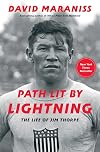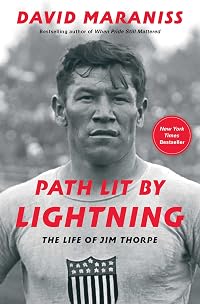
Path Lit by Lightning: The Life of Jim Thorpe
by David Maraniss
On This Page
Description
Jim Thorpe rose to world fame as a mythic talent who excelled at every sport. He won gold medals in the decathlon and pentathlon at the 1912 Stockholm Olympics, was an All-American football player at the Carlisle Indian School, in the first class of the Pro Football Hall of Fame, and played major league baseball for the New York Giants. But despite his colossal skills, Thorpe's life was a struggle against the odds. As a member of the Sac and Fox Nation, he encountered duplicitous authorities show more who turned away from him when their reputations were at risk. At Carlisle, he dealt with the racist assimilationist philosophy Kill the Indian, Save the Man. His gold medals were unfairly rescinded because he had played minor league baseball. His later life was troubled by alcohol, broken marriages, and financial distress. But for all his travails, Thorpe did not succumb. The man survived, complications and all, and so did the myth. show lessTags
Recommendations














Member Reviews
Many biographies of the “greatest athlete of them all” have been written over the years, and Maraniss’ has to be among the very best. Scrupulously researched, Maraniss gives the reader deep insight into not only Jim Thorpe’s incredible talent in many sports, but he also educates the reader about Jim’s battle with his Indian culture and the obstacles placed in front of him by white society. I learned much about both and feel those lessons are worth the time it took to read this lengthy book. I noticed the few negative reviews on Amazon seem to center on the feeling by those readers that Maranass is attempting some sort of “political correctness” in setting the record straight about the white man’s treatment of Native show more Americans throughout history. Those reviews shouldn’t distract other readers who want to know the truth about this issue. show less
Path Lit by Lightning, David Maraniss’ latest book, is a biography of the legendary athlete Jim Thorpe. The book takes its name from a translation of Thorpe’s Indian name Wa-tho-Huk, which refers to the lightning storm gathering outside as Jim Thorpe and his twin brother Charlie were born.
The story of Thorpe’s Indian name is the first of many tales about his life that Maraniss takes us through. The author does his best to separate fact from myth, but it’s not always easy given the legendary nature of Thorpe’s life, and the fact that those around him, and Thorpe himself, had their own reasons to sometimes shade the truth.
Maraniss gives us all of Thorpe’s life. We learn about Thorpe’s early days born into the Sac and Fox show more tribe in Oklahoma. Then on to his time at the Carlisle Indian Industrial School in Pennsylvania, and his performance on the football field and at the 1912 Olympics.
Maraniss spends quite a bit of time exploring Jim’s Olympic experience, and then showing how his medals were stripped from him. Though Thorpe himself was not blameless, other famous sports figures like Pop Warner and Avery Brundage come in for their share of blame for the circumstances surrounding Thorpe’s Olympic fall from amateur sports grace, and deservedly so.
We also see Thorpe meet his first wife Iva Miller at Carlisle and marry her after a long (and mostly long distance) relationship in 1913. We see him as a professional baseball player, and as president of the newly formed American Professional Football Association, forerunner to the NFL. And there is much more after that about his professional career, his later loves, his carousing, the movie made of his life, and the end of his days in 1953.
Also well documented in this book is the racism and abuse aimed at Native Americans. Much of Thorpe’s early experiences were of forced assimilation (“Kill the Indian, Save the Man” was the philosophy of the founder of the Carlisle School). He dealt with white people’s preconceptions of native people all through his life. It’s a testament to Thorpe’s amazing athletic abilities that he achieved so much under such circumstances.
I liked this book a lot. It’s mostly chronological, but it's not dry and avoids the trap of being a “this happened, then this happened” account of Thorpe’s life. However, Maraniss can and does take some deep dives - some sections of the book go into A LOT of detail. So I found myself getting bogged down in places.
That means that I found myself reading a few chapters at a time, both to soak in all that was being covered, and to avoid being dissuaded from continuing if the going got too “boggy”. In the end, because I love Maraniss’ writing style, I always looked forward to picking the book back up.
Maraniss is a gifted writer. I’ve read several of his previous books and reviewed one of them here on my blog - A Good American Family. What you expect from a book by Maraniss is a good story, thoroughly told, with thoughtfulness and a touch of humanity. This latest book does not disappoint.
RATING: Four Stars ⭐⭐⭐⭐
NOTE: I received an advanced copy of this book from Simon & Schuster and NetGalley, and am voluntarily providing this review. show less
The story of Thorpe’s Indian name is the first of many tales about his life that Maraniss takes us through. The author does his best to separate fact from myth, but it’s not always easy given the legendary nature of Thorpe’s life, and the fact that those around him, and Thorpe himself, had their own reasons to sometimes shade the truth.
Maraniss gives us all of Thorpe’s life. We learn about Thorpe’s early days born into the Sac and Fox show more tribe in Oklahoma. Then on to his time at the Carlisle Indian Industrial School in Pennsylvania, and his performance on the football field and at the 1912 Olympics.
Maraniss spends quite a bit of time exploring Jim’s Olympic experience, and then showing how his medals were stripped from him. Though Thorpe himself was not blameless, other famous sports figures like Pop Warner and Avery Brundage come in for their share of blame for the circumstances surrounding Thorpe’s Olympic fall from amateur sports grace, and deservedly so.
We also see Thorpe meet his first wife Iva Miller at Carlisle and marry her after a long (and mostly long distance) relationship in 1913. We see him as a professional baseball player, and as president of the newly formed American Professional Football Association, forerunner to the NFL. And there is much more after that about his professional career, his later loves, his carousing, the movie made of his life, and the end of his days in 1953.
Also well documented in this book is the racism and abuse aimed at Native Americans. Much of Thorpe’s early experiences were of forced assimilation (“Kill the Indian, Save the Man” was the philosophy of the founder of the Carlisle School). He dealt with white people’s preconceptions of native people all through his life. It’s a testament to Thorpe’s amazing athletic abilities that he achieved so much under such circumstances.
I liked this book a lot. It’s mostly chronological, but it's not dry and avoids the trap of being a “this happened, then this happened” account of Thorpe’s life. However, Maraniss can and does take some deep dives - some sections of the book go into A LOT of detail. So I found myself getting bogged down in places.
That means that I found myself reading a few chapters at a time, both to soak in all that was being covered, and to avoid being dissuaded from continuing if the going got too “boggy”. In the end, because I love Maraniss’ writing style, I always looked forward to picking the book back up.
Maraniss is a gifted writer. I’ve read several of his previous books and reviewed one of them here on my blog - A Good American Family. What you expect from a book by Maraniss is a good story, thoroughly told, with thoughtfulness and a touch of humanity. This latest book does not disappoint.
RATING: Four Stars ⭐⭐⭐⭐
NOTE: I received an advanced copy of this book from Simon & Schuster and NetGalley, and am voluntarily providing this review. show less
As sports became embedded within the American cultural zeitgeist at the turn of the 20th Century, one man’s raw athletic ability and accomplishments would make him a legend in his own time even while being described in disparaging language at the same time. Path Lit by Lightning: The Life of Jim Thorpe by David Maraniss follows the wandering life of the greatest athlete of the first half of the 20th Century who straddled the divide between White American culture and his Native roots that mirrored thousands of others who wasn’t as well known.
Maraniss, basing the book’s title on Thorpe’s given Sac-and-Fox name, gives a very detailed chronicle of Thorpe’s life from his childhood on the reservation to attending Carlisle Indian show more Industrial School where is athletic prowess in first track and field then football gained national attention before his Olympic triumph followed by ‘disgrace’ then sis long professional careers in baseball, football, and even a little basketball before wandering across the country looking to make a living and get by. Yet while Thorpe the man’s story is amazing, Maraniss uses him to highlight the plight of Native Americans within the larger text of mainstream White American culture from the military and government’s treatment of tribes over history to the benign sound but cultural devastating “Kill the Indian, save the man” philosophy of Carlisle and the casual racism that the press and organized sport’s white elitism who viewed amateurism as the ideal over professionalism thus causing a 110+ year injustice. This dual purpose was executed very well by Maraniss, though I will admit that he appeared to belabor some things like his critique on historical accuracy of the 1951 Hollywood biopic because at that point the reader was in 400 pages of a biography and could tell what the inaccuracies were already. And ironically mere weeks before it’s publication some information in the biography became dated when the IOC fully restored Thorpe as sole champion and his scores of his 1912 Olympic events.
Path Lit by Lightning is not only a revealing look into the man who was head and shoulders the best athlete of his time, but also of the difficulty Native Americans dealt within as they tried to remain true to their culture while attempt to live in White American society. David Maraniss writes in a very good narrative style though at times belabors inaccuracies as if the readers didn’t pay attention in early portions of the book. Overall, highly recommend for those interested in sports biographies or Native Americans in the United States.
I received a free copy of this book through Goodreads First Reads program in exchange for an honest review. show less
Maraniss, basing the book’s title on Thorpe’s given Sac-and-Fox name, gives a very detailed chronicle of Thorpe’s life from his childhood on the reservation to attending Carlisle Indian show more Industrial School where is athletic prowess in first track and field then football gained national attention before his Olympic triumph followed by ‘disgrace’ then sis long professional careers in baseball, football, and even a little basketball before wandering across the country looking to make a living and get by. Yet while Thorpe the man’s story is amazing, Maraniss uses him to highlight the plight of Native Americans within the larger text of mainstream White American culture from the military and government’s treatment of tribes over history to the benign sound but cultural devastating “Kill the Indian, save the man” philosophy of Carlisle and the casual racism that the press and organized sport’s white elitism who viewed amateurism as the ideal over professionalism thus causing a 110+ year injustice. This dual purpose was executed very well by Maraniss, though I will admit that he appeared to belabor some things like his critique on historical accuracy of the 1951 Hollywood biopic because at that point the reader was in 400 pages of a biography and could tell what the inaccuracies were already. And ironically mere weeks before it’s publication some information in the biography became dated when the IOC fully restored Thorpe as sole champion and his scores of his 1912 Olympic events.
Path Lit by Lightning is not only a revealing look into the man who was head and shoulders the best athlete of his time, but also of the difficulty Native Americans dealt within as they tried to remain true to their culture while attempt to live in White American society. David Maraniss writes in a very good narrative style though at times belabors inaccuracies as if the readers didn’t pay attention in early portions of the book. Overall, highly recommend for those interested in sports biographies or Native Americans in the United States.
I received a free copy of this book through Goodreads First Reads program in exchange for an honest review. show less
David Maraniss dives deep into the life of a man whose name many people know without knowing why he is famous. Along the way, he exposes the abuses of the residential schools for native Americans and of the abuse and exploitation of native Americans who excel in sport. The years of Thorpe's development and ascendancy make for wonderful reading but the story of his long life of disappointments and exploitation is grim despite his efforts to help other native Americans and to pursue his case for justice.
4.3 Jim Thorpe truly was a great man, as defined by his daughter Grace on the final pages of the book. Finely researched and written by Maraniss, it depicts the up and down life of Thorpe, including his rise to greatness in many sports: track and field, baseball and football. He was larger than life, but as they say, the big fall harder. It was often hard to read about his falls from grace (ironic that his daughter’s name is Grace) involving alcohol, poor business decisions and eroding relationships. His family received some semblance of peace having his Olympic medals restored in the 1980s, despite the failure to correct the actual history of his accomplishments. Highly recommend this book!
Half the size of War And Peace, this book tells the story of the abuse of Native Americans by focusing on one besieged man of the sports world of his time. Fame has toppled many an overpublicized man, but Jim Thorpe had so many obstacles placed in his path and still survived. This is an amazing book that takes quite a while to read and absorb.
I requested and received a free e-book copy from Simon & Schuster via NetGalley. Thank you!
I requested and received a free e-book copy from Simon & Schuster via NetGalley. Thank you!
Somewhat dry. Goes into great detail about every game, road trip, etc. I was hoping for a more narrative style. It was still interesting.
Members
- Recently Added By
Lists

Top Five Books of 2022
736 works; 272 members

Anticipated 2022 & Early 2023 Releases
209 works; 4 members
Author Information

15+ Works 4,442 Members
David Maraniss is a Pulitzer Prize winning journalist who chronicled the Clinton era during his time at the Washington Post. After leaving the Washington Post, Maraniss wrote "First in His Class," a book about Clinton that won the American Society of Newspaper Editors Jesse Laventhal Prize. He has also published "The Clinton Enigma," a book show more interpreting the Clinton scandal. (Bowker Author Biography) show less
Some Editions
Awards and Honors
Common Knowledge
- Original publication date
- 2022-08-09
- People/Characters
- Jim Thorpe
- Dedication
- In memory of Alice Mayhew, the editor whose inimitable voice I still hear in my head, with the wisdom and vigor that kept me going through twelve and a half books . . . and also to the wondrous voices that herald a better fut... (show all)ure - grandchildren Heidi, Ava, Eliza, and Charlie.
- First words
- (Preface) The late Reuben Snake, onetime chairman of the American Indian Movement and member of the Winnnebago nation, said that to be an Indian meant "having every third person you meet tell you about his great-grandmother w... (show all)ho was a real Cherokee princess" and "nine out of ten people tell you how great Jim Thorpe was".
People were eager to see "the big Indian" as soon as he returned to America. - Last words
- (Click to show. Warning: May contain spoilers.)Grace waved good-bye to her Sac and Fox father, the greatest athlete in the world, as he stood there quiet and alone, until the door sighed open and he got on board.
(Click to show. Warning: May contain spoilers.)(Epilogue) " . . . He was remarkable in magnitude, degree, and effectiveness. He was great." - Blurbers
- Leavy, Jane; Eig, Jonathan; Bryant, Howard; Olney, Buster; Loew, Patty
- Original language
- English US
Classifications
- Genres
- Sports and Leisure, Biography & Memoir, Nonfiction, General Nonfiction, History
- DDC/MDS
- 796.092 — Arts & recreation Recreation, sports, and performing arts Sports Biography And History Biography
- LCC
- GV697 .T5 .M27 — Geography, Anthropology and Recreation Recreation. Leisure Recreation. Leisure Sports
- BISAC
Statistics
- Members
- 301
- Popularity
- 106,298
- Reviews
- 8
- Rating
- (3.84)
- Languages
- English
- Media
- Paper, Audiobook, Ebook
- ISBNs
- 6
- ASINs
- 2