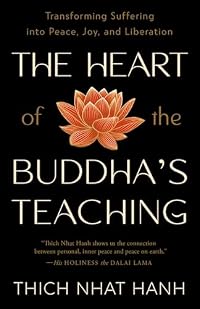
The Heart of the Buddha's Teaching: Transforming Suffering into Peace, Joy, and Liberation
by Thich Nhat Hanh
On This Page
Description
With poetry and clarity, Thich Nhat Hanh imparts comforting wisdom about the nature of suffering and its role in creating compassion, love, and joy - all qualities of enlightenment. "Thich Nhat Hanh shows us the connection between personal, inner peace, and peace on earth."--His Holiness the Dalai Lama In The Heart of the Buddha's Teaching, now revised with added material and new insights, Nhat Hanh introduces us to the core teachings of Buddhism and shows us that the Buddha's teachings show more are accessible and applicable to our daily lives. Covering such significant teachings as the Four Noble Truths, the Noble Eightfold Path, the Three Doors of Liberation, the Three Dharma Seals, and the Seven Factors of Awakening, The Heart of the Buddha's Teaching is a radiant beacon on Buddhist thought for the initiated and uninitiated alike. show lessTags
Recommendations


Member Reviews
The author imparts wisdom about the nature of suffering and its role in creating compassion, love, and joy – all qualities of enlightenment. He introduces us to the core teachings of Buddhism and shows us that the Buddha’s teachings are accessible and applicable to our daily lives covering such significant teachings as the Four Noble Truths, the Noble Eightfold Path, the Three Doors of Liberation, the Three Dharma Seals, and the Seven Factors of Awakening.
An excellent introduction to a wealth of Buddhist teachings and principles. Some passages are pure gold. And for my money, there is no better source than Thich Nhat Hanh.
Best for:
Those interested in learning more about Buddhism.
In a nutshell:
Buddhist teacher Thich Nhat Hanh shares an overview of some of the basic tenets of Buddhism.
Worth quoting:
I underlined and starred so, so much.
Why I chose it:
I’ve read some very basic writings on Buddhism many years ago; I’m not more interested in learning more to see if it is a spiritual path I’d like to learn more about.
What it left me feeling:
Calm.
Review:
I tend to think of Buddhists as people who take things in stride, so it was kind of funny to me that the program I use to write my book reviews kept throwing up error messages when I was trying to write this review. Lessons are available everywhere!
The first half of the book focuses on two major Buddhism show more teachings - The Four Noble Truths and The Nobel Eightfold Path. The second half looks at a variety of other Buddhist teachings in slightly less detail.
I appreciate Thich Nhat Hanh’s writing style. He takes concepts that are a bit challenging and provides analogies and examples that makes things a bit easier to digest. At the same time, I am definitely still a bit confused about … a lot. It’s clear I need to visit an actual Buddhism center and speak with others and learn from others outside of a book, but I think this book was a good place to start.
Recommend to a Friend / Keep / Donate it / Toss it:
Keep show less
Those interested in learning more about Buddhism.
In a nutshell:
Buddhist teacher Thich Nhat Hanh shares an overview of some of the basic tenets of Buddhism.
Worth quoting:
I underlined and starred so, so much.
Why I chose it:
I’ve read some very basic writings on Buddhism many years ago; I’m not more interested in learning more to see if it is a spiritual path I’d like to learn more about.
What it left me feeling:
Calm.
Review:
I tend to think of Buddhists as people who take things in stride, so it was kind of funny to me that the program I use to write my book reviews kept throwing up error messages when I was trying to write this review. Lessons are available everywhere!
The first half of the book focuses on two major Buddhism show more teachings - The Four Noble Truths and The Nobel Eightfold Path. The second half looks at a variety of other Buddhist teachings in slightly less detail.
I appreciate Thich Nhat Hanh’s writing style. He takes concepts that are a bit challenging and provides analogies and examples that makes things a bit easier to digest. At the same time, I am definitely still a bit confused about … a lot. It’s clear I need to visit an actual Buddhism center and speak with others and learn from others outside of a book, but I think this book was a good place to start.
Recommend to a Friend / Keep / Donate it / Toss it:
Keep show less
Well meaning with brief moments of insight, but largely tedious. It felt like an endless amount of lists and repetitive phrasings. I really tried to give this text every benefit of the doubt, but I kept putting it down in boredom. There are better ways to teach than this pedantic method. Perhaps the monk is a better speaker than writer?
With poetry and clarity, Thich Nhat Hanh imparts comforting wisdom about the nature of suffering and its role in creating compassion, love, and joy – all qualities of enlightenment.
In The Heart of the Buddha’s Teaching, now revised with added material and new insights, Nhat Hanh introduces us to the core teachings of Buddhism and shows us that the Buddha’s teachings are accessible and applicable to our daily lives.
In The Heart of the Buddha’s Teaching, now revised with added material and new insights, Nhat Hanh introduces us to the core teachings of Buddhism and shows us that the Buddha’s teachings are accessible and applicable to our daily lives.
In a relatively compact book Nhat Than knows how to explain some essential thoughta of Buddhism. It introduces the fundamental principles (the four noble truths, etc) and goes into quite some detail when presenting them. Most of the times Nhat Than knows how to maintain an objective point of view, though at times stressing what is important in his interpretation. This makes a quite direct approach on the topic possible, and due to this he is able to present the reader with an abundance of information. Which leads to my two criticisms of this book. Firstly, the information in the second part if the book is not put into a clear order; How do the skandhas related to the twelve chains, and what is different about the three doors to show more detachment compared to the Noble truths? The answers are probably somewhere hidden in the book, but the relations between the concepts are not always explaiNed explicitly. This may be due to the limited length of the book, but for me it made it harder to get the whole picture. My second point of ccriticism is that Nhat Than can get emotional sometimes, abruptly breaking the gentle objective flow of the book. he has lived through terrible things, and it is no wonder that he sometimes wants to stress the meaning of some of the those events. But this book was not the place for that. for example: How can making a human torch of yourself be seen in the light of the Road of Moderation? It is more a political than a Buddhist act, and anecdotes like these (for the record: Thich didnt make a torch out of himself, he mentioned another monk here) Do not fit well into the otherwise detached tone of the book. show less
http://nwhyte.livejournal.com/1935728.html
A book by a prominent Buddhist monk outlining key teachings of Buddhism. I started off rather liking it as an approach to mindfulness and how to process suffering and the good things about life. But after he Four Noble Truths and the Eightfold Path, I started to get a bit irritated with the constant discovery of new lists of important spiritual things, from the Two Truths up to the Twelve Links of Interdependent Co-Arising; it seems to me that over-describing the undescribable is fundamentally a mistake. I also started wondering to what extent Thich Nhat Hanh is presenting a mainstream account of Buddhism or his own particular take (or his school's). And I wonder also if there is much sense of show more the numinous in Buddhism; there didn't seem a lot here. Anyway, it is still the most interesting book by a Buddhist on Buddhism that I have read. show less
A book by a prominent Buddhist monk outlining key teachings of Buddhism. I started off rather liking it as an approach to mindfulness and how to process suffering and the good things about life. But after he Four Noble Truths and the Eightfold Path, I started to get a bit irritated with the constant discovery of new lists of important spiritual things, from the Two Truths up to the Twelve Links of Interdependent Co-Arising; it seems to me that over-describing the undescribable is fundamentally a mistake. I also started wondering to what extent Thich Nhat Hanh is presenting a mainstream account of Buddhism or his own particular take (or his school's). And I wonder also if there is much sense of show more the numinous in Buddhism; there didn't seem a lot here. Anyway, it is still the most interesting book by a Buddhist on Buddhism that I have read. show less
Members
- Recently Added By
Lists

Our Favorite Comfort Reads
334 works; 200 members
Author Information

497+ Works 42,729 Members
Thich Nhat Hanh was born in central Vietnam on October 11, 1926. He entered Tu Hieu Temple as a novice monk at the age of sixteen. During the Vietnam War, he was part of a movement called "engaged Buddhism", which combines traditional practices with nonviolent civil disobedience. For this, he was exiled by both the Communist and non-Communist show more governments and was nominated by Martin Luther King, Jr. for the Nobel Peace Prize in 1967 for his efforts to reconcile North and South Vietnam. He is a teacher, author, poet, and peace activist. He has written over 100 titles on meditation, mindfulness and Engaged Buddhism, as well as poems, children's stories, and commentaries on ancient Buddhist texts. His books include The Heart of the Buddha's Teaching: An Introduction to Buddhism, Peace Is Every Step, The Miracle of Mindfulness, The Art of Power, True Love and Anger, Vietnam: Lotus in a Sea of Fire, and Living Buddha, Living Christ. He founded a retreat in France called Plum Village. (Bowker Author Biography) show less
Work Relationships
Is contained in
Common Knowledge
- Canonical title
- The Heart of the Buddha's Teaching: Transforming Suffering into Peace, Joy, and Liberation
- Original publication date
- 1998
- First words
- Buddha was not a god.
- Blurbers
- Gyatso, Tenzin; Lowell, Robert
Classifications
Statistics
- Members
- 2,293
- Popularity
- 8,616
- Reviews
- 22
- Rating
- (4.19)
- Languages
- 7 — Dutch, English, French, German, Italian, Portuguese, Spanish
- Media
- Paper, Audiobook, Ebook
- ISBNs
- 23
- ASINs
- 11