On This Page
Description
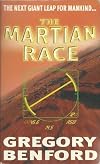
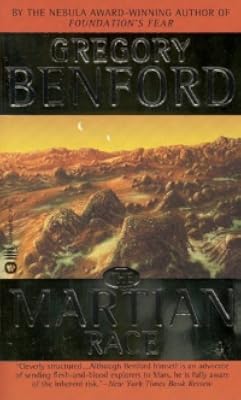
From the Nebula Award-winning author of Timescape and Foundation's Fear comes a hard-science thriller about the race to Mars.When an explosion of the rocket launching the Mars Transit Vehicle kills four crewmen, the US decides to redirect its energies to near-Earth projects, killing the manned mission to Mars. But tycoon John Axelrod assembles a consortium to fund the project, and he expects to net billions. But a European-Asian airbus will make a similar expedition. Now, the race is on to show more get to the Red Planet first. show lessTags
Recommendations















Member Reviews
Benford, Gregory. The Martian Race. Adventures of Victor and Julia No. 1. Aspect, 1999.
It is impossible to read Gregory Benford’s The Martian Race these days without setting it up against Andy Weir’s The Martian (2011). I find it hard to believe that Weir did not read Benford’s book in his late teens or early twenties. Certainly, The Martian Race and The Martian cover a lot of the same ground. Both books are Martian survival stories. Benford’s privately funded team gets to Mars before their Chinese competitors, but they damage their return vehicle in the process. While they work to repair it and raise enough crops to keep them alive for a longer-than-planned stay, biologist Julie discovers organic material in a lava tube. show more Ultimately, both teams will need to work together to get home. Both books pay attention to orbital mechanics and to the planetary science available at the time. To his credit, Benford does not ignore inconvenient Martian facts in service of plot as Weir sometimes does. It is true that Benford’s characters do not pop off the page the way Mark Watney does, but the husband-and-wife team of Russian pilot Viktor and Australian biologist Julie are fun to follow. I am grateful to Edward Lerner’s blog for putting me on the trail of this series. 4 stars. show less
It is impossible to read Gregory Benford’s The Martian Race these days without setting it up against Andy Weir’s The Martian (2011). I find it hard to believe that Weir did not read Benford’s book in his late teens or early twenties. Certainly, The Martian Race and The Martian cover a lot of the same ground. Both books are Martian survival stories. Benford’s privately funded team gets to Mars before their Chinese competitors, but they damage their return vehicle in the process. While they work to repair it and raise enough crops to keep them alive for a longer-than-planned stay, biologist Julie discovers organic material in a lava tube. show more Ultimately, both teams will need to work together to get home. Both books pay attention to orbital mechanics and to the planetary science available at the time. To his credit, Benford does not ignore inconvenient Martian facts in service of plot as Weir sometimes does. It is true that Benford’s characters do not pop off the page the way Mark Watney does, but the husband-and-wife team of Russian pilot Viktor and Australian biologist Julie are fun to follow. I am grateful to Edward Lerner’s blog for putting me on the trail of this series. 4 stars. show less
Fiction about Mars is one of my favorite sub-genres. This example can be a little slow-moving at times, but the description of life found on Mars more than makes up for any other shortcomings. However, this is not your typical alien life and first contact story.
Two private consortiums vie to become the first to send a mission to Mars and have it return with in-depth scientific reports along with samples of rocks and any other interesting artifacts. The winning group receives a prize of $30 billion, most of which will be needed to reimburse expenses incurred. But the winner will also have ownership of the science, the all-important prize.
The main character is a biologist, Julia, whose husband is the pilot of the first team to leave show more Earth. There is also a geologist and an engineer on board. They land safely but face the immediate problem that the vehicle in which they are to return in a year and a half has been damaged. While they all spend time helping the engineer with that, the geologist and biologist work on their assigned experiments. Meanwhile, the second team leaves Earth using a different propulsion system and arrives while repairs are still being made on the first group's return vehicle. So, let's just say some organizational rivalry and not very pleasant backroom dealing go on, on both Earth and Mars.
But while this is going on, the two scientists have made an astounding discovery: anaerobic life (i.e., life that is not dependent on oxygen) living in still-active volcanic vents. This ups the stakes for the two consortiums, but the big plus for the reader is the analysis of why it's there, how far it extends, and how it's survived as it has (some of the lifeforms even have eyes, or, at least, light receptors, so for some reason they haven't lost the need for them over the millions of years since there was surface water and life on the surface was possible.
I'd recommend this to anyone with an interest in Mars or in the variety if life possible in the universe. The scientific explanations for what's found, and the ethical questions raised, make this a refreshing and thought-provoking novel for a species that dreams of leaving its home planet. show less
Two private consortiums vie to become the first to send a mission to Mars and have it return with in-depth scientific reports along with samples of rocks and any other interesting artifacts. The winning group receives a prize of $30 billion, most of which will be needed to reimburse expenses incurred. But the winner will also have ownership of the science, the all-important prize.
The main character is a biologist, Julia, whose husband is the pilot of the first team to leave show more Earth. There is also a geologist and an engineer on board. They land safely but face the immediate problem that the vehicle in which they are to return in a year and a half has been damaged. While they all spend time helping the engineer with that, the geologist and biologist work on their assigned experiments. Meanwhile, the second team leaves Earth using a different propulsion system and arrives while repairs are still being made on the first group's return vehicle. So, let's just say some organizational rivalry and not very pleasant backroom dealing go on, on both Earth and Mars.
But while this is going on, the two scientists have made an astounding discovery: anaerobic life (i.e., life that is not dependent on oxygen) living in still-active volcanic vents. This ups the stakes for the two consortiums, but the big plus for the reader is the analysis of why it's there, how far it extends, and how it's survived as it has (some of the lifeforms even have eyes, or, at least, light receptors, so for some reason they haven't lost the need for them over the millions of years since there was surface water and life on the surface was possible.
I'd recommend this to anyone with an interest in Mars or in the variety if life possible in the universe. The scientific explanations for what's found, and the ethical questions raised, make this a refreshing and thought-provoking novel for a species that dreams of leaving its home planet. show less
Very similar to, but published years before, Weir's The Martian. This is the story of the first expedition to Mars, the challenges to surviving there for a year, and the search for life. This is hard SF, a few years in the future, in the vein of Robinson's Martian trilogy, but much faster paced, told from the viewpoint of the female biologist on the team.
Those are the good points. The bad side is the plot involving the Earth-side contest, i.e., race, to get to Mars and back, that funds this expedition. Presumably modeled on the X Prize competition, the premise is that our heroes not only have to get to Mars first, but do real science, and then get back before a rival group from AirBus does. There's much debating about what would satisfy show more the arbitrary rules of this contest. I don't know whether Benford feels this is the most likely means of actually funding a Mars expedition, or just used it to generate additional tension. Either way, I found this whole element -unconvincing and annoying.
Recommended for the 75% of the story about the trip to and survival on Mars. Solid hard SF. show less
Those are the good points. The bad side is the plot involving the Earth-side contest, i.e., race, to get to Mars and back, that funds this expedition. Presumably modeled on the X Prize competition, the premise is that our heroes not only have to get to Mars first, but do real science, and then get back before a rival group from AirBus does. There's much debating about what would satisfy show more the arbitrary rules of this contest. I don't know whether Benford feels this is the most likely means of actually funding a Mars expedition, or just used it to generate additional tension. Either way, I found this whole element -unconvincing and annoying.
Recommended for the 75% of the story about the trip to and survival on Mars. Solid hard SF. show less
The Martian Race tells the story of the first manned mission to Mars.
It is a light read and an interesting look at how such a mission might proceed. The storytelling is fairly straightforward. There's no contrived drama the way there is in many books of this type. The characters get along and do their jobs about as well as could be expected and there's no grandstanding and no 'nefarious dealings'. This made quite a pleasant change - I kept waiting for one of the characters to do something essentially out of character just to "add drama" but it didn't happen.
This book doesn't provide the detail that a book like Kim Stanley Robinson's Red Mars does - but is an easier read for that.
One aspect of the book that amused and rang very true was show more that the mission was funded by a private consortium rather than NASA. The astronauts became, by necessity, media stars - and sponsorship deals were everything. Picture Astronauts taking that first historic step onto mars, then holding up a Mars Bar for the cameras. show less
It is a light read and an interesting look at how such a mission might proceed. The storytelling is fairly straightforward. There's no contrived drama the way there is in many books of this type. The characters get along and do their jobs about as well as could be expected and there's no grandstanding and no 'nefarious dealings'. This made quite a pleasant change - I kept waiting for one of the characters to do something essentially out of character just to "add drama" but it didn't happen.
This book doesn't provide the detail that a book like Kim Stanley Robinson's Red Mars does - but is an easier read for that.
One aspect of the book that amused and rang very true was show more that the mission was funded by a private consortium rather than NASA. The astronauts became, by necessity, media stars - and sponsorship deals were everything. Picture Astronauts taking that first historic step onto mars, then holding up a Mars Bar for the cameras. show less
Ratings
Members
- Recently Added By
Lists

Books Set on Mars
22 works; 7 members
Author Information

239+ Works 22,494 Members
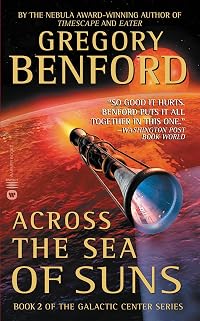
Gregory Benford, was born on January 30, 1941 in Mobile, Alabama. He is a physicist and science fiction writer who earned his Ph.D. from the University of California, San Diego, in 1967. He is a Woodrow Wilson Fellow and a consultant for NASA. Benford's first novel "Deeper than the Darkness" (1970), which was revised as "The Stars in Shroud" show more (1978), gave him notice as a serious Science Fiction writer. His most popular work is "Timescape" (1980), which was the winner of the Nebula and John W. Campbell Memorial Awards; it presented a hard physics approach to limited time travel. "In the Ocean of Night" (1977), "Across the Sea of Suns" (1984), "Great Sky River" (1987), "Tides of Light" (1989) and "Furious Gulf" (1994) were all a part of the Galactic Cluster Series. He has also written the juvenile novel "Jupiter Project" (1975), "Against Infinity" (1983) and the thriller "Artifact" (1985). He has been nominated for 12 Nebula Awards (winning for "Timescape" and for the novelette, "If the Stars are Gods"). Benford, writing alternately with Bruce Sterling, produces science fact articles for the Magazine of Fantasy and Science Fiction. They took over after the death of regular columnist Isaac Asimov. He has also co-edited theme anthologies with Martin H. Greenburg, which include "Hitler Victorious" (1986), "Nuclear War" (1988), "What Might Have Been, Volume 1: Alternate Empires" (1988), "Volume 2: Alternate Heroes" (1989) and "Volume 3: Alternate Wars." (Bowker Author Biography) show less
Some Editions
Awards and Honors
Awards
Series

Common Knowledge
- Canonical title
- The Martian Race
- Original publication date
- 1999
- Important places
- Mars
- Dedication
- To an idea and those who pursue it:
Mars in our time - First words
- "Welcome back to Mars!"
- Last words
- (Click to show. Warning: May contain spoilers.)From a member of the Martian race.
Classifications
Statistics
- Members
- 628
- Popularity
- 46,233
- Reviews
- 6
- Rating
- (3.54)
- Languages
- English, French, German
- Media
- Paper, Audiobook, Ebook
- ISBNs
- 17
- ASINs
- 8