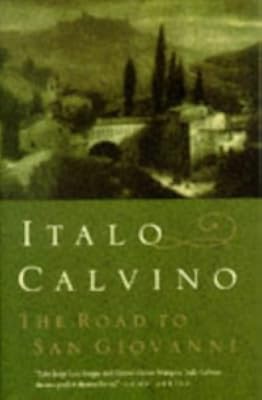
The Road to San Giovanni
by Italo Calvino
On This Page
Description
"In each other's presence we became mute, would walk in silence side by side along the road to San Giovanni. To my father's mind, words must serve as confirmations of things, and as signs of possession; to mine, they were foretastes of things barely glimpsed, not possessed, presumed." -from The Road to San Giovanni. In these autobiographical essays, published after Italo Calvino's death, the intellectually vibrant writer not only reflects on his own past, but also inquires into the very show more workings of memory itself. From the title essay's lyrical evocation of the author's relationship with his father, and a charming account of teenage years spent in the glow of the cinema screen, to Calvino's reminiscences of his experiences in the Italian Resistance during World War II and of his years in Paris, to his declaration of purpose as a writer in the final essay's visionary fragments, these five "memory exercises" are heartfelt, affecting, and wise. show lessTags
Recommendations












Member Reviews
Io non riconoscevo ne' una pianta ne' un uccello. Per me le cose erano mute. Le parole fluivano fluivano nella mia testa non ancorate a oggetti, ma ad emozioni fantasie presagi. E bastava un brandello di giornale calpestato che mi finiva tra i piedi ed ero assorto a bere la scrittura che ne sortiva mozza e inconfessabile - nomi di teatri, attrici, vanita' – e gia' la mia mente aveva preso il galoppo, la catena delle immagini non si sarebbe fermata per ore e ore mentre continuavo a seguire in silenzio mio padre, che additava certe foglie di la' da un muro e diceva: “Ypotoglaxia … (18-9)
Ma cio' che muoveva mio padre ogni mattina su per la strada di San Giovanni – e me giu' per la mia via – piu' che dovere di proprietario show more operoso, disinteresse d'innovatore di metodi agricoli, - e per me, piu' che le definizioni di doveri che via via mi sarei imposto -, era passione feroce, dolore a esistere – cosa se non questo poteva spingere lui a arrampicarsi per i gerbidi e i boschi e me a addentrarmi in un labirinto di muri e carta scritta? - confronto disperato con cio' che resta fuori di noi, spreco di se' opposto allo spreco generale del mondo. (22)
Cos'era stato dunque allora il cinema, in questo contesto, per me? Direi: la distanza. Rispondeva a un bisogno di distanza, di dilazione dei confini del reale, di veder aprirsi intorno delle dimensioni incommensurabili, astratte come entita' geometriche, ma anche concrete, assolutamente piene di facce e situazioni e ambienti, che col mondo dell'esperienza diretta stabilivano una loro rete (astratta) di rapporti. (52)
Continuo a scrutare nel fondovalle della memoria. E la mia paura di adesso e' che appena si profila un ricordo, subito prenda una luce sbagliata, di maniera, sentimentale come sempre la guerra e la giovinezza, diventi un pezzo di racconto con lo stile di allora, che non puo' dirci come erano davvero le cose ma solo come credevamo di vederle e di dirle. (70-1)
… dal fondo dell'opaco io scrivo, ricostruendo la mappa d'un aprico (a solatio) che e' solo un inverificabile assioma per i calcoli della memoria, il luogo geometrico dell'io, di un me stesso di cui il me stesso ha bisogno per sapersi me stesso, l'io che serve solo perche' il mondo riceva continuamente notizie dell'esistenza del mondo, un congegno di cui il mondo dispone per sapere se c'e'. (116) show less
The title piece and "From the Opaque" seemed to be the highpoints in this collection of "memory exercises". Both do an admirable job of attempting to recreate not just memories but direct sensory experience and how it was translated into a more subjective world view of simpler, fewer, and less sharply defined objects a younger age. I'm sure it is possible to dig some hard philosophy out of these pieces, but as a casual reader the strongest impression was of an almost transcendental nostalgia.
The other three essays were less interesting to me. The piece on cinema was decent while the war time recollection felt a little too slight and the essay on the Parisian garbage can seemed a bit self-indulgent. Still, I am sure all of these essays show more have their fans (well, maybe not the second). I haven't read anything else by Calvino, so I don't really know whether it is representative of his work as a whole. show less
The other three essays were less interesting to me. The piece on cinema was decent while the war time recollection felt a little too slight and the essay on the Parisian garbage can seemed a bit self-indulgent. Still, I am sure all of these essays show more have their fans (well, maybe not the second). I haven't read anything else by Calvino, so I don't really know whether it is representative of his work as a whole. show less
A beautiful collection of essays from the master fabulist. My favorite was about garbage cans. Covers Fellini through Latin plant names. Worth it.
Italo Calvino avait le projet d'un livre qui rassemblerait une série d' « exercices de mémoire ». La Route de San Giovanni en réunit .cinq, écrits entre 1962 et 1977 : cinq fragments d'une sorte d'autobiographie involontaire, où l'auteur s'interroge sur le mystérieux fonctionnement du langage quand celui-ci répond à notre besoin de nous souvenir. Ainsi, au fil des pages, l'écriture remémore l'enfance de l'écrivain à San Remo et le chemin qui l'éloignait de son père; sa passion pour le cinéma américain dans les salles de province de sa jeunesse; l'expérience d'une bataille sous la Résistance; ou encore, la descente des ordures ménagères, unique activité domestique à laquelle il se livrait à Paris. Enfin, une show more merveilleuse investigation poétique sur la forme du monde clôt le livre. show less
These "memory exercises" could not be called significant in my opinion, though they were occasionally interesting when they weren't rambling. I do not see the difference between these and ordinary literary reminiscences. One might spend their time reviewing the marginalia of Coleridge, or reading the literary reviews of Poe as well. It is really just a matter of how obsessed a person is with Calvino's writing, and the determination to read every word he wrote will be the only impetus for anyone to finish this book. If you want to know more about Fellini, or rubbish bins, give this one a perusal.
The weaker parts of the collection detracted from the stronger parts, the latter of which were the descriptions of his father. It seems to me show more any halfway decent writer could have written the other sections, as they consisted of everyday knowledge - with a few personal details about Fellini and Italian countrysides and cinema thrown in, culminating in well-expressed sentiments of a mundane and uninspired nature.
For Calvino PhD students only. show less
The weaker parts of the collection detracted from the stronger parts, the latter of which were the descriptions of his father. It seems to me show more any halfway decent writer could have written the other sections, as they consisted of everyday knowledge - with a few personal details about Fellini and Italian countrysides and cinema thrown in, culminating in well-expressed sentiments of a mundane and uninspired nature.
For Calvino PhD students only. show less
Pezzi brevi, più che racconti, riflessioni che prendono spunto da immagini autobiografiche: la campagna sui bricchi dietro a Sanremo, il cinema da ragazzino, le immondizie da portar fuori a Parigi, la guerra partigiana, l'orizzonte a Sanremo.
Members
- Recently Added By
Lists

Italian Literature
558 works; 42 members

Books about Books
149 works; 24 members
Author Information

393+ Works 70,123 Members
Italo Calvino 1923-1984 Novelist and short story writer Italo Calvino was born in Cuba on October 15, 1923, and grew up in Italy, graduating from the University of Turin in 1947. He is remembered for his distinctive style of fables. Much of his first work was political, including Il Sentiero dei Nidi di Ragno (The Path of the Nest Spiders, 1947), show more considered one of the main novels of neorealism. In the 1950s, Calvino began to explore fantasy and myth as extensions of realism. Il Visconte Dimezzato (The Cloven Knight, 1952), concerns a knight split in two in combat who continues to live on as two separates, one good and one bad, deprived of the link which made them a moral whole. In Il Barone Rampante (Baron in the Trees, 1957), a boy takes to the trees to avoid eating snail soup and lives an entire, fulfilled life without ever coming back down. Calvino was awarded an honorary degree from Mount Holyoke College in 1984 and died in 1985, following a cerebral hemorrhage. At the time of his death, he was the most translated contemporary Italian writer and a contender for the Nobel Prize for Literature. (Bowker Author Biography) show less
Some Editions
Awards and Honors
Series
Belongs to Publisher Series
dtv (12344)
Gallimard, Folio (6554)
Common Knowledge
- Canonical title*
- La route de San Giovanni
- Original title
- La strada di San Giovanni
- Original publication date
- 1990
- Original language*
- Italien
*Some information comes from Common Knowledge in other languages. Click "Edit" for more information.
Classifications
- Genres
- Biography & Memoir, Fiction and Literature
- DDC/MDS
- 853.914 — Literature & rhetoric Italian, Romanian & related literatures Italian fiction 1900- 20th Century 1945-1999
- LCC
- PQ4809 .A45 .S7713 — Language and Literature French, Italian, Spanish and Portuguese literatures Italian literature Individual authors, 1900-1960
- BISAC
Statistics
- Members
- 559
- Popularity
- 52,926
- Reviews
- 9
- Rating
- (3.60)
- Languages
- 11 — Dutch, English, Finnish, French, German, Greek, Italian, Japanese, Portuguese, Spanish, Turkish
- Media
- Paper, Audiobook, Ebook
- ISBNs
- 35
- ASINs
- 9