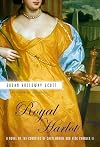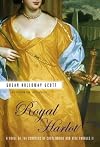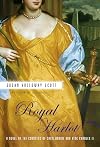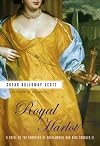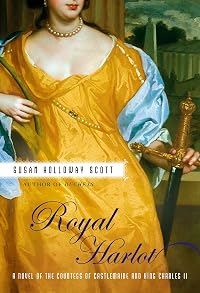
Royal Harlot
by Susan Holloway Scott
On This Page
Description
London, 1660: Ready to throw off a generation of Puritan rule, all England rejoices when Charles Stuart returns to reclaim the throne. Among those welcoming him is young Barbara Villiers Palmer, a breathtaking Royalist beauty whose sensuality and clever wit instantly captivate the handsome, jaded king. Though each is promised to another, Barbara soon becomes Charles's mistress and closest friend, and the uncrowned queen of his bawdy Restoration court. Rewarded with titles, land, and jewels, show more she is the most envied and desired woman in England--and the most powerful. But the role of royal mistress is a precarious one, and Barbara's enemies and rivals are everywhere in the palace. show lessTags
Recommendations




Member Recommendations
Member Reviews
By now, I've been starting to rack up a good number of Susan Holloway Scott reads. I'm at a grand total of 3 now, and I'm eager to keep that number growing. Thus far, though, Scott's Royal Harlot is by far the best book in her library.
Scott has firmly positioned herself as a historical resource on the bawdy pre-Restoration Court of Charles II, having explored no less than three of his mistresses in her novels. In Royal Harlot, she takes on Barbara Villiers, the Countess of Castlemaine, who, it appears, was one of Charles' first mistresses after he was restored to the British throne, and one of his longest. Barbara is a low-born citizen who manages to make her way to court, where she catches the eye of Robert Palmer, whom she soon show more marries. But things are unsteady in the highly-Puritan government of Lord Protector Oliver Cromwell, especially among the nobility. After Cromwell dies, many of the Royalist nobility move to restore the Stuart line to the British throne. Thus, through her husband's Royalist leanings, Barbara meets Charles II, who, it seems, has always had a soft spot for beautiful women. It's not long until Barbara, a free spirit, becomes his mistress and begins to grow her power. Even after Charles marries, Barbara is the unspoken queen of court and, through her relationship with Charles, she gains incredible power, wealth and other prestige that women of the period could never imagine. But, as a mistress rather than a wife, Charles could cast her off at any moment without consequence.
I feel like Scott has really found her writing zen here. The writing style is completely comfortable and flows very easily (as in, it's a joy to read). The novel is well-paced and intriguing from the very beginning to the very end. It doesn't hurt that Barbara is an unknown and incredibly compelling historical figure. Scott depicts her as a free spirit with intelligence, beauty and a hint of wantonness that helps her use the gifts she has to get further than any woman could in the period. I was completely enthralled with Barbara's story and cheered for her as she overcame obstacles and found her place in politics and power (not to mention the Restoration-period setting is a welcome change from the absurd amount of Tudor fiction out there right now).
Highly recommended to anyone who enjoys reading historical fiction, especially about scandalous women, women in power or women who rose above their place despite the society of the time and did something amazing with their lives. show less
Scott has firmly positioned herself as a historical resource on the bawdy pre-Restoration Court of Charles II, having explored no less than three of his mistresses in her novels. In Royal Harlot, she takes on Barbara Villiers, the Countess of Castlemaine, who, it appears, was one of Charles' first mistresses after he was restored to the British throne, and one of his longest. Barbara is a low-born citizen who manages to make her way to court, where she catches the eye of Robert Palmer, whom she soon show more marries. But things are unsteady in the highly-Puritan government of Lord Protector Oliver Cromwell, especially among the nobility. After Cromwell dies, many of the Royalist nobility move to restore the Stuart line to the British throne. Thus, through her husband's Royalist leanings, Barbara meets Charles II, who, it seems, has always had a soft spot for beautiful women. It's not long until Barbara, a free spirit, becomes his mistress and begins to grow her power. Even after Charles marries, Barbara is the unspoken queen of court and, through her relationship with Charles, she gains incredible power, wealth and other prestige that women of the period could never imagine. But, as a mistress rather than a wife, Charles could cast her off at any moment without consequence.
I feel like Scott has really found her writing zen here. The writing style is completely comfortable and flows very easily (as in, it's a joy to read). The novel is well-paced and intriguing from the very beginning to the very end. It doesn't hurt that Barbara is an unknown and incredibly compelling historical figure. Scott depicts her as a free spirit with intelligence, beauty and a hint of wantonness that helps her use the gifts she has to get further than any woman could in the period. I was completely enthralled with Barbara's story and cheered for her as she overcame obstacles and found her place in politics and power (not to mention the Restoration-period setting is a welcome change from the absurd amount of Tudor fiction out there right now).
Highly recommended to anyone who enjoys reading historical fiction, especially about scandalous women, women in power or women who rose above their place despite the society of the time and did something amazing with their lives. show less
This is the story of Barbara Palmer, notorious mistress of King Charles II of England.
I had a terrible education in history--which is not to say that I had trouble with it in school--I got As in it, just like everything else. But it was deadly dull. In my small-town high school, history was the class taught by the two-hatted teachers: American history was taught by the football coach, European history by the basketball coach... you get the idea. It was rote memorization of names and dates that I promptly forgot after each test. I was so bored with it that I steered clear of the subject in college, mystified by why anyone would choose such classes. My interest slowly developed from living here in Europe, where history is everywhere, and show more has grown since my kids are all fascinated by history--they've had great teachers.
All of which is just a long-winded way of explaining that before picking up this book, I had no idea who Barbara Palmer was.
You can also tell that I don't read fictionalized biographies often, because I was surprised that Barbara's character wasn't sugar-coated, or made to seem noble and wise. Nor was she vilified, as she had been in life.
It's a clear, fascinating, readable account of an ambitious woman who married for respectability and had a long-lasting affair with the king for power and friendship, and maybe love.
Unlike Sarah Churchill in Scott's previous book, Barbara wasn't all that interested in politics. She was interested in Barbara. And then when she had children, she was interested in their welfare and future prospects.
Barbara's actions were viewed as wicked and immoral at the time, and even from a modern perspective, they're not by any means admirable. But seeing the very real woman behind the actions--a very ordinary woman, even if she was celebrated for her beauty, full of both strengths and faults--was quite thought-provoking.
I don't think I'll start looking for books in this genre, or researching the time period, but I will definitely be buying The King's Favorite next July. show less
I had a terrible education in history--which is not to say that I had trouble with it in school--I got As in it, just like everything else. But it was deadly dull. In my small-town high school, history was the class taught by the two-hatted teachers: American history was taught by the football coach, European history by the basketball coach... you get the idea. It was rote memorization of names and dates that I promptly forgot after each test. I was so bored with it that I steered clear of the subject in college, mystified by why anyone would choose such classes. My interest slowly developed from living here in Europe, where history is everywhere, and show more has grown since my kids are all fascinated by history--they've had great teachers.
All of which is just a long-winded way of explaining that before picking up this book, I had no idea who Barbara Palmer was.
You can also tell that I don't read fictionalized biographies often, because I was surprised that Barbara's character wasn't sugar-coated, or made to seem noble and wise. Nor was she vilified, as she had been in life.
It's a clear, fascinating, readable account of an ambitious woman who married for respectability and had a long-lasting affair with the king for power and friendship, and maybe love.
Unlike Sarah Churchill in Scott's previous book, Barbara wasn't all that interested in politics. She was interested in Barbara. And then when she had children, she was interested in their welfare and future prospects.
Barbara's actions were viewed as wicked and immoral at the time, and even from a modern perspective, they're not by any means admirable. But seeing the very real woman behind the actions--a very ordinary woman, even if she was celebrated for her beauty, full of both strengths and faults--was quite thought-provoking.
I don't think I'll start looking for books in this genre, or researching the time period, but I will definitely be buying The King's Favorite next July. show less
Although a light read, this was mildly entertaining. For more detail I picked up Stephen Coote's biography of Charles II, "Royal Survivor", and read it through before I finished Royal Harlot. I do think we should stop calling women harlots and sluts and so I did not appreciate the title. The woman had a name and a few titles. The book strays into trashy romance at times but overall follows a correct chronology of events.
It was a decent read, however, I am a bit baffled by the fact that it was written as if you are reading Barbara Castlemaine's diary or journal of some sort. With that I don't believe she truly revealed her feelings/emotions enough at least in truth and as hard as I tried I couldn't connect to her nor truly believe in her feelings towards Charles II. The book also seemed very rushed at the end. I have read other books on her and this is a complete 180 on her character, much toned down and having her more refined. I thought I might be disappointed by that but in fact it was a bit refreshing to see a different take on this interesting woman.
I loved this book!
This was the first time reading a book by Susan Scott, and it won't be my last. I am a huge fan of history, especially British history, but I admit I don't know a lot about this particular time period, so I don't know how historically accurate any of this book actually was. I've heard of Barbara Palmer, the infamous whore of Babylon, of course, but had no idea anything about her.
The book was very well written, very well paced, and I think touched upon the "adult" nature of Barbara & the king's relationship very well, without being over-the-top graphic, a balance that I personally prefer. There were times when I would have liked to have heard more about the historical events going on, but since the book was about show more *Barbara* and not the time period, I do understand why the author chose to write the book the way she did. All in all, a very good, engrossing book, that I managed to finish in just a few days. show less
This was the first time reading a book by Susan Scott, and it won't be my last. I am a huge fan of history, especially British history, but I admit I don't know a lot about this particular time period, so I don't know how historically accurate any of this book actually was. I've heard of Barbara Palmer, the infamous whore of Babylon, of course, but had no idea anything about her.
The book was very well written, very well paced, and I think touched upon the "adult" nature of Barbara & the king's relationship very well, without being over-the-top graphic, a balance that I personally prefer. There were times when I would have liked to have heard more about the historical events going on, but since the book was about show more *Barbara* and not the time period, I do understand why the author chose to write the book the way she did. All in all, a very good, engrossing book, that I managed to finish in just a few days. show less
I don't know how historically accurate this novel is, but I really enjoyed it. It read quickly and the main character, Barbara Palmer, seemed true to her time rather than a modern woman plunked in Restoration-era England. In fact, despite being a hard woman to like at times, I liked her and felt sadness at the end -- the novel had a delicious, bittersweet note of ending which was great.
I seem to be a serial reader. When I find an author I like - especially one that writes of a time period that I am exceedingly fond of - I seem to try to read every book written by them! This same propensity holds true for Susan Holloway Scott - whose novels never cease to please me. Her books transport me and I am always sad when I come to the end of one of her books. That's high praise from mew and is, perhaps, why I go on the hunt for the next title right away.
Since I generally read so much about the Tudors I have thoroughly enjoyed reading about the reign of King Charles II, the "merry" king. "Royal Harlot" follows the life of Mistress Barbara Villiers, later Lady Castlemaine, as she becomes Charles' II maitress-en-titre - better show more know as Charles' "head honcha" mistress. Barbara Villier's family, the second Earl and Countess of Anglesea had been staunch Royalists during the reign of Charles' father, Charles I, but after the government was overthrown ,and Charles I beheaded, the family fortunes had turned. Necessity brought the young and beautiful Barbara to an an arranged marriage to Roger Palmer, the Earl of Castlemaine. Barbara become Charles' mistress while she still married to her Palmer, but ultimately he was, it is believed, paid off in one manner or another leaving free Barbara to devote her energies to Charles alone.
The story chronicles the many flirtations and mistresses that Charles had during his relationship with Barbara. She gave the King five children that he acknowledged as well as a sixth girl who Charles adopted as his own but who most likely was a product of Barbara's own affair with the dashing military officer John Churchill (who ultimately married Sarah Jennings - the topic of the book I am currently reading be Ms. Holloway).
What I enjoyed the most about this book is that it effectively takes you the the Court of Charles II. One can so easily 'feel' the pique and jealousy of Barbara as Charles wends his way through affair after affair. One glimpses the life of Charles' wife as well - the tolerant and lonely Catherine of Braganza who, it seems, was unable to provide the King and England with an heir.
In the end, Barbara leaves the English Court and Charles. By this time Charles has taken Louise de Kerouelle, Duchess of Portsmouth, as his maitress-en-titre. Barbara moved to France in 1676 and returned to England only in 1679 to attend the marriage of heir son, Henry to Lady Isabella Bennett. Surprisingly, while she lived in France she became reconciled with her former husband, Roger Palmer and they maintained a friendly relationship hereafter. Charles died at an early age, 55, of a presumed stroke. Barbara lived to a relatively ripe old age of 68, dying of edema (dropsy) in 1704.
Susan Holloway's books about the many mistresses of Charles II are all, in my opinion, exceeding well done, highly entertaining and well worth reading. I am currently reading another of her "mistress" books, "Duchess, A Novel of Sarah Churchill" which is also a terrific read! I have already read her two other "mistress" books - "The King's Favorite : A novel of Nell Gwynn (a must read I think!) as well as "The French Mistress" (about Louise de Kerouelle). I don't think any of the excellent titles would disappoint in any way ! show less
Since I generally read so much about the Tudors I have thoroughly enjoyed reading about the reign of King Charles II, the "merry" king. "Royal Harlot" follows the life of Mistress Barbara Villiers, later Lady Castlemaine, as she becomes Charles' II maitress-en-titre - better show more know as Charles' "head honcha" mistress. Barbara Villier's family, the second Earl and Countess of Anglesea had been staunch Royalists during the reign of Charles' father, Charles I, but after the government was overthrown ,and Charles I beheaded, the family fortunes had turned. Necessity brought the young and beautiful Barbara to an an arranged marriage to Roger Palmer, the Earl of Castlemaine. Barbara become Charles' mistress while she still married to her Palmer, but ultimately he was, it is believed, paid off in one manner or another leaving free Barbara to devote her energies to Charles alone.
The story chronicles the many flirtations and mistresses that Charles had during his relationship with Barbara. She gave the King five children that he acknowledged as well as a sixth girl who Charles adopted as his own but who most likely was a product of Barbara's own affair with the dashing military officer John Churchill (who ultimately married Sarah Jennings - the topic of the book I am currently reading be Ms. Holloway).
What I enjoyed the most about this book is that it effectively takes you the the Court of Charles II. One can so easily 'feel' the pique and jealousy of Barbara as Charles wends his way through affair after affair. One glimpses the life of Charles' wife as well - the tolerant and lonely Catherine of Braganza who, it seems, was unable to provide the King and England with an heir.
In the end, Barbara leaves the English Court and Charles. By this time Charles has taken Louise de Kerouelle, Duchess of Portsmouth, as his maitress-en-titre. Barbara moved to France in 1676 and returned to England only in 1679 to attend the marriage of heir son, Henry to Lady Isabella Bennett. Surprisingly, while she lived in France she became reconciled with her former husband, Roger Palmer and they maintained a friendly relationship hereafter. Charles died at an early age, 55, of a presumed stroke. Barbara lived to a relatively ripe old age of 68, dying of edema (dropsy) in 1704.
Susan Holloway's books about the many mistresses of Charles II are all, in my opinion, exceeding well done, highly entertaining and well worth reading. I am currently reading another of her "mistress" books, "Duchess, A Novel of Sarah Churchill" which is also a terrific read! I have already read her two other "mistress" books - "The King's Favorite : A novel of Nell Gwynn (a must read I think!) as well as "The French Mistress" (about Louise de Kerouelle). I don't think any of the excellent titles would disappoint in any way ! show less
Members
- Recently Added By
Author Information

64+ Works 3,112 Members
Awards and Honors
Distinctions
Common Knowledge
- Canonical title
- Royal Harlot
- People/Characters
- Barbara Palmer, duchess of Cleveland; Charles II, King of England, Scotland, and Ireland; Roger Palmer; Sir James
- Important places
- London, England, UK
- First words
- "This is the house, miss," called the driver of the hackney carriage as he climbed from his box.
Classifications
Statistics
- Members
- 274
- Popularity
- 117,831
- Reviews
- 14
- Rating
- (3.58)
- Languages
- English
- Media
- Paper, Ebook
- ISBNs
- 3
- ASINs
- 3