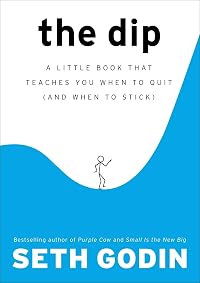
The Dip: A Little Book That Teaches You When to Quit (and When to Stick)
by Seth Godin
On This Page
Description
A New York Times, USA Today, and Wall Street Journal bestseller In this iconic bestseller, popular business blogger and bestselling author Seth Godin proves that winners are really just the best quitters. Godin shows that winners quit fast, quit often, and quit without guilt—until they commit to beating the right Dip. Every new project (or job, or hobby, or company) starts out fun…then gets really hard, and not much fun at all. You might be in a Dip—a temporary setback that will get show more better if you keep pushing. But maybe it’s really a Cul-de-Sac—a total dead end. What really sets superstars apart is the ability to tell the two apart. Winners seek out the Dip. They realize that the bigger the barrier, the bigger the reward for getting past it. If you can beat the Dip to be the best, you’ll earn profits, glory, and long-term security. Whether you’re an intern or a CEO, this fun little book will help you figure out if you’re in a Dip that’s worthy of your time, effort, and talents. The old saying is wrong—winners do quit, and quitters do win. show lessTags
Recommendations


Member Reviews
Good career advice
Horrendous life advice
The entire book talks about how you must focus on one thing, one single thing.
This is not bad advice but he went on to say that if you are not better than the 99% in a thing you must either focus on that thing or abandon it, hobbies included, he went on to say that you have to organize when you will abandon a task and if you will.
This is horrendous advice.
We humans are very bad at making previsions, how do you know if you like piano if you never play it? How do you know that you don't like snowboarding if you have only take a few lessons? Maybe there are certain things that you like at beginners level but not on competitive.
But let say that you know that you will like a thing and you will become show more better than the 99% of people in that thing, there is another problem, just like our body needs varied food in order to remain healthy a healthy mind needs varied sources in order to stay healthy, this is because our brain like to experiment and connect ideas and sources trying to produce something, so having a large number of resources make so your brain has more to connect.
This book gives some good career advice like "even if it is a high paying, high position job, a dead-end is still a dead-end if you want to advance you need to find another job"
And if this was all that the book had to offer I will give it a good 4 star, but there is another problem, this book is too long, people on reviews were not joking when they say that you could read the essence of the book in their review! Why he diluted his book so much I don't know, because of this i will give this book a 3-star rating. show less
Horrendous life advice
The entire book talks about how you must focus on one thing, one single thing.
This is not bad advice but he went on to say that if you are not better than the 99% in a thing you must either focus on that thing or abandon it, hobbies included, he went on to say that you have to organize when you will abandon a task and if you will.
This is horrendous advice.
We humans are very bad at making previsions, how do you know if you like piano if you never play it? How do you know that you don't like snowboarding if you have only take a few lessons? Maybe there are certain things that you like at beginners level but not on competitive.
But let say that you know that you will like a thing and you will become show more better than the 99% of people in that thing, there is another problem, just like our body needs varied food in order to remain healthy a healthy mind needs varied sources in order to stay healthy, this is because our brain like to experiment and connect ideas and sources trying to produce something, so having a large number of resources make so your brain has more to connect.
This book gives some good career advice like "even if it is a high paying, high position job, a dead-end is still a dead-end if you want to advance you need to find another job"
And if this was all that the book had to offer I will give it a good 4 star, but there is another problem, this book is too long, people on reviews were not joking when they say that you could read the essence of the book in their review! Why he diluted his book so much I don't know, because of this i will give this book a 3-star rating. show less
Seth Godin is a master at writing short, powerful, slap-you-in-the-face with inspiration, and put practical tools in your hands books and THE DIP is no exception. He also has a talent for taking patterns and principles and assigning memorable and helpful metaphors to them. It helps make the intangible something you can grab a hold of and use. THE DIP is very much like that as well.
I found this book incredibly helpful and liberating. The bottom line is that quitting is a good thing. At least when it is strategic rather than emotional and/or reactionary and this book helps you learn the difference. The subtitle is “A little book that teaches you when to quit (and when to stick).” That is EXACTLY what it does.
In the concepts presented show more in this book, you will find applications to business as well as your personal life. The metaphor of the Dip and the Cul-De-Sac are easy to grasp and are memorable. They give you a filter through which to view your activities and your projects. I know I will never think of quitting in the same way again.
Favorite Concept: Setting Your Limits Before You Start
Favorite Quote: “The next time you catch yourself being average when you feel like quitting, realize that you have only two good choices: Quit or be exceptional. Average is for losers.”
I will definitely be reading THE DIP again. show less
I found this book incredibly helpful and liberating. The bottom line is that quitting is a good thing. At least when it is strategic rather than emotional and/or reactionary and this book helps you learn the difference. The subtitle is “A little book that teaches you when to quit (and when to stick).” That is EXACTLY what it does.
In the concepts presented show more in this book, you will find applications to business as well as your personal life. The metaphor of the Dip and the Cul-De-Sac are easy to grasp and are memorable. They give you a filter through which to view your activities and your projects. I know I will never think of quitting in the same way again.
Favorite Concept: Setting Your Limits Before You Start
Favorite Quote: “The next time you catch yourself being average when you feel like quitting, realize that you have only two good choices: Quit or be exceptional. Average is for losers.”
I will definitely be reading THE DIP again. show less
I find Seth Godin's work a mix of interesting insights and um-the-real-world-is-more-complicated-than-that.
What I found useful in this book: the reminder that it's okay, and even a good idea, to quit things that aren't getting you anywhere.
What I found dubious:
1. The idea that it'll be obvious whether you're in a dip or a cul-de-sac. Sure, sometimes it will be when you step back and look at it, but I'm not convinced that it's always so clear. (What would Godin have told Madeleine L'Engle on year nine of her ten-year publication dry spell?)
2. Godin's apparent belief that there's no place in the world for a "best Renaissance man/woman" -- that the world has only room for specialists, and that there's no place for someone whose skills and show more knowledge are shallow but broad, no place for someone who can say "Hey, this thing in this field connects with that thing in that field; what happens if we work with that connection?"
3. Even for ultra-focused people, is their one specialty *really* the only thing they should be trying to be best at? You can either be the best programmer in the world or the best parent your child has, so you're going to quit the parent part because your spouse does better at that anyway? Really?
4. And ultimately, while the message that it's okay to quit is one I need, I think Godin goes too far. I'm not the best knitter in the world and unlikely to ever be. According to Godin, I should therefore quit knitting, despite the enjoyment I get from it. I'm not the best singer in the world and never will be, and therefore I shouldn't waste my time joining a community choir. I'm not going to be the best Spanish speaker in the world, so I shouldn't bother trying to learn a few phrases. Well, in that case, I don't want to be the best in the world in a single area, to the exclusion of all else; I want to be the best in the world at combining the activities and pursuits and maintenance that make my life a happy one.
So, an intereting and quick read, but on reflection, not one that's going to stay with me. show less
What I found useful in this book: the reminder that it's okay, and even a good idea, to quit things that aren't getting you anywhere.
What I found dubious:
1. The idea that it'll be obvious whether you're in a dip or a cul-de-sac. Sure, sometimes it will be when you step back and look at it, but I'm not convinced that it's always so clear. (What would Godin have told Madeleine L'Engle on year nine of her ten-year publication dry spell?)
2. Godin's apparent belief that there's no place in the world for a "best Renaissance man/woman" -- that the world has only room for specialists, and that there's no place for someone whose skills and show more knowledge are shallow but broad, no place for someone who can say "Hey, this thing in this field connects with that thing in that field; what happens if we work with that connection?"
3. Even for ultra-focused people, is their one specialty *really* the only thing they should be trying to be best at? You can either be the best programmer in the world or the best parent your child has, so you're going to quit the parent part because your spouse does better at that anyway? Really?
4. And ultimately, while the message that it's okay to quit is one I need, I think Godin goes too far. I'm not the best knitter in the world and unlikely to ever be. According to Godin, I should therefore quit knitting, despite the enjoyment I get from it. I'm not the best singer in the world and never will be, and therefore I shouldn't waste my time joining a community choir. I'm not going to be the best Spanish speaker in the world, so I shouldn't bother trying to learn a few phrases. Well, in that case, I don't want to be the best in the world in a single area, to the exclusion of all else; I want to be the best in the world at combining the activities and pursuits and maintenance that make my life a happy one.
So, an intereting and quick read, but on reflection, not one that's going to stay with me. show less
Godin has a talent for distilling obvious things into pithy little books, because sometimes people need to be reminded of obvious things; myself not excluded.
Review from my blog, This Space Intentionally Left Blank
Most of the time, we deal with obstacles by persevering. Sometimes we get discouraged and turn to inspirational writing, like stuff from Vince Lombardi: "Quitters never win and winners never quit." Bad advice. Winners quit all the time. They just quit the right stuff at the right time.
Review from my blog, This Space Intentionally Left Blank
Godin is a marketing guru & prolific blogger. This book is about 78 pages, so it reads more like a long blog post and you can read it in less than an hour.
The "dip" Godin refers to is that point in any activity where the activity becomes difficult and requires serious commitment to complete. Becoming a CPA, or learning to surf, or getting a PhD are some examples of activities with serious dips. You enter into the subject area with zeal & interest and then probably quit when the going gets tough. And this is stupid because if you were mature, you'd have not gotten into the activity to begin with (not bought a surfboard, for example). And if you just hang on and determine to be the best in the world, then you'll be a scarce and valuable show more commodity. Quitting in the middle of the dip is often stupid, but we do it all the time.
The book is about quitting those tasks at which you're not going to be the best in the world at in order to focus on other areas where you WILL become the best in the world at. That's your goal: Be the very best there is. You should also quit your dead-end job and look for one that you can move upward with.
There's nothing really insightful in this book, just a way to evaluate where you're at in your job, career, etc. But Godin assumes that career is the most important thing. He counsels one person to quit because that person has achieved stability at his current job. The fact that the guy now can spend more time with his family after seriously making them sacrifice for him for years doesn't factor into Godin's advice. In fact, Godin basically says "Yuck, apple pie is mediocrity. Quit your job and take risks again." The guy probably could have kept his good job and instead worked on stepping up his game as far as his commitment to wife, children, community, etc. I'm reminded of many of Nassim Taleb's almost daily tweet snipes about business writing.
I give it about 2.5 stars out of 5. If you have an hour to kill in a Barnes & Noble somewhere, then check it out. show less
The "dip" Godin refers to is that point in any activity where the activity becomes difficult and requires serious commitment to complete. Becoming a CPA, or learning to surf, or getting a PhD are some examples of activities with serious dips. You enter into the subject area with zeal & interest and then probably quit when the going gets tough. And this is stupid because if you were mature, you'd have not gotten into the activity to begin with (not bought a surfboard, for example). And if you just hang on and determine to be the best in the world, then you'll be a scarce and valuable show more commodity. Quitting in the middle of the dip is often stupid, but we do it all the time.
The book is about quitting those tasks at which you're not going to be the best in the world at in order to focus on other areas where you WILL become the best in the world at. That's your goal: Be the very best there is. You should also quit your dead-end job and look for one that you can move upward with.
There's nothing really insightful in this book, just a way to evaluate where you're at in your job, career, etc. But Godin assumes that career is the most important thing. He counsels one person to quit because that person has achieved stability at his current job. The fact that the guy now can spend more time with his family after seriously making them sacrifice for him for years doesn't factor into Godin's advice. In fact, Godin basically says "Yuck, apple pie is mediocrity. Quit your job and take risks again." The guy probably could have kept his good job and instead worked on stepping up his game as far as his commitment to wife, children, community, etc. I'm reminded of many of Nassim Taleb's almost daily tweet snipes about business writing.
I give it about 2.5 stars out of 5. If you have an hour to kill in a Barnes & Noble somewhere, then check it out. show less
The thesis of the book: whatever you’re doing, there will be a sucky part (“the dip”). When you hit it, you have to decide if you want to push through it to get what’s on the other side or not. You also have to evaluate whether there is an “other side” or if you’ve hit a dead end (“cul du sac”)
It’s not a bad message but it’s written in a stereotypical workaholic “hustle culture” tone and language, hence the rating.
In this worldview, “quitting” anything is bad and a sign of weakness so a huge chunk of this book is convincing hustle culture people to “quit” things that might distract them from their true goals, or to quit pursuits that aren’t getting results .
At the same time it says if you don’t quit show more things, then there’s untold rewards at the other side.
I don’t think the author intended this as some sort of “reverse psychology” contradiction — i just don’t think he worked the messaging out very well on it.
(Also, in 2023 the dated internet references are pretty fun!) show less
It’s not a bad message but it’s written in a stereotypical workaholic “hustle culture” tone and language, hence the rating.
In this worldview, “quitting” anything is bad and a sign of weakness so a huge chunk of this book is convincing hustle culture people to “quit” things that might distract them from their true goals, or to quit pursuits that aren’t getting results .
At the same time it says if you don’t quit show more things, then there’s untold rewards at the other side.
I don’t think the author intended this as some sort of “reverse psychology” contradiction — i just don’t think he worked the messaging out very well on it.
(Also, in 2023 the dated internet references are pretty fun!) show less
¿Para qué escribir un buen post largo si puedes alargarlo innecesariamente hasta convertirlo en un mal libro corto? En este libro de 80 páginas hay unas 10 buenas, y el resto es relleno o repetición. The Dip es el bajón, las dificultades que aparecen cuando la curva de aprendizaje empieza a no ser tan agradable, se trate de la actividad que se trate: aprender un idioma, pilotar un avión, dominar un nuevo lenguaje de programación, química orgánica. Cuando empezamos con una actividad nueva los progresos se ven, se perciben diariamente, hasta que no. llegamos al Dip, a la zona del bajón. Y el autor sostiene, y ésta es la principal idea del libro, que al alcanzar ese punto hay que abandonar muchas veces. Pero abandonar show more conscientemente, como táctica de combate.
Hay un dicho en inglés que es Winners never quit, quitters never win, con la que el autor no puede estar más en desacuerdo. De hecho además del dip mete otros dos tipos de evolución en una actividad (un trabajo, unos estudios...): el callejón sin salida y el precipicio. El callejón sin salida es aquella actividad en la que vemos que no mejoraremos con el paso del tiempo. Aquella en la que vemos que podemos quedar instalados en la mediocridad cuando hayamos echado todo nuestro esfuerzo. Y también habla del precipicio, que esa aquella actividad de la que no podemos escapar hasta que reviente y todo finalice de manera catastrófica.
Al autor anima a buscar callejones sin salida y precipicios en las actividades en las que estamos involucrados, y abandonar inmediatamente cuando percibamos una de las dos. Y si estamos en el bajón, aguantarlo, forzarlo, obligarnos a sacar todo lo posible de él. Si es algo que merezca la pena, probablemente contiene un Dip. Y la frase de "no abandones nunca" la reescribe como "no abandones nunca algo que estratégicamente es bueno a largo plazo solo por as dificultades que estás teniendo a corto plazo". Abandonar solo porque llegamos al Dip es un error.
No hay que ser el primero en todo, solo en una cosa. A nadie le interesa que un buen piloto sea capaz además de analizar la literatura francesa del XIX.
El libro tiene algunas buenas ideas sueltas más. Se agradecería algo menos de repetición, pero entonces ya ni siquiera podría ser un libro corto. show less
Hay un dicho en inglés que es Winners never quit, quitters never win, con la que el autor no puede estar más en desacuerdo. De hecho además del dip mete otros dos tipos de evolución en una actividad (un trabajo, unos estudios...): el callejón sin salida y el precipicio. El callejón sin salida es aquella actividad en la que vemos que no mejoraremos con el paso del tiempo. Aquella en la que vemos que podemos quedar instalados en la mediocridad cuando hayamos echado todo nuestro esfuerzo. Y también habla del precipicio, que esa aquella actividad de la que no podemos escapar hasta que reviente y todo finalice de manera catastrófica.
Al autor anima a buscar callejones sin salida y precipicios en las actividades en las que estamos involucrados, y abandonar inmediatamente cuando percibamos una de las dos. Y si estamos en el bajón, aguantarlo, forzarlo, obligarnos a sacar todo lo posible de él. Si es algo que merezca la pena, probablemente contiene un Dip. Y la frase de "no abandones nunca" la reescribe como "no abandones nunca algo que estratégicamente es bueno a largo plazo solo por as dificultades que estás teniendo a corto plazo". Abandonar solo porque llegamos al Dip es un error.
No hay que ser el primero en todo, solo en una cosa. A nadie le interesa que un buen piloto sea capaz además de analizar la literatura francesa del XIX.
El libro tiene algunas buenas ideas sueltas más. Se agradecería algo menos de repetición, pero entonces ya ni siquiera podría ser un libro corto. show less
Members
- Recently Added By
Author Information

137+ Works 15,418 Members
Bestselling business book author, entrepreneur, and speaker Seth Godin was born on July 10, 1960. He graduated from Tufts University in 1982 and earned an MBA in marketing from Stanford Business School. Godin worked as a brand manager for Spinnaker Software and founded his own book packaging business, followed by the online marketing company show more Yoyodyne. He was a vice president of direct marketing for Yahoo, and in 2006 he launched the popular community website Squidoo. (Bowker Author Biography) show less
Awards and Honors
Distinctions
Common Knowledge
- Canonical title*
- Basta!
- Original title
- The Dip
*Some information comes from Common Knowledge in other languages. Click "Edit" for more information.
Classifications
Statistics
- Members
- 1,659
- Popularity
- 13,556
- Reviews
- 49
- Rating
- (3.42)
- Languages
- 8 — Bulgarian, Dutch, English, French, Italian, Korean, Portuguese, Turkish
- Media
- Paper, Audiobook, Ebook
- ISBNs
- 17
- ASINs
- 6