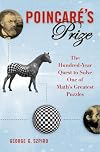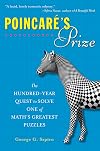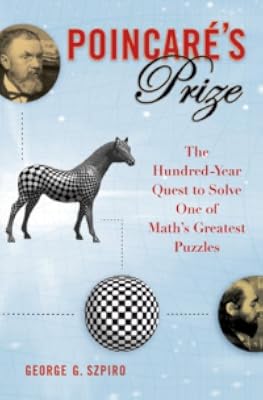
Poincare's Prize: The Hundred-Year Quest to Solve One of Math's Greatest Puzzles
by George G. Szpiro
On This Page
Description
"The Poincare Conjecture was a holy grail to mathematicians around the world. Decade after decade, the unproven theorem that would help us understand higher dimensional space and, possibly, the shape of the universe defied every effort to solve it. Now, after more than a century, an eccentric Russian recluse has found the solution to one of the seven greatest math problems of our time, earning the right to claim the first one-million-dollar Millennium math prize." "George Szpiro begins his show more masterfully told story in 1904 when Frenchman Henri Poincare formulated a conjecture about a seemingly simple problem. Imagine an ant crawling around on a large surface. How would it know whether the surface is a flat plane, a round sphere, or a bagel-shaped object? The ant would need to lift off from the surface to observe the object from afar, so how could one prove the shape was spherical without actually seeing it? Raise the surface to the next higher dimension, and you have the problem that Poincare sought to solve." "In fact, Poincare thought he had solved it but soon realized his proof was flawed. Across generations and around the globe, from China to Texas, great minds stalked the solution in the wilds of higher dimensions."--BOOK JACKET. show lessTags
Recommendations


Member Recommendations
Member Reviews
A very interesting history of the field of topology from its beginnings in Poincare's time through the present, when one of its most elusive mysteries was finally proven for all dimensions. There are no equations in the book, but one does have to be able to visualize some complex topography to follow some of the more challenging arguments.
While I found the history, the math, and the characters fascinating, I finished the book feeling that the forest was lost for the trees. A lot of time was spent on the stepping stones, blind alleys, and breakthroughs on the way to the proof, little time was spent describing the implications of the conjecture. In the jacket notes, and a little in the introduction, it is promised that if proven true, show more then the conjecture it would make it possible to know the shape of our universe.
I would have given the book an extra star if, after wading through the patient and careful explanation of topography and the conjecture, there was one more chapter that had taken that knowledge, stepped back, and shown the implications of the Poincare Theorem in the context of the geometry of the universe and how the tools developed in the proof could be used to determine if the universe is flat, spherical, hyperbolic, or other.
Other than that quibble, a very enjoyable and engaging book. show less
While I found the history, the math, and the characters fascinating, I finished the book feeling that the forest was lost for the trees. A lot of time was spent on the stepping stones, blind alleys, and breakthroughs on the way to the proof, little time was spent describing the implications of the conjecture. In the jacket notes, and a little in the introduction, it is promised that if proven true, show more then the conjecture it would make it possible to know the shape of our universe.
I would have given the book an extra star if, after wading through the patient and careful explanation of topography and the conjecture, there was one more chapter that had taken that knowledge, stepped back, and shown the implications of the Poincare Theorem in the context of the geometry of the universe and how the tools developed in the proof could be used to determine if the universe is flat, spherical, hyperbolic, or other.
Other than that quibble, a very enjoyable and engaging book. show less
Necessarily shallow, but the author tries harder than most popular math articles, which I appreciated. The dozens of capsule biographies (born in xxxx, son of xxxx, went to high school at xxxx, etc.) were extremely tedious and almost useless for learning anything about the people involved. With that said, it was a very fast read, and enjoyable enough.
Interesting history of an abstruse mathematical conjecture. I would have preferred more mathematical explanation, but that would make it less accessible.
The writing is mediocre, and in particular, the author should work on trying to be cute less often. There were too many attempts at neat turns of phrase or jokes that completely fell flat. Write well, but don't call attention to yourself.
More importantly, though, the mathematical descriptions were lacking! I know it's a hard subject, but if I couldn't follow what was going on mathematically, I don't know how people without a math major under their belts could. If this were more of a human drama story, then the mediocre math would be fine, but the human drama doesn't really get started until the last fifty pages or so, with petty squabbles over priority and disses in print and journal publication procedures.
The author seems to try to get show more human drama flowing in the early pages, as every single mathematician mentioned gets a few paragraphs of biographical information, but dozens of snippets of encyclopedia-type information do not add up to an interesting story.
Finally, does the author have a point? I couldn't find one. I guess the argument is that it's just a biography of a math problem, but good biographies have, if not necessarily something as full-blown as a thesis, at least a point. And I fail to see the point of this book. show less
More importantly, though, the mathematical descriptions were lacking! I know it's a hard subject, but if I couldn't follow what was going on mathematically, I don't know how people without a math major under their belts could. If this were more of a human drama story, then the mediocre math would be fine, but the human drama doesn't really get started until the last fifty pages or so, with petty squabbles over priority and disses in print and journal publication procedures.
The author seems to try to get show more human drama flowing in the early pages, as every single mathematician mentioned gets a few paragraphs of biographical information, but dozens of snippets of encyclopedia-type information do not add up to an interesting story.
Finally, does the author have a point? I couldn't find one. I guess the argument is that it's just a biography of a math problem, but good biographies have, if not necessarily something as full-blown as a thesis, at least a point. And I fail to see the point of this book. show less
Bon livre de vulgarisation . Malheureusement mes pauvres connaissances en algèbres et en géométrie ne m'ont pas permis de suivre l’évolution des démonstrations au fil du livre.
A relire dés que possible !
A relire dés que possible !
Avreste mai pensato che il percorso storico e teorico che ha portato alla soluzione di questa celebre congettura, potrebbe assumere i contorni di un romanzo giallo? In questo libro alla storia matematica si intreccia, infatti, anche l'enigma della figura di Perelman, il matematico russo che riuscì a dimostrare la congettura, ma che ancora rifiuta qualunque riconoscimento.
Jan 16, 2009Italian
J’ai gardé un très agréable souvenir d’une lointaine lecture du livre de Simon Singh Le dernier théorème de Fermat. Ce souvenir m’est revenu en mémoire lorsque chez mon libraire, en passant devant la section scientifique, j’ai aperçu La Conjecture de Poincaré sur la table des suggestions. Je n’ai pas hésité une seconde et me suis emparé du volume sans même jeter un oeil à la quatrième de couverture. Le nom de Poincaré parle à tout le monde car nous avons en mémoire le patronyme de l’ancien président de la république. La confusion n’est pas si grande car Raymond Poincaré, le président, était le cousin d’Antoine, l’ingénieur et mathématicien, dont il est question dans ce livre. Comme beaucoup de show more génies il fut très prolifique bien qu’il eut la réputation de prendre des raccourcis. Certaines parties des démonstrations lui paraissaient tellement évidentes qu’il ne prenait pas la peine de les traiter en profondeur. Ce comportement — vous le constaterez en lisant ce livre — lui a parfois joué des tours.
La conjecture dont il est question faisait partie des sept “problèmes du prix du millénaire” qui sont censés être des défis mathématiques insurmontables. Contrairement au théorème de Fermat qui est assez simple à énoncer et à comprendre, la conjecture de Poincaré l’est beaucoup moins pour le profane que je suis. Elle concerne un domaine particulier des mathématiques connu sous le nom de topologie algébrique et plus particulièrement un objet appelé sphère de dimension trois. J’avoue bien humblement ne pas avoir tout compris aux diverses explications mathématiques et aux — malheureuses — tentatives de vulgarisation entreprises par l’auteur. Il faut dire que la géométrie n’a jamais été mon fort en deux dimensions alors lorsqu’il s’agit d’évoluer dans des dimensions supérieures à trois, je jette vite l’éponge. Mais, j’ai trouvé que l’intérêt du livre ne résidait pas là — heureusement pour moi. J’ai pris beaucoup de plaisir à suivre l’histoire de cette conjecture au fil des années. Découvrir le nombre de savants qui ont planché sur ce problème est assez impressionnant — si l’on arrivait à comptabiliser le nombre d’heures passées, le total serait faramineux.
Il faut dire que George Szpiro rend cette aventure scientifique agréable et fait preuve d’un certain talent pour nous faire découvrir tous ces hommes — la parité n’existe pas dans le domaine des mathématiques — grâce à de petites notices biographiques très instructives et distrayantes. Le ton employé par l’auteur est presque enjoué ce qui n’est pas choquant si l’on considère que les mathématiques, en plus d’être une science très sérieuse, peuvent aussi parfois ressembler à un jeu pour de grands enfants.
Si vous n’avez pas de solides connaissances en mathématiques et que vous souhaitez tout de même lire ce livre, il vous faudra accepter — je le crains — de ne pas tout comprendre. J’avoue que c’est un peu gênant à la longue, mais l’expérience vaut quand même le coup même si ce livre reste bien moins abordable que celui de Simon Singh que je conseille, quant à lui, sans réserve. http://www.aubonroman.com/2014/04/la-conjecture-de-poincare-par-george.html show less
La conjecture dont il est question faisait partie des sept “problèmes du prix du millénaire” qui sont censés être des défis mathématiques insurmontables. Contrairement au théorème de Fermat qui est assez simple à énoncer et à comprendre, la conjecture de Poincaré l’est beaucoup moins pour le profane que je suis. Elle concerne un domaine particulier des mathématiques connu sous le nom de topologie algébrique et plus particulièrement un objet appelé sphère de dimension trois. J’avoue bien humblement ne pas avoir tout compris aux diverses explications mathématiques et aux — malheureuses — tentatives de vulgarisation entreprises par l’auteur. Il faut dire que la géométrie n’a jamais été mon fort en deux dimensions alors lorsqu’il s’agit d’évoluer dans des dimensions supérieures à trois, je jette vite l’éponge. Mais, j’ai trouvé que l’intérêt du livre ne résidait pas là — heureusement pour moi. J’ai pris beaucoup de plaisir à suivre l’histoire de cette conjecture au fil des années. Découvrir le nombre de savants qui ont planché sur ce problème est assez impressionnant — si l’on arrivait à comptabiliser le nombre d’heures passées, le total serait faramineux.
Il faut dire que George Szpiro rend cette aventure scientifique agréable et fait preuve d’un certain talent pour nous faire découvrir tous ces hommes — la parité n’existe pas dans le domaine des mathématiques — grâce à de petites notices biographiques très instructives et distrayantes. Le ton employé par l’auteur est presque enjoué ce qui n’est pas choquant si l’on considère que les mathématiques, en plus d’être une science très sérieuse, peuvent aussi parfois ressembler à un jeu pour de grands enfants.
Si vous n’avez pas de solides connaissances en mathématiques et que vous souhaitez tout de même lire ce livre, il vous faudra accepter — je le crains — de ne pas tout comprendre. J’avoue que c’est un peu gênant à la longue, mais l’expérience vaut quand même le coup même si ce livre reste bien moins abordable que celui de Simon Singh que je conseille, quant à lui, sans réserve. http://www.aubonroman.com/2014/04/la-conjecture-de-poincare-par-george.html show less
Apr 15, 2014French
Members
- Recently Added By
Author Information
14 Works 637 Members
Awards and Honors
Distinctions
Series
Belongs to Publisher Series
Common Knowledge
- Original publication date
- 2007
- People/Characters
- Henri Poincaré; Grigory Perelman
- Dedication
- Dedicated to Grisha Perelman, a man of rare genius and modesty. His devotion to mathematics and his refusal to let glory get the better of him are admirable.
- First words
- August is not the best time of year to visit Spain.
- Last words
- (Click to show. Warning: May contain spoilers.)Let's allow the magnificent enterprise to continue.
- Blurbers
- Adams, Colin
Classifications
Statistics
- Members
- 252
- Popularity
- 129,053
- Reviews
- 8
- Rating
- (3.28)
- Languages
- 6 — English, French, German, Italian, Japanese, Portuguese
- Media
- Paper, Ebook
- ISBNs
- 10
- ASINs
- 3