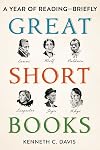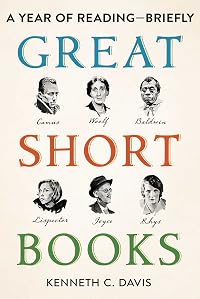
Great Short Books: A Year of Reading―Briefly
by Kenneth C. Davis
On This Page
Description
An entertaining guide to some of the best short novels of all time looks at works from the eighteenth century to the present day, spanning multiple genres, cultures, and countries. Davis provides a guide to some of the best short novels of all time. The works span from the eighteenth century to the present day, covering multiple genres, cultures, and countries, and are arranged alphabetically by title. Each short (4-to-6 pages) profile includes the first lines of the work, a brief plot show more summery, information about the author, and Davis's opinion on why you should read the book-- and what you should read next. -- adapted from perusal of book show lessTags
Recommendations











Member Reviews
Why isn’t more attention given to short books? Davis suggests they’re the literature equivalent to stand-up comedian Rodney Dangerfield’s signature line. They get no respect.
LibraryThing colleagues who have perused my reviews know I have a penchant for shorter books. I’ve lost count of the number of times I’ve critiqued works in the 350-to 500-page tier by suggesting that a word-slashing editor could have dramatically improved the final product. Hence, it’s no surprise that I thoroughly enjoyed Davis’ thumbnail summaries of 58 short books — most of them under 200 pages.
Of course, there were some predictable entries (“The Great Gatsby,” “Animal Farm,” “The Stranger,” etc.) There are also a handful of classics show more I’ve long viewed as over-rated (Sorry, Ernie, “The Old Man and the Sea” was a total slog — even in its brevity).
Although, I wish the author had included more works, his efforts helped me to compile a list of nearly a dozen recommended reads. They include “Sula,” “The Ghost Writer,” “The Lathe of Heaven” and “Agostino.”
While I agree with some who suggest that Davis’ summaries are a bit dry, I loved the book’s user-friendly format. Each entry, organized alphabetically, begins with the first lines of the book, serves up a plot summary, shares details about the author and has a section titled “Why You Should Read it.” Each entry ends with suggestions on what to read next.
Speaking of endings, my time is up. Writing a long review about a tome that touts the virtues of short books would border on hypocrisy. show less
LibraryThing colleagues who have perused my reviews know I have a penchant for shorter books. I’ve lost count of the number of times I’ve critiqued works in the 350-to 500-page tier by suggesting that a word-slashing editor could have dramatically improved the final product. Hence, it’s no surprise that I thoroughly enjoyed Davis’ thumbnail summaries of 58 short books — most of them under 200 pages.
Of course, there were some predictable entries (“The Great Gatsby,” “Animal Farm,” “The Stranger,” etc.) There are also a handful of classics show more I’ve long viewed as over-rated (Sorry, Ernie, “The Old Man and the Sea” was a total slog — even in its brevity).
Although, I wish the author had included more works, his efforts helped me to compile a list of nearly a dozen recommended reads. They include “Sula,” “The Ghost Writer,” “The Lathe of Heaven” and “Agostino.”
While I agree with some who suggest that Davis’ summaries are a bit dry, I loved the book’s user-friendly format. Each entry, organized alphabetically, begins with the first lines of the book, serves up a plot summary, shares details about the author and has a section titled “Why You Should Read it.” Each entry ends with suggestions on what to read next.
Speaking of endings, my time is up. Writing a long review about a tome that touts the virtues of short books would border on hypocrisy. show less
During the pandemic, author Davis, of “Don’t Know Much About…” series fame, found relief from anxiety through short fiction. He selected his top 58 to profile in this book. With only a couple of exceptions, the books are less than 200 pages in length. The book profiles include the opening lines, a non-spoilery plot summary, an author bio, a case for why you should read the book, and recommendations for what to read next.
Although the featured books are short, they’re not what I would consider light reading. The authors include Chinua Achebe, Margaret Atwood, Albert Camus, J. M. Coetzee, Ernest Hemingway, Kazuo Ishiguro, Thomas Mann, Toni Morrison, and Aleksandr Solzhenitsyn. This book would be a good guide for readers who want show more to sample the works of lots of heavyweight writers within a relatively short span of time. show less
Although the featured books are short, they’re not what I would consider light reading. The authors include Chinua Achebe, Margaret Atwood, Albert Camus, J. M. Coetzee, Ernest Hemingway, Kazuo Ishiguro, Thomas Mann, Toni Morrison, and Aleksandr Solzhenitsyn. This book would be a good guide for readers who want show more to sample the works of lots of heavyweight writers within a relatively short span of time. show less
I really like how this book is organized: each entry has the first lines, a robust plot summary, information about the author, an explanation of why the book should be read, and suggestions on what to read next.
I was less enthralled with the content, as I had read over half of the works Davis discusses. Still, I'm sure it will inspire others to pick up some good books that can be read in a few hours.
Received via NetGalley.
I was less enthralled with the content, as I had read over half of the works Davis discusses. Still, I'm sure it will inspire others to pick up some good books that can be read in a few hours.
Received via NetGalley.
Mini-essays introducing readers to iconic and rediscovered
these are a compilation of stories by the great writers of the past , well done , enjoyed all the stories and would recommend this if you want to dip your toe in and see who's style of writing you may like to deep dive into .
Ratings
Members
- Recently Added By
Published Reviews
It’s time to remedy the fact that short novels “get no respect,” according to this thoughtful survey from historian Davis (Two-Bit Culture: The Paperbacking of America). Brief novels, which usually land between 100 and 200 pages, are “like a great first date... pleasant, even exciting, and memorable,” he writes. “But there is no long-term commitment.” Davis presents one short show more novel for every week of the year, “plus six bonus books” and follows the same format for each entry: he quotes the opening paragraph of the book, before offering a (spoiler-free) plot summary, a biographical essay on the author, a “why you should read it” assessment, and a list of things to read next by the author....Davis’s conversational tone makes him a great guide to these literary aperitifs. This is sure to leave book lovers with something new to add to their lists. show less
added by Lemeritus
Davis, who has written numerous books about literature and history, believes that books of less than 200 pages can be a good antidote to our troubled times and the stream of doom-laden news. For each of the 58 books on his list, which make up a year’s worth of quality literature, he provides a plot summary, a brief biography of the author, the first paragraph of the book, “Why You Should show more Read It,” and “What To Read Next.” ... Davis admits that there are many good novels that he did not include (he provides a supplementary list of titles in an appendix), but his love of books and reading shines through. From 1759 (Candide) to 2019 (The Nickel Boys), he’s got you covered. An entertaining journey with a fun, knowledgeable guide. show less
added by Lemeritus
Lists

Great Short Books: A Year of Reading-Briefly
59 works; 4 members

On Books
70 works; 1 member
Author Information

39 Works 15,438 Members
Kenneth C. Davis is an American popular historian, best known for his Don't Know Much About... series. Born in Mount Vernon, New York, Davis attended Concordia College, Bronxville in New York, and Fordham University at Lincoln Center, New York City. Davis's second book, Don't Know Much About History, spent 35 consecutive weeks on The New York show more Times bestseller list and sold nearly 1.5 million copies. This unexpected success launched the Don't Know Much About... series. (Bowker Author Biography) show less
Awards and Honors
Distinctions
Common Knowledge
- Epigraph
- In these tales will be found a variety of love adventures, bitter as well as pleasing, and other exciting incidents, which took place in both ancient and modern times -Boccaccio, The Decameron
There should therefore be a time in adult life devoted to revisiting the most important books of our youth. -Italo Calvino, "Why Read the Classics?"
17. Omit needless words -William Strunk Jr. and E.B. White, The Elements of Style - First words
- Time. We all wish we had more of it. To do errands. To hit the gym or take a long walk. To bake bread or whip up that recipe we clipped last year. And, maybe, simply read. The intrusion of the screen - first the big ones in o... (show all)ur living rooms, then those sitting on our desk, and finally, the little ones many of us carry around - has made it more challenging to make space for the simple joy of getting lost in a book. -Introduction, Notes of a Common Reader
- Canonical DDC/MDS
- 011.73
- Canonical LCC
- Z1035.9
Classifications
- Genres
- Literature Studies and Criticism, Nonfiction
- DDC/MDS
- 011.73 — Computer science, information & general works Bibliographies (books containing lists of books) Bibliographies by Authors Specific kinds of contents Best books
- LCC
- Z1035.9 — Bibliography, Library Science and Information Resources General bibliography Best books
- BISAC
Statistics
- Members
- 143
- Popularity
- 229,056
- Reviews
- 5
- Rating
- (3.97)
- Languages
- English
- Media
- Paper, Audiobook, Ebook
- ISBNs
- 6
- ASINs
- 2