On This Page
Description
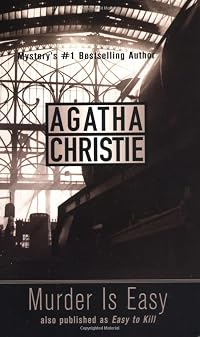
Luke Fitzwilliam does not believe Miss Pinkerton's wild allegation that a multiple murderer is at work in the quiet English village of Wychwood and that her local doctor is next in line. But within hours, Miss Pinkerton has been killed in a hit-and-run car accident. Mere coincidence? Luke is inclined to think so-until he reads in the Times of the unexpected demise of Wychwood's Dr. Humbleby.… This title was previously published as Easy to Kill.Tags
Recommendations


















Member Reviews
'Murder Is Easy' was new to me and I enjoyed it for its freshness and its distinctive tone of quiet menace. This is a book about subversive, powerful, determined women - the kind who, in earlier times, in their village of Wychwood, would have been branded as witches. It is a warning to men who underestimate the older, invisible women or who accept the exterior image of the young, attractive ones. It's a book in which most men are fools or tools or both. There's a sort of proto-Marple feel to the book except that while these village women, like Jane Marple, miss nothing, they feel entitled and perhaps obliged to intervene in events and force them to a conclusion.
I think that Christie deliberately masks the subversive, show more never-mind-the-patriarchy-it's-the-women-pulling-the-strings nature of 'Murder Is Easy' by having a man as the hero. Fitzwilliam is a 'rude colonial', blinkered by a Public School education, an outdated understanding of England, no recent personal experience of English women, a romantic streak a mile wide a middling intellect and the limited imagination of a plodding policeman. When the book came out in 1939, I imagine that Fitzwilliam would have made the male readers feel comfortable while the women readers saw right through him.
As usual with Agatha Christie's books, 'Murder Is Easy' is ripe with good candidates for being the hand behind the killings. I was happily mislead a number of times and kept revisiting my own assessments of people. I found the absence of a clever detective quite liberating. I didn't have to wade through their logic or put up with their mannerisms (OK, so I find Poirot annoying and Marple scary. I refuse to be ashamed of that.). It seemed as if this opened up the possibilities in the book and apart from the too-hapless-to-be-dangerous Fitzwilliam, left me with no safe place to stand.
Like other Christie books, this one has some into-love in it. I didn't believe it. I never do. But, this time, I don't think I was meant to. It seems to me that while Luke Fitzwilliam, a man with very little experience of women and now in search of a wife, might easily convince himself of love at first sight, Bridget Conway's far too strong-willed and intelligent and has too great a sense of her own worth, to entertain the idea. My favourite image in the book is of Conway, head down, in the witches' field, thinking. It's the only time we see her when she isn't presenting herself to create a particular impression. It's an image of quiet, independent strength accustomed to reflection. Fitzwilliam should have known then that he was in over his head. I think I was meant to see Conway as a woman who having fully understood the cost of her future comfort, has decided to change course and hitch a ride with a man she knew that she could out-think and, if necessary, replace later.
I listened to the audiobook version of 'Murder Is Easy', narrated by Gemma Whelan, who did an excellent job. I recommend this version rather than the Hugh Fraser version because this is a book that needs strong female voices and Gemma Whelan provides them. Click on the SoundCloud link below to hear a sample.
https://soundcloud.com/harpercollinspublishers/murder-is-easy-by-agatha-1?utm_so... show less
I think that Christie deliberately masks the subversive, show more never-mind-the-patriarchy-it's-the-women-pulling-the-strings nature of 'Murder Is Easy' by having a man as the hero. Fitzwilliam is a 'rude colonial', blinkered by a Public School education, an outdated understanding of England, no recent personal experience of English women, a romantic streak a mile wide a middling intellect and the limited imagination of a plodding policeman. When the book came out in 1939, I imagine that Fitzwilliam would have made the male readers feel comfortable while the women readers saw right through him.
As usual with Agatha Christie's books, 'Murder Is Easy' is ripe with good candidates for being the hand behind the killings. I was happily mislead a number of times and kept revisiting my own assessments of people. I found the absence of a clever detective quite liberating. I didn't have to wade through their logic or put up with their mannerisms (OK, so I find Poirot annoying and Marple scary. I refuse to be ashamed of that.). It seemed as if this opened up the possibilities in the book and apart from the too-hapless-to-be-dangerous Fitzwilliam, left me with no safe place to stand.
Like other Christie books, this one has some into-love in it. I didn't believe it. I never do. But, this time, I don't think I was meant to. It seems to me that while Luke Fitzwilliam, a man with very little experience of women and now in search of a wife, might easily convince himself of love at first sight, Bridget Conway's far too strong-willed and intelligent and has too great a sense of her own worth, to entertain the idea. My favourite image in the book is of Conway, head down, in the witches' field, thinking. It's the only time we see her when she isn't presenting herself to create a particular impression. It's an image of quiet, independent strength accustomed to reflection. Fitzwilliam should have known then that he was in over his head. I think I was meant to see Conway as a woman who having fully understood the cost of her future comfort, has decided to change course and hitch a ride with a man she knew that she could out-think and, if necessary, replace later.
I listened to the audiobook version of 'Murder Is Easy', narrated by Gemma Whelan, who did an excellent job. I recommend this version rather than the Hugh Fraser version because this is a book that needs strong female voices and Gemma Whelan provides them. Click on the SoundCloud link below to hear a sample.
https://soundcloud.com/harpercollinspublishers/murder-is-easy-by-agatha-1?utm_so... show less
Well, this was great fun! Murder is Easy seemed to be Agatha Christie having great fun as well, more freewheeling outside the confines of Hercule Poirot or Miss Marple. Even the Bells and Motley is mentioned here, which all Christie fans will be familiar with if they’ve read her wonderfully atmospheric Mr. Quin stories, featuring Mr. Satterthwaite. All throughout, I felt Christie was giving a quaint nod of sorts to her legendary paramour across the pond, Mary Roberts Rinehart. While the immediacy of the narrative is non-reflective, the reader certainly gets that had they but known vibe by the end of this one.
The premise is a dandy: a man going home to England meets an old auntie type on the train he finds himself on due to his show more preoccupation with winning a horse race. After mentioning to Luke Fitzwilliam that Miss Pinkerton has a friend whose son has just joined the police force in Palestine, he reveals to her that he too, had been a policeman, in the Mayang Straits. This opens the floodgates, as Miss Lavina Pinkerton reveals she is on her way to Scotland Yard, because she suspects several recent deaths in her village of Wychwood-under-Ashe to be murder; moreover, she knows who committed them. Her conclusion in regard to how she knows this seems very superficial, very aunt-like, causing Luke to smile and peg it as harmless imagination. But later, he discovers she was run down by a hit-and-run driver on the way there, and further, the man she named as the next victim, Dr. Humbleby, has suddenly perished.
Well, of course Luke must find out if there’s anything to it; he liked the old gal, and is perhaps feeling guilty that no matter how preposterous it may have sounded, Miss Lavina Pinkerton may have been onto something. And for the reader, the fun begins. Luke heads down to Wychwood under pretense, imbedding himself in a strange little village full of more oddballs and secrets than an episode of Midsomer Murders. And of course there is the dark-haired and bewitching Bridget Conway, smart and infuriating; and of course quite wonderful, were it not for her intent to marry the pot-bellied Lord Whitfield.
This is breezy fun, with a very unusual romance, some strange and eerie goings on that seem part of a Mr. Quin story, and some real excitement and danger when Luke brings in Superintendent Battle because he’s finally got it figured out — he thinks. But Bridget may have other ideas.
Fun and exciting, pleasantly romantic yet in an unusual way — and with an unlikely romantic pairing, Murder is Easy is a refreshing little mystery. Though I guessed who the real murderer in Wychwood was much earlier than either hero or heroine, and I suspect many others will, this one is about the fun of getting there, and it is that.
Overall Murder is Easy is a delightful change of pace from Christie. Often cited as a 1939 release, it was actually serialized in The Saturday Evening Post, beginning in November of 1938, the same year Rinehart’s fabulous The Wall was released. My book is the exact one shown here, a 2017 edition, but it has 261 pages. By no means a brain teaser, but more a fun vacation with murder, mystery, romance, and a weird little English village, Murder is Easy is everything a light mystery should be. Highly recommended! show less
The premise is a dandy: a man going home to England meets an old auntie type on the train he finds himself on due to his show more preoccupation with winning a horse race. After mentioning to Luke Fitzwilliam that Miss Pinkerton has a friend whose son has just joined the police force in Palestine, he reveals to her that he too, had been a policeman, in the Mayang Straits. This opens the floodgates, as Miss Lavina Pinkerton reveals she is on her way to Scotland Yard, because she suspects several recent deaths in her village of Wychwood-under-Ashe to be murder; moreover, she knows who committed them. Her conclusion in regard to how she knows this seems very superficial, very aunt-like, causing Luke to smile and peg it as harmless imagination. But later, he discovers she was run down by a hit-and-run driver on the way there, and further, the man she named as the next victim, Dr. Humbleby, has suddenly perished.
Well, of course Luke must find out if there’s anything to it; he liked the old gal, and is perhaps feeling guilty that no matter how preposterous it may have sounded, Miss Lavina Pinkerton may have been onto something. And for the reader, the fun begins. Luke heads down to Wychwood under pretense, imbedding himself in a strange little village full of more oddballs and secrets than an episode of Midsomer Murders. And of course there is the dark-haired and bewitching Bridget Conway, smart and infuriating; and of course quite wonderful, were it not for her intent to marry the pot-bellied Lord Whitfield.
This is breezy fun, with a very unusual romance, some strange and eerie goings on that seem part of a Mr. Quin story, and some real excitement and danger when Luke brings in Superintendent Battle because he’s finally got it figured out — he thinks. But Bridget may have other ideas.
Fun and exciting, pleasantly romantic yet in an unusual way — and with an unlikely romantic pairing, Murder is Easy is a refreshing little mystery. Though I guessed who the real murderer in Wychwood was much earlier than either hero or heroine, and I suspect many others will, this one is about the fun of getting there, and it is that.
Overall Murder is Easy is a delightful change of pace from Christie. Often cited as a 1939 release, it was actually serialized in The Saturday Evening Post, beginning in November of 1938, the same year Rinehart’s fabulous The Wall was released. My book is the exact one shown here, a 2017 edition, but it has 261 pages. By no means a brain teaser, but more a fun vacation with murder, mystery, romance, and a weird little English village, Murder is Easy is everything a light mystery should be. Highly recommended! show less
Luke Fitzwilliam shares a train carriage with a lovely, if strange, old lady as they're both on their way to London. The woman seems nice, but has a curious story: she's on her way to Scotland Yard to report a mass murderer in her small country village. Luke listens politely but mentally dismisses the possibility, until he sees in the paper the next day that the old woman was killed by a hit-and-run just near the police station. He decides to investigate her story, which now seems like a very possible one.
And so starts another Murder in a Small English Village mystery. And it's a good one. Tons of possible culprits, all with interesting motives, and a couple of excellent twists along the way. I figured out the Bad Guy *just* before show more they were revealed, which is exactly how I like it. Another win for Christie. show less
And so starts another Murder in a Small English Village mystery. And it's a good one. Tons of possible culprits, all with interesting motives, and a couple of excellent twists along the way. I figured out the Bad Guy *just* before show more they were revealed, which is exactly how I like it. Another win for Christie. show less
Luke Fitzwilliam falls into conversation on a train with an old lady, who tells him that she is going to Scotland Yard to report her suspicions that a serial killer is operating in her village. When the old lady meets with a fatal accident in London, Luke decides to investigate matters for himself.
What with the disappearing train and the old lady's yarn, I did wonder if we'd wandered into Michael Innes territory. But no, we were safe in Christie land, and very enjoyable it was too.
What with the disappearing train and the old lady's yarn, I did wonder if we'd wandered into Michael Innes territory. But no, we were safe in Christie land, and very enjoyable it was too.
This is classic Agatha Christie. Luke Fitzwilliam, a British policeman just retired from service abroad, finds himself traveling by train opposite a dear old spinster who flutters out a most astonishing theory: that there is a serial murderer loose in her little country village, and she knows who the next victim will be. And she's proved right—well, almost. Because she didn't realize the very next victim would be herself.
Luke, stunned by the coincidence, decides to undertake an investigation. Wychwood is a sleepy little village where the worst scandal is a remnant of Satanic rituals played at by a local dilettante. It's hardly the place where one would expect a maniacal murderer to reside. But murder is so easy, so very easy if you show more do it carefully...
This story possesses a sly awareness of itself as a work of fiction; at one point one of the female characters muses how the heroines of books are never killed though they live in constant danger; in another place Luke, deducing, tells himself this is not a book and so things may not necessarily follow the pattern set by books; and later Luke introduces himself as a private investigator just like the ones found in the pages of detective fiction.
This mystery also reflects the tenuous relationship between the author and reader, a relationship curious and unique to this particular genre. How much does the author give in the way of real clues, and how much does the reader want to undermine the author's efforts by guessing the murderer before the big reveal? I admit it: I was duped most of the way through. Christie sets up elaborate red herrings and writes chapters devoted to analyzing the motives of a bunch of innocent suspects. I marveled a little at her for being able (and patient) to spin it out as long as she does. Not that it drags.
Christie writes economically and well; her character delineations are crisp and to the point, and her dialogue is excellent. I listened to this on audiobook read by Hugh Fraser, and he does a brilliant job with the various characters.
Hints of ugly pagan rites, a cast of decidedly interesting and intertwined characters, a sympathetic hero, an enigmatic heroine, and several fascinating theories about how easy it is to get away with murder combine to make this a good all-round mystery and satisfying read. Recommended, especially for those who would like a Christie mystery not featuring Miss Marple, Poirot, or the Beresfords. show less
Luke, stunned by the coincidence, decides to undertake an investigation. Wychwood is a sleepy little village where the worst scandal is a remnant of Satanic rituals played at by a local dilettante. It's hardly the place where one would expect a maniacal murderer to reside. But murder is so easy, so very easy if you show more do it carefully...
This story possesses a sly awareness of itself as a work of fiction; at one point one of the female characters muses how the heroines of books are never killed though they live in constant danger; in another place Luke, deducing, tells himself this is not a book and so things may not necessarily follow the pattern set by books; and later Luke introduces himself as a private investigator just like the ones found in the pages of detective fiction.
This mystery also reflects the tenuous relationship between the author and reader, a relationship curious and unique to this particular genre. How much does the author give in the way of real clues, and how much does the reader want to undermine the author's efforts by guessing the murderer before the big reveal? I admit it: I was duped most of the way through. Christie sets up elaborate red herrings and writes chapters devoted to analyzing the motives of a bunch of innocent suspects. I marveled a little at her for being able (and patient) to spin it out as long as she does. Not that it drags.
Christie writes economically and well; her character delineations are crisp and to the point, and her dialogue is excellent. I listened to this on audiobook read by Hugh Fraser, and he does a brilliant job with the various characters.
Hints of ugly pagan rites, a cast of decidedly interesting and intertwined characters, a sympathetic hero, an enigmatic heroine, and several fascinating theories about how easy it is to get away with murder combine to make this a good all-round mystery and satisfying read. Recommended, especially for those who would like a Christie mystery not featuring Miss Marple, Poirot, or the Beresfords. show less
I broke the unwritten rule and read the end before I finished. But I'm glad I did. Here's why:
This book was, after a few of her fast paced, early ones, a nice return to her typical mystery. There was the ominous foreboding, the small town, the nasty characters, and the usually red herrings. Not to mention the world weary hero/veteran(because everyone was one back then) and the tough as nails counterpart.
And I peeped at the end and ruined it. But! Not really. Because then I was able to appreciate the deftness with which Christie plots her book. I saw the way she hides her murderer like Hitchcock--- in plain sight. We just, in this case, succumb to our natural positive biases---"it can't be so-and-so. Because show more elderly/religious/cat-lovers/artists aren't really dangerous" (cause we totally should have learned about bias this year). So I'm glad I looked. Because it made me notice my issues and also admire her skills just a tiny bit more. show less
This book was, after a few of her fast paced, early ones, a nice return to her typical mystery. There was the ominous foreboding, the small town, the nasty characters, and the usually red herrings. Not to mention the world weary hero/veteran(because everyone was one back then) and the tough as nails counterpart.
And I peeped at the end and ruined it. But! Not really. Because then I was able to appreciate the deftness with which Christie plots her book. I saw the way she hides her murderer like Hitchcock--- in plain sight. We just, in this case, succumb to our natural positive biases---"it can't be so-and-so. Because show more elderly/religious/cat-lovers/artists aren't really dangerous" (cause we totally should have learned about bias this year). So I'm glad I looked. Because it made me notice my issues and also admire her skills just a tiny bit more. show less
A middling Christie. There's a good hook—on a train journey, recently retired policeman Luke Fitzwilliam meets an elderly lady who is convinced there's a serial killer at work in her village. When Luke learns that the woman was killed shortly after, and that one of her predictions appears to have come true, he decides to investigate the goings on personally. Equally enjoyable is the portrait Christie sketches of bucolic Wychwood, which is of course populated by characters both grotesque and comic. But these assets aren't good enough to make up for the predictable plot (admittedly perhaps fresher in the 1930s than it is almost a century later), the limp romance subplot, and how annoying Luke is.
Members
- Recently Added By
Lists

Crime and Mysteries to Read
746 works; 31 members

British Mystery
469 works; 14 members

Agatha Christie
28 works; 3 members

Books About Murder
313 works; 7 members

Detective Stories
343 works; 5 members

Books Read in 2009
464 works; 11 members

TBR
77 works; 1 member

Agatha Christie Chronology
93 works; 1 member
Talk Discussions
Past Discussions
Murder mystery set in England in Name that Book (March 2019)
Author Information

2,149+ Works 439,722 Members
One of the most successful and beloved writer of mystery stories, Agatha Mary Clarissa Christie was born in 1890 in Torquay, County Devon, England. She wrote her first novel, The Mysterious Affair at Styles, in 1920, launching a literary career that spanned decades. In her lifetime, she authored 79 crime novels and a short story collection, 19 show more plays, and six novels written under the name of Mary Westmacott. Her books have sold over a billion copies in the English language with another billion in 44 foreign languages. Some of her most famous titles include Murder on the Orient Express, Mystery of the Blue Train, And Then There Were None, 13 at Dinner and The Sittaford Mystery. Noted for clever and surprising twists of plot, many of Christie's mysteries feature two unconventional fictional detectives named Hercule Poirot and Miss Jane Marple. Poirot, in particular, plays the hero of many of her works, including the classic, The Murder of Roger Ackroyd (1926), and Curtain (1975), one of her last works in which the famed detective dies. Over the years, her travels took her to the Middle East where she met noted English archaeologist Sir Max Mallowan. They married in 1930. Christie accompanied Mallowan on annual expeditions to Iraq and Syria, which served as material for Murder in Mesopotamia (1930), Death on the Nile (1937), and Appointment with Death (1938). Christie's credits also include the plays, The Mousetrap and Witness for the Prosecution (1953; film 1957). Christie received the New York Drama Critics' Circle Award for 1954-1955 for Witness. She was also named Dame Commander of the Order of the British Empire in 1971. Christie died in 1976. (Bowker Author Biography) show less
Some Editions
Series

Belongs to Publisher Series
Work Relationships
Is contained in
Five Complete Novels of Murder and Detection: And Then There Were None / Peril at End House / The Murder at Hazelmoor / Easy to Kill / Evil Under the Sun by Agatha Christie
1930s Omnibus: The Sittaford Mystery, Why Didn't They Ask Evans, And Then There Were None, Murder is Easy by Agatha Christie
Agatha Christie Crime Collection: Dead Man's Folly / The Man in the Brown Suit / Murder is Easy by Agatha Christie
Death on the Nile; Dumb Witness; Appointment with Death; Murder for Christmas; Murder is Easy by Agatha Christie
Common Knowledge
- Canonical title
- Murder Is Easy
- Original title
- Murder is Easy
- Alternate titles
- Easy to Kill
- Original publication date
- 1938-06-05
- People/Characters
- Luke Fitzwilliam; Superintendent Battle; Lavinia Pinkerton; Bridget Conway; Lord Easterfield; Alfred Wake (show all 15); Mr. Abbot; Honoria Waynflete; Mr. Ellsworthy; Major Horton; Dr. Geoffrey Thomas; Rose Humbleby; Mrs. Humbleby; Sir William Ossington; Gordon, Lord Whitfield
- Important places
- Wychwood under Ashe, England, UK; Wychwood, England, UK; London, England, UK
- Related movies
- Murder Is Easy (1982 | IMDb); Marple: Murder Is Easy (2008 | IMDb)
- Dedication
- Dedicated to
ROSALIND and SUSAN
the first two critics
of this book - First words
- England!
- Last words
- (Click to show. Warning: May contain spoilers.)'Now--we'll begin to Live....'
- Original language
- English
Classifications
Statistics
- Members
- 3,344
- Popularity
- 5,051
- Reviews
- 62
- Rating
- (3.61)
- Languages
- 21 — Catalan, Chinese, Czech, Danish, Dutch, English, Estonian, Finnish, French, German, Hungarian, Italian, Japanese, Norwegian (Bokmål), Polish, Portuguese, Serbian, Spanish, Swedish, Turkish, Ukrainian
- Media
- Paper, Audiobook, Ebook
- ISBNs
- 152
- UPCs
- 1
- ASINs
- 84