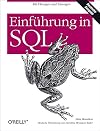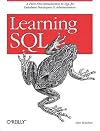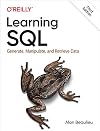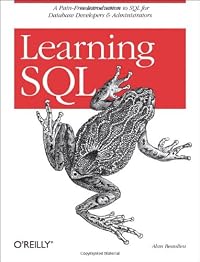
Learning SQL
by Alan Beaulieu
On This Page
Description
As data floods into your company, you need to put it to work right away-and SQL is the best tool for the job. With the latest edition of this introductory guide, author Alan Beaulieu helps developers get up to speed with SQL fundamentals for writing database applications, performing administrative tasks, and generating reports. You'll find new chapters on SQL and big data, analytic functions, and working with very large databases. Each chapter presents a self-contained lesson on a key SQL show more concept or technique using numerous examples. Exercises let you practice the skills you learn. Knowledge of SQL is a must for interacting with data. With Learning SQL, you'll quickly discover how to put the power and flexibility of this language to work. - Move quickly through SQL basics and several advanced features - Use SQL data statements to generate, manipulate, and retrieve data - Create database objects, such as tables, indexes, and constraints with SQL schema statements - Learn how datasets interact with queries; understand the importance of subqueries - Convert and manipulate data with SQL's built-in functions and use conditional logic in data statements. show lessTags
Recommendations





Member Reviews
Although a little dated in places, and clearly favoring MySQL, it covers the essentials for working with SQL. By building a database that is used throughout the book, it becomes easier to grasp the concepts by working with the same data throughout instead of wasting time trying to comprehend the schema before looking at the problem itself. Unless your business does a lot of data processing, the concepts learned here may be sufficient for doing real-world work.
On the whole I was very impressed with this book. It is, in my opinion, a very well paced tutorial introduction to working with SQL. In order to make examples that the reader can try out on their own computer and get the same results as the book, it is based throughout on MySQL (which is freely available), although it sticks as closely as possible to standard SQL and, where the common database managers (MySQL, Oracle, and Microsoft SQL Server, at any rate) diverge it provides notes about the differences and suggests references for further reading. Also, in order to avoid confusing the novice with details of too many different databases it uses a single database (for a bank) in all the examples. A copy of this database is available to show more download from the publisher's website, making it possible to try out all the examples and exercises in the book.
I have a few minor niggles. Firstly, there are a few places where the data in the version of the DB that I downloaded from the website seems to diverge from the version used in the book (most notably in the employee start dates), so a few of the queries don't produce the same results. Secondly, there are a few topics (such as user-defined variables) that get sneaked into some of the examples and exercise solutions without a proper explanation in the text (at least not one that I could find, having read the entire book fairly carefully and consulted the index). Thirdly, the book talks about MySQL 6.0 as the current version, while in February 2010 (some months after it was published) the most up-to-date version I could find was 5.5 - evidently 6.0 was pulled at the Alpha stage of development and has not yet been reintroduced (this is not a major problem, as everything covered in the book seems to work fine with MySQL 5). Finally, it's slightly Windows-centric as it does a couple of times refer to "your Windows box" and never mentions any other operating systems apart from a couple of references to mainframes. Fortunately I know my way round Linux well enough not to be phased by the lack of installation instructions for MySQL, but it could be an issue for less experienced users of non-Windows OSes. show less
I have a few minor niggles. Firstly, there are a few places where the data in the version of the DB that I downloaded from the website seems to diverge from the version used in the book (most notably in the employee start dates), so a few of the queries don't produce the same results. Secondly, there are a few topics (such as user-defined variables) that get sneaked into some of the examples and exercise solutions without a proper explanation in the text (at least not one that I could find, having read the entire book fairly carefully and consulted the index). Thirdly, the book talks about MySQL 6.0 as the current version, while in February 2010 (some months after it was published) the most up-to-date version I could find was 5.5 - evidently 6.0 was pulled at the Alpha stage of development and has not yet been reintroduced (this is not a major problem, as everything covered in the book seems to work fine with MySQL 5). Finally, it's slightly Windows-centric as it does a couple of times refer to "your Windows box" and never mentions any other operating systems apart from a couple of references to mainframes. Fortunately I know my way round Linux well enough not to be phased by the lack of installation instructions for MySQL, but it could be an issue for less experienced users of non-Windows OSes. show less
Ratings
Members
- Recently Added By
Published Reviews
ThingScore 88
"Learning SQL [second edition] does a good job of keeping things simple and to the point, never obfuscating topics in language likely to dazzle you. ... The best way to learn about SQL, and useful long after you've read it. 10/10"
added by legallypuzzled
"Perhaps this book should have been called Get Better at SQL ... because it goes into every nook and cranny of SQL. ... [T]he examples are primarily focused on MySQL. ... Not an easy read, but packed with learning and great value for money. (7/10)"
added by legallypuzzled
Author Information
5 Works 394 Members
Alan Beaulieu has been designing, building, and implementing custom database applications for over 25 years. He's the coauthor of Mastering Oracle SQL (O'Reilly) and has written an online course on SQL for the University of California. Alan runs his own consulting company that specializes in database design and development for financial services show more and telecommunications. show less
Some Editions
Common Knowledge
- Original publication date
- 2005-08
Classifications
- Genres
- Technology, Nonfiction, General Nonfiction
- DDC/MDS
- 005.133 — Computer science, information & general works Computer science, knowledge & systems Artificial Intelligence/Virtual Reality Software development Computer programming Specific programming languages
- LCC
- QA76.73 .S67 .B43 — Science Mathematics Mathematics Instruments and machines Calculating machines Electronic computers. Computer science
- BISAC
Statistics
- Members
- 333
- Popularity
- 94,946
- Reviews
- 2
- Rating
- (3.76)
- Languages
- English, German, Spanish
- Media
- Paper, Audiobook, Ebook
- ISBNs
- 23
- UPCs
- 2
- ASINs
- 2