On This Page
Description
Eithnie is a young painter who is acclaimed by the art world, until the critics start noticing that her work has lost the animating passion that had set her apart from the crowd. She returns to her cabin in Canada's remote woods, hoping to find a place where she can seek solitude and focus on her art. At first, Eithnie's muse remains elusive, but then beautiful and disturbing creatures start slipping into her sketches unbidden. The following days bring strange visitors bearing cryptic show more messages indicating that Eithnie may be bound by a promise made in a forgotten, magical childhood. The world of Faerie is clearly reaching out to her for help, and her ability to figure out what they need may mark the difference between their survival and their doom. show lessTags
Recommendations










Member Reviews
It’s been a shamefully long time since I last reread this book, considering that it was my very first Charles de Lint novel and the one that got me hooked on his writing, but it is also true that one shouldn’t have too much of a good thing lest it become less special from overabundance and become common. Delving back into the story after so many years was like coming home to the Canadian woods and mountains which surround my hometown, an experience that can’t be replicated elsewhere on earth and speaks to the wildness that seems to live quietly within those of us who grew up in these specific spaces and places. Following artist Eithnie, we are introduced to her unique life in the woods just outside of Ottawa as she begins dreaming show more of the faerie that live nearby and who are being challenged by the encroachment of humanity. De Lint has always had environmental themes resonating throughout his work, but this short novel at once brings these themes home and yet remains one of his most esoterically fey tales in its telling. Bordering the line between dream, art, and reality, Eithnie must face the truth of her past and step into living her present life more openly if she is going to find fulfillment in her chosen path. Her choice during the final pages, the third and seemingly final task of discovery in her journey, to have a child by a mysterious woodsman, to me felt a bit at odds with the story as it unfolded - a sort of unexpected twist and hardness and extreme reaction, even though in the vein of tellings of dealings with faerie rang true. Maybe this story is just closer to the fey truth of the world, and we should remain slightly uncomfortable with it so that we continue questioning the world we see around us and keep striving to make it better. show less
For a book so short, this feels awfully unfocused. Although I felt the pay-off at the end, I was tempted multiple times to abandon the story. I think I will stick with de Lint's longer works, as I find them more satisfying.
The main interest in [The Wild Wood] is that it is [[Charles de Lint]]'s first novel. It's awkward and uneven - alternating from first to third person and back again, and dipping in and of more than one 'mode- from elegiac to pragmatic, from metaphysical debate to preachy (about environmental damage). Eithne Gerrow is an artist in a dry uninspired spell and has retreated to her cabin north of Ottawa where she comes face-to-face with her own sorrows in an unexpected way. In some ways the meta-debate is the best part - is Faerie real? Does it matter if it is real or not? We summon and see the spiritual 'beings' , each in our own way and according to our own needs, to heal ourselves and others. It feels as though de Lint is working out his show more own view of the matter here. My daughter loves his books and has asked me recently, Do you think the world he writes about is real. Do people go there? Have you been there? I gave her pretty much the same answer de Lint comes up with here. All the same, I'm not sure this would be a great place to begin the de Lint adventure; while the writing has the smooth elegance characteristic of de Lint, it's not as well crafted as his later work. Nonetheless it was a fascinating read, watching a writer find himself. ***1/2 show less
I enjoyed this book about different world interacting - the "real" world and the "faerie". Eithnie, an artist, becomes entangled in both as she wrestles with finding her muse and trying to figure out whether the faces she sees in the woods are real or not. I liked de Lint's descriptions of the woods and the sounds Eithnie hears as she moves through them. I look forward to reading the next book in the series, Something Rich and Strange by Patricia McKillip.
Eithnie has always loved the Canadian woods, it was home to her and as an artist she has always found inspiration and comfort among the trees. But now something is different. There is a change in the air and the woods are full of whispers, shadows and visions that fill her with fear. For the first time in her life the woods no longer feel safe, and so Eithnie flees.
In the desert plains of Arizona, a world away from her familiar landscape of trees, Eithnie discovers a new land, a new vision of inspiration, a new understanding for the sparse plains before her and for the wooded lands she left behind. Armed with new courage, Eithnie returns to her woods where she discovers a love she never thought possible and a new future in the woods show more that have always been home.
The Wild Wood is changing, there is a magic in the air and a presence among the trees. But there is also desperation, the woods are dying, crying out for help and only Eithnie has the power to save them, if she has the courage to accept the responsibility. A story of magic and romance, this first book in the Fairyland series is beautifully written by a masterful storyteller bringing to life the magical imagery of an enchanting illustrator. show less
In the desert plains of Arizona, a world away from her familiar landscape of trees, Eithnie discovers a new land, a new vision of inspiration, a new understanding for the sparse plains before her and for the wooded lands she left behind. Armed with new courage, Eithnie returns to her woods where she discovers a love she never thought possible and a new future in the woods show more that have always been home.
The Wild Wood is changing, there is a magic in the air and a presence among the trees. But there is also desperation, the woods are dying, crying out for help and only Eithnie has the power to save them, if she has the courage to accept the responsibility. A story of magic and romance, this first book in the Fairyland series is beautifully written by a masterful storyteller bringing to life the magical imagery of an enchanting illustrator. show less
I liked this lot. It was much more grounded in the real world than I expeted though. As in, a modern, real woman set in modern times with real friends and real problems. Usually I prefer pure fantasy, but I often enjoy mixed stories when I read them. She was likeable, and there wasn't really any negative real world angst (to me, anyway). I mean, there are real problems, but it's not all bleak and hopeless.
Anyway, back to the story! It is an interesting, if vague, take on faerie - nothing is set in stone or clearly defined. But this gives it quite an ethereal air. It is written in quite a poetic, complex style too, perhaps characteritic of the author (I don't know his work). It was very beautiful to read, and good at evoking images and show more landscape. The characters are actually very likeable, and there is some "romance" is you can call it that. I couldn't see where the book was going either, until right at the end. Perhaps I just missed the obvious! But I like a bit of 'romance' in a book, when it's done tastefully and well, as this was.
Generally, the book was evocative and ethereal while still containing plenty of description - quite a tricky accomplishment, I think! show less
Anyway, back to the story! It is an interesting, if vague, take on faerie - nothing is set in stone or clearly defined. But this gives it quite an ethereal air. It is written in quite a poetic, complex style too, perhaps characteritic of the author (I don't know his work). It was very beautiful to read, and good at evoking images and show more landscape. The characters are actually very likeable, and there is some "romance" is you can call it that. I couldn't see where the book was going either, until right at the end. Perhaps I just missed the obvious! But I like a bit of 'romance' in a book, when it's done tastefully and well, as this was.
Generally, the book was evocative and ethereal while still containing plenty of description - quite a tricky accomplishment, I think! show less
I enjoyed this quickly read book because it is set in the north woods of Canada and the descriptions remind me so much of what I love about nature. It is a sweet story about a young woman artist dealing with her muses and faeries in the woods. It is also about change and being open to live. In the end, it was a sweet, uplifting read but not hugely remarkable.
Members
- Recently Added By
Author Information

196+ Works 43,390 Members
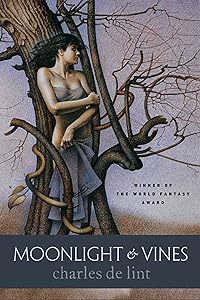
Charles de Lint, an extraordinarily prolific writer of fantasy works, was born in the Netherlands in 1951. Due to his father's work as a surveyor, the family lived in many different places, including Canada, Turkey, and Lebanon. De Lint was influenced by many writers in the areas of mythology, folklore, and science fiction. De Lint originally show more wanted to play Celtic music. He only began to write seriously to provide an artist friend with stories to illustrate. The combination of the success of his work, The Fane of the Grey Rose (which he later developed into the novel The Harp of the Grey Rose), the loss of his job in a record store, and the support of his wife, Mary Ann, helped encourage de Lint to pursue writing fulltime. After selling three novels in one year, his career soared and he has become a most successful fantasy writer. De Lint's works include novels, novellas, short stories, chapbooks, and verse. He also publishes under the pseudonyms Wendelessen, Henri Cuiscard, and Jan Penalurick. He has received many awards, including the 2000 World Fantasy Award for Best Collection for Moonlight and Vines, the Ontario Library Association's White Pine Award, as well as the Great Lakes Great Books Award for his young adult novel The Blue Girl. His novel Widdershins won first place, Amazon.com Editors' Picks: Top 10 Science Fiction & Fantasy Books of 2006. In 1988 he won Canadian SF/Fantasy Award, the Casper, now known as the Aurora for his novel Jack, the Giant Killer. Also, de Lint has been a judge for the Nebula Award, the World Fantasy Award, the Theodore Sturgeon Award and the Bram Stoker Award. (Bowker Author Biography) show less
All Editions
Some Editions
Series

Common Knowledge
- Canonical title
- The Wild Wood
- Original publication date
- 1994
- People/Characters
- Eithnie; Sharleen Tuck; Joe Ikeda; Broceliande; Albin
- Epigraph
- We have loved the stars too fondly
to be fearful of the night.
-- Inscription on a New England tombstone
Animula, vagula, blandula,
Hospes, comesque, corporis;
Quae nunc abibis in loca,
Pallidula, rigida, nudula?
(Sorry-lived, blithe little, flittering sprite,
Comrade and guest in this body of clay,
Whither... (show all), ah! whither, departing in flight,
Rigid, half-naked, pale minion, away?)
-- Attributed to Emperor Hadrian on his deathbed
Go and wake up your luck.
-- Persian proverb - Dedication
- For Donna Gordon, whose artistic talent is equalled only by her generous spirit
- First words
- ...like music entangled in a thorny embrace, leaf-sigh, branch-rustle.
- Last words
- (Click to show. Warning: May contain spoilers.)It's going to be so hard to say good-bye.
Classifications
Statistics
- Members
- 813
- Popularity
- 33,719
- Reviews
- 11
- Rating
- (3.90)
- Languages
- English
- Media
- Paper, Audiobook, Ebook
- ISBNs
- 5
- ASINs
- 4