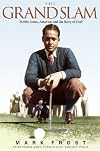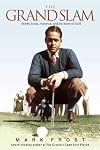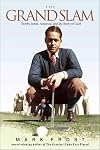
The Grand Slam: Bobby Jones, America, and the Story of Golf
by Mark Frost
On This Page
Description
Presents a study of the life and career of golf icon Bobby Jones, focusing on his accomplishment of winning four major golfing championships during the sumer of 1930 and his sudden retirement from competition at the age of twenty-eight.Tags
Recommendations











































Member Reviews
As an avid reader of biographies, I'm familiar with hagiography, the tendency of biographers to inflate the accomplishments of their subjects, but never in all my years have I ever encountered such an extreme case of it. It's a shame, too, as Jones's life needs no such embellishment.
Bobby Jones was, without question, the greatest golfer of his generation and one of the greatest that ever lived. However, to read Frost's account, every match he ever lost was due to illness, injury, extreme bad fortune or circumstances beyond his control. In every one of his victories, he overcame illness, injury, bad luck, dastardly opponents and extreme fatigue (which for some reason Frost insinuates his opponents, who played the same or significantly show more more rigorous schedules, never faced). Some of Frost's accounts border on the ludicrous.
He alleges that Walter Hagen recruited gallery memebers in an attempt to form windbreaks along the windswept fairways of the British Open. As a golfer, I can attest without question that human beings stationed along the edges of the fairway have absolutely no effect on the wind encountered by a golf ball, at any stage in its flight.
Despite playing a total of ten rounds of golf in the months leading up to one of his U. S. Open victories, Frost describes Jones as being so exhausted that his knees were buckling as he attempted to finish his final round. Again, as if his efforts were somehow more draining than those of his competitors, some of whom were forced to play tournaments every week in order to survive.
Sprinkled throughout the book are the author's attempts to add historical perspective. I actually think this could have been helpful if done well, however Frost, perhaps a frustrated historian, makes numerous absurd statements concerning the root causes of World War I, the Warren Harding administration, the Wall Street collapse of 1929. Set the stage, reference contemporanious historical events, but leave the political and social analysis to those who have a clue.
While I might reluctantly recommend the book to those who wish to learn of the life and accomplishments of Bobby Jones, I even question some of the facts contained in the book. Frost frequently cites astonishing feats performed by many of the players of the era. He tosses around 300-325 yard drives as though they were the norm for the era, even though players of the current era struggle to hit such shots with the aid of titanium, oversized drivers, fiberglass shafts and souped up golf balls. Shots of the type frequently described by Frost were simply impossible with hickory shafts and marshmellow golf balls (in the absence of asphalt or gale force winds).
He refers to 275 yard par 3s and 450+ yard par 4s, when courses of the era were actually significantly shorter than current tracts. In a disconnect, he describes very long iron and sometimes 3 wood shots into par 4s (which are probably accurate) despite the fact that his players are bombing 300+ yard drives. Something doesn't compute in his distance claims and club selections.
All in all, a very tiresome product by its conclusion. By the time he won the U.S. Amateur, securing the Grand Slam, I expected Jones to be carted up the 18th fairway in a hospital bed, on the verge of death, only to hole out a 300 yard seven iron to snatch victory from the jaws of defeat from an opponent that had cheated by 10 strokes. I've got to think that there are better, more objective books for those seeking to learn the story of Bobby Jones. show less
Bobby Jones was, without question, the greatest golfer of his generation and one of the greatest that ever lived. However, to read Frost's account, every match he ever lost was due to illness, injury, extreme bad fortune or circumstances beyond his control. In every one of his victories, he overcame illness, injury, bad luck, dastardly opponents and extreme fatigue (which for some reason Frost insinuates his opponents, who played the same or significantly show more more rigorous schedules, never faced). Some of Frost's accounts border on the ludicrous.
He alleges that Walter Hagen recruited gallery memebers in an attempt to form windbreaks along the windswept fairways of the British Open. As a golfer, I can attest without question that human beings stationed along the edges of the fairway have absolutely no effect on the wind encountered by a golf ball, at any stage in its flight.
Despite playing a total of ten rounds of golf in the months leading up to one of his U. S. Open victories, Frost describes Jones as being so exhausted that his knees were buckling as he attempted to finish his final round. Again, as if his efforts were somehow more draining than those of his competitors, some of whom were forced to play tournaments every week in order to survive.
Sprinkled throughout the book are the author's attempts to add historical perspective. I actually think this could have been helpful if done well, however Frost, perhaps a frustrated historian, makes numerous absurd statements concerning the root causes of World War I, the Warren Harding administration, the Wall Street collapse of 1929. Set the stage, reference contemporanious historical events, but leave the political and social analysis to those who have a clue.
While I might reluctantly recommend the book to those who wish to learn of the life and accomplishments of Bobby Jones, I even question some of the facts contained in the book. Frost frequently cites astonishing feats performed by many of the players of the era. He tosses around 300-325 yard drives as though they were the norm for the era, even though players of the current era struggle to hit such shots with the aid of titanium, oversized drivers, fiberglass shafts and souped up golf balls. Shots of the type frequently described by Frost were simply impossible with hickory shafts and marshmellow golf balls (in the absence of asphalt or gale force winds).
He refers to 275 yard par 3s and 450+ yard par 4s, when courses of the era were actually significantly shorter than current tracts. In a disconnect, he describes very long iron and sometimes 3 wood shots into par 4s (which are probably accurate) despite the fact that his players are bombing 300+ yard drives. Something doesn't compute in his distance claims and club selections.
All in all, a very tiresome product by its conclusion. By the time he won the U.S. Amateur, securing the Grand Slam, I expected Jones to be carted up the 18th fairway in a hospital bed, on the verge of death, only to hole out a 300 yard seven iron to snatch victory from the jaws of defeat from an opponent that had cheated by 10 strokes. I've got to think that there are better, more objective books for those seeking to learn the story of Bobby Jones. show less
Dignity, grace, and greatness are often hard to find together, and even more difficult to reconcile when they are discovered among one another. Mark Frost writes about the life of the life of Bobby Jones, a man who embodied those traits, with a grace and skill worthy of Mr. Jones.
got this one for my father, his reading improving!
Ratings
Members
- Recently Added By
Lists

Recommend the 20 best books you've read in the last five years
2,168 works; 603 members

Top Five Books of 2017
757 works; 231 members
Author Information

28+ Works 7,612 Members
Mark Frost is a novelist, television/film writer, director, and producer. Frost is the son of actor Warren Frost, brother of writer Scott Frost and actress Lindsay Frost. He studied acting, directing, and playwriting at Carnegie Mellon. Frost worked on the TV shows Hill Street Blues (as a writer), Twin Peaks (as a co-creator, writer, and show more co-executive producer with David Lynch) and On the Air (as a co-creator, writer, and co-executive producer with David Lynch). He received an Emmy nomination in 1984 for Outstanding Writing for a Drama Series for Hill Street Blues. He received 2 Emmy nominations in 1990 for Twin Peaks. Mark Frost published his first novel, The List of Seven, in 1993. His other published works include The Six Messiahs (1996), Before I Wake (1997 under the pseudonym Eric Bowman), The Greatest Game Ever Played (2002), The Match (2007) and The Palladin Prophecy Series. He provided the story for Fantastic Four: Rise of the Silver Surfer that was released in 2007. Twin Peaks: The Final Dossier was published in 2017. (Bowker Author Biography) show less
Common Knowledge
- Original publication date
- 2006
- People/Characters
- Bobby Jones [golfer]
Classifications
- Genres
- Sports and Leisure, Nonfiction, Biography & Memoir, General Nonfiction, History
- DDC/MDS
- 796.352 — Arts & recreation Recreation, sports, and performing arts Athletic and outdoor sports and games Ball sports Ball and stick sports Golf
- LCC
- GV964 .J6 .F76 — Geography, Anthropology and Recreation Recreation. Leisure Recreation. Leisure Sports Ball games: Baseball, football, golf, etc.
- BISAC
Statistics
- Members
- 183
- Popularity
- 179,623
- Reviews
- 3
- Rating
- (4.18)
- Languages
- English
- Media
- Paper, Audiobook, Ebook
- ISBNs
- 12
- ASINs
- 4