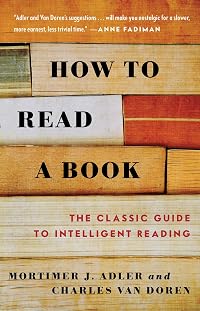
How to Read a Book, Revised and Updated Edition
by Mortimer J. Adler (Author), Charles Van Doren (Author), Charles Van Doran (Author)
On This Page
Description
With half a million copies in print, How to Read a Book is the best and most successful guide to reading comprehension for the general reader, completely rewritten and updated with new material.Originally published in 1940, this book is a rare phenomenon, a living classic that introduces and elucidates the various levels of reading and how to achieve themfrom elementary reading, through systematic skimming and inspectional reading, to speed reading. Readers will learn when and how to judge a show more book by its cover, and also how to X-ray it, read critically, and extract the authors message from the text.Also included is instruction in the different techniques that work best for reading particular genres, such as practical books, imaginative literature, plays, poetry, history, science and mathematics, philosophy and social science works.Finally, the authors offer a recommended reading list and supply reading tests you can use measure your own progress in reading skills, comprehension, and speed. show lessTags
Recommendations


Member Reviews
A revised edition of a classic. For awhile I avoided this book out of juvenile assumption that it was for people who were poor readers, quite unlike my own esteemed self. Instead, I found it stimulating as I consider the education of the second half of my life. Adler tackles the idea that reading for understanding is far more than reading for information. I was fascinated by his assertion that any book I read for understanding will necessarily be one "over my head." His part is to assist readers to know how to get more out of these kinds of books. Of course, he discusses being an active reader. His discussion of understanding a book within the context of other books in its family or theme articulated something I've felt vaguely. For a show more critique, I was particularly interested to read Adler's statement that the original edition was almost a completely different book. This kind of statement invites testing, doesn't it? So I purchased the original edition, and discovered that in some ways, I like the old edition better. In the revision at times, it seemed as though Adler was repeating himself, or giving minor variations on a theme. The original kept to the main idea of developing active readers. If I were giving the book to a teenager, I'd track down the original, because I think the longer version is more likely to be overwhelming or too much of a stretch for the very audience that Adler wishes to influence. A strong adult reader will probably enjoy the revised edition better, simply because he discusses more "advanced" reading techniques. In any case, I think this is an essential book. I am particularly interested in the implications for this book as it relates to helping readers become more active readers of the Bible. See also I Read It, But I Don't Get It. show less
Some books take no extra skills to read--all of their benefits are on the surface waiting for you. Others hide their treasures below the surface and you have to go after them like a deep sea diver, returning and returning again to appreciate their beauty and discover their meaning. Books like The Brothers Karamazov and City of God require extra literary skills to understand, but the effort is worth it.
If you've never had a good literature class, or if it's been a while since your last one, then you might consider reading Mortimer Adler's How to Read a Book. Adler begins with the best definition of reading I've ever come across:
Reading is "...the process whereby a mind, with nothing to operate on but the symbols of the readable matter, show more and with no help from outside, elevates itself by the power of its own operations. The mind passes from understanding less to understanding more. The skilled operations that cause this to happen are the various acts that constitute the art of reading."
I like to share that definition and break it down for my eighth grade students each year because it's easy to think of reading as just an alternative to television. The idea that reading elevates is important for them to understand. As Henry Fielding states in On Taste in Books, books are not merely for entertainment:
"This present age seems pretty well agreed in an opinion, that the utmost scope and end of reading is amusement only; and such, indeed, are now the fashionable books, that a reader can propose no more than mere entertainment, and it is sometimes very well for him if he finds even this, in his studies.
Letters, however, were surely intended for a much more noble and profitable purpose than this. Writers are not, I presume, to be considered as mere jack-puddings, whose business it is only to excite laughter...when no moral, no lesson, no instruction is conveyed to the reader, where the whole design of the composition is no more than to make us laugh, the writer comes very near to the character of a buffoon; and his admirers, if an old Latin proverb be true, deserve no great compliments to be paid to their wisdom."
Reading and writing are not only meant to elevate us intellectually, but spiritually as well. All of our skills and abilities are given to us by God so that we may know, love and serve Him; any other use of them is a waste of time and will detour us off the road to eternal joy. It does, however, take a conscious and deliberate act of the will to use our gifts in this way, and it often requires extra effort. Regarding reading, Adler puts it this way:
"To pass from understanding less to understanding more by your own intellectual effort in reading is something like pulling yourself up by your bootstraps. It certainly feels that way. It is a major exertion. Obviously, it is a more active kind of reading than you have done before....Obviously, too, the things that are usually regarded as more difficult to read, and hence as only for the better reader, are those that are more likely to deserve and demand this kind of reading."
For one interested in acquiring the skills to read difficult books, How to Read a Book is an essential resource. Not only does Adler explain how to read in general, but he also devotes individual chapters to reading specific kinds of literature, including how to read history, philosophy, science and mathematics. I've owned the book for fifteen years, and I still return to it again and again to improve my reading skills. I spent $10.95 on my copy of How to Read a Book but it is worth more than some of the college classes I took, which cost me considerably more. show less
If you've never had a good literature class, or if it's been a while since your last one, then you might consider reading Mortimer Adler's How to Read a Book. Adler begins with the best definition of reading I've ever come across:
Reading is "...the process whereby a mind, with nothing to operate on but the symbols of the readable matter, show more and with no help from outside, elevates itself by the power of its own operations. The mind passes from understanding less to understanding more. The skilled operations that cause this to happen are the various acts that constitute the art of reading."
I like to share that definition and break it down for my eighth grade students each year because it's easy to think of reading as just an alternative to television. The idea that reading elevates is important for them to understand. As Henry Fielding states in On Taste in Books, books are not merely for entertainment:
"This present age seems pretty well agreed in an opinion, that the utmost scope and end of reading is amusement only; and such, indeed, are now the fashionable books, that a reader can propose no more than mere entertainment, and it is sometimes very well for him if he finds even this, in his studies.
Letters, however, were surely intended for a much more noble and profitable purpose than this. Writers are not, I presume, to be considered as mere jack-puddings, whose business it is only to excite laughter...when no moral, no lesson, no instruction is conveyed to the reader, where the whole design of the composition is no more than to make us laugh, the writer comes very near to the character of a buffoon; and his admirers, if an old Latin proverb be true, deserve no great compliments to be paid to their wisdom."
Reading and writing are not only meant to elevate us intellectually, but spiritually as well. All of our skills and abilities are given to us by God so that we may know, love and serve Him; any other use of them is a waste of time and will detour us off the road to eternal joy. It does, however, take a conscious and deliberate act of the will to use our gifts in this way, and it often requires extra effort. Regarding reading, Adler puts it this way:
"To pass from understanding less to understanding more by your own intellectual effort in reading is something like pulling yourself up by your bootstraps. It certainly feels that way. It is a major exertion. Obviously, it is a more active kind of reading than you have done before....Obviously, too, the things that are usually regarded as more difficult to read, and hence as only for the better reader, are those that are more likely to deserve and demand this kind of reading."
For one interested in acquiring the skills to read difficult books, How to Read a Book is an essential resource. Not only does Adler explain how to read in general, but he also devotes individual chapters to reading specific kinds of literature, including how to read history, philosophy, science and mathematics. I've owned the book for fifteen years, and I still return to it again and again to improve my reading skills. I spent $10.95 on my copy of How to Read a Book but it is worth more than some of the college classes I took, which cost me considerably more. show less
I regret my disappointment with this book which has been recommended to me over and over again. Especially since its author was Mortimer Adler, tireless defender of the Great Books.
There is great and very useful practical advice in here. But it is buried in endless meandering essays. Adler makes a lot of sweeping and highly opinionated statements that only serve to undermine the practical advice. Some of his judgments are entirely befuddling. His rather dismissive view of the field of history was, for example, as far as I am familiar the history of historiography, outdated even in the period in which he first wrote this book. At one point, I even found him to have an ironically very dogmatic view of the alleged dogmatic views of show more adherents of political and religious ideologies.
I probably would have gotten more out of this book's practical aspects if I had read it in an earlier stage of my life, but I am not sure if I would have had the patience to wade through its tedious repetition. I feel like the true meat of the book could have better been presented as a concise booklet.
On a positive note, I did very much like his pitch for his «The Great Ideas A Syntopicon of Great Books of the Western World», the topical index to his Great Books of the Western World collection. show less
There is great and very useful practical advice in here. But it is buried in endless meandering essays. Adler makes a lot of sweeping and highly opinionated statements that only serve to undermine the practical advice. Some of his judgments are entirely befuddling. His rather dismissive view of the field of history was, for example, as far as I am familiar the history of historiography, outdated even in the period in which he first wrote this book. At one point, I even found him to have an ironically very dogmatic view of the alleged dogmatic views of show more adherents of political and religious ideologies.
I probably would have gotten more out of this book's practical aspects if I had read it in an earlier stage of my life, but I am not sure if I would have had the patience to wade through its tedious repetition. I feel like the true meat of the book could have better been presented as a concise booklet.
On a positive note, I did very much like his pitch for his «The Great Ideas A Syntopicon of Great Books of the Western World», the topical index to his Great Books of the Western World collection. show less
Who This Book is (not) For
It focuses mainly on reading expositional, rather than imaginative material. It was written in 1940, and revised in 1972, though it looks and feels more like a 40s book.
I read it in the hope of becoming a more analytical reader who could go on to write more coherent, concise, and original reviews. It didn’t help. A much more relevant book is How to Read Literature Like a Professor, which I've reviewed HERE.
This may once have been a good book. Had I read it as an undergraduate, I may even have found bits of it slightly useful. As a middle-aged fiction reader in the 21st century, I found it infuriating, boring, and mostly irrelevant.
Types of Reading
There are four levels of reading:
1. Elementary (learning to show more decode the symbols).
2. Inspectional (time-limited skimming).
3. Analytical.
4. Syntopical (comparing and drawing conclusions).
I used Inspectional for most of the book - because my patience and interest were severely, and increasingly, limited.
It focuses mainly on analytical reading of non-fiction: knowing what sort of book it is, having an idea of the content and structure etc. Its own structure is very poor. For example, four rules of analytical reading are spread across two chapters, and only listed together at the end of the second. Then, in the next chapter, you discover rule five, and six… It turns out there are 15 (yes, 15!) rules of analytical reading. Enough to put me off reading altogether.
There are a couple of chapters devoted to fiction, but I didn’t find them helpful or insightful.
Example of Annoyances
“Most plays are not worth reading… because they are incomplete.”
Sweeping generalisation followed by a non-sequitur. I rarely read plays precisely because they were written for performance, and I can’t do that effectively in my head. It does not mean that most plays are not worth reading, though.
“An author uses most words as men ordinarily do in conversation.”
I nearly threw the book across the room, though that was probably an overreaction, born of my mounting dislike. Yes, I know it was written when it was more common to use male pronouns as generic ones, and to use “man” to mean “mankind/humankind”. But it was revised in 1972, and “men” grates far more than “man”: surely “people” would be more natural, even back then?
The Literary Canon (only one?!)
I don’t think the authors really know who their audience is - a fatal flaw in any writer/reader relationship. There are constant assumptions that the reader is familiar with the classical Western canon, from ancient civilisations, through to the start of the twentieth century: Homer’s Ulysses, though to Joyce’s Ulysses. If you’d read them in school (as the authors expect), you’d either have understood them and so have little need of this book, or not understood them, and have no intention of reading this book.
This is reflected in the impressive and somewhat daunting reading list. It explicitly includes only Western works because:
1. The authors admit they know very little about Indian, Chinese, Japanese and other literary traditions. (They could have consulted someone else.)
2. Apparently, there is not a single tradition in Eastern literature, as there is in Western. (I’m not sure I understand the truth or untruth of that.)
3. It’s better to really know your own culture’s canon before branching out to others. (I don’t agree, but it is a valid and somewhat interesting opinion.)
Exercises
An appendix has a lot of comprehension exercises (I’m not sure what term is used outside the UK). I didn’t do any of them. I’d rather read a good book.
If you want to read a book, I suggest you read a book.
But probably not this one.
If you want exercises, make it a large, heavy one! show less
It focuses mainly on reading expositional, rather than imaginative material. It was written in 1940, and revised in 1972, though it looks and feels more like a 40s book.
I read it in the hope of becoming a more analytical reader who could go on to write more coherent, concise, and original reviews. It didn’t help. A much more relevant book is How to Read Literature Like a Professor, which I've reviewed HERE.
This may once have been a good book. Had I read it as an undergraduate, I may even have found bits of it slightly useful. As a middle-aged fiction reader in the 21st century, I found it infuriating, boring, and mostly irrelevant.
Types of Reading
There are four levels of reading:
1. Elementary (learning to show more decode the symbols).
2. Inspectional (time-limited skimming).
3. Analytical.
4. Syntopical (comparing and drawing conclusions).
I used Inspectional for most of the book - because my patience and interest were severely, and increasingly, limited.
It focuses mainly on analytical reading of non-fiction: knowing what sort of book it is, having an idea of the content and structure etc. Its own structure is very poor. For example, four rules of analytical reading are spread across two chapters, and only listed together at the end of the second. Then, in the next chapter, you discover rule five, and six… It turns out there are 15 (yes, 15!) rules of analytical reading. Enough to put me off reading altogether.
There are a couple of chapters devoted to fiction, but I didn’t find them helpful or insightful.
Example of Annoyances
“Most plays are not worth reading… because they are incomplete.”
Sweeping generalisation followed by a non-sequitur. I rarely read plays precisely because they were written for performance, and I can’t do that effectively in my head. It does not mean that most plays are not worth reading, though.
“An author uses most words as men ordinarily do in conversation.”
I nearly threw the book across the room, though that was probably an overreaction, born of my mounting dislike. Yes, I know it was written when it was more common to use male pronouns as generic ones, and to use “man” to mean “mankind/humankind”. But it was revised in 1972, and “men” grates far more than “man”: surely “people” would be more natural, even back then?
The Literary Canon (only one?!)
I don’t think the authors really know who their audience is - a fatal flaw in any writer/reader relationship. There are constant assumptions that the reader is familiar with the classical Western canon, from ancient civilisations, through to the start of the twentieth century: Homer’s Ulysses, though to Joyce’s Ulysses. If you’d read them in school (as the authors expect), you’d either have understood them and so have little need of this book, or not understood them, and have no intention of reading this book.
This is reflected in the impressive and somewhat daunting reading list. It explicitly includes only Western works because:
1. The authors admit they know very little about Indian, Chinese, Japanese and other literary traditions. (They could have consulted someone else.)
2. Apparently, there is not a single tradition in Eastern literature, as there is in Western. (I’m not sure I understand the truth or untruth of that.)
3. It’s better to really know your own culture’s canon before branching out to others. (I don’t agree, but it is a valid and somewhat interesting opinion.)
Exercises
An appendix has a lot of comprehension exercises (I’m not sure what term is used outside the UK). I didn’t do any of them. I’d rather read a good book.
If you want to read a book, I suggest you read a book.
But probably not this one.
If you want exercises, make it a large, heavy one! show less
Mortimer Adler was Editor-in-Chief of the Great Books series, and a proponent of a liberal education in the Western tradition. This work is in the same vein, but it is what Adler refers to as a "practical" book. In the introduction he notes the fun that was made of his book title, with a spoof How to Read Two Books written shortly after by Erasmus G. Addlepate. As I started reading the book, I felt like I was being taught by an "old school" teacher who had to go through the basics before getting to the point some time later in life. But therein lies the charm of the work - by the end, I felt I had been reading [a:John Stuart Mill|57651|John Stuart Mill|https://images.gr-assets.com/authors/1208804881p2/57651.jpg]'s [b:On show more Liberty|385228|On Liberty|John Stuart Mill|https://images.gr-assets.com/books/1459346459s/385228.jpg|2387235] - all the ideas were lining up, my liberal education had been delivered correctly, and I understood why I do what I do. What struck me most is that the four stages of reading, from elementary to syntopical, lead one to being able to organise a literature review. If ever there was a book that teaches how to systematically, and practicably, go about conducting a literature review, this is it. The process seems almost absurd when spelt out - much like [a:Aristotle|2192|Aristotle|https://images.gr-assets.com/authors/1390143800p2/2192.jpg]'s [b:Poetics|13270|Poetics|Aristotle|https://images.gr-assets.com/books/1348161995s/13270.jpg|2301058] - it reads like:
1. Select two eggs. 2. Suck.But that would be so wrong! There is so much here, I am pleased it was my first read for the year, and I intend to add some of the techniques to my daily journalling practice (or maybe even keep a separate book journal). The two appendices are helpful. The first provides an updated list of the Great Books of the Western World (most of which are available online free these days). The second provides a series of tests on each of the levels of reading. This was designed to be "exemplary" but it was also a bit of fun, with some interesting text on Mill, Newton, Dante, et al. For anyone interested in classic works, this book is a useful guide to the art of reading, but also desktop research. One interesting change to my reading habits has resulted. Adler states that part of the fun of owning a book is that you can write in the margins. For decades I have cringed at the thought of doing this - my books are all catalogued and covered - but in Adler's book, I took out my sharpened pencil and begin to make margin notes. I suppose it is fine if I do this in pencil. And it will certainly make it easier to relocate quotes, instead of using my typically ineffective method of remembering page numbers for important quotes. I am a devotee to the Great Books cause. I was pleased to note that Adler writes that he has limited knowledge of the great books of the eastern world, and this was his main reason for not introducing "Eastern" works (a little Orientalism goes a long way), but given the work was written in 1940 and then revised in the 1970s, it was ahead of its time. There is something about the liberal democratic ideal and reading that Adler points to time and again, and while my own ideals have been systematically destroyed through practice, Adler paints an honourable picture of liberalism as it is rarely practised these days. This is not an easy book, and for some it might be off-putting, but for me, I learnt more in this volume than I have in the last five years. show less
Thought I was in for a treat.
First let me say that I did learn some terminology I didn't know:
Abeccedarian Ignorance - being illiterate
Doctoral Ignorance - one who misreads
Syntopical Reading - comparative reading (of a number of books on one specific subject)
I did find the sections on Syntopical Reading more compelling to me because I don't think I've done enough of this type of reading (years ago in school) and wanted to know more. Now when I read one book I am almost always thinking of similar characters, plots, ideas, I read in other books.
But...I think that what Adler and Van Doren had in mind by syntopical reading is reading mainly non-fiction books or sections of books to glean very specific information on one topic. To me show more this seems to be a more science or research based reading. The syntopical reader compares the info (s)he has understood to determine if it addresses a pre-determined question or problem within the topic positively, negatively or neither.
Will check out other sources of information of syntopical reading and comparative reading to learn more.
While I did gain some knowledge, in general I found the book pretentious, over-analytical, bossy, unfriendly and arrogant. I believe this book would discourage and bore most folks interesting in learning about upping their reading skills. show less
First let me say that I did learn some terminology I didn't know:
Abeccedarian Ignorance - being illiterate
Doctoral Ignorance - one who misreads
Syntopical Reading - comparative reading (of a number of books on one specific subject)
I did find the sections on Syntopical Reading more compelling to me because I don't think I've done enough of this type of reading (years ago in school) and wanted to know more. Now when I read one book I am almost always thinking of similar characters, plots, ideas, I read in other books.
But...I think that what Adler and Van Doren had in mind by syntopical reading is reading mainly non-fiction books or sections of books to glean very specific information on one topic. To me show more this seems to be a more science or research based reading. The syntopical reader compares the info (s)he has understood to determine if it addresses a pre-determined question or problem within the topic positively, negatively or neither.
Will check out other sources of information of syntopical reading and comparative reading to learn more.
While I did gain some knowledge, in general I found the book pretentious, over-analytical, bossy, unfriendly and arrogant. I believe this book would discourage and bore most folks interesting in learning about upping their reading skills. show less
Honestly, this whole book is a 2.5 stars for me. Not quite a 3-star, but also not as low as a 2-star.
The book is certainly a product of its time, and it goes into MASSIVE detail about how one should read a book. But the way it presents the concepts that it wants to show are just... too much. This book can be condensed to approximately 200 pages at most.
For those who are struggling with reading or not understanding many of the books they pick up - whether because English is a second/third language, or because they have difficulty parsing classic books - this book will be invaluable in helping you try to understand hard-to-read books. Unfortunately for me, I've been an avid reader since I was a kid, and I remember picking up a condensed show more version of this book meant for children back in middle school. So a lot of the lessons in this book were familiar to me.
Here, let me save you $30 and just tell you what the contents are:
1) Read the book's title, blurb, skim a Wikipedia article about the book, read the Goodreads/Amazon description, and maybe read some reviews about the book. For fiction, skip reviews that give spoilers. Read a few 4-5 star reviews and a few 1-star reviews to get an idea of what you're getting into.
2) Read the prefaces, acknowledgements, foreword, and introduction segments, and skim the Table of Contents to see what the contents of the book are. If you're reading a nonfiction book, feel free to skim chapters that seem interesting to you.
3) Be actively reading! Skim if you want, but otherwise, don't be afraid to reread passages that don't make sense, and mark them down via a post-it note for physical books or highlight tool in your e-reader of choice.
4) Every few chapters, take a small break and review what you learned in your mind. What were your biggest takeaways? Did it make sense? Would you have to reread it? Were there any themes you're starting to see? Does it connect with previous chapters?
5) Once you get to the end of the book, take a moment to reflect on it as a whole. If you took any notes, reevaluate with them. If you left post-it notes to reread segments, reread them. After you are sure you got everything you wanted from the book, review it as a whole. You don't have to leave an actual review on Goodreads/Amazon or anywhere else. Instead, just think about what you learned and read, to help the lessons stick with you.
There you go. BOOM. Active reading. You basically just did what the book suggested, but it was condensed down to five points. Obviously, there are other things that you could do that the book suggests. Mr. Adler suggests not researching words or phrases till after you've thoroughly read the book, but I argue that keeping a thesaurus, dictionary, and Wikipedia open to pause and look up words or phrases is actually a good thing to keep you from misunderstanding what the Author is trying to say.
All in all, this book is a slog that you might end up skipping major sections of. The information is very good, but the writing style is dry, and some chapters don't really feel connected to the whole (early chapters cover the history of reading in America, which I found outdated). If you don't mind reading something that goes extremely in-depth to engaging a book, have at it. If you feel confident that you are a decent reader but just want to cover a condensed version of the book, then read what I wrote above or find several guides that succinctly go over the information. show less
The book is certainly a product of its time, and it goes into MASSIVE detail about how one should read a book. But the way it presents the concepts that it wants to show are just... too much. This book can be condensed to approximately 200 pages at most.
For those who are struggling with reading or not understanding many of the books they pick up - whether because English is a second/third language, or because they have difficulty parsing classic books - this book will be invaluable in helping you try to understand hard-to-read books. Unfortunately for me, I've been an avid reader since I was a kid, and I remember picking up a condensed show more version of this book meant for children back in middle school. So a lot of the lessons in this book were familiar to me.
Here, let me save you $30 and just tell you what the contents are:
1) Read the book's title, blurb, skim a Wikipedia article about the book, read the Goodreads/Amazon description, and maybe read some reviews about the book. For fiction, skip reviews that give spoilers. Read a few 4-5 star reviews and a few 1-star reviews to get an idea of what you're getting into.
2) Read the prefaces, acknowledgements, foreword, and introduction segments, and skim the Table of Contents to see what the contents of the book are. If you're reading a nonfiction book, feel free to skim chapters that seem interesting to you.
3) Be actively reading! Skim if you want, but otherwise, don't be afraid to reread passages that don't make sense, and mark them down via a post-it note for physical books or highlight tool in your e-reader of choice.
4) Every few chapters, take a small break and review what you learned in your mind. What were your biggest takeaways? Did it make sense? Would you have to reread it? Were there any themes you're starting to see? Does it connect with previous chapters?
5) Once you get to the end of the book, take a moment to reflect on it as a whole. If you took any notes, reevaluate with them. If you left post-it notes to reread segments, reread them. After you are sure you got everything you wanted from the book, review it as a whole. You don't have to leave an actual review on Goodreads/Amazon or anywhere else. Instead, just think about what you learned and read, to help the lessons stick with you.
There you go. BOOM. Active reading. You basically just did what the book suggested, but it was condensed down to five points. Obviously, there are other things that you could do that the book suggests. Mr. Adler suggests not researching words or phrases till after you've thoroughly read the book, but I argue that keeping a thesaurus, dictionary, and Wikipedia open to pause and look up words or phrases is actually a good thing to keep you from misunderstanding what the Author is trying to say.
All in all, this book is a slog that you might end up skipping major sections of. The information is very good, but the writing style is dry, and some chapters don't really feel connected to the whole (early chapters cover the history of reading in America, which I found outdated). If you don't mind reading something that goes extremely in-depth to engaging a book, have at it. If you feel confident that you are a decent reader but just want to cover a condensed version of the book, then read what I wrote above or find several guides that succinctly go over the information. show less
Members
- Recently Added By
Lists

Best books about books
209 works; 104 members

Books about Books
149 works; 23 members

Best non-science books for scientists
11 works; 7 members

Best Self Help Books
87 works; 18 members

Recommended Non-Fiction Books
26 works; 2 members

Books Read in 2008
335 works; 8 members

Informational TBR
2 works; 1 member

Ambleside Year 8
80 works; 1 member

Ambleside Year 7
69 works; 1 member

Ambleside Books
459 works; 18 members

Biblioteca de não ficção
41 works; 1 member

Shaykh Hamza's Book Recommendations
439 works; 3 members

Favourite Books
1,819 works; 316 members

Develop Your Personal Christian Library
101 works; 15 members

Xenos Christian Fellowship Book Suggestions
102 works; 2 members

Sonlight Books
1,487 works; 25 members

Education
16 works; 1 member
Author Information

Born in New York, Mortimer Adler was educated at Columbia University. Later as a philosophy instructor there, he taught in a program focused on the intellectual foundations of Western civilization. Called to the University of Chicago in 1927 by President Robert Maynard Hutchins, Adler played a major role in renovating the undergraduate curriculum show more to center on the "great books." His philosophical interests committed to the dialectical method crystallized in a defense of neo-Thomism, but he never strayed far from concerns with education and other vital public issues. From 1942 to 1945, Adler was director of the Institute for Philosophical Research, based in San Francisco, California. Beginning in 1945 he served as associate editor of Great Books of the Western World series, and in 1952 he published Syntopicon, an analytic index of the great ideas in the great books. In 1966 he became director of the editorial planning for the fifteen edition of the Encyclopaedia Britannica, and in 1974, chairman of its editorial board. Adler has been devoted in recent years to expounding his interpretations of selected great ideas and to advocating his Paideia Proposal. That proposal would require that all students receive the same quantity and quality of education, which would concentrate on the study of the great ideas expressed in the great books, a study conducted by means of the dialectical method. Mortimer J. Adler died June 28, 2001 at his home in San Mateo, California at the age of 98. (Bowker Author Biography) show less

Charles Lincoln Van Doren was born in Manhattan, New York on February 12, 1926. During World War II, he served with the Army Air Forces. He received a bachelor's degree from St. John's College and a master's degree in mathematics from Columbia University in 1949. After studies at Cambridge University in England and the Sorbonne in Paris, he show more started teaching English at Columbia in 1955 and received a doctorate in literature there in 1959. From November 28, 1956 to March 11, 1957, he appeared on the NBC quiz show Twenty-One. He won a total of $129,000. He appeared on the cover of Time magazine and signed a $150,000 contract to appear on NBC shows for three years. As rumors and skepticism over TV quiz shows being fixed arose, he insisted that he had not taken part in any deceptions. However, on November 2, 1959, he told congressional investigators that the shows had all been fixed, that he had been given questions and answers in advance, and that he had been coached to make the performances more dramatic. He lost his job at Columbia, NBC canceled his contract, and he pleaded guilty to second-degree perjury and received a suspended sentence. He became an editor and a writer. He took a job with Encyclopaedia Britannica and eventually became a vice president in charge of the editorial department. He retired in 1982. He wrote several books including The Joy of Reading and A History of Knowledge. He died on April 9, 2019 at the age of 93. (Bowker Author Biography) show less

Series
Belongs to Publisher Series
Kodansha Academic Library (1299)
Work Relationships
Has the adaptation
Is an expanded version of
Has as a student's study guide
Common Knowledge
- Canonical title
- How to Read a Book, Revised and Updated Edition
- Original title
- How to Read a Book: The Classic Best-Selling Guide to Reading Books and Accessing Information
- Alternate titles
- How to Read a Book: The Classic Guide to Intelligent Reading
- Original publication date
- 1972-08-15
- People/Characters
- Dante Alighieri; Galileo Galilei; Shakespeare
- First words
- How to Read a Book was originally published in the early months of 1940. To my surprise and, I confess, to my delight. it immediately became a best seller and remained at the top of the nationwide best-seller list for ... (show all)more than a year. Since 1940, it has continued to be widely circulated in numerous printings, both hardcover and paperback, and it has been translated into other languages - French, Swedish, German, Spanish, and Italian. Why, the, attempt to recast and rewrite the book for the present generation of readers? -Preface
This is a book for readers and for those who wish to become readers. Particularly, it is for readers of books. Even more particularly, it is for those whose main purpose in reading books is to gain increased understanding. -C... (show all)hapter 1, The Activity and Art of Reading - Original language
- English
- Canonical DDC/MDS
- 028
- Canonical LCC
- PN83 .A43
- Disambiguation notice
- Please distinguish Mortimer J. Adler's later Revised and Updated Edition co-authored with Charles Van Doren, How to Read a Book: The Classic Best-Selling Guide to Reading Books and Accessing Information (1972), from hi... (show all)s original work, How to Read a Book: The Art of Getting a Liberal Education (1940). See Wikipedia on How to Read a Book.
Classifications
Statistics
- Members
- 9,070
- Popularity
- 1,177
- Reviews
- 86
- Rating
- (3.95)
- Languages
- 7 — Chinese, English, German, Japanese, Portuguese, Spanish, Turkish
- Media
- Paper, Audiobook, Ebook
- ISBNs
- 29
- ASINs
- 27