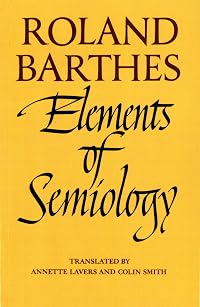
Elements of Semiology
by Roland Barthes
On This Page
Description
"Roland Barthes, the West's master critic, has given us fertile rereading of such classic French authors as Racine and Balzac, brought to attention lesser-known writers like Fourier and Loyola, studied the mythologies and sign systems of modern life and fashion, explored cinema and music, examined culture-as-system in Japan, tried to delineate the erotics of reading and writing, and touched provocatively on numerous other topics. What he shares with the best of his colleagues is the show more assumption that criticism is an attitude, not an act. He brings his readers questions and speculations that are always engaging and expansive. It is just this temperament that makes him the latest heir of the tradition of French moralistes--Montaigne, Diderot, Voltaire, and, in his own day, Gide and Sartre--who used their cultural conscience and experimental brilliance to synthesize intellectual, ethical, and literary concerns."--Jacob Stockinger, San Francisco Review of Books. show lessTags
Recommendations
















Member Reviews
A key text in structuralism. From the Introduction by Barthes: "In his Course in General Linguistics, first published in 1916, Saussure postulated the existence of a general science of signs, or Semiology, of which linguistics would form only one part. Semiology, therefore aims to take in any system of signs, whatever their substance and limits; images, gestures, musical sounds, objects, and the complex associations of all these, which form the content of ritual, convention or public entertainment: these constitute, if not languages, at least systems of signification . . . The Elements here presented have as their sole aim the extraction from linguistics of analytical concepts which we think a priori to be sufficiently general to start show more semiological research on its way." show less
SUMÁRIO:
[007] - Nota de Comunicación.
(.)
[013] - Introducción.
(.)
[017] - Lengua y Habla.
(.)
[037] - Significado y Significante.
(.)
[059] - Sintagma y Sistema.
(.)
[089] - Denotación y Connotación.
(.)
[097] - Conclusión.
(.)
[007] - Nota de Comunicación.
(.)
[013] - Introducción.
(.)
[017] - Lengua y Habla.
(.)
[037] - Significado y Significante.
(.)
[059] - Sintagma y Sistema.
(.)
[089] - Denotación y Connotación.
(.)
[097] - Conclusión.
(.)
May 28, 2013Portuguese (Brazil)
Ratings
Members
- Recently Added By
Author Information

196+ Works 22,362 Members
Roland Barthes (1915-1980), a French critic and intellectual, was a seminal figure in late twentieth-century literary criticism. Barthes's primary theory is that language is not simply words, but a series of indicators of a given society's assumptions. He derived his critical method from structuralism, which studies the rules behind language, and show more semiotics, which analyzes culture through signs and holds that meaning results from social conventions. Barthes believed that such techniques permit the reader to participate in the work of art under study, rather than merely react to it. Barthes's first books, Writing Degree Zero (1953), and Mythologies (1957), introduced his ideas to a European audience. During the 1960s his work began to appear in the United States in translation and became a strong influence on a generation of American literary critics and theorists. Other important works by Barthes are Elements of Semiology (1968), Critical Essays (1972), The Pleasure of the Text (1973), and The Empire of Signs (1982). The Barthes Reader (1983), edited by Susan Sontag, contains a wide selection of the critic's work in English translation. (Bowker Author Biography) show less
Series
Belongs to Publisher Series
Common Knowledge
- Canonical title*
- Elementi di semiologia
- Original title
- Élements de Sémiologie
- Original publication date
- 1964
- Original language
- French
*Some information comes from Common Knowledge in other languages. Click "Edit" for more information.
Classifications
- Genres
- Nonfiction, Literature Studies and Criticism, Philosophy, General Nonfiction
- DDC/MDS
- 401 — Language Language Philosophy and theory; international languages
- LCC
- P123 .B3813 — Language and Literature Philology. Linguistics Language. Linguistic theory. Comparative grammar Science of language (Linguistics)
- BISAC
Statistics
- Members
- 555
- Popularity
- 53,565
- Reviews
- 3
- Rating
- (3.49)
- Languages
- 6 — English, German, Italian, Polish, Portuguese, Spanish
- Media
- Paper
- ISBNs
- 13
- ASINs
- 6