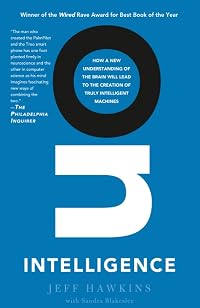
On Intelligence
by Jeff Hawkins
On This Page
Description
From the inventor of the PalmPilot comes a new and compelling theory of intelligence, brain function, and the future of intelligent machines Jeff Hawkins, the man who created the PalmPilot, Treo smart phone, and other handheld devices, has reshaped our relationship to computers. Now he stands ready to revolutionize both neuroscience and computing in one stroke, with a new understanding of intelligence itself.Hawkins develops a powerful theory of how the human brain works, explaining why show more computers are not intelligent and how, based on this new theory, we can finally build intelligent machines.The brain is not a computer, but a memory system that stores experiences in a way that reflects the true structure of the world, remembering sequences of events and their nested relationships and making predictions based on those memories. It is this memory-prediction system that forms the basis of intelligence, perception, creativity, and even consciousness.In an engaging style that will captivate audiences from the merely curious to the professional scientist, Hawkins shows how a clear understanding of how the brain works will make it possible for us to build intelligent machines, in silicon, that will exceed our human ability in surprising ways.Written with acclaimed science writer Sandra Blakeslee, On Intelligencepromises to completely transfigure the possibilities of the technology age. It is a landmark book in its scope and clarity. show lessTags
Recommendations






Member Reviews
Very insightful and hard to believe this book was published more than 16 years ago in 2004. It brings a fresh perspective on the current debate about the dangers of AI and how likely we are to make machines that are super-intelligent. It does a great job of demystifying human intelligence and explaining why it has been so hard to replicate in computers. I suspect it will turn out to be quite prescient and one of the more important books on the subject. I was particularly impressed with the author's personal journey vis-a-vis his interest in brains and how he was willing to challenge conventional wisdom and the way the AI industry approached the problem. My only gripe is that after introducing the reader to the problem of invariant show more representation as one of the greatest scientific mysteries of our time, the author didn't dwell much on the nature of the problem, why it is so difficult and how over the coming years or decades it may be solved. show less
This book was like an uncle, the eccentric uncle who your parents don't like to hang out with, and with whom *you* don't like to hang out with, much, who will tell you how smart he is, how everyone else is so dumb, how super intelligent he is, how so very dumb everyone else is, and they're dumb because it's just so *obvious* they're dumb, but then you hear one thing he says and you think, "Hey, that might be an interesting thought..." but then you remember it's your crazy flipping uncle and he starts telling you the same story, but this time by naming all the synonyms he can name for 'discourse,' just a straight list of them, and not for nothing he knows *a lot* of synonyms for the word 'discourse.'
Or maybe, let's think of it another show more way, like it's a song, only the song only repeats itself over and over and over again. The notes are all the same set of three, and they are repeated endlessly. Occasionally different words are sung over the same three notes, but mostly they're the same, usually in the same order.
Imagine, because you're not as smart as the author, that the book is like a mighty river at the bottom of a valley that you hold in higher regard than a crummy little stream at the top of a mountain. Now just because, stupid, the river is actually *physically* lower than the stream it doesn't mean that your regard for it is necessarily lower.
"Can we trust that the world is as it seems? Yes. The world really does exist in an absolute form very close to how we perceive it." I'm just going to toss that out there, not going to back it up, but I said it, so there it is.
I think this book could have been interesting (and far, far shorter if he didn't feel the need to make three or four or five or more different comparisons to try and explain how we perceive things), but the author and I just didn't get on pretty early, and I found myself desperate to get to the end, just to get it over with. And I did. Thank goodness. show less
Or maybe, let's think of it another show more way, like it's a song, only the song only repeats itself over and over and over again. The notes are all the same set of three, and they are repeated endlessly. Occasionally different words are sung over the same three notes, but mostly they're the same, usually in the same order.
Imagine, because you're not as smart as the author, that the book is like a mighty river at the bottom of a valley that you hold in higher regard than a crummy little stream at the top of a mountain. Now just because, stupid, the river is actually *physically* lower than the stream it doesn't mean that your regard for it is necessarily lower.
"Can we trust that the world is as it seems? Yes. The world really does exist in an absolute form very close to how we perceive it." I'm just going to toss that out there, not going to back it up, but I said it, so there it is.
I think this book could have been interesting (and far, far shorter if he didn't feel the need to make three or four or five or more different comparisons to try and explain how we perceive things), but the author and I just didn't get on pretty early, and I found myself desperate to get to the end, just to get it over with. And I did. Thank goodness. show less
Jeff Hawkins has a knack for abstracting and interpreting the structure of our brain. His ideas are very thought provoking mostly because he makes it all seem so simple (even if he did not intend it to be so). I don't want to say he is wrong and the optimist in me even hopes he is right since a simple solution is usually nicer.
Author is one of the top people in consumer tech (created Palm Pilot), and is deeply interested in AI. He does a pretty good job of presenting a few elements of the field (neural networks, primarily, and that prediction is the most key activity in the neocortex) to a general audience, and then includes some of his own theories and predictions (which is tricky because it's hard for a non-expert to know which parts are broadly accepted and which are his own theories...). Overall, a very interesting book, and since it's nearly 20 years old, it's interesting to see which of his predictions were accurate (things took about 10-20% longer than he predicted, I think, but were much more successful than he predicted); always neat when someone's show more errors in "wild predictions" are that they were too conservative in some way.
I honestly don't know anywhere near enough about neuroscience to really evaluate that portion or his presentation, but the more general information/cs part was pretty solid.
Most interesting thing to me was the theory that the neocortex evolved to make predictions better in animals, which is a great way to have it merge with the sensory and motor control parts of lower elements of the brain, and provides an incremental and continuous benefit from even slight levels of new capability all the way up to what we have in humans today. show less
I honestly don't know anywhere near enough about neuroscience to really evaluate that portion or his presentation, but the more general information/cs part was pretty solid.
Most interesting thing to me was the theory that the neocortex evolved to make predictions better in animals, which is a great way to have it merge with the sensory and motor control parts of lower elements of the brain, and provides an incremental and continuous benefit from even slight levels of new capability all the way up to what we have in humans today. show less
eff Hawkins is the man who was the architect of the PalmPilot, the Treo, and invented Graffiti, an alphabet for inputing data to a computer with a stylus. But this book is about his other love, the deciphering of the code that makes the human brain work. There is nothing like a big, important puzzle to get the blood working, and mine was powerfully pulled along . With the human genome project's sequencing of human DNA nearly completed, understanding the brain has got to be the most important scientific undertaking one can think of. Hawkins easily persuades us that there is a burning need for a "top down" model for the brain that can play a role something analogous to the Central Dogma of molecular biology, which guides and organizes show more research, prioritizing the myriad of possible tasks into something like that required for the logistics of a conquering army's march through an alien land.
He also persuaded me that he has some important insights of that model that I found tantalizing, new and exciting. His central model concerns the role of the cortex in producing intelligence. He makes the case for a central dogma he calls "the memory-prediction framework." This idea says that the cortex is a machine for making predictions for temporal sensory patterns based on memories of past patterns. The prediction algorithm carried out in the cortex is the same for all of the senses of vision, touch, hearing, etc., which accounts for, among other things, the basic physiological uniformity of the cortex, and the plasticity of the brain in adapting to such problems as blindness or deafness.
He argues that since the "clock" of the brain operates at a tick-rate on the order of 5 milli-seconds, and most of the functions of the brain (e. g. recognizing that a picture of a cat shows a cat) are carried out in less than 100 ticks. From the time that light enters the eye, to the time it takes to signify recognition takes less than a second. A computer would take billions of instruction steps, and even the fastest parallel computer available would not do it in less than millions of steps. So the brain doesn't really "compute" the answer, it retrieves it from memory, which requires far fewer steps than the computation. Sounds good to me.
His explication of the memory-prediction framework is clear and accessible even to the uninitiated like me, though I found some of it in the middle pretty heavy going. But this is something like reading Watson and Crick's paper on the structure of DNA. The part about turning the diffraction diagram and other insights into a workable model was a little above my head, but I could still see the importance of the answer, and how it addressed the problem of replication and how it gave clues as to how to "read the genes." I can only grasp part of what Hawkins has done, and I can see that there is still a long way to go. But I can still jump up and down about it! show less
He also persuaded me that he has some important insights of that model that I found tantalizing, new and exciting. His central model concerns the role of the cortex in producing intelligence. He makes the case for a central dogma he calls "the memory-prediction framework." This idea says that the cortex is a machine for making predictions for temporal sensory patterns based on memories of past patterns. The prediction algorithm carried out in the cortex is the same for all of the senses of vision, touch, hearing, etc., which accounts for, among other things, the basic physiological uniformity of the cortex, and the plasticity of the brain in adapting to such problems as blindness or deafness.
He argues that since the "clock" of the brain operates at a tick-rate on the order of 5 milli-seconds, and most of the functions of the brain (e. g. recognizing that a picture of a cat shows a cat) are carried out in less than 100 ticks. From the time that light enters the eye, to the time it takes to signify recognition takes less than a second. A computer would take billions of instruction steps, and even the fastest parallel computer available would not do it in less than millions of steps. So the brain doesn't really "compute" the answer, it retrieves it from memory, which requires far fewer steps than the computation. Sounds good to me.
His explication of the memory-prediction framework is clear and accessible even to the uninitiated like me, though I found some of it in the middle pretty heavy going. But this is something like reading Watson and Crick's paper on the structure of DNA. The part about turning the diffraction diagram and other insights into a workable model was a little above my head, but I could still see the importance of the answer, and how it addressed the problem of replication and how it gave clues as to how to "read the genes." I can only grasp part of what Hawkins has done, and I can see that there is still a long way to go. But I can still jump up and down about it! show less
Fairly easy read but still contains some deep ideas about the mind. He argues that the mind is not, as popularly believed, a giant computer, but rather a huge memory system. Specifically an “auto-associative” memory that is able to retrieve complete memories based on only partial memories given as input, much like we can recall entire songs given only the first few notes. This in itself is not a new idea, but the way the author ties it all together is new. He avoids too much detail and neuroscience jargon so it is very accessible to the general science reader. Chapter 6 on how the cortex works is the most difficult section and occupies about a quarter of the book. By difficult I mean it will take some concentration and a fairly show more close reading in order to not get lost. The authors do a splendid job explaining a complicated topic and I found the book a very enjoyable read.
Here is a quote to give you a feeling for the writing:
"I realized that if someone had invented the concept of a computer with a graphical user interface and a spreadsheet application, and presented it to me on paper, I would have rejected it as impractical. I would have said it would take forever to do anything. It was a humbling thought because it did work. It was then that I realized my intuitive sense for the speed of the microprocessor and my intuitive sense for the power of hierarchical design were inadequate. There is a lesson here about the neocortex. It isn't made of superfast components and the rules under which it operates are not that complex. However, it does have a hierarchical structure that contains billions of neurons and trillions of synapses. If we find it hard to imagine how such a logically simple but numerically vast memory system can create our consciousness, our languages, our cultures, our art, this book, and our science and technology, I suggest it is because our intuitive sense of the capacity of the cortex and the power of its hierarchical structure is inadequate. The neocortex does work. It isn't magic. We can understand it. And like a computer, ultimately we can build intelligent machines that work on the same principles". (pg. 175) show less
Here is a quote to give you a feeling for the writing:
"I realized that if someone had invented the concept of a computer with a graphical user interface and a spreadsheet application, and presented it to me on paper, I would have rejected it as impractical. I would have said it would take forever to do anything. It was a humbling thought because it did work. It was then that I realized my intuitive sense for the speed of the microprocessor and my intuitive sense for the power of hierarchical design were inadequate. There is a lesson here about the neocortex. It isn't made of superfast components and the rules under which it operates are not that complex. However, it does have a hierarchical structure that contains billions of neurons and trillions of synapses. If we find it hard to imagine how such a logically simple but numerically vast memory system can create our consciousness, our languages, our cultures, our art, this book, and our science and technology, I suggest it is because our intuitive sense of the capacity of the cortex and the power of its hierarchical structure is inadequate. The neocortex does work. It isn't magic. We can understand it. And like a computer, ultimately we can build intelligent machines that work on the same principles". (pg. 175) show less
I liked the fairly straightforward description and explanation of the premise - that intelligence comes from a memory-prediction architecture that is hierarchical. However, in trying to speak to a general, mainstream audience, I think the author may have aimed too low . It seemed to me that a lot of the examples were overly simple and tiresome, in some cases. At times, it also felt like it was more of a common-sense persuasive argument than hard-core science. All in all, though, it was a quick read, and it motivated me to look for more detailed accounts elsewhere.
Members
- Recently Added By
Lists

Books That Changed Our Perspective
423 works; 168 members
Author Information

2 Works 1,817 Members
All Editions
Series
Belongs to Publisher Series
Common Knowledge
- Original title
- On Intelligence
- Original publication date
- 2005
- People/Characters
- Thomas Bayes; Deep Blue; Eliza
- First words
- Prologue
This book and my life are animated by two passions.
1:Artificial Intelligence
When I graduated from Cornell in June 1979 with a degree in electrical engineering, I didn't have any major plans for my life. - Last words
- (Click to show. Warning: May contain spoilers.)9:The Future of Intelligence
Now is the turning point
(Click to show. Warning: May contain spoilers.)Epilogue
I hope you will join me, along with others who take up the challenge, to create one of the greatest technologies the world has ever seen. - Original language
- English
Classifications
Statistics
- Members
- 1,471
- Popularity
- 15,951
- Reviews
- 26
- Rating
- (4.03)
- Languages
- 8 — English, Finnish, French, German, Korean, Russian, Spanish, Turkish
- Media
- Paper, Audiobook, Ebook
- ISBNs
- 10
- ASINs
- 7