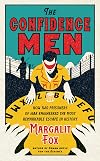
The Confidence Men: How Two Prisoners of War Engineered the Most Remarkable Escape in History
by Margalit Fox
On This Page
Description
"Imprisoned in a remote Turkish prison camp during World War I, having survived a two-month forced march and a terrifying shootout in the desert, two British officers, Harry Jones and Cedric Hill, join forces to bamboozle their iron-fisted captors. To stave off despair and boredom, Jones takes a handmade Ouija board and fakes elaborate séances for his fellow prisoners. Word gets around camp, and one day, a Turkish officer approaches Jones with a query: Could Jones contact the spirit world show more to find a vast treasure rumored to be buried nearby? Jones, a trained lawyer, and Hill, a brilliant magician, use the Ouija board--and their keen understanding of the psychology of deception--to build a trap for the Turkish officers that will ultimately lead them to freedom. The Confidence Men is the story of the only known con game played for a good cause--and of a profound but unlikely friendship. Had it not been for "the Great War," Jones, the Oxford-educated son of a British lord, and Hill, a mechanic from an Australian sheep farm, would never have met. But in pain, loneliness, hunger, and isolation, they formed a powerful emotional and intellectual alliance that saved both of their lives. Margalit Fox brings her "nose for interesting facts, the ability to construct a taut narrative arc, and a Dickens-level gift for concisely conveying personality" (Kathryn Schulz, New York) to this gripping tale of psychological strategy that is rife with cunning, danger, and moments of high farce that rival anything in Catch-22"-- show lessTags
Recommendations



Member Reviews
This is one of those books I couldn't stop telling people about:
So there's these two prisoners of war, and they use slight of hand and cold-reading to convince their Turkish captors that they're psychics and then lean in to the Turk's xenophobia to further convince them that there is secret Armenian treasure
So there's these two prisoners of war, and they use slight of hand and cold-reading to convince their Turkish captors that they're psychics and then lean in to the Turk's xenophobia to further convince them that there is secret Armenian treasure
A readable yarn about the story of two soldiers in WWI Turkey—the British Elias Henry Jones and the Australian Cedric Hill—who used feigned abilities in telepathy and spiritualism to get out of the remote POW camp in which they were being held.
Margalit Fox provides a little more historical context and benefit-of-hindsight analysis than might be gleaned from the accounts that both Jones and Hill wrote in later life, and some dry humour, but I couldn't shake the feeling that I was reading simply a paraphrase/synthesis of their respective books.
What I really felt was lacking from The Confidence Men was some sense of why they did it. Yes, I could see how the sheer boredom of being trapped in a POW camp might lead you to start running show more harmless(-ish) Ouija board cons on the people around you to pass the time; I could even see why Jones and Hill started thinking about ways they could use their tricks to potentially get out of Yozgat. But both men went to incredible lengths, endured incredible suffering, and came close to death, in order to get home... a fortnight earlier than they might have otherwise? And sure, that's not nothing, but they were getting communications from their families which told them that the tide of war was turning in the favour of the Allied Powers. So why risk so much? Why not tap out? I really got no sense of motivation here. Perhaps there really were few hints in the surviving records as to what drove both men—something which inclines me to think that their exploits deserved a novelization more so than an attempt at a straight historical recounting. show less
Margalit Fox provides a little more historical context and benefit-of-hindsight analysis than might be gleaned from the accounts that both Jones and Hill wrote in later life, and some dry humour, but I couldn't shake the feeling that I was reading simply a paraphrase/synthesis of their respective books.
What I really felt was lacking from The Confidence Men was some sense of why they did it. Yes, I could see how the sheer boredom of being trapped in a POW camp might lead you to start running show more harmless(-ish) Ouija board cons on the people around you to pass the time; I could even see why Jones and Hill started thinking about ways they could use their tricks to potentially get out of Yozgat. But both men went to incredible lengths, endured incredible suffering, and came close to death, in order to get home... a fortnight earlier than they might have otherwise? And sure, that's not nothing, but they were getting communications from their families which told them that the tide of war was turning in the favour of the Allied Powers. So why risk so much? Why not tap out? I really got no sense of motivation here. Perhaps there really were few hints in the surviving records as to what drove both men—something which inclines me to think that their exploits deserved a novelization more so than an attempt at a straight historical recounting. show less
This was fairly readable, but mostly it felt like the book version of bumping a post on a message board or retweeting to spread awareness: Fox is just recapitulating the accounts that these men wrote to get them a wider audience. She does add some content in the form of background that Jones's and Hill's contemporaneous audience might not have needed, but she also quotes long extracts from their books verbatim and mostly just -- retells the story they've already told in book form. And often the extracts are the most engaging part of the book; Fox doesn't add much in the way of personality or flair.
I tell you what, though: I would love to see a historical novel inspired by this story, because that could supply a lot of the deficiencies show more that this book has -- more motivation, more personality, more about the relationships between prisoners, and maybe a slightly more satisfying ending.
(This book did give me yet another chance to marvel at the training provided to pilots in WWI. Two takeoffs and landings, eight loops, and ascending to 900 feet -- you are qualified for war, buddy! A little more training on other aircraft and a few written tests and you can TEACH. But you'll have to figure out target practice on your own, because we have no procedure for that. Just. Never over it, really.) show less
I tell you what, though: I would love to see a historical novel inspired by this story, because that could supply a lot of the deficiencies show more that this book has -- more motivation, more personality, more about the relationships between prisoners, and maybe a slightly more satisfying ending.
(This book did give me yet another chance to marvel at the training provided to pilots in WWI. Two takeoffs and landings, eight loops, and ascending to 900 feet -- you are qualified for war, buddy! A little more training on other aircraft and a few written tests and you can TEACH. But you'll have to figure out target practice on your own, because we have no procedure for that. Just. Never over it, really.) show less
Wild and crazy scheme to escape a Turkish WW I prison camp. The story has a bit of everything, but most especially chutzpah. Success was achieved eventually, but the irony of having only gained a few weeks before the rest of the prisoners were released upon the conclusion of the war had to be painful.
Ouija Escapees
Review of the Random House hardcover (June 2021)
The Confidence Men is the incredible story of how two British officers in a World War One prisoner of war camp in the then Ottoman Empire managed to escape using their combined skills of telling tall tales, memory, sleight of hand and acting. Elias Henry Jones (1883-1942) and Cedric Waters Hill (1891-1975) were captured in the Mesopotamian theatre of the war, Jones after the Seige of Kut, and Hill when his bomber airplane was shot down.
During their incarceration they managed to convince not only their fellow prisoners, but also their Turkish captors, that they possessed not only the powers to contact the dead but also the power of telepathy. This all started off with nightly show more seances with a custom built Ouija board leading up to a hoax to convince their greedy camp commandant that they could get the spirits of the dead to lead them to a buried Armenian treasure. Eventually they had to feign insanity as well in order to qualify for a prisoner exchange of the sick and wounded.
See image at https://www.flyingbooks.co.uk/acatalog/The-Spook-and-The-Commandant.4672.gif
Cover image of "The Spook and the Commandant" (1975), the posthumously published account of Jones & Hill's escape by Cedric Waters Hill. Image sourced from Flying Books Co. UK.
Margalit Fox has done an excellent job in not only telling the escape plan story, which was first documented in Jones' own account The Road to En-dor (1919), but providing the additional background and context of the war situation and how spiritualism had a strong enough hold on people in that era for the hoax to be believed by many parties.
I read The Confidence Men due to its nomination for Best Fact Crime in the 2022 Edgar Awards by the Mystery Writers of America. The winners of the 76th Annual Edgar® Awards will be announced on April 28, 2022.
Other Reviews
The Brilliance of Two Captured WWI Officers, by Margaret Quamme, The Columbus Dispatch, July 18, 2021.
Trivia and Link
The Road to En-Dor (1919) by Elias Henry Jones is in the public domain and can be read on Project Gutenberg here.
There was apparently an attempt to adapt this story for film and a script was written by writer Neil Gaiman in collaboration with magician Penn Jillette, but the production has never proceeded. show less
Review of the Random House hardcover (June 2021)
The Confidence Men is the incredible story of how two British officers in a World War One prisoner of war camp in the then Ottoman Empire managed to escape using their combined skills of telling tall tales, memory, sleight of hand and acting. Elias Henry Jones (1883-1942) and Cedric Waters Hill (1891-1975) were captured in the Mesopotamian theatre of the war, Jones after the Seige of Kut, and Hill when his bomber airplane was shot down.
During their incarceration they managed to convince not only their fellow prisoners, but also their Turkish captors, that they possessed not only the powers to contact the dead but also the power of telepathy. This all started off with nightly show more seances with a custom built Ouija board leading up to a hoax to convince their greedy camp commandant that they could get the spirits of the dead to lead them to a buried Armenian treasure. Eventually they had to feign insanity as well in order to qualify for a prisoner exchange of the sick and wounded.
See image at https://www.flyingbooks.co.uk/acatalog/The-Spook-and-The-Commandant.4672.gif
Cover image of "The Spook and the Commandant" (1975), the posthumously published account of Jones & Hill's escape by Cedric Waters Hill. Image sourced from Flying Books Co. UK.
Margalit Fox has done an excellent job in not only telling the escape plan story, which was first documented in Jones' own account The Road to En-dor (1919), but providing the additional background and context of the war situation and how spiritualism had a strong enough hold on people in that era for the hoax to be believed by many parties.
I read The Confidence Men due to its nomination for Best Fact Crime in the 2022 Edgar Awards by the Mystery Writers of America. The winners of the 76th Annual Edgar® Awards will be announced on April 28, 2022.
Other Reviews
The Brilliance of Two Captured WWI Officers, by Margaret Quamme, The Columbus Dispatch, July 18, 2021.
Trivia and Link
The Road to En-Dor (1919) by Elias Henry Jones is in the public domain and can be read on Project Gutenberg here.
There was apparently an attempt to adapt this story for film and a script was written by writer Neil Gaiman in collaboration with magician Penn Jillette, but the production has never proceeded. show less
Actual Rating 3.5. Listened on audio book.
The Confidence Men is slow to start, requiring a significant amount of preamble to set the scene of the First World War and the events and battles leading up to Hill and Jones' capture. I found this part interesting, but the logistics and movements (etc) of warfare is something I find interesting. Other people may find this section tedious as it is not the main purpose of the book. The pace increases as Jone's reaches the camp, but breaks are often taken throughout the story to fill in historical information and provide context; some of these I found interesting, and some I did not. The book itself straddles the middle ground between being a story and a historical text, but most of the story is show more conveyed via distant narration with only a couple scenes throughout actually putting the reader in the moment. When they happen these scenes and enjoyable, but they only supply about a quarter of the book. show less
The Confidence Men is slow to start, requiring a significant amount of preamble to set the scene of the First World War and the events and battles leading up to Hill and Jones' capture. I found this part interesting, but the logistics and movements (etc) of warfare is something I find interesting. Other people may find this section tedious as it is not the main purpose of the book. The pace increases as Jone's reaches the camp, but breaks are often taken throughout the story to fill in historical information and provide context; some of these I found interesting, and some I did not. The book itself straddles the middle ground between being a story and a historical text, but most of the story is show more conveyed via distant narration with only a couple scenes throughout actually putting the reader in the moment. When they happen these scenes and enjoyable, but they only supply about a quarter of the book. show less
Extremely fascinating. The two main characters are some of the most brilliant and dedicated people I have ever heard of. After a while I started to wonder whether the escapees made up their story like they faked their spiritualism and their mind-reading abilities, but there were many other people who wrote about them and corroborated their stories, so it must be true.
Members
- Recently Added By
Lists

History: War & Terrorism
64 works; 1 member

War Literature
101 works; 19 members

THE WAR ROOM
813 works; 24 members
Author Information

6 Works 1,813 Members
Margalit Fox is a reporter for The New York Times. She holds bachelor's and master's degrees in linguistics from Stony Brook University and a master's degree from the Columbia University Graduate School of Journalism
Awards and Honors
Awards
Distinctions
Common Knowledge
- Canonical title
- The Confidence Men: How Two Prisoners of War Engineered the Most Remarkable Escape in History
- Original title
- The Confidence Men
- People/Characters
- Cedric Waters Hill; Elias Henry Jones
- Important places
- Turkey
- Blurbers
- Mundy, Liza; Olson, Lynne; Weinman, Sarah
- Canonical DDC/MDS
- 940.4725638
Classifications
- Genres
- History, General Nonfiction, Nonfiction, Biography & Memoir
- DDC/MDS
- 940.4725638 — History & geography History of Europe History of Europe Military History Of World War I Prisons, hospitals, charities Prisons Asia Turkey in Asia
- LCC
- D627 .T8 .F69 — History of Europe, Asia, Africa and Oceania History (General) World War I (1914-1918)
- BISAC
Statistics
- Members
- 247
- Popularity
- 131,379
- Reviews
- 11
- Rating
- (3.77)
- Languages
- English
- Media
- Paper, Audiobook, Ebook
- ISBNs
- 8
- ASINs
- 2