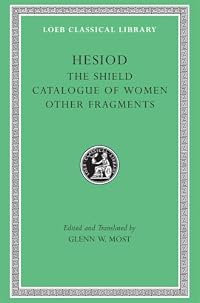
Hesiod, Volume II
by Hesiod
On This Page
Description
This volume, which completes the new Loeb Classical Library edition of Hesiod, contains The Shield and extant fragments of other poems, including the Catalogue of Women, that were attributed to Hesiod in antiquity. None of these is now thought to be by Hesiod himself, but all have considerable literary and historical interest. The Catalogue of Women is a systematic presentation in five books of a large number of Greek legendary heroes and episodes, organized according to the genealogy of the show more heroes' mortal mothers. The Shield provides a Hesiodic counterpoint to the shield of Achilles in the Iliad, with Heracles as the protagonist. The volume concludes with a comprehensive index to the complete edition. show lessTags
Recommendations

Member Reviews
Before I get started, It should be noted that I am by no means a specialist in anything to do with ancient Greek culture or language, but simply a novice dabbler who delights in discovering these old stories. It is the closest thing I can imagine, asides from reading the cracked papyrus scrolls themselves. Thus, I can't really be relied upon to review these sorts of dual language books appropriately.
That being said, this second volume of Hesiod, published by the Loeb Classical Library, nicely rounds out the fragments where the first volume leaves off. I found it entertaining to piece together the fragments, like some sort of ancient literary jigsaw puzzle, into some coherent order. Even though this volume wasn't as enjoyable as Hesiod: show more Volume I, it was still filled with little wisps of deep storytelling revealed here and there by other ancient authors who cited Hesiod in their writings. The book also contains The Shield of Heracles, easily comparable to Homer's The Shield of Achilles in the Illiad, and just as enjoyable. How can one resist descriptions like this:
"Just as in a mountain's dales a jutting-tusked boar, formidable to catch sight of up ahead, decides in its spirit to fight with huntsmen, and it whets its white tusk, turning aslant, and foam drips around its mouth as it gnashes its teeth, its eyes shine like fire, and it makes the hairs stand up and bristle on its mane around its neck: just so, Zeus' son sprang from his horse-chariot."
The Catalogue of Women may be of more interest to mythology buffs, where it lays out some the finer details in who begat who and under what circumstances. Unsprisingly, these circumstance often include some Olympian God seducing or outright raping some poor female mortal, only for some jealous Goddess to come around and punish the poor woman even more. The collection also features some trivia regarding some of the peripheral characters of the Iliad and the Odyssey, such as Nestor the Gerenian horseman.
There are some beautiful poetic passages in here, such as this description of Atalanta, Daughter of Schoeneus:
"The long-ankled maiden rushed; all around stood a great crowd of suitors; astonishment gripped them all when they saw how the breeze of Zephyrus fluttered her tunic around her tender breasts." It helps one understand why men would suffer death to collect the golden apples and thus win her hand in marriage.
I can't exactly place my finger on why I like these little books so much, but I do. I rejoice and cringe at the thought of reading of all of them someday. Eventually perhaps, in the meantime I will relish the experience of seeing how far I get, one by one. show less
That being said, this second volume of Hesiod, published by the Loeb Classical Library, nicely rounds out the fragments where the first volume leaves off. I found it entertaining to piece together the fragments, like some sort of ancient literary jigsaw puzzle, into some coherent order. Even though this volume wasn't as enjoyable as Hesiod: show more Volume I, it was still filled with little wisps of deep storytelling revealed here and there by other ancient authors who cited Hesiod in their writings. The book also contains The Shield of Heracles, easily comparable to Homer's The Shield of Achilles in the Illiad, and just as enjoyable. How can one resist descriptions like this:
"Just as in a mountain's dales a jutting-tusked boar, formidable to catch sight of up ahead, decides in its spirit to fight with huntsmen, and it whets its white tusk, turning aslant, and foam drips around its mouth as it gnashes its teeth, its eyes shine like fire, and it makes the hairs stand up and bristle on its mane around its neck: just so, Zeus' son sprang from his horse-chariot."
The Catalogue of Women may be of more interest to mythology buffs, where it lays out some the finer details in who begat who and under what circumstances. Unsprisingly, these circumstance often include some Olympian God seducing or outright raping some poor female mortal, only for some jealous Goddess to come around and punish the poor woman even more. The collection also features some trivia regarding some of the peripheral characters of the Iliad and the Odyssey, such as Nestor the Gerenian horseman.
There are some beautiful poetic passages in here, such as this description of Atalanta, Daughter of Schoeneus:
"The long-ankled maiden rushed; all around stood a great crowd of suitors; astonishment gripped them all when they saw how the breeze of Zephyrus fluttered her tunic around her tender breasts." It helps one understand why men would suffer death to collect the golden apples and thus win her hand in marriage.
I can't exactly place my finger on why I like these little books so much, but I do. I rejoice and cringe at the thought of reading of all of them someday. Eventually perhaps, in the meantime I will relish the experience of seeing how far I get, one by one. show less
Ratings
Members
- Recently Added By
Author Information

163+ Works 7,387 Members
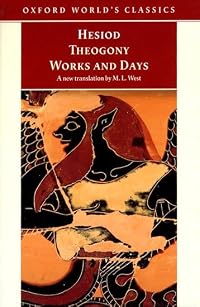
The poet Hesiod tells us that his father gave up sea-trading and moved from Ascra to Boeotia, that as he himself tended sheep on Mount Helicon the Muses commanded him to sing of the gods, and that he won a tripod for a funeral song at Chalcis. The poems credited to him with certainty are: the Theogony, an attempt to bring order into the otherwise show more chaotic material of Greek mythology through genealogies and anecdotes about the gods; and The Works and Days, a wise sermon addressed to his brother Perses as a result of a dispute over their dead father's estate. This latter work presents the injustice of the world with mythological examples and memorable images, and concludes with a collection of folk wisdom. Uncertain attributions are the Shield of Heracles and the Catalogue of Women. Hesiod is a didactic and individualistic poet who is often compared and contrasted with Homer, as both are representative of early epic style. "Hesiod is earth-bound and dun colored; indeed part of his purpose is to discredit the brilliance and the ideals of heroism glorified in the homeric tradition. But Hesiod, too, is poetry, though of a different order. . . " (Moses Hadas, N.Y. Times). (Bowker Author Biography) show less
Series
Belongs to Publisher Series
Loeb Classical Library (503)
Common Knowledge
- Canonical title
- Hesiod, Volume II
- Alternate titles
- Hesiod: Volume II, The Shield. Catalogue of Women. Other Fragments
Classifications
- Genres
- Fiction and Literature, Poetry
- DDC/MDS
- 881.01 — Literature & rhetoric Classical & modern Greek literatures Classical Greek poetry Different categories of Greek classical poetry Philosophy and Theory
- LCC
- PA4009 .A2 — Language and Literature Greek language and literature. Latin language and literature Greek literature Individual authors
- BISAC
Statistics
- Members
- 55
- Popularity
- 553,373
- Reviews
- 1
- Rating
- (3.88)
- Languages
- English, Greek (Ancient)
- Media
- Paper
- ISBNs
- 1