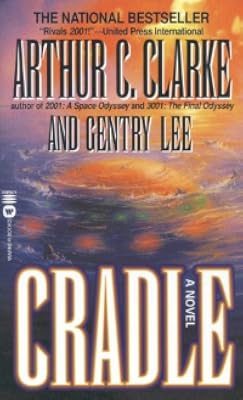
Cradle
by Arthur C. Clarke (Author), Gentry Lee (Author)
On This Page
Description
A journalist hunting military secrets uncovers an alien presence off the Florida Keys in this novel by the award-winning author of 2001: A Space Odyssey.In 1994, an experimental navy missile mysteriously disappears off the coast of Florida during testing. While investigating the link between the disappearance and some unusual whale sightings, journalist Carol Dawson finds much more: a strange golden trident that may be worth millions . . . and may not be of earthly origin.
While Dawson show more and treasure hunter Nick Williams try to make sense of their discovery, they must also outwit thieves and criminals to keep it safe. But the trident leads them to another, more unsettling discovery. Deep underwater, Dawson and Williams encounter the highly advanced beings that placed the trident where it is. And their plans for it could change the face of humanity forever.
In Cradle, the Hugo and Nebula Award–winning author Arthur C. Clarke, widely considered one of the most important figures in science fiction literature, teams up with author Gentry Lee to deliver another thrilling tale of alien contact and human conflict. Science Fiction. Fiction. show less
Tags
Recommendations













Member Reviews
I always assumed that Shaun Hutson's [b:Slugs|3836481|Slugs|Shaun Hutson|http://photo.goodreads.com/books/1248256416s/3836481.jpg|907812] would be the worst book I ever read. People being chased and caught by ferocious, man-eating slugs was sufficient to break my usually robust suspension of disbelief.
However, Cradle was bad in a whole different way. I don't mind character development in science fiction, but the clumsy attempts at it in this novel are just embarrassing to read. A typical chapter could be paraphrased by:
Steve turned away from the courgette-shaped alien. Suddenly he was fifteen years old again, vividly reliving a traumatic experience; probably one involving a courgette. Sex was probably involved too. When the memory ranshow more
out of narrative flow he realised he was sad. 'I'm so sad,' he thought, sadly. Then he kicked a puppy lest anyone saw through his tough-guy exterior and realised he just wanted to dance.The author(s) feel obliged to point out the deep, psychological reasons behind each barb the two main characters exchange, until fifteen pages from the end when these two admit to each other what terribly hackneyed characters they are and hook up. Despite hating themselves and one another. Worse, most of the 368 pages in the book are made up of this stuff, the actual science fiction is crammed into three brief 'interlude' chapters and some barely developed scenes toward the end. After discovering an alien spacecraft during one of these rare late scenes the protagonists are remarkably nonchalant, occasionally remarking that the whole thing feels like a science-fiction book. At this point I couldn't help but imagine the two authors nudging me and winking, proclaiming "Because it is a science-fiction book, geddit? Geddit?!" Ah, forget it. show less
I always assumed that Shaun Hutson's [b:Slugs|3836481|Slugs|Shaun Hutson|http://photo.goodreads.com/books/1248256416s/3836481.jpg|907812] would be the worst book I ever read. People being chased and caught by ferocious, man-eating slugs was sufficient to break my usually robust suspension of disbelief.
However, Cradle was bad in a whole different way. I don't mind character development in science fiction, but the clumsy attempts at it in this novel are just embarrassing to read. A typical chapter could be paraphrased by:
Steve turned away from the courgette-shaped alien. Suddenly he was fifteen years old again, vividly reliving a traumatic experience; probably one involving a courgette. Sex was probably involved too. When the memory ranshow more
out of narrative flow he realised he was sad. 'I'm so sad,' he thought, sadly. Then he kicked a puppy lest anyone saw through his tough-guy exterior and realised he just wanted to dance.The author(s) feel obliged to point out the deep, psychological reasons behind each barb the two main characters exchange, until fifteen pages from the end when these two admit to each other what terribly hackneyed characters they are and hook up. Despite hating themselves and one another. Worse, most of the 368 pages in the book are made up of this stuff, the actual science fiction is crammed into three brief 'interlude' chapters and some barely developed scenes toward the end. After discovering an alien spacecraft during one of these rare late scenes the protagonists are remarkably nonchalant, occasionally remarking that the whole thing feels like a science-fiction book. At this point I couldn't help but imagine the two authors nudging me and winking, proclaiming "Because it is a science-fiction book, geddit? Geddit?!" Ah, forget it. show less
Clarke, Arthur C., and Gentry Lee. Cradle. 1987. Gateway, 2011.
Great hitters sometimes strike out. Great writers don’t always manage a masterpiece. Sadly, in Cradle, Arthur C. Clarke and Gentry Lee are not at their best. Both writers usually work well together, and both know their science; yet Cradle falls well short of their Rendezvous with Rama. Like RWR, Cradle is a first-contact story featuring aliens who are on their way somewhere else. This time we have a spacecraft downed off the Florida coast. Its robot minders co-opt some hapless scuba divers to get them the stuff they need to make repairs. Like Hal in 2001: A Space Odyssey, the robots are well conceived, and the technology of the spacecraft is fascinating. But almost every show more reviewer has noted that the character drama has little to do with the rest of the story. Some have even said that it sinks to the level of a Harlequin Romance. I would not go that far, but the characters do seem needlessly emotive and not focused on the task at hand. In fact, I think the story would be better with fewer characters and a less busy plot. 3.5 stars for good robots. show less
Great hitters sometimes strike out. Great writers don’t always manage a masterpiece. Sadly, in Cradle, Arthur C. Clarke and Gentry Lee are not at their best. Both writers usually work well together, and both know their science; yet Cradle falls well short of their Rendezvous with Rama. Like RWR, Cradle is a first-contact story featuring aliens who are on their way somewhere else. This time we have a spacecraft downed off the Florida coast. Its robot minders co-opt some hapless scuba divers to get them the stuff they need to make repairs. Like Hal in 2001: A Space Odyssey, the robots are well conceived, and the technology of the spacecraft is fascinating. But almost every show more reviewer has noted that the character drama has little to do with the rest of the story. Some have even said that it sinks to the level of a Harlequin Romance. I would not go that far, but the characters do seem needlessly emotive and not focused on the task at hand. In fact, I think the story would be better with fewer characters and a less busy plot. 3.5 stars for good robots. show less
A great romp with a filmic quality to it - which was obviously understood by the authors as there were "Credits" at the end! Not as good as A Fall of Moondust which I read immediately before and started me off on a sci-fi binge, but it entertained, kept me guessing and had some interseting ideas.
http://www.saltmanz.com/blog/2006/11/book-read-cradle.html
Yesterday (11/02/06) during lunch, I finished my most recent book: Cradle, by Arthur C. Clarke and Genry Lee.
This is same team that wrote the last 3/4 of the Rama series (following Clarke's standalone classic, Rendevous With Rama). Those were good books. Cradle, which was written a couple of years before the Rama sequels, is not.
Not that it's a terribly bad book. I was entertained for almost all of the 408 pages. But I'd never read it again. The book is basically a character study on the 3 protagonists, with the odd chapter of sci-fi alien stuff thrown in every hundred pages or so. Contrary to most reviews I've read, I actually found the characters engaging, and the sci-fi bits show more to be clunky and confusing. What little plot there is involves Carol (a reporter) hunting down a lost Navy missile somewhere off the Florida Keys. To do this, she charters a boat run by Nick and Troy. They go diving and find something odd, butt heads with some rival treasure hunters, and try to avoid the Navy. It's not as exciting as it sounds.
Every main character has had one emotionally-traumatic experience in their past, and the authors take a chapter or two out of the story to replay this. Most maddening is the Navy Commander: his personal life and problems are dwelt on perhaps more so than any of the protagonists, and yet he has almost zero impact on the story. At first, the dialogue felt forced an unnatural, but either it got better, or I just grew accustomed to it.
The aliens' side of the story is told in 3 or so single-chapter chunks, spaced out regularly throughout the book. But they're confusing, written in terms that manage to sound advanced yet wholly generic at the same time, and go on far too long for the scant information they provide. Eventually, near the end of the book, there's interaction between the aliens and the main characters, but you can already tell that there's not enough book left for anything to really happen. And it doesn't. The book even manages to end abruptly, after dragging on and on, plot-wise. No resolution or denouement; just the climax, and then "The End". Heck, my copy ends on the back of the last page, which means I hit the last sentence in the book, and then: back cover. Rather jarring, to tell the truth.
Like I mentioned earlier, though, the characters were decent. Even if they were annoying or artificial-feeling to begin with, I got wrapped up in their adventures and cared about what happened to them, even if their stories didn't actually go anywhere.
I won't likely ever read this again, and I can't in good conscience recommend it. I'll give it 1.5 out of 5 stars. show less
Yesterday (11/02/06) during lunch, I finished my most recent book: Cradle, by Arthur C. Clarke and Genry Lee.
This is same team that wrote the last 3/4 of the Rama series (following Clarke's standalone classic, Rendevous With Rama). Those were good books. Cradle, which was written a couple of years before the Rama sequels, is not.
Not that it's a terribly bad book. I was entertained for almost all of the 408 pages. But I'd never read it again. The book is basically a character study on the 3 protagonists, with the odd chapter of sci-fi alien stuff thrown in every hundred pages or so. Contrary to most reviews I've read, I actually found the characters engaging, and the sci-fi bits show more to be clunky and confusing. What little plot there is involves Carol (a reporter) hunting down a lost Navy missile somewhere off the Florida Keys. To do this, she charters a boat run by Nick and Troy. They go diving and find something odd, butt heads with some rival treasure hunters, and try to avoid the Navy. It's not as exciting as it sounds.
Every main character has had one emotionally-traumatic experience in their past, and the authors take a chapter or two out of the story to replay this. Most maddening is the Navy Commander: his personal life and problems are dwelt on perhaps more so than any of the protagonists, and yet he has almost zero impact on the story. At first, the dialogue felt forced an unnatural, but either it got better, or I just grew accustomed to it.
The aliens' side of the story is told in 3 or so single-chapter chunks, spaced out regularly throughout the book. But they're confusing, written in terms that manage to sound advanced yet wholly generic at the same time, and go on far too long for the scant information they provide. Eventually, near the end of the book, there's interaction between the aliens and the main characters, but you can already tell that there's not enough book left for anything to really happen. And it doesn't. The book even manages to end abruptly, after dragging on and on, plot-wise. No resolution or denouement; just the climax, and then "The End". Heck, my copy ends on the back of the last page, which means I hit the last sentence in the book, and then: back cover. Rather jarring, to tell the truth.
Like I mentioned earlier, though, the characters were decent. Even if they were annoying or artificial-feeling to begin with, I got wrapped up in their adventures and cared about what happened to them, even if their stories didn't actually go anywhere.
I won't likely ever read this again, and I can't in good conscience recommend it. I'll give it 1.5 out of 5 stars. show less
Unfortunately, while this book has an interesting premise, the characterisation is pathetic. The way people in this book talk and think is totally unbelievable.
I gave up on it well before the 100 page point.
I gave up on it well before the 100 page point.
I felt the writing was subpar,especially for an Arthur C Clarke novel (co-written by Gentry Lee).
However, this was an entertaining tale with suprising subject matter, plot and characters. It certainly presents and interesting premise.
I felt the characters were well crafted, though I felt Greta (German amazon) was a bit overdrawn.
Though the novel was long, when I came to the end, I wanted a bit more. I think another chapter to show us how the world/characters were impacted by this great story would have benefited this story significantly.
However, this was an entertaining tale with suprising subject matter, plot and characters. It certainly presents and interesting premise.
I felt the characters were well crafted, though I felt Greta (German amazon) was a bit overdrawn.
Though the novel was long, when I came to the end, I wanted a bit more. I think another chapter to show us how the world/characters were impacted by this great story would have benefited this story significantly.
Members
- Recently Added By
Lists

Books Read in 2022
5,226 works; 112 members
Author Information

Arthur C. Clarke was born in Minehead, Somerset, England, on December 16, 1917. During World War II, he served as a radar specialist in the RAF. His first published piece of fiction was Rescue Party and appeared in Astounding Science, May 1946. He graduated from King's College in London with honors in physics and mathematics, and worked in show more scientific research before turning his attention to writing fiction. His first book, Prelude to Space, was published in 1951. He is best known for his book 2001: A Space Odyssey, which was later turned into a highly successful and controversial film under the direction of Stanley Kubrick. His other works include Childhood's End, Rendezvous with Rama, The Garden of Rama, The Snows of Olympus, 2010: A Space Odyssey II, 2062: Odyssey III, and 3001: The Final Odyssey. During his lifetime, he received at least three Hugo Awards and two Nebula Awards. He died of heart failure on March 19, 2008 at the age of 90. (Bowker Author Biography) show less

Gentry Lee has been chief engineer on Project Galileo, director of science analysis & mission planning for NASA's Viking mission to Mars, & partner with Carl Sagan in the design, development, & implementation of the television series "Cosmos." He is the co-author of "Rama II," "The Garden of Rama" & "Rama Revealed," & author of "Bright Messengers" show more & "Double Full Moon." He lives in Frisco, Texas. (Bowker Author Biography) show less
Some Editions
Series
Belongs to Publisher Series
Heyne Allgemeine Reihe (7887)
Work Relationships
Is contained in
Common Knowledge
- Canonical title
- Cradle
- Original title
- Cradle
- Alternate titles
- Cradle, A Novel
- Original publication date
- 1988
- Dedication
- This book is dedicated to the four youngest
children in our families,
Cherene, Tamara, Robert, and Patrick.
May their lives be filled
with joy and wonder. - First words
- The emerald water smashes against the dark volcanic cliffs.
- Last words
- (Click to show. Warning: May contain spoilers.)"Fantastic," said Commander Winters.
- Original language
- English
Classifications
Statistics
- Members
- 1,872
- Popularity
- 11,555
- Reviews
- 14
- Rating
- (3.04)
- Languages
- 11 — Czech, English, Finnish, French, German, Hungarian, Italian, Portuguese, Spanish, Swedish, Turkish
- Media
- Paper, Ebook
- ISBNs
- 27
- ASINs
- 16