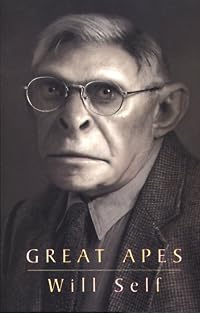
Great Apes
by Will Self
On This Page
Description
Some people lose their sense of proportion, others their sense of scale, but Simon Dykes, the artist, has lost his sense of perspective in a most disturbing fashion. After a night of debauchery in West End clubs, Simon falls asleep and awakens to find his girlfriend has changed into a chimpanzee.Tags
Recommendations















Member Recommendations


Member Reviews
The best critique of footnotes came from the actor John Barrymore (or Noel Coward or I don't know who) who likened footnotes to something "rushing down the stairs every time the doorbell rings on one's wedding night." Well, encountering a twenty-five-cent word the same way with definition not obvious context is like having to leave the honeymoon suite to go to Western Union to send money to bail out a misbehaving friend. Self can't get past himself to do that often and so often he used a shoe horn to wedge in a word like spondee or other artifact of deep literature. Does he wish he was making the high art if not the crude if clever novel? Well, at least he hipped me to a definition of "gloss" that I can use at the day job.
As for the show more story, in a Planet of the Apes like parallel universe, a chimp artist has a psychotic break and like The Metamorphosis finds himself ostracized by transformation - he thinks he is human. While Franz Kafka explored the possibilities in about 200 hundred pages, Self takes twice that long to repeat his own tropes of his imaginative, mirror world and take us on a long walk to an anticlimactic end making a shaggy dog story out of a good premise seasoned with allusions to pop culture and more.
Don't get me wrong - Self is great. I love is mocking of the academic world, especially psychoanalysis and vain attempts to probe the human mind as well as the shallow affectations of knowledge, like in this quote:
"No, to catch one moiety of the members you’d need a pot or cage, baited with publicity, or gossip, or innuendo, or money, or all four; or combinations thereof: gossip about money, public innuendo, lucrative publicity, and so on. Because this lot were bottom feeders, pure and simple, who came to the club in the unadulterated spirit of undersea exploration, to check out how low they could go.
As for the other moiety, well, you’d have to say that they were even easier to catch, if no better to eat. All that would be required to land them was a low tide — which came twice in the twenty-four, at noon and three in the morning, when the barroom was little more than a muddy flat of wrack — a dinghy which could be maneuvered around the downlights — which were set behind horrid metal basketry — and a long knife-arm, with which to reach down and prise them from the carpeting.
For this box-load were bivalves — to an hermaphrodite. Eyeless in the gloom, de-tentacled by devolution, possessing at most one febrile limb with which to lift a glass or tote a cigarette, they reposed as the currents of conversation flowed through them, extracting sufficient nutriment simply by the act of being. Some argued — and Simon was on occasion among them, there had to be some defence — that if a grain of insight, a granule of originality, were inserted into their cloistered, sharp-edged minds, placed on the mantel where the invitations sat, it might well be cultured, swaddled in a carbonate of some kind until it formed, if not wisdom, at any rate something resembling culture. But Simon only ever said this when he was drunk and full of the world. Drunk, and so full of the world that the world must be good — or at any rate capable of inclusion — for him to be so full of it." show less
As for the show more story, in a Planet of the Apes like parallel universe, a chimp artist has a psychotic break and like The Metamorphosis finds himself ostracized by transformation - he thinks he is human. While Franz Kafka explored the possibilities in about 200 hundred pages, Self takes twice that long to repeat his own tropes of his imaginative, mirror world and take us on a long walk to an anticlimactic end making a shaggy dog story out of a good premise seasoned with allusions to pop culture and more.
Don't get me wrong - Self is great. I love is mocking of the academic world, especially psychoanalysis and vain attempts to probe the human mind as well as the shallow affectations of knowledge, like in this quote:
"No, to catch one moiety of the members you’d need a pot or cage, baited with publicity, or gossip, or innuendo, or money, or all four; or combinations thereof: gossip about money, public innuendo, lucrative publicity, and so on. Because this lot were bottom feeders, pure and simple, who came to the club in the unadulterated spirit of undersea exploration, to check out how low they could go.
As for the other moiety, well, you’d have to say that they were even easier to catch, if no better to eat. All that would be required to land them was a low tide — which came twice in the twenty-four, at noon and three in the morning, when the barroom was little more than a muddy flat of wrack — a dinghy which could be maneuvered around the downlights — which were set behind horrid metal basketry — and a long knife-arm, with which to reach down and prise them from the carpeting.
For this box-load were bivalves — to an hermaphrodite. Eyeless in the gloom, de-tentacled by devolution, possessing at most one febrile limb with which to lift a glass or tote a cigarette, they reposed as the currents of conversation flowed through them, extracting sufficient nutriment simply by the act of being. Some argued — and Simon was on occasion among them, there had to be some defence — that if a grain of insight, a granule of originality, were inserted into their cloistered, sharp-edged minds, placed on the mantel where the invitations sat, it might well be cultured, swaddled in a carbonate of some kind until it formed, if not wisdom, at any rate something resembling culture. But Simon only ever said this when he was drunk and full of the world. Drunk, and so full of the world that the world must be good — or at any rate capable of inclusion — for him to be so full of it." show less
".....human intelligence is by definition what humans naturally do.."
After a night of routine debauchery in London clubland surrounded by sycophants, artist Simon Dykes awakes up one morning from an uneasy dream to discover himself transformed into a giant ape and his world irretrievably altered. Worse, still his attractive girlfriend, Sarah, is now a sex-obsessed chimpanzee. Simon, not unreasonably, assumes that he is suffering a psychotic episode brought on by overdoing the drink and drugs but he finds himself carted off to a secure psychiatric hospital where a team of primate psychiatrists set about 'curing' him of his bizarre delusion; that he is human. Maverick psychiatrist and sometime television personality, Dr Zack Busner, takes show more an interest in Simon's case and decides to take him under his wing in the hope that here is a case that will finally make his name.
The London of 'Great Apes' is similar to our own. Its adults drive Volvos and are bankers or work in insurance, whilst their delinquent offspring either hang around on street corners, drinking Special Brew and smoking pot, or patrolling the streets looking for casual sex and violence. But at home their social structure is rigorously chimp: polygamous groups(where premature ejaculation denotes sexual prowess) which are maintained by a strict hierarchy and mutual grooming.Communication is by sign-language, supplemented by hoots and growls.
Self is original and very funny; here he satirises human masculinity, drugs, hospitals, academics, psychiatrists and is gruesomely vivid at times. However, the story feels like a long string of clever puns and in-jokes which ultimately don't seem to go anywhere and are overly drawn out. I found the first 300 pages or so of this novel an outrageous roller-coaster of a ride but unfortunately there were still a quarter of it to go. show less
After a night of routine debauchery in London clubland surrounded by sycophants, artist Simon Dykes awakes up one morning from an uneasy dream to discover himself transformed into a giant ape and his world irretrievably altered. Worse, still his attractive girlfriend, Sarah, is now a sex-obsessed chimpanzee. Simon, not unreasonably, assumes that he is suffering a psychotic episode brought on by overdoing the drink and drugs but he finds himself carted off to a secure psychiatric hospital where a team of primate psychiatrists set about 'curing' him of his bizarre delusion; that he is human. Maverick psychiatrist and sometime television personality, Dr Zack Busner, takes show more an interest in Simon's case and decides to take him under his wing in the hope that here is a case that will finally make his name.
The London of 'Great Apes' is similar to our own. Its adults drive Volvos and are bankers or work in insurance, whilst their delinquent offspring either hang around on street corners, drinking Special Brew and smoking pot, or patrolling the streets looking for casual sex and violence. But at home their social structure is rigorously chimp: polygamous groups(where premature ejaculation denotes sexual prowess) which are maintained by a strict hierarchy and mutual grooming.Communication is by sign-language, supplemented by hoots and growls.
Self is original and very funny; here he satirises human masculinity, drugs, hospitals, academics, psychiatrists and is gruesomely vivid at times. However, the story feels like a long string of clever puns and in-jokes which ultimately don't seem to go anywhere and are overly drawn out. I found the first 300 pages or so of this novel an outrageous roller-coaster of a ride but unfortunately there were still a quarter of it to go. show less
I 1st read mention of Will Self in a text by Stewart Home. Home insulted Self as being something along the lines of a rich Oxford junkie who doesn't deserve his reputation as an underground writer. Since I'd never heard of Self before, he had no reputation w/ me at all. Knowing Stewart's tendency to publically degrade anyone who he perceives as competition, I didn't take the negativity as representative of any substantial critical take. After all, it seems that Home's usual intention is to discourage conformists & sycophants from even experiencing the work of the people he puts down by making experiencing such work 'uncool'. Thusly, idiots can automatically hate Self's writing on the basis of Home's word & never discover for themselves show more whether Self's writing might be more interesting than Home's.
W/ that in mind, when I finally saw this bk by Self I picked it up. Having just finished reading it, I have to wonder whether Self is a pseudonym of Home. However, after doing extremely cursory pseudo-research on the net, this appears to be not the case. The writing style is similarly somewhat simple-minded but I'd give Self credit for being a little more accomplished. Home's use of the same joking repetitive description of sex over & over in his 1st novel "Pure Mania" is somewhat akin to Self's running joke referring to his character Zack Busner's self-inflated self-definitions: "the maverick anti-psychiatrist - as he liked to style himself" eg. I can certainly see why the 2 writers wd be professional rivals.
ANYWAY, I started reading this & at 1st took it to be a sign that the once-great Grove Press had deteriorated from its days as the publisher of William S. Burroughs & Jean Genet. Despite a promising alternate reality premise, I quickly got bored w/ what strikes me as a malaise of post-censorship writing: too much sex & drugs for sensationalism's sake & as a substitute for genuine incisive examination.
HOWEVER, that eventually changed & I became engrossed. "Great Apes" begins w/ an "Author's Note" in wch the author presents himself as a chimpanzee perversely writing about humans as if they'd become the dominant species instead of chimps. Then the main character, Simon Dykes, a British painter, is introduced. We follow Simon's night & sex & art life as a human for awhile until he has a breakdown & finds himself in a world in wch chimps ARE the dominant species & in wch he's one too.
From then on, the world is described w/ many references to modern-day human conditions but w/ chimps substituted for humans. Simon ends up in the doctoral care of Zack Busner & the reader follows the steps he goes thru to regain his "chimpunity". I assume Self did some research into chimpanzee studies b/c it's all fairly convincingly presented. "Arse-Lickers" definitely takes on a highly socially defined meaning here.
In the process, Self manages to give the reader a refreshing take on humanity - esp in relation to hierarchical posturings of the art & scientific worlds. Take this paragraph:
"'Of course, Zackiekins "chup-chupp", I am honored that you acknowledge my ascent up the hierarchy. Now, as I was signing, the reputations of these artists - if that's what they are - are also so arguable, that they require continual interpretation and "gru-nnn" adjustment by a large party of critics "grnn". The critics have their own hierarchy, and the hierarchy that exists between them and the artists' party is also highly fluid - subject to continual flux. That's why "chup-chupp" they're all dressed up, and displaying and presenting and grooming and mating, for all the buggers are worth "h'hee-hee-hee"!'"
In the above excerpt the main text is being signed by Simon & the things like "chup-chupp" are being vocalized - in a sortof reversal of human communication in wch the hands are used gesturally & the voice as the main communicator - something I assume to be accurate in chimps.
All in all, I ended up liking this alot. I've been preoccupied for many a yr w/ humans as animals. As a child, I was raised w/ the common notion that humans are distinguished from animals by various cognitive abilities that supposedly make us superior. As a teenager that seemed like a crock of shit & I've always stated that we ARE animals. Not such a radical idea, of course. I never had a problem w/ being an animal. Oddly, though, these days I DO have a problem w/ being one. Not b/c being an animal is something I consider to be 'bad' but b/c I'm a bit sick of the conflicts between instinctual behavior & intellectual behavior.
Sex between humans is a constant struggle between instincts & thoughts. I use the term BOD (Biological OverDrive) to refer to what propels us into sexual contact. The idea's obvious: we're driven to mate to further our DNA's quest for new forms. Men try to impregnate, women try to be impregnated. Perhaps gays & lesbians try to create a Third Mind. At any rate, the body cooperates w/ this process by making sexual contact a form of pleasure to be lusted for w/ great frequency. Such an acknowledgement of biological drives is almost taboo amongst political activists who prefer to emphasize social hierarchies entirely.
But back to chimps & humans. Chimpanzees have Alpha Males - males who dominate &, therefore, fuck the most females. These males use violence, displays, to maintain this position. This has preoccupied me for a long time. Humans parallel chimps in this & many respects. Alpha Male Humans rule for a while & are eventually overthrown when they get too weak to effectively use violence against the up & coming. This is instinctual. But humans have complex intellectual & social codes that temper this. The male instinctual drive may push toward impregnating as many females as possible, but the intellectual deterrents might include a lack of desire for producing children, & a desire for using sex purely for pleasure. Social deterrents might be that producing children usually carries w/ it the responsibility of taking care of them - a responsibility that the fe/male might abhor.
I often say that being in bands is just the human form of mating displaying - trying to attract a mate or mates. There's not often a strong musical impetus behind it - even if lip service is pd to music or other purposes the mating display seems like the strong, & usually underacknowledged, undercurrent. Males, esp, have bands when the members are in their 20s & then gradually fade out of the music biz after the attraction factor has served its purpose somewhat.
"Great Apes" is a good exploration of parallels between chimp & human behavior. Throughout it, there are carefully implanted references to such purposes - such as when the use of humans as cute cuddly animals in chimp society representations are alluded to, eg. show less
W/ that in mind, when I finally saw this bk by Self I picked it up. Having just finished reading it, I have to wonder whether Self is a pseudonym of Home. However, after doing extremely cursory pseudo-research on the net, this appears to be not the case. The writing style is similarly somewhat simple-minded but I'd give Self credit for being a little more accomplished. Home's use of the same joking repetitive description of sex over & over in his 1st novel "Pure Mania" is somewhat akin to Self's running joke referring to his character Zack Busner's self-inflated self-definitions: "the maverick anti-psychiatrist - as he liked to style himself" eg. I can certainly see why the 2 writers wd be professional rivals.
ANYWAY, I started reading this & at 1st took it to be a sign that the once-great Grove Press had deteriorated from its days as the publisher of William S. Burroughs & Jean Genet. Despite a promising alternate reality premise, I quickly got bored w/ what strikes me as a malaise of post-censorship writing: too much sex & drugs for sensationalism's sake & as a substitute for genuine incisive examination.
HOWEVER, that eventually changed & I became engrossed. "Great Apes" begins w/ an "Author's Note" in wch the author presents himself as a chimpanzee perversely writing about humans as if they'd become the dominant species instead of chimps. Then the main character, Simon Dykes, a British painter, is introduced. We follow Simon's night & sex & art life as a human for awhile until he has a breakdown & finds himself in a world in wch chimps ARE the dominant species & in wch he's one too.
From then on, the world is described w/ many references to modern-day human conditions but w/ chimps substituted for humans. Simon ends up in the doctoral care of Zack Busner & the reader follows the steps he goes thru to regain his "chimpunity". I assume Self did some research into chimpanzee studies b/c it's all fairly convincingly presented. "Arse-Lickers" definitely takes on a highly socially defined meaning here.
In the process, Self manages to give the reader a refreshing take on humanity - esp in relation to hierarchical posturings of the art & scientific worlds. Take this paragraph:
"'Of course, Zackiekins "chup-chupp", I am honored that you acknowledge my ascent up the hierarchy. Now, as I was signing, the reputations of these artists - if that's what they are - are also so arguable, that they require continual interpretation and "gru-nnn" adjustment by a large party of critics "grnn". The critics have their own hierarchy, and the hierarchy that exists between them and the artists' party is also highly fluid - subject to continual flux. That's why "chup-chupp" they're all dressed up, and displaying and presenting and grooming and mating, for all the buggers are worth "h'hee-hee-hee"!'"
In the above excerpt the main text is being signed by Simon & the things like "chup-chupp" are being vocalized - in a sortof reversal of human communication in wch the hands are used gesturally & the voice as the main communicator - something I assume to be accurate in chimps.
All in all, I ended up liking this alot. I've been preoccupied for many a yr w/ humans as animals. As a child, I was raised w/ the common notion that humans are distinguished from animals by various cognitive abilities that supposedly make us superior. As a teenager that seemed like a crock of shit & I've always stated that we ARE animals. Not such a radical idea, of course. I never had a problem w/ being an animal. Oddly, though, these days I DO have a problem w/ being one. Not b/c being an animal is something I consider to be 'bad' but b/c I'm a bit sick of the conflicts between instinctual behavior & intellectual behavior.
Sex between humans is a constant struggle between instincts & thoughts. I use the term BOD (Biological OverDrive) to refer to what propels us into sexual contact. The idea's obvious: we're driven to mate to further our DNA's quest for new forms. Men try to impregnate, women try to be impregnated. Perhaps gays & lesbians try to create a Third Mind. At any rate, the body cooperates w/ this process by making sexual contact a form of pleasure to be lusted for w/ great frequency. Such an acknowledgement of biological drives is almost taboo amongst political activists who prefer to emphasize social hierarchies entirely.
But back to chimps & humans. Chimpanzees have Alpha Males - males who dominate &, therefore, fuck the most females. These males use violence, displays, to maintain this position. This has preoccupied me for a long time. Humans parallel chimps in this & many respects. Alpha Male Humans rule for a while & are eventually overthrown when they get too weak to effectively use violence against the up & coming. This is instinctual. But humans have complex intellectual & social codes that temper this. The male instinctual drive may push toward impregnating as many females as possible, but the intellectual deterrents might include a lack of desire for producing children, & a desire for using sex purely for pleasure. Social deterrents might be that producing children usually carries w/ it the responsibility of taking care of them - a responsibility that the fe/male might abhor.
I often say that being in bands is just the human form of mating displaying - trying to attract a mate or mates. There's not often a strong musical impetus behind it - even if lip service is pd to music or other purposes the mating display seems like the strong, & usually underacknowledged, undercurrent. Males, esp, have bands when the members are in their 20s & then gradually fade out of the music biz after the attraction factor has served its purpose somewhat.
"Great Apes" is a good exploration of parallels between chimp & human behavior. Throughout it, there are carefully implanted references to such purposes - such as when the use of humans as cute cuddly animals in chimp society representations are alluded to, eg. show less
20 pages into this, you’d be forgiven for thinking Will Self was a meaningful pseudonym. Pretty much from the get go, this seems to be all about convincing us how clever the author is. As Lyn Gardner writes in her Guardian review of the Great Apes stage play,
… the show always seems keener on showcasing its larky cleverness than on creating real feeling.
Replace “the show” with “the novel” and my job here is done.
But for those of you expecting some sort of synopsis, Simon Dykes wakes up from what is effectively a Self-ian version of life to find that he is, not a beetle (cf Kafka), but a chimpanzee.
Or at least everyone else thinks he is. Simon remains convinced for pretty much the rest of our tedious literary journey that he show more is human. This is quite patently not the case at least from his affinity for touching other chimpanzees genitalia, copulating in a matter of seconds and feeling urges to swing through trees.
There’s very, very little here that hasn’t been done before unless you want to argue that Gulliver failed to include the London borough of Finchley in his travels. What is unique is probably best left in darkness between the covers.
Suffice to say, if you left an infinite number of chimpanzees in a room with an infinite number of typewriters, they might come up with the complete works of Shakespeare, but they’d probably form a committee to ensure they never randomly produced the rubbish that is Great Apes. show less
… the show always seems keener on showcasing its larky cleverness than on creating real feeling.
Replace “the show” with “the novel” and my job here is done.
But for those of you expecting some sort of synopsis, Simon Dykes wakes up from what is effectively a Self-ian version of life to find that he is, not a beetle (cf Kafka), but a chimpanzee.
Or at least everyone else thinks he is. Simon remains convinced for pretty much the rest of our tedious literary journey that he show more is human. This is quite patently not the case at least from his affinity for touching other chimpanzees genitalia, copulating in a matter of seconds and feeling urges to swing through trees.
There’s very, very little here that hasn’t been done before unless you want to argue that Gulliver failed to include the London borough of Finchley in his travels. What is unique is probably best left in darkness between the covers.
Suffice to say, if you left an infinite number of chimpanzees in a room with an infinite number of typewriters, they might come up with the complete works of Shakespeare, but they’d probably form a committee to ensure they never randomly produced the rubbish that is Great Apes. show less
Instead of the thud of a simple inversion where a world of chimps occupy the place of humans (and this is acknowledged with the wink of the simian preface with references to the trite and banal series of movies "Planet of the Humans"), Self retains almost all the attributes of chimps - rigid physical hierarchy, sign languge (figures of speech are carefully changed from "that is to say" to "that is to sign), grooming habits, polygamous coupling, etc - while the near-extinct humans retain theirs, but in zoos. Self reprises his perennial celebrity charlatan shrink, Dr Zack Busner (who we find in several short stories and a few novels) to treat high-flown, troubled, excessive, conceptual artist Simon Dykes who thinks he is a human. In a show more way, this novel plays with many of the coveted themes of psychoanalysis and delusion, thrown over a simian world, set in a diminutive London where the "lonely master of the animals" brachiate through their lives. show less
I have listened to Will Self expound with erudition upon a host of subjects via the wireless. I have found myself agreeing with his point of view on many occasions and, when I did not, I still found much to commend itself in the manner of his argument. I have not, however, previously read any of his literary output and so, when the excellent Kindle offered 'Great Apes' at the bargain price of 99 pence, I felt that it would be churlish to decline - even allowing for my, almost usual, state of impecunity.
This was a mistake. I found the book to lack any characters or discernible story. Will Self has, it seems to me, written an entire book with the sole purpose of lampooning a certain London based upper middle class genre. Even if one show more agrees that they are as contemptible as Mr. Self appears to believe, it is a group which has been targeted before. This book really adds nothing new to the table and for an intellect of this height to train its guns upon such a sorry target, leaves my British love of the underdog sympathising with the impaled.
I did not connect with this book at any stage. show less
This was a mistake. I found the book to lack any characters or discernible story. Will Self has, it seems to me, written an entire book with the sole purpose of lampooning a certain London based upper middle class genre. Even if one show more agrees that they are as contemptible as Mr. Self appears to believe, it is a group which has been targeted before. This book really adds nothing new to the table and for an intellect of this height to train its guns upon such a sorry target, leaves my British love of the underdog sympathising with the impaled.
I did not connect with this book at any stage. show less
I've been putting off reviewing this for a while, so I'm just going to bite the bullet and get it over with. This may be a quickie.
I fully expected to love [b:Great Apes|40261|Great Apes|Will Self|http://photo.goodreads.com/books/1169433198s/40261.jpg|1359304]. It's completely absurd, filled with drugs, violence, and wild monkey sex (as in, literally involving monkeys). There are some hysterical, laugh-out-loud funny bits and some perverse, cringe-worthy sections. Unfortunately, there are also some fucking boring parts. After a while, I thought the metaphor and satire became strained, and while Self's parallel world was slightly more creative than writing a standard novel and find-and-replacing the word "human" with "chimpanzee", the show more cleverness kind of wore off after a while. About halfway through I started checking to see how many pages I had left -- never a good sign.
I didn't hate this, but it was kind of disappointing. I'm still really intrigued by Will Self's writing and hoping to try some of his other books, but they may be pushed down my list a little. show less
I fully expected to love [b:Great Apes|40261|Great Apes|Will Self|http://photo.goodreads.com/books/1169433198s/40261.jpg|1359304]. It's completely absurd, filled with drugs, violence, and wild monkey sex (as in, literally involving monkeys). There are some hysterical, laugh-out-loud funny bits and some perverse, cringe-worthy sections. Unfortunately, there are also some fucking boring parts. After a while, I thought the metaphor and satire became strained, and while Self's parallel world was slightly more creative than writing a standard novel and find-and-replacing the word "human" with "chimpanzee", the show more cleverness kind of wore off after a while. About halfway through I started checking to see how many pages I had left -- never a good sign.
I didn't hate this, but it was kind of disappointing. I'm still really intrigued by Will Self's writing and hoping to try some of his other books, but they may be pushed down my list a little. show less
Members
- Recently Added By
Lists

The Guardian's 1000 Novels Everyone Must Read
1,005 works; 551 members

the dog was the hero
31 works; 5 members
Talk Discussions
Past Discussions
Group Read, September 2019: Great Apes in 1001 Books to read before you die (October 2019)
Author Information

66+ Works 10,333 Members
William Woodard "Will" Self was born on September 26, 1961. He is a British author, journalist and political commentator. He wrote ten novels, five collections of short fiction, three novellas and five collections of non-fiction writing. His novel Umbrella was shortlisted for the Man Booker Prize. His subject matter often includes mental illness, show more illegal drugs and psychiatry. Self is a regular contributor to publications including Playboy, The Guardian, Harpers, The New York Times and the London Review of Books. He also writes a column for New Statesman, and over the years he has been a columnist for The Observer, The Times and the Evening Standard. His columns for Building Design on the built environment, and for the Independent Magazine on the psychology of place brought him to prominence as a thinker concerned with the politics of urbanism. Will Self will deliver the closing address at the 2015 Melbourne Writers Festival (MWF) 2015. (Bowker Author Biography) show less
Awards and Honors
Series
Belongs to Publisher Series
Common Knowledge
- Canonical title
- Great Apes
- Original title
- Great Apes
- Original publication date
- 1997
- People/Characters
- Simon Dykes; Dr Zack Busner; Sarah Peasenhulme; Tony Figes; Gambol; Dr Jane Bowen (show all 11); Dr Kevin Whatley; Dr Anthony Bohm; George Levinson; Ken Braithwaite; Jean Dykes
- Epigraph
- ‘An ape, a most ill-favoured beast. How like us in all the rest?’
Cicero
‘When I come home late at night from banquets, from social gatherings, there site waiting for me a half-trained little chimpanzee and I take comfort from her as apes do. By day I cannot bear to see her; for she has the insa... (show all)ne look of a bewlidered half-broken animal in her eye; no one else sees it, but I do and I cannot bear it.’
Kafka, A Report to the Academy - Dedication
- For Madeleine.
And with thanks
to D.J.O - First words
- Simon Dykes, the artist, stood, rented glass in hand, and watched as a rowing eight emerged from the brown brick wall of one building, slid across a band of grey-green water, and then eased into the grey concrete of another b... (show all)uilding.
- Last words
- (Click to show. Warning: May contain spoilers.)For a long time afterwards, the two allies tenderly touched each other, and passed the Scotch back and forth, while all around them in the equatorial night, the humans yowled and yammered their near meaningless vocalisations, “Fuuuuuckoooofff-Fuuuuuuckooofff-Fuccckooooofff.”
- Blurbers
- Leith, Sam; Poole, Steven; Callil, Carmen; Krist, Gary
- Original language
- English
Classifications
Statistics
- Members
- 1,239
- Popularity
- 19,964
- Reviews
- 17
- Rating
- (3.41)
- Languages
- 9 — Danish, English, Finnish, French, German, Italian, Portuguese, Spanish, Swedish
- Media
- Paper, Ebook
- ISBNs
- 22
- ASINs
- 9