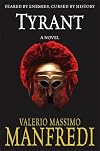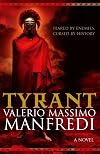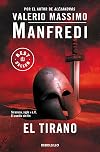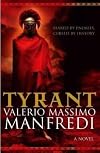
Tyrant
by Valerio Massimo Manfredi
On This Page
Description
Sicily 412 BC: the infinite duel between a man and a superpower begins. The man is Dionysius, who has just made himself Tyrant of Syracuse. The superpower Carthage, mercantile megalopolis and mistress of the seas.Over the next eight years, Dionysius' brutal military conquests will strike down countless enemies and many friends to make Syracuse the most powerful Greek city west of mainland Greece. He builds the largest army of antiquity and invents horrific war machines to use against the show more Carthaginians, who he will fight in five wars.But who was Dionysius? Historians have condemned him as one of the most ruthless, egocentric despots. But he was also patron of the arts, a dramatist, poet and tender lover. show lessTags
Recommendations











Member Reviews
I've read about a third of it, and have added it to the Lifeline box. I can't stomach any more of its heavy-handed "tyrant rules, democracy drools". That's the young, handsome, capable, hunky, bad-ass, heroic, noble budding tyrant Dionysius of Syracuse vs the doddering, ugly, old, venal, indecisive, stupid, elected democratic rulers.
Now, extremely probably the democrats weren't all that great, and the tyrant had his good side. It is 400 BC, and the democrats of the time were really much more like aristocrats and plutocrats. Maybe there is a decent historical novel to be written about this interesting chunk of history. But this sharply black and white apologia for fascism is not it.
Now, extremely probably the democrats weren't all that great, and the tyrant had his good side. It is 400 BC, and the democrats of the time were really much more like aristocrats and plutocrats. Maybe there is a decent historical novel to be written about this interesting chunk of history. But this sharply black and white apologia for fascism is not it.
2.5/5. The novel gives us an unusual subject and time period--Greek Sicily at the time of the Peloponnesian War and beyond. I'm just using that as a reference as to when the story takes place. The novel tells of Dionysius of Syracuse, a good man who is badly affected by the death and destruction of his beloved wife. He then seizes power and becomes a tyrant, in the worst sense of the word--ruthless, merciless, cold-hearted. We see how absolute power corrupts him. He has mixed success against Carthaginians but does make Sicily into something to be reckoned with.
Hampered by a poor translation, was the wording of the original Italian also as bad? The novel was overwhelmed with battles, but I did have to admire Dionysius's military genius: show more hauling ships overland, the invention to catapults. Sex scenes were risible, especially the one under water. Characters were one-dimensional but for his brother, Leptines, and his friend, the historian Philistus, whose original work has been lost. I feel this author was a better historian than novelist, although I applaud him for tackling this subject. A superior novel on a Greek who lived somewhat later, Timoleon, whose name will always be coupled with Syracuse is Peter Vansittart's A Choice Of Murder. show less
Hampered by a poor translation, was the wording of the original Italian also as bad? The novel was overwhelmed with battles, but I did have to admire Dionysius's military genius: show more hauling ships overland, the invention to catapults. Sex scenes were risible, especially the one under water. Characters were one-dimensional but for his brother, Leptines, and his friend, the historian Philistus, whose original work has been lost. I feel this author was a better historian than novelist, although I applaud him for tackling this subject. A superior novel on a Greek who lived somewhat later, Timoleon, whose name will always be coupled with Syracuse is Peter Vansittart's A Choice Of Murder. show less
This book is to be commended in the sense that it's one of the very few novels based in classical Sicily, and it therefore provides an introduction to a period that most people are unlikely to know. From that angle, I am glad to have read it. However, Manfredi is so keen to counteract the traditional negative portrayal of Dionysius, tyrant of Syracuse, that he ends up with a character who is implausibly perfect. We are given an insight into Dionysius' personality, with the invention of a beloved wife whose tragic death propels him into tyranny; and yet we are never fully able to sympathise with him because he doesn't convince as a three-dimensional, multifaceted character. We are invited to marvel at his intelligence, his tactical show more acumen, his good looks and his sense of honour. We are constantly shown how his strategic brilliance overshadows the selfish plotting of Syracuse's oligarch generals. As one previous reviewer noted, it's presented as self-evident that Syracuse will do better under the rule of a tyrant than under a democracy. But it isn't enough to be shown these things - we also need to be convinced of the character's reality and engaged in the story, and that's where I felt the novel failed. I simply ended up frustrated that the author was trying to dictate my reactions to his character - a character whom I felt lacked that most appealing aspect: a convincing grey area.
I must also mention the translation, which may accurately reflect the original Italian but which does little to make the text fluent and engaging for English-speakers. The style veers between overly academic and flamboyant; the dialogue is either implausibly colloquial or stilted. Throughout, you remain conscious that you are not reading the original language. Had I not been intrigued to find out more of the history behind the story - which does, generally, seem to be accurately represented here - I would have given up without finishing. I am sorry, as this is my first venture into Manfredi for quite some years, and I was expecting something more gripping and complex.
For a longer review, please visit my blog at https://theidlewoman.net/2012/09/21/tyrant-valerio-massimo-manfredi/ show less
I must also mention the translation, which may accurately reflect the original Italian but which does little to make the text fluent and engaging for English-speakers. The style veers between overly academic and flamboyant; the dialogue is either implausibly colloquial or stilted. Throughout, you remain conscious that you are not reading the original language. Had I not been intrigued to find out more of the history behind the story - which does, generally, seem to be accurately represented here - I would have given up without finishing. I am sorry, as this is my first venture into Manfredi for quite some years, and I was expecting something more gripping and complex.
For a longer review, please visit my blog at https://theidlewoman.net/2012/09/21/tyrant-valerio-massimo-manfredi/ show less
2.5 stars
Il tiranno
Devo ammettere che sono molto di parte sul giudizio dei libri di Manfredi, (A lui posso perdonare tutto!!) Nel caso in questione non conoscevo la storia del tiranno di Siracusa, e lui con la sua straordinaria vena narrativa ha provveduto, tenendomi letteralmente incollato alle pagine fino alla fine. Una bella storia dove si mescolano ambizioni, sentimenti, affetti, adatta anche a chi non è appassionato di antichità classica.
Devo ammettere che sono molto di parte sul giudizio dei libri di Manfredi, (A lui posso perdonare tutto!!) Nel caso in questione non conoscevo la storia del tiranno di Siracusa, e lui con la sua straordinaria vena narrativa ha provveduto, tenendomi letteralmente incollato alle pagine fino alla fine. Una bella storia dove si mescolano ambizioni, sentimenti, affetti, adatta anche a chi non è appassionato di antichità classica.
Jun 16, 2017Italian
Sicilia, siglo V a.C. Dionisio, el guerrero más audaz de Siracusa, tiene una sola pasión: liberar a la isla de los cartagineses y fortalecer el dominio griego sobre ella.
De ese modo comenzó la prodigiosa aventura de Dionisio, el Tirano de Siracusa, temido por quienes se oponían a su política. Logró convertir a su ciudad en la más próspera del mundo griego y los magníficos monumentos que hizo construir todavía se admiran hoy.
De ese modo comenzó la prodigiosa aventura de Dionisio, el Tirano de Siracusa, temido por quienes se oponían a su política. Logró convertir a su ciudad en la más próspera del mundo griego y los magníficos monumentos que hizo construir todavía se admiran hoy.
Mar 27, 2023Spanish
No se si la traduccion o la novela pero me pareció tan mala que la abandone
Apr 30, 2017Spanish
Members
- Recently Added By
Lists

Books Read in 2005
185 works; 7 members
Author Information

124+ Works 9,458 Members
Italian historian and archaeologist Valerio Massimo Manfredi is a professor of classical archaeology at the University of Milan. He was named Man of the Year 1999 by the American Biographical Institute for this bestselling trilogy. Manfredi's books have been published in France, Germany, Greece, Russia, Spain, and the United Kingdom. (Bowker show more Author Biography) show less
Some Editions
Common Knowledge
- Canonical title
- Tyrant
- Original title
- Il tirano
- Original publication date
- 2003
- People/Characters
- Dionysius, the Areopagite (Acts 17:34)
- Important places
- Syracuse, Sicily, Italy; Sicily, Italy; Ancient Greece; Ancient Rome
- Epigraph*
- No cabe duda, en efecto, de que la Divinidad utiliza a ciertos hombres con el fin de castigar la maldad de otros y hace de ellos en cierto modo unos carniceros, antes de aniquilarlos.
Plutarco - Dedication*
- A la memoria de mi padre
- First words*
- El hombre llegó poco después de la puesta de sol cuando las sombras comenzaban a extenderse sobre la ciudad y sobre el puerto.
- Last words*
- (Click to show. Warning: May contain spoilers.)Echó a andar con paso inseguro y su anfitrión se quedó mirándole asombrado, hasta que su figura se disolvió en el fulgor del sol naciente.
*Some information comes from Common Knowledge in other languages. Click "Edit" for more information.
Classifications
- Genres
- Fiction and Literature, General Fiction, Historical Fiction
- DDC/MDS
- 813 — Literature & rhetoric American literature in English American fiction in English
- LCC
- PQ4873 .A4776 .T57 — Language and Literature French, Italian, Spanish and Portuguese literatures Italian literature Individual authors, 1961-2000
- BISAC
Statistics
- Members
- 401
- Popularity
- 78,046
- Reviews
- 8
- Rating
- (3.25)
- Languages
- 8 — Catalan, English, French, German, Italian, Portuguese, Russian, Spanish
- Media
- Paper, Audiobook, Ebook
- ISBNs
- 30
- ASINs
- 8