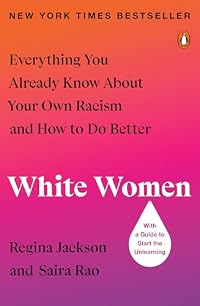
White Women: Everything You Already Know About Your Own Racism and How to Do Better
by Regina Jackson
On This Page
Description
"It's no secret that white women are conditioned to be nice, but did you know that the desire to be perfect and to avoid conflict at all costs are characteristics of white supremacy culture? As the founders of Race2Dinner, an organization which facilitates conversations between white women about racism and white supremacy, Regina Jackson and Saira Rao have noticed white women's tendency to maintain a veneer of niceness, and strive for perfection, even at the expense of anti-racism work. In show more this book, Jackson and Rao pose these urgent questions: how has being nice helped Black women, Indigenous women and other women of color? How has being nice helped you in your quest to end sexism? Has being nice earned you economic parity with white men? Beginning with freeing white women from this oppressive need to be nice, they deconstruct and analyze nine aspects of traditional white woman behavior--from tone-policing to weaponizing tears--that uphold white supremacy society, and hurt all of us who are trying to live a freer, more equitable life. White Women is a call to action to those of you who are looking to take the next steps in dismantling white supremacy. Your white supremacy. If you are in fact doing real anti-racism work, you will find few reasons to be nice, as other white people want to limit your membership in the club. If you are not ticking white people off on a regular basis, you are not doing it right."-- show lessTags
Recommendations








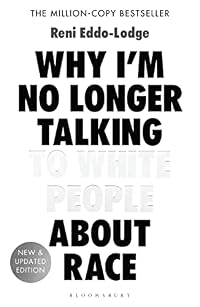
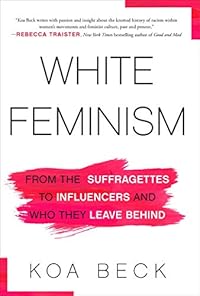
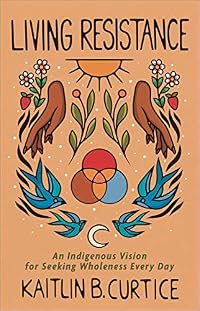

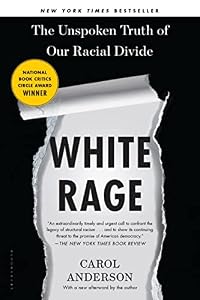










Member Reviews
First things first here is that I’m starring this at five because I think it’s BS that the one-star review here is by someone who literally created an LT profile just to give this book a bad review (it’s the only book in their library), so I’m trying to get the average back up. So just putting it out there that I’m not squeeing (my five-star definition) this as it’s a pretty rough listen basically getting told you’re a POS for six hours, but it’s a very important one for where we as white women are in the world right now.
The way I took in their words was to acknowledge the racism in white women that they’re talking about and at minimum do better in myself by recognizing it, and at a next level deal with other white show more women pulling crap too. Just like rape culture can only be stopped when men actually stop men from raping women, white women have to deal with white women and not expect women of color to have to put up with this bull.
Their dinner concept fascinates me because I wanted to hear if there was ever a “successful” one that didn’t devolve into white women spewing at them, but it sounded like that’s how they all went which is horribly hilariously awkward. They’re very big on the “all white women” thing which I don’t deny, but their dinners were a very specific demographic of white women (it sounds like they’re based in Denver, so I know exactly who these women are—possibly literally—since I dealt with many and likely helped educate their children in my seven years there) who can pay for them.
Anyway if you’re a white woman, you just have to get through the stereotype aspect (I can see their genius though in lumping us together because historically that’s what we as white women have always done to “other” everyone too) and read this book because even if you don’t see yourself anywhere in their words (you do though…), you need to hear them and get to a place where you’re working toward antiracism rather than upholding white supremacy. show less
The way I took in their words was to acknowledge the racism in white women that they’re talking about and at minimum do better in myself by recognizing it, and at a next level deal with other white show more women pulling crap too. Just like rape culture can only be stopped when men actually stop men from raping women, white women have to deal with white women and not expect women of color to have to put up with this bull.
Their dinner concept fascinates me because I wanted to hear if there was ever a “successful” one that didn’t devolve into white women spewing at them, but it sounded like that’s how they all went which is horribly hilariously awkward. They’re very big on the “all white women” thing which I don’t deny, but their dinners were a very specific demographic of white women (it sounds like they’re based in Denver, so I know exactly who these women are—possibly literally—since I dealt with many and likely helped educate their children in my seven years there) who can pay for them.
Anyway if you’re a white woman, you just have to get through the stereotype aspect (I can see their genius though in lumping us together because historically that’s what we as white women have always done to “other” everyone too) and read this book because even if you don’t see yourself anywhere in their words (you do though…), you need to hear them and get to a place where you’re working toward antiracism rather than upholding white supremacy. show less
I read a lot of anti-racism books and I learn something from every one of them. I’ll never know it all and accepting that is important when doing anti-racism work. I learned a lot from this book. I especially appreciated the section of this book about white feminism and how it is actually holding up white supremacy. That is one topic that I didn’t know much about. There are also sections on micro aggressions, schools, color-blindness and more.
I originally checked this book out from the library but I liked it so much I bought a copy. I know it’s one that I’ll read again and again, taking in more information each time.
Highly, highly recommended for all white women. (If the title makes you uncomfortable, you need to read it for sure.)
I originally checked this book out from the library but I liked it so much I bought a copy. I know it’s one that I’ll read again and again, taking in more information each time.
Highly, highly recommended for all white women. (If the title makes you uncomfortable, you need to read it for sure.)
3.5/5
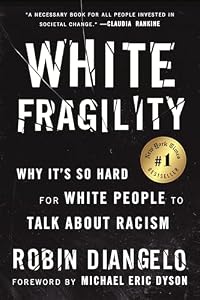
The tone is very strong in this one. I picked this and White Fragility up. It was suggested that White Fragility isn't good, I've gotten mixed recommendations about it but all good things about this one. The authors of this book seem to feel the same, that White Fragility isn't good enough and written by a white woman. This book is tough though, it is in your face. Try to breathe and listen, but I understand if it's hard because you feel like you're being yelled at or scolded multiple times on every page.
I felt like there were some good things in here. White silence is a big one. Reading the stories felt very American, but similar things happen in Canada too. I've seen it on the bus to the ferry, I've heard it at work in the food show more industry, I've heard it from myself and my white friends of all genders. Don't think you're better and not like those whites, really reflect on how you acted in similar situations to the stories they tell. See where you can do better and act.
This isn't a long book. I just think it took me a long time to get through because it made me so tired. The tone, the constant reflection. It's not easy. You might not agree with everything, but I do think it will open your eyes to something within its pages and you will think differently.
This is the first book I've ever read on anti-racism and maybe it was heavy-handed, but it's understanding. People are tired of teaching people for free and for no reason. Just because you ask to learn and understand, doesn't mean you'll take what they say and apply it to your life. They talk about how it's a fad. They got over 300 requests for dinners when Trump was elected, but only 100 replied back to the women when they followed up, and only 3 followed through with having the actual dinner they wanted. I would suggest you try this book. I got some good things out of it, but it was a slower read because of tone.
I read Ducks by Kate Beaton after this because I knew it would be a bit easier, still educational, but a palete cleanser before I jump into another heavy topic. show less
The tone is very strong in this one. I picked this and White Fragility up. It was suggested that White Fragility isn't good, I've gotten mixed recommendations about it but all good things about this one. The authors of this book seem to feel the same, that White Fragility isn't good enough and written by a white woman. This book is tough though, it is in your face. Try to breathe and listen, but I understand if it's hard because you feel like you're being yelled at or scolded multiple times on every page.
I felt like there were some good things in here. White silence is a big one. Reading the stories felt very American, but similar things happen in Canada too. I've seen it on the bus to the ferry, I've heard it at work in the food show more industry, I've heard it from myself and my white friends of all genders. Don't think you're better and not like those whites, really reflect on how you acted in similar situations to the stories they tell. See where you can do better and act.
This isn't a long book. I just think it took me a long time to get through because it made me so tired. The tone, the constant reflection. It's not easy. You might not agree with everything, but I do think it will open your eyes to something within its pages and you will think differently.
This is the first book I've ever read on anti-racism and maybe it was heavy-handed, but it's understanding. People are tired of teaching people for free and for no reason. Just because you ask to learn and understand, doesn't mean you'll take what they say and apply it to your life. They talk about how it's a fad. They got over 300 requests for dinners when Trump was elected, but only 100 replied back to the women when they followed up, and only 3 followed through with having the actual dinner they wanted. I would suggest you try this book. I got some good things out of it, but it was a slower read because of tone.
I read Ducks by Kate Beaton after this because I knew it would be a bit easier, still educational, but a palete cleanser before I jump into another heavy topic. show less
Deeply problematic and dangerous. In my view, their work does nothing to advance anti-racism work, is a one-sided argument and uses bullying tactics. I watched their documentary "Deconstructing Karen", followed the authors on social media, bought multiple copies of the book and started to read it but will not finish.
1. It's premise seems to be based on the false assumption that we can judge women by their skin colour (lumping everyone who appears white into the same group);
2. They seem to assert that all women who appear white by virtue of their skin colour uphold racism and white supremacy. Jewish women and others are perceived as white so such an assertion would seem to me to beyond pale;
3. I don't think the authors are interested in show more open dialogue, having difficult conversations or taking any feedback to their work under consideration. How can any cause be advanced when female voices are scolded and silenced?
In my view, this book is white female bashing at it's worst. All women living in a patriarchal society are marginalized. I believe that when one group of women takes open fire upon another group of women it is damaging. show less
1. It's premise seems to be based on the false assumption that we can judge women by their skin colour (lumping everyone who appears white into the same group);
2. They seem to assert that all women who appear white by virtue of their skin colour uphold racism and white supremacy. Jewish women and others are perceived as white so such an assertion would seem to me to beyond pale;
3. I don't think the authors are interested in show more open dialogue, having difficult conversations or taking any feedback to their work under consideration. How can any cause be advanced when female voices are scolded and silenced?
In my view, this book is white female bashing at it's worst. All women living in a patriarchal society are marginalized. I believe that when one group of women takes open fire upon another group of women it is damaging. show less
Needing to process some thoughts. Doing research. Taking notes. What do to and what not to do.
Ratings
Members
- Recently Added By
Lists

TBR of Books I Don't Own
132 works; 1 member
Author Information

1 Work 291 Members
Awards and Honors
Common Knowledge
- Original publication date
- 2022
- Dedication
- For all Black, Indigenous, brown, and non-white girls, women, and non-binary identifying folks who are sick and tires of white women's bullshit.
With love and sisterhood, Regina and Saira
For... (show all) my family and extended family, my late mother and father, my husband, my children and grandchildren, my twelve siblings, nieces, nephews, and their children.
"As long as the spirit of a warrior lives in the heart of just one of us, the dance is not over." - Afircan Proverb
With Love, Regina
For my late mother, Greenie; my second mother, Baj; my mother-in-law, Ajji; my sister, Tooth; my daughter, LG; my father, Piñata; my husband, Beagle; and my son, DG
With Love, Saira - First words
- If white womanhood is a house, your need to be perfect is the foundation.
- Blurbers
- Handler, Chelsea; Joseph, Frederick; Paquin, Anna; Rodriguez, Prisca Dorcas Mojica; Lorenz, Jo; Saahene, Michelle (show all 9); Strawn, Tina; Butler, Madison; Govindan, Abby
- Original language
- English
Classifications
- Genres
- Anthropology, Nonfiction, General Nonfiction, Sexuality and Gender Studies
- DDC/MDS
- 305.8 — Society, Government, and Culture Social sciences, sociology & anthropology Social group - Age, Gender, Ethnicity Ethnic and national groups
- LCC
- HT1563 .J33 — Social sciences Communities. Classes. Races Communities. Classes. Races Races
- BISAC
Statistics
- Members
- 293
- Popularity
- 109,598
- Reviews
- 5
- Rating
- (3.97)
- Languages
- English
- Media
- Paper, Audiobook, Ebook
- ISBNs
- 4
- ASINs
- 2