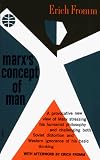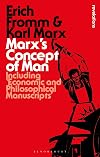
Marx's Concept of Man
by Erich Fromm
On This Page
Description
In publishing Marx's Concept of Man in 1961, Erich Fromm presented to the English-speaking world for the first time Karl Marx's then recently discovered Economic and Philosophical Manuscripts. Including the Manuscripts and many other philosophical writings by Marx as well as Fromm's own extended response, many of these writings have since become recognised as important works in their own right. Fromm stresses Marx's humanist philosophy and challenges both contemporary Western ignorance of show more Marx and Soviet corruptions of his work. Fromm's analysis of Marx's work and his dissemination of these neglected writings by Marx himself fundamentally altered the prevailing discourse about Marxism, revolutionising contemporary thought and providing a formative influence for the development of the New Left. show lessTags
Recommendations

































Member Reviews
After reading two of Marx's anthologies, this was indispensable in helping me understand what the hell Marx was really talking about. It was like studying Marx in a college class but without the class and only Fromm as your professor. It further cements Fromm's status in my book as one of the top thinkers of the 20th century. It also gives me a deeper admiration for Marx. Whereas after reading him by myself I had been most impressed just by his sheer audacity in taking the idea of private property to its logical (but extreme) conclusion, Fromm's book left me regarding Marx as a true humanist, people-first Zen political scientist.
Interesting overview of some of the early ruminations of Marx on man, alienation and labor. To some extent the author attempts to fit him into a more classic, romantic mold, and it's like trying to stuff a round peg into a square hole. But the translated original was interesting, and this book is still a worthy backgrounder on young or early Marx, and on the efforts of mid-2oth century German philosophy to reconcile him with their existentialism and humanism.
"Marx's Concept of Man" is essentially a pamphlet establishing the humanist, philosophical side of Marx as against the orthodox, Soviet view of Marx as tyrannical and economistic, and against the degree to which this view has seeped into academic literature in the West also. Famous Freudian Marxist Erich Fromm uses the "Economic and Philosophical Manuscripts" as well as "The German Ideology" to stress the importance of humanist concepts such as alienation, freedom, and creativity for Marx, and in so doing explains what these and similar terms mean in Marx' work. Fromm has clearly paid careful attention to Marx' philosophy, and this part of the book is quite good as a simple overview.
The second half of the book covers the English show more translation of the aforementioned "Economic and Philosophical Manuscripts" by Tom Bottomore, as well as excerpts from various other works by and about Marx meaning to show his humanism, his good nature, and his sensitivity to culture. Of special interest are the excerpts from the memoirs of those who knew Marx, like his daughter Eleanor as well as Paul Lafargue. These works are often quoted, but rarely does one find a larger part in English, not even in McLellan's biography.
Fromm goes a bit overboard here and there in stressing Marx' 'spiritual' nature. Although nothing Fromm writes is of itself incorrect, it may unwittingly reinforce the old canard of Marxism 'really' being a religion, and Marx a millennarian prophet, and so on. Fromm obviously rejects this old refrain, but should have made that clearer. In other aspects this collection is an interesting primer on Marx as thinker on human action and human nature, and sheds good light on this side of Marxist thought for those not familiar with it. show less
The second half of the book covers the English show more translation of the aforementioned "Economic and Philosophical Manuscripts" by Tom Bottomore, as well as excerpts from various other works by and about Marx meaning to show his humanism, his good nature, and his sensitivity to culture. Of special interest are the excerpts from the memoirs of those who knew Marx, like his daughter Eleanor as well as Paul Lafargue. These works are often quoted, but rarely does one find a larger part in English, not even in McLellan's biography.
Fromm goes a bit overboard here and there in stressing Marx' 'spiritual' nature. Although nothing Fromm writes is of itself incorrect, it may unwittingly reinforce the old canard of Marxism 'really' being a religion, and Marx a millennarian prophet, and so on. Fromm obviously rejects this old refrain, but should have made that clearer. In other aspects this collection is an interesting primer on Marx as thinker on human action and human nature, and sheds good light on this side of Marxist thought for those not familiar with it. show less
Ratings
Members
- Recently Added By
Lists

Some Things for Me to Read
20 works; 1 member

ENTENDIENDO LA FILOSOFÍA
16 works; 1 member
Author Information

179+ Works 18,423 Members
Psychologist and philosopher Erich Fromm was born in Frankfurt, Germany on March 23, 1900. He received a Ph.D in sociology from the University of Heidelberg in 1922 and finished his psychoanalytical training at the Psychoanalytical Institute in Berlin in 1930. He started his own clinical practice and joined the Frankfurt Institute for Social show more Research. In 1934, he moved to New York and became a professor at Columbia University. In 1950, he moved to Mexico City and became a professor at the Universidad Nacional Autónoma de Mexico, where he created a psychoanalytic section at the medical school. He retired from there in 1965 and moved to Muralto, Switzerland in 1974. Throughout his life, Fromm maintained a clinical practice and wrote books. His writings were notable for both their social and political commentary and their philosophical and psychological underpinnings. He became known for linking human personality types with socioeconomic and political structures. His most popular book, The Art of Loving, was first published in 1956 and became an international bestseller. He died on March 18, 1980. (Bowker Author Biography) show less
All Editions
Some Editions
Series
Belongs to Publisher Series
Work Relationships
Common Knowledge
- Original publication date
- 1961
Classifications
Statistics
- Members
- 589
- Popularity
- 49,784
- Reviews
- 4
- Rating
- (4.00)
- Languages
- 9 — Czech, Dutch, English, French, German, Japanese, Portuguese, Spanish, Turkish
- Media
- Paper, Ebook
- ISBNs
- 27
- ASINs
- 12