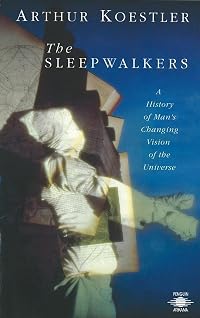
The Sleepwalkers: A History of Man's Changing Vision of the Universe
by Arthur Koestler
On This Page
Description
An extraordinary history of humanity's changing vision of the universe. In this masterly synthesis, Arthur Koestler cuts through the sterile distinction between 'sciences' and 'humanities' to bring to life the whole history of cosmology from the Babylonians to Newton. He shows how the tragic split between science and religion arose and how, in particular, the modern world-view replaced the medieval world-view in the scientific revolution of the seventeenth century. He also provides vivid and show more judicious pen-portraits of a string of great scientists and makes clear the role that political bias and unconscious prejudice played in their creativity. show lessTags
Recommendations



















Member Reviews
La storia della cosmologia di Koestler è piena di informazioni ben studiate raccolte in una storia così ben raccontata che sembra una buona "fiction", un romanzo, appunto. Per lo più è un resoconto storico dell'opera di Copernico, Keplero e Galileo, ma le prime sezioni ambientano perfettamente la narrazione descrivendo l'opera sorprendente dei loro predecessori come Tolomeo e Pitagora.
Koestler fornisce analisi psicologiche plausibili degli osservatori del cielo mentre mettono insieme faticosamente e in modo irregolare le loro teorie, con un piede nel passato e uno nel futuro, circondati da caos e intrighi, cercando di salvare la loro vita, le famiglie e la loro mente, spesso inciampando sulla verità per errore, o dimenticandola o show more ignorandola.
Dopo aver letto le loro opere nell'originale, Koestler smonta miti e sfumature teoriche e infilza gran parte degli apocrifi che hanno contribuito alle leggende che circondano questi giganti della scienza. Scrive molto bene anche sul rapporto mutevole tra religione e scienza nel corso dei secoli.
Tutto sommato, decenni dopo la pubblicazione, il libro rimane una boccata d'aria fresca. Lo consiglio vivamente a chiunque sia interessato alla cosmologia, alla matematica, all'alchimia, al medioevo o alla storia e filosofia della scienza o della religione. show less
Koestler fornisce analisi psicologiche plausibili degli osservatori del cielo mentre mettono insieme faticosamente e in modo irregolare le loro teorie, con un piede nel passato e uno nel futuro, circondati da caos e intrighi, cercando di salvare la loro vita, le famiglie e la loro mente, spesso inciampando sulla verità per errore, o dimenticandola o show more ignorandola.
Dopo aver letto le loro opere nell'originale, Koestler smonta miti e sfumature teoriche e infilza gran parte degli apocrifi che hanno contribuito alle leggende che circondano questi giganti della scienza. Scrive molto bene anche sul rapporto mutevole tra religione e scienza nel corso dei secoli.
Tutto sommato, decenni dopo la pubblicazione, il libro rimane una boccata d'aria fresca. Lo consiglio vivamente a chiunque sia interessato alla cosmologia, alla matematica, all'alchimia, al medioevo o alla storia e filosofia della scienza o della religione. show less
Ritka szerencsés pillanat, amikor egy magasan kvalifikált szépíró és a nyitott tudományos gondolkodás egy személyben találkozik – az Alvajárók ilyen pillanat eredménye. Végig lenyűgözött az a lelkesültség, ahogy Koestler a természetfilozófia világát kezelte a babilóniai asztronómusoktól egészen a newton-i szintézisig. Ez a lelkesültség éppúgy lemérhető Kepler iránt érzett vonzalmán, mint Galilei-kritikáján – az volt a benyomásom, hogy ilyen éllel csak azt tudjuk bírálni, aki már-már személyes ismerősünk. Ez a helyenként lírai hév nagyon megkapó, mert jelzi, Koestler mély szerelemmel szereti a gondolkodás bátorságát, ami a tárgyalt elmékre oly igen jellemző – és ami engem show more is elkápráztat, mert alig hiszem, hogy Isten (akit most mint munkahipotézist emlegetek) olyan világot teremtett volna, amit minél tüzetesebben megismerünk, annál távolabb kerülünk a teremtőjétől. Lássuk be, egy ilyen teremtett világ elég rossz vicc lenne – egy igazi patkányfogó.
Másrészt Koestler az igazi szintetizáló gondolkodók mintapéldánya. Arra törekszik, hogy az elemekből egészt hozzon létre, egyetlen gigantikus felépítményt. Persze az effajta építmények részleteikben esetleg vitathatóak, mégis lenyűgözőek, mert öröm továbbgondolni őket. A koestler-i szintézis bőven használ analógiákat – ilyen például a biológiai evolúció és a tudományos gondolkodás párba állítása. Előbbi is számos zsákutca, megtorpanás és tömeges fajkihalás után jutott el oda, ahova, és a természettudomány esetében sincs ez másképp. A nagy görög „kognitív forradalom” után, ami elhozta Püthagoraszt, Arisztarkhoszt, a heliocentrikus világképet és az atomokat, az agy behúzta a kéziféket, visszatáncolt és leragadt Platónnál meg Arisztotelésznél. Innentől kétezer éves böjt következett, amiből csak Kopernikusz, majd Kepler és Galilei, végül Newton szabadított ki minket. Ez a folyamat időbeliségében gyanúsan egyszerre zajlott a reformációval, ami újabb analógiára csábítja Koestlert, aki a két eseményt ugyanarra az igényre vezeti vissza: a megcsontosodott dogmatikával való leszámolás vágyára. Ugyanakkor az író tagadja, hogy tudomány és vallás elhidegülése törvényszerű lett volna, szerinte inkább hibás személyes döntésekre (elsősorban Galilei döntéseire, hogy pontosak legyünk) vezethető vissza. Ez Koestler megközelítésében szerencsétlen szakítás volt, hiszen amíg a XVI-XVII. században vallás és tudomány többé-kevésbé azonos nyelvet beszéltek (a jezsuiták közül kerültek ki a korszak legjobb csillagászai), addig a szakadás után nyelvük és univerzumuk szinte összevethetetlenül elkülönült, így fel is adták annak esélyét, hogy érdemben tanuljanak egymástól.
A harmadik analógia, amivel Koestler dolgozik, értelemszerűen a múlt és a jelen között állítható fel. Az író az ötvenes évek közepéből küldi hozzánk utószavát, abból a korból, amit alaposan meghatározott a félelem, hogy bolygónk atombomba által fogja megöngyilkolni enmagát. Ennek fényében értelmezendő az óva intés: Ember, vigyázz a tudományos zsákutcákra! Ne hidd, hogy feltalálni valamit önmagában bármit is jelent – keress hozzá koncepciót is, egy célt, ami meghatároz. És folyamatosan, újra és újra vizsgáld felül a dogmáidat, hogy nem megszokásból ragaszkodsz-e hozzájuk.
Szóval nagy könyv, csodás könyv. Nem klasszikus értelemben vett természettudomány, a szónak abban az értelmében, hogy bár akad benne bolygópálya-modellezés és némi matematika, mégsem ezeken van a hangsúly – sokkal inkább magán a tudományos gondolkodáson, a folyamaton, amikor az elme szépen, lassan, kínlódva lebontja az elődei által épített mentális falakat, és a törmelékből új lakhelyet épít magának. És ez jó így, mert amíg előbbi elem Einstein és a kvantumfizikusok óta veszített aktualitásából, addig ez utóbbi örök. És az örök könyvek azok bizony a legjobb könyvek. show less
Másrészt Koestler az igazi szintetizáló gondolkodók mintapéldánya. Arra törekszik, hogy az elemekből egészt hozzon létre, egyetlen gigantikus felépítményt. Persze az effajta építmények részleteikben esetleg vitathatóak, mégis lenyűgözőek, mert öröm továbbgondolni őket. A koestler-i szintézis bőven használ analógiákat – ilyen például a biológiai evolúció és a tudományos gondolkodás párba állítása. Előbbi is számos zsákutca, megtorpanás és tömeges fajkihalás után jutott el oda, ahova, és a természettudomány esetében sincs ez másképp. A nagy görög „kognitív forradalom” után, ami elhozta Püthagoraszt, Arisztarkhoszt, a heliocentrikus világképet és az atomokat, az agy behúzta a kéziféket, visszatáncolt és leragadt Platónnál meg Arisztotelésznél. Innentől kétezer éves böjt következett, amiből csak Kopernikusz, majd Kepler és Galilei, végül Newton szabadított ki minket. Ez a folyamat időbeliségében gyanúsan egyszerre zajlott a reformációval, ami újabb analógiára csábítja Koestlert, aki a két eseményt ugyanarra az igényre vezeti vissza: a megcsontosodott dogmatikával való leszámolás vágyára. Ugyanakkor az író tagadja, hogy tudomány és vallás elhidegülése törvényszerű lett volna, szerinte inkább hibás személyes döntésekre (elsősorban Galilei döntéseire, hogy pontosak legyünk) vezethető vissza. Ez Koestler megközelítésében szerencsétlen szakítás volt, hiszen amíg a XVI-XVII. században vallás és tudomány többé-kevésbé azonos nyelvet beszéltek (a jezsuiták közül kerültek ki a korszak legjobb csillagászai), addig a szakadás után nyelvük és univerzumuk szinte összevethetetlenül elkülönült, így fel is adták annak esélyét, hogy érdemben tanuljanak egymástól.
A harmadik analógia, amivel Koestler dolgozik, értelemszerűen a múlt és a jelen között állítható fel. Az író az ötvenes évek közepéből küldi hozzánk utószavát, abból a korból, amit alaposan meghatározott a félelem, hogy bolygónk atombomba által fogja megöngyilkolni enmagát. Ennek fényében értelmezendő az óva intés: Ember, vigyázz a tudományos zsákutcákra! Ne hidd, hogy feltalálni valamit önmagában bármit is jelent – keress hozzá koncepciót is, egy célt, ami meghatároz. És folyamatosan, újra és újra vizsgáld felül a dogmáidat, hogy nem megszokásból ragaszkodsz-e hozzájuk.
Szóval nagy könyv, csodás könyv. Nem klasszikus értelemben vett természettudomány, a szónak abban az értelmében, hogy bár akad benne bolygópálya-modellezés és némi matematika, mégsem ezeken van a hangsúly – sokkal inkább magán a tudományos gondolkodáson, a folyamaton, amikor az elme szépen, lassan, kínlódva lebontja az elődei által épített mentális falakat, és a törmelékből új lakhelyet épít magának. És ez jó így, mert amíg előbbi elem Einstein és a kvantumfizikusok óta veszített aktualitásából, addig ez utóbbi örök. És az örök könyvek azok bizony a legjobb könyvek. show less
Koestler's history of cosmology is filled with well-researched information bundled into a story so well told it reads like good fiction. Mostly it's a historical account of the work of Copernicus, Kepler and Galileo, but the early sections set the scene perfectly by describing the astonishing work of their predecessors like Ptolemy and Pythagoras.
Koestler provides plausible psychological analyses of the skywatchers as they painstakingly and erratically put their theories together with a foot in the past and one in the future, surrounded by chaos and intrigue and trying to hold their lives, families and minds together, often stumbling on to the truth by mistake, or forgetting or ignoring it.
Having read their works in the original, show more Koestler reveals jokes and theoretical nuances, and skewers much of the apocrypha that has contributed to the legends that surround these scientific giants. He also writes very well about the changing relationship between religion and science over the centuries.
All told, decades after publication this remains a breath of fresh air, and probably my favourite of the Koestler books I've read. I highly recommend it to anyone interested in cosmology, maths, alchemy, the middle ages, or the history and philosophy of science or religion. show less
Koestler provides plausible psychological analyses of the skywatchers as they painstakingly and erratically put their theories together with a foot in the past and one in the future, surrounded by chaos and intrigue and trying to hold their lives, families and minds together, often stumbling on to the truth by mistake, or forgetting or ignoring it.
Having read their works in the original, show more Koestler reveals jokes and theoretical nuances, and skewers much of the apocrypha that has contributed to the legends that surround these scientific giants. He also writes very well about the changing relationship between religion and science over the centuries.
All told, decades after publication this remains a breath of fresh air, and probably my favourite of the Koestler books I've read. I highly recommend it to anyone interested in cosmology, maths, alchemy, the middle ages, or the history and philosophy of science or religion. show less
It's a really good book about the history of scientific discovery, focusing on the ancient Greeks, Copernicus, Kepler, and Galileo. Highlights: Greek scientists had worked out a lot of stuff, but Plato and Aristotle sort of squashed that line of inquiry. Copernicus was possibly the most boring famous person in history, and generally seemed like a slacker. Also, we probably credit him with the beginnings of modern astronomy not because he was right about the Sun, but because his book was so unreadable that no one could figure out how wrong he was about the details. Kepler was a superstar, working out the tides, figuring out how telescopes worked, and realizing that planets travel in that most obscure and debased shape, the ellipse. He show more also had no idea what he'd be remembered for, and he was mostly interested in his totally wrong mystical ideas. He developed the inverse square relationship for optics, and rightly applied it to gravity, but then he totally forgot about it!?. Galileo was a big old douche canoe, and most of the myths about him are completely wrong. He was also wrong in his reasons as to why the earth moved around the sun, and wasted 25 years of his life on it. It was only after the Inquisition put him in his place that he did all his good work.
Koestler is possibly too lenient on the Catholic church throughout, but not egregiously so. There are a lot of eye openers and his writing is usually vivid and dynamic. I have a feeling that current historical scholarship could add a lot of detail and nuance to his story, but as it stands it's quite good.
4 stars oc show less
Koestler is possibly too lenient on the Catholic church throughout, but not egregiously so. There are a lot of eye openers and his writing is usually vivid and dynamic. I have a feeling that current historical scholarship could add a lot of detail and nuance to his story, but as it stands it's quite good.
4 stars oc show less
A heavy subject, but very interesting. A mixture of history, cosmology/astronomy, and physics. I never was good at physics back in school, due to whatever reason (mainly the way the teachers explained it, I guess). Astronomy was an interest of mine, but without all the mathematics and what not. History, too, but again, circumstances weren't always favourable. Or, in other words, once out of school, I became more interested in certain subjects at which I wasn't always successful in school.
In any case, this book was a sort of blind purchase: I never checked reviews or other info prior to buying it. But the blurb looked interesting and the shopkeeper told me several other customers had really liked the book.
Arthur Koestler has - or rather, show more had - a way with words. His style is quite fluent, eloquent (if I may write so). This is no fast-paced thriller, it's best to take your time to explore the many centuries of exploring the Solar System, from /- 600 BC until the 17th century. Or, from a.o. the Babylonians until Newton, with in-between famous chaps like Ptolemy, Plato, Aristotle, Copernicus, Kepler, and Galileo. Keywords: heliocentric cosmology, geocentric cosmology.
Koestler presents a nice and detailed overview of how man's view on the cosmos changed from gods to a scientific approach (though that one came quite late). The book also tells how at some point in history, the perception was better - more accurate - than it was several centuries later, when the Church (or religion) was very adamant about Holy Scripture and how one could not go against that. Related to that: the trial against Galileo, for example.
You can also read how e.g. Copernicus, Kepler, and Galileo found out by accident (whilst concentrating on other matters, other influences) about Earth's and other planets' rotation around the sun (and not the other way around). How one invented spheres to describe the movements of the planets, how another wrote of spokes, and how much later magnetism came into play.
Of course, it's not all about those researches and findings of the various scientists (in whatever age they lived). The book also tells about the struggles, the hurdles and what not - especially - Copernicus, Kepler, and Galileo had to face. But also how Galileo saw himself as THE chosen one with regards to the cosmos, how he claimed to have found the solution to problem x or y, while it were other researches who had done all the work, which Galileo never thought of examining and continued stubbornly his own work. This sort of matches - as far as I remember - the Galileo I read about in [a:Kim Stanley Robinson|1858|Kim Stanley Robinson|https://d.gr-assets.com/authors/1376955089p2/1858.jpg]'s book, [b:Galileo's Dream|8864105|Galileo's Dream|Kim Stanley Robinson|https://d.gr-assets.com/books/1333102668s/8864105.jpg|6579805] (see my review here).
Copernicus is described as an introvert, one with a low self-esteem, very obedient towards authority. He also - pardon my French - lacked the balls to stand up for himself. When offered help and advice, he remained stubborn and didn't publish his findings. For a long time he clung unto the principles of Aristotle, who was partly responsible for the dark ages in cosmology, and didn't want to alter his views and theory.
Isaac Newton is mentioned only briefly - certainly compared to the more detailed accounts about Corpernicus, Kepler, and Galileo - and mainly his findings and further explorations are discussed. Koestler wrote that there have been many books already about the man's life, that it wasn't really necessary to include such details, thus better to focus on his work. And so you'll read how he took elements from Kepler and from Galileo, and improved their examinations.
In the Epilogue, Koestler throws in a large chunk of physics and some philosophy, but also looks back at the evolution of cosmology. And how the separation of religion and science sort of impoverished both and made our view on the cosmos and the world a rather cold one, since the workings come across as mechanistic; there's no god or other being to keep the system in place, to maintain it now and then (a perception people did have many centuries ago). Religion and science don't complement each other any more (unless you're open-minded to find that it's not one or the other, of course, that each is, one way or another, right).
Throughout the book (and sometimes in the Notes section), you'll see several extracts (also very eloquently written, of course - very interesting if you're into languages) from the works, letters, ... of Copernicus, Kepler, and Galileo. The whole is (fortunately) enhanced with chronological tables (summarizing each part of the book, or each historical era, featuring names, dates, short info), drawings/illustrations, and maps.
In short: A very worthwhile synthesis of 2,000 years of cosmology (through European eyes) and how man's view changed massively, thanks to several bright minds, and despite the struggle with the Church. There's also enough food for thought for years to come.
It has sparked my interest to read more about the subject. In due time, of course.
P.S.: An interesting book for amateurs of Space Operas (SF) as well, obviously. ;-) show less
In any case, this book was a sort of blind purchase: I never checked reviews or other info prior to buying it. But the blurb looked interesting and the shopkeeper told me several other customers had really liked the book.
Arthur Koestler has - or rather, show more had - a way with words. His style is quite fluent, eloquent (if I may write so). This is no fast-paced thriller, it's best to take your time to explore the many centuries of exploring the Solar System, from /- 600 BC until the 17th century. Or, from a.o. the Babylonians until Newton, with in-between famous chaps like Ptolemy, Plato, Aristotle, Copernicus, Kepler, and Galileo. Keywords: heliocentric cosmology, geocentric cosmology.
Koestler presents a nice and detailed overview of how man's view on the cosmos changed from gods to a scientific approach (though that one came quite late). The book also tells how at some point in history, the perception was better - more accurate - than it was several centuries later, when the Church (or religion) was very adamant about Holy Scripture and how one could not go against that. Related to that: the trial against Galileo, for example.
You can also read how e.g. Copernicus, Kepler, and Galileo found out by accident (whilst concentrating on other matters, other influences) about Earth's and other planets' rotation around the sun (and not the other way around). How one invented spheres to describe the movements of the planets, how another wrote of spokes, and how much later magnetism came into play.
Of course, it's not all about those researches and findings of the various scientists (in whatever age they lived). The book also tells about the struggles, the hurdles and what not - especially - Copernicus, Kepler, and Galileo had to face. But also how Galileo saw himself as THE chosen one with regards to the cosmos, how he claimed to have found the solution to problem x or y, while it were other researches who had done all the work, which Galileo never thought of examining and continued stubbornly his own work. This sort of matches - as far as I remember - the Galileo I read about in [a:Kim Stanley Robinson|1858|Kim Stanley Robinson|https://d.gr-assets.com/authors/1376955089p2/1858.jpg]'s book, [b:Galileo's Dream|8864105|Galileo's Dream|Kim Stanley Robinson|https://d.gr-assets.com/books/1333102668s/8864105.jpg|6579805] (see my review here).
Copernicus is described as an introvert, one with a low self-esteem, very obedient towards authority. He also - pardon my French - lacked the balls to stand up for himself. When offered help and advice, he remained stubborn and didn't publish his findings. For a long time he clung unto the principles of Aristotle, who was partly responsible for the dark ages in cosmology, and didn't want to alter his views and theory.
Isaac Newton is mentioned only briefly - certainly compared to the more detailed accounts about Corpernicus, Kepler, and Galileo - and mainly his findings and further explorations are discussed. Koestler wrote that there have been many books already about the man's life, that it wasn't really necessary to include such details, thus better to focus on his work. And so you'll read how he took elements from Kepler and from Galileo, and improved their examinations.
In the Epilogue, Koestler throws in a large chunk of physics and some philosophy, but also looks back at the evolution of cosmology. And how the separation of religion and science sort of impoverished both and made our view on the cosmos and the world a rather cold one, since the workings come across as mechanistic; there's no god or other being to keep the system in place, to maintain it now and then (a perception people did have many centuries ago). Religion and science don't complement each other any more (unless you're open-minded to find that it's not one or the other, of course, that each is, one way or another, right).
Throughout the book (and sometimes in the Notes section), you'll see several extracts (also very eloquently written, of course - very interesting if you're into languages) from the works, letters, ... of Copernicus, Kepler, and Galileo. The whole is (fortunately) enhanced with chronological tables (summarizing each part of the book, or each historical era, featuring names, dates, short info), drawings/illustrations, and maps.
In short: A very worthwhile synthesis of 2,000 years of cosmology (through European eyes) and how man's view changed massively, thanks to several bright minds, and despite the struggle with the Church. There's also enough food for thought for years to come.
It has sparked my interest to read more about the subject. In due time, of course.
P.S.: An interesting book for amateurs of Space Operas (SF) as well, obviously. ;-) show less
Read this for a graduate course in rationalism. I was particularly impressed by the section dedicated to Kepler, who, I am reminded, essentially wrote the first piece of science fiction waaaay back when.
In the middle of the all the gory religious persecution of medieval Europe, a guy figured out that the planets move in an elliptical, as opposed to a circular, orbit around the sun. Koestler takes the reader through the stages of Kepler's thinking, with a wink and a nod to the intuitions that would, at times, lift him above that thinking. Highly recommended.
In the middle of the all the gory religious persecution of medieval Europe, a guy figured out that the planets move in an elliptical, as opposed to a circular, orbit around the sun. Koestler takes the reader through the stages of Kepler's thinking, with a wink and a nod to the intuitions that would, at times, lift him above that thinking. Highly recommended.
I think I read 2 of Koestler's bks. This must've been one of them b/c I remember the subject matter but I reckon it's possible that there's another Koestler bk w/ a long section on Kepler (as this one has). Anyway, in some respects, this must've been an important bk to me b/c it wd've been one of the 1st I wd've read on 'heretics' - ie: people persecuted by Christian Gangstas for having a mind & using it for something other than Christian hegemony. Alas, this is the only bk I've read in my astronomy section. Obviously, I 'need' to catch up on the subject! But, then, who can see the stars anymore? I live in the city.
Strangely, I don't remember being that impressed w/ this. Maybe it was too drily scientific for me. Maybe I just didn't show more get it. In retrospect it seems like a fascinating subject. Then, though, I was more interested in art & literature - so it's probably remarkable that I slogged thru a 600 page bk of this nature. Looking at it now I realize I shd add it to the read-again-if you-discover-you're-immortal category. show less
Strangely, I don't remember being that impressed w/ this. Maybe it was too drily scientific for me. Maybe I just didn't show more get it. In retrospect it seems like a fascinating subject. Then, though, I was more interested in art & literature - so it's probably remarkable that I slogged thru a 600 page bk of this nature. Looking at it now I realize I shd add it to the read-again-if you-discover-you're-immortal category. show less
Members
- Recently Added By
Lists

Vote: Science, Religion, and History Group Reads
30 works; 17 members

The Torchlight List
95 works; 1 member
Author Information

118+ Works 13,163 Members
Arthur Koestler was born on September 5, 1905 in Budapest, Hungary and studied at the University of Vienna. Koestler was a Middle East correspondent for several German newspapers, wrote for the Manchester Guardian, the London Times and the New York Herald Tribune. Koestler wrote Darkness at Noon, which centers on the destructiveness of politics, show more The Act of Creation, a book about creativity, and The Ghost in the Machine, which bravely attacks behaviorism. Arthur Koestler died in London on March 3, 1983. (Bowker Author Biography) show less
Some Editions
Awards and Honors
Notable Lists
Torchlight List (5)
Series
Belongs to Publisher Series
Work Relationships
Common Knowledge
- Canonical title
- The Sleepwalkers: A History of Man's Changing Vision of the Universe
- Original title
- The Sleepwalkers: A History of Man's Changing Vision of the Universe
- Original publication date
- 1959
- People/Characters
- Nicolaus Copernicus; Galileo Galilei; Johannes Kepler; Ptolemy; Pythagoras
- Dedication
- To the memory of Mamaine
- First words
- We can add to our knowledge, but we cannot subtract from it.
- Last words
- (Click to show. Warning: May contain spoilers.)Conversely, the example of Plato's obsession with perfect spheres, of Aristotle's arrow propelled by the surrounding air, the forty-eight epicycles of Canon Koppernigk and his moral cowardice, Tycho's mania of grandeur, Kepler's sun-spokes, Galileo's confidence tricks, and Descartes' pituitary soul, may have some sobering effect on the worshippers of the new Baal, lording over the moral vacuum with his electronic brain.
- Original language
- English
Classifications
- Genres
- Science & Nature, Nonfiction, History, General Nonfiction, Philosophy, Religion & Spirituality
- DDC/MDS
- 523.109 — Natural sciences & mathematics Astronomy The Solar System Universe
- LCC
- BL245 .K63 — Philosophy, Psychology and Religion Religions. Mythology. Rationalism Religions. Mythology. Rationalism Natural theology Religion and science
- BISAC
Statistics
- Members
- 1,087
- Popularity
- 23,467
- Reviews
- 12
- Rating
- (4.21)
- Languages
- 10 — English, French, German, Greek, Hungarian, Italian, Polish, Romanian, Spanish, Swedish
- Media
- Paper, Ebook
- ISBNs
- 20
- ASINs
- 30