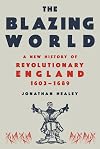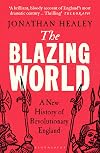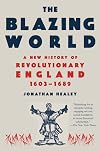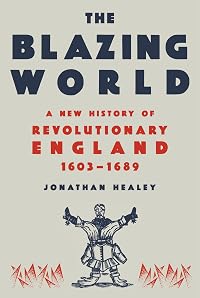
The Blazing World: A New History of Revolutionary England, 1603-1689
by Jonathan Healey
On This Page
Description
"A fresh, exciting history of seventeenth-century England, a time of revolution when society was on fire and simultaneously forging the modern world. The seventeenth century was a revolutionary age for the English. It started as they suddenly found themselves ruled by a Scotsman, and it ended in the shadow of an invasion by the Dutch. Under James I, England suffered terrorism and witch panics. Under his son Charles, state and society collapsed into civil war, to be followed by an army coup show more and regicide. For a short time--for the only time in history--England was a republic. There were bitter struggles over faith and Parliament asserted itself like never before. There were no boundaries to politics. In fiery, plague-ridden London, in coffee shops and alehouses, new ideas were forged that were angry, populist, and almost impossible for monarchs to control. But the story of this century is less well known than it should be. Myths have grown around key figures. People may know about the Gunpowder Plot and the Great Fire of London, but the Civil War is a half-remembered mystery to many. And yet the seventeenth century has never seemed more relevant. The British constitution is once again being bent and contorted, and there is a clash of ideologies reminiscent of when Roundhead fought Cavalier"-- show lessTags
Recommendations












Member Reviews
I like narrative history and I like concrete examples to illustrate and amplify the broad story being told. This excellent history of seventeenth century England reads easily, with this from the introduction:
So this book is about raw politics, but it is also about the social change that conditioned those politics. It is narrative history, and for this it makes no apologies, but it’s also about how those two forces combined to create nearly a hundred years of turbulence, out of which arose a remarkable new world, one which – for better or worse – was blazing a path towards our own.
As has been said, “history is just one damn thing after another”, but I begin to understand how true this is for the English Civil War, which forms show more the central section of this book. Although the events cover many years, with unexpected twists and turns, Healey helped me follow the important changes, and the accidents that create historical turning points, and as importantly, when they do not.
The book is split into twenty chapters and for my own reference I have made well over a hundred notes.
There is one chapter (17) which felt out of place, perhaps because I have already read detailed histories of this period, 1665 and 1666, discussing the Dutch naval wars, the Plague and the Great Fire of London.
It also includes rather a lot about Margaret Cavendish, Duchess of Newcastle, which although interesting, read as though inserted to introduce a female voice. Cavendish’s achievements were considerable, including a early work of speculative/utopian fiction, The Blazing World, and being the first female inducted into the Royal Society (discussed natural philosophy, which is the contemporary description of scientific knowledge). However, Cavendish comes across as very much unique because of her social position, ahead of her time, and not part of some larger feminist movement.
To cover such a long period I am sure that Healey has had to make many choices over what to emphasise and what to omit, but for me as a lay reader, the book gives a wonderful understanding of a complex period. There are many detours that can be taken into the various Protestant religious sects (Quakers, Socinians, Muggletonians, Seekers etc) and political groups (Levellers, Diggers etc), which are mentioned sufficiently, but which don’t lose the overall narrative drive of the book. I really enjoyed this and highly recommend it to the interested reader of popular history.
I received a Netgalley copy of this book, but this review is my honest opinion. show less
So this book is about raw politics, but it is also about the social change that conditioned those politics. It is narrative history, and for this it makes no apologies, but it’s also about how those two forces combined to create nearly a hundred years of turbulence, out of which arose a remarkable new world, one which – for better or worse – was blazing a path towards our own.
As has been said, “history is just one damn thing after another”, but I begin to understand how true this is for the English Civil War, which forms show more the central section of this book. Although the events cover many years, with unexpected twists and turns, Healey helped me follow the important changes, and the accidents that create historical turning points, and as importantly, when they do not.
The book is split into twenty chapters and for my own reference I have made well over a hundred notes.
There is one chapter (17) which felt out of place, perhaps because I have already read detailed histories of this period, 1665 and 1666, discussing the Dutch naval wars, the Plague and the Great Fire of London.
It also includes rather a lot about Margaret Cavendish, Duchess of Newcastle, which although interesting, read as though inserted to introduce a female voice. Cavendish’s achievements were considerable, including a early work of speculative/utopian fiction, The Blazing World, and being the first female inducted into the Royal Society (discussed natural philosophy, which is the contemporary description of scientific knowledge). However, Cavendish comes across as very much unique because of her social position, ahead of her time, and not part of some larger feminist movement.
To cover such a long period I am sure that Healey has had to make many choices over what to emphasise and what to omit, but for me as a lay reader, the book gives a wonderful understanding of a complex period. There are many detours that can be taken into the various Protestant religious sects (Quakers, Socinians, Muggletonians, Seekers etc) and political groups (Levellers, Diggers etc), which are mentioned sufficiently, but which don’t lose the overall narrative drive of the book. I really enjoyed this and highly recommend it to the interested reader of popular history.
I received a Netgalley copy of this book, but this review is my honest opinion. show less
The 17th century was one of huge political change in England. From the absolutist monarchy to republic and then back to a more constitutional monarchy, the people of England saw their daily lives changed massively. One driving force was religion but in this book Healey explains that there were so many more and that the history of these turbulent times was influenced in so many different ways.
I really enjoyed reading this book as I hadn't really studied this century in great detail and found the style educated but engaging. The source materials are really well used to illustrate points and run the panoply from royalty to the very poorest.
I really enjoyed reading this book as I hadn't really studied this century in great detail and found the style educated but engaging. The source materials are really well used to illustrate points and run the panoply from royalty to the very poorest.
In The Blazing World, published in 2023, Jonathan Healy presents a detailed history of the turmoil that roiled seventeenth century England. It was a period that featured a power struggle as Parliament sought to limit the power of royalty. Religion played a major role in the unrest, with the rise of puritanism and other sects seeking to prevent the return of the Catholic dogma into churches and governance. It was a time that witnessed the overthrow and beheading of King Charles I, the rise of Oliver Cromwell into power, and later, the return of Charles II to the throne. After the death of Charles II, his brother James II assumed the monarchy, only to be chased from power after his embrace of Catholicism. It was an epoch with few dull show more moments.
While the century was troubled by bloody warfare, persecutions, and famine, by its end there was a dramatic drop in executions, an end to witch trials, and a much improved British economy. One reason for this was the rise of a middle class that provided an influencing factor in limiting the power of both puritanism and the royalty. Though a topsy turvy period, it laid the groundwork for the industrial revolution that would make Britain a global power in the following century. Healy masterfully captures the revolutionary fervor of the 17th century, presenting its complexities with prose that is easily understood, and which entertains as well. show less
While the century was troubled by bloody warfare, persecutions, and famine, by its end there was a dramatic drop in executions, an end to witch trials, and a much improved British economy. One reason for this was the rise of a middle class that provided an influencing factor in limiting the power of both puritanism and the royalty. Though a topsy turvy period, it laid the groundwork for the industrial revolution that would make Britain a global power in the following century. Healy masterfully captures the revolutionary fervor of the 17th century, presenting its complexities with prose that is easily understood, and which entertains as well. show less
Informative, a few too many “interesting” anecdotes.
Ratings
Members
- Recently Added By
Lists

History: England, Ireland, Scotland, Wales
94 works; 2 members

read in 2024
21 works; 1 member

THE WAR ROOM
813 works; 24 members
Author Information

3 Works 385 Members
Awards and Honors
Common Knowledge
- Canonical title
- The Blazing World: A New History of Revolutionary England, 1603-1689
- Dedication
- For Alice, with love and curiosity.
Classifications
- Genres
- History, General Nonfiction, Nonfiction
- DDC/MDS
- 941.0600 — History & geography History of Europe British Isles Historical periods of British Isles 1603-1714, House of Stuart and Commonwealth periods
- LCC
- DA375 .H43 — History of Europe, Asia, Africa and Oceania Great Britain History of Great Britain England History By period Modern, 1485-
- BISAC
Statistics
- Members
- 318
- Popularity
- 100,513
- Reviews
- 4
- Rating
- (4.15)
- Languages
- English
- Media
- Paper, Audiobook, Ebook
- ISBNs
- 8
- ASINs
- 5