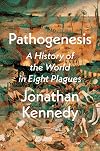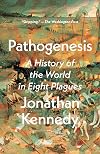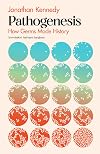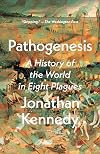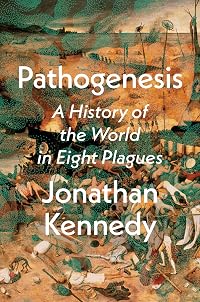
Pathogenesis: A History of the World in Eight Plagues
by Jonathan Kennedy
On This Page
Description
This book shows how infectious disease has shaped humanity at every stage, from the first success of Homo sapiens over the equally intelligent Neanderthals to the fall of Rome and the rise of Islam. How did the Black Death lead to the birth of capitalism? Why do most North Americans speak English rather than French? And how did the Industrial Revolution lead to the birth of the welfare state? Infectious diseases are not just something that happens to us, but a part of who we are. The only show more reason humans don't lay eggs is that a virus long ago inserted itself into our DNA. In fact, 8% of the human genome was put there by viruses. We have been thinking about the survival of the fittest all wrong -- human evolution is not simply about our strength and intelligence, but about what viruses can and can't use for their benefit. By confronting our ongoing battle with infectious diseases globally, Dr Jonathan Kennedy shows how germs have been responsible for some of the seismic revolutions in human history, and how the crises they precipitate offer vital opportunities to change course. show lessTags
Recommendations






















Member Reviews
2.5 stars, rounded up for showing his work.
Let's start with the two 800-pound primates in the room.
First, this book is thoroughly Eurocentric and should have been titled "Eight Diseases That Kicked White People's Asses." After his problematic discussion of hominid evolution (see Issue #2), Kennedy charts a course for civilization arising in Mesopotamia, growing up in the Mediterranean world, and then proceeding through Europe to its colonies; it's as if he cannot even be bothered to note that agriculture and complex societies arose independently and permanently in multiple places such as...oh, China. Plagues that radically affected Asian civilizations are not addressed, Africa apparently never had the Ghanaian Empire, Great Zimbabwe, or show more ages of trans-Indian Ocean trade with Asia, and no mention is made that the New World saw multiple waves of human immigration before white folks showed up....it's all about how white populations were affected by contact with "Others." Also, he spends way too much ink in the last third of the book on how diseases among the urban poor directly influenced modern UK law and civil infrastructure: just as one would expect from a British sociologist.
Secondly, I again find myself, a professor of anthropology, wishing modern sociologists would abstain from writing about early hominids. Kennedy falls into the trap of calling all archaic populations of Homo sapiens separate species without acknowledging that it just ain't so. Further, he sings the song of infectious disease being the main driver of selection and adaption among early hominids without seeming to understand global climate changes through the Pliocene and Pleistocene, population competition for resources, and both social and sexual selection factors. It presents as _reductio ad absurdum_.
While Kennedy shows how disease outbreaks profoundly affected the course of the Greek and Roman cultures and does pretty cogently demonstrate how immunity or lack thereof to malaria, yellow fever, and such directly influenced modern population settlement patterns, it all ends up being too little content for all the colonial-capitalist hand-wringing. show less
Let's start with the two 800-pound primates in the room.
First, this book is thoroughly Eurocentric and should have been titled "Eight Diseases That Kicked White People's Asses." After his problematic discussion of hominid evolution (see Issue #2), Kennedy charts a course for civilization arising in Mesopotamia, growing up in the Mediterranean world, and then proceeding through Europe to its colonies; it's as if he cannot even be bothered to note that agriculture and complex societies arose independently and permanently in multiple places such as...oh, China. Plagues that radically affected Asian civilizations are not addressed, Africa apparently never had the Ghanaian Empire, Great Zimbabwe, or show more ages of trans-Indian Ocean trade with Asia, and no mention is made that the New World saw multiple waves of human immigration before white folks showed up....it's all about how white populations were affected by contact with "Others." Also, he spends way too much ink in the last third of the book on how diseases among the urban poor directly influenced modern UK law and civil infrastructure: just as one would expect from a British sociologist.
Secondly, I again find myself, a professor of anthropology, wishing modern sociologists would abstain from writing about early hominids. Kennedy falls into the trap of calling all archaic populations of Homo sapiens separate species without acknowledging that it just ain't so. Further, he sings the song of infectious disease being the main driver of selection and adaption among early hominids without seeming to understand global climate changes through the Pliocene and Pleistocene, population competition for resources, and both social and sexual selection factors. It presents as _reductio ad absurdum_.
While Kennedy shows how disease outbreaks profoundly affected the course of the Greek and Roman cultures and does pretty cogently demonstrate how immunity or lack thereof to malaria, yellow fever, and such directly influenced modern population settlement patterns, it all ends up being too little content for all the colonial-capitalist hand-wringing. show less
Jonathan Kennedy's Pathogenesis: A History of the World in Eight Plagues has much to recommend it. At the very least, the reader is reminded of his or her place in existence, just another animal amidst a plethora of creatures striving to exist long enough to reproduce. Evolutionary adaptation works to give creatures that survive at least partial immunity against a slew of pathogenic “animalcules” while other adaptations work to make those same bacteria and viruses more proficient at dodging our biological walls so that they themselves can survive. The effects of this competition, Kennedy explains, have influenced human history much more than many realize.
How was the Black population on Hispaniola successful in overthrowing French show more control and in liberating the island when their opponent was far better trained and equipped for warfare? Thank a climate that was very favorable for propagation of the yellow fever arbovirus and the Aedes mosquito that carries it, as well as the fact that the Black population had already experienced the virus in Africa and had evolved better immunity to it than had the French.
How were the Conquistadors able to vanquish the great Aztec polity, which massively outnumbered the Spanish invaders? Thank Old World diseases to which the Spanish had long been exposed, while the Aztec had had no opportunity to develop any immunity to the new pathogens.
How did the Black Death reach Europe? According to Kennedy's analysis, we should blame Icelandic volcanoes. Apparently, the pathogen, Yersinia pestis, was living rather amicably in marmots dwelling on the Eurasian Steppe when the volcanoes erupted, obscuring the sunlit skies and dropping temperatures. The climate change decreased the marmots' local food supply, causing them to range further afield in search of sustenance. Their expanded geographical range brought them into contact with black rats, who acquired the pathogen and whose ranges overlapped those of humans. Fleas on the rats ingested the pathogens, infected the humans, and the great die-off began.
I'm giving away too much of the book, which is not my desire, but there is one further event that really caught my attention, the Chinese “Great Leap Forward” in 1958, when the government launched a nationwide campaign to “exterminate the four pests”: rats, flies, mosquitoes, and sparrows, the last “because they were accused by the Chinese Communist Party of being capitalist birds due to their penchant for 'stealing' large amounts of grain and fruit from hard-working peasants.” Apparently unrealized by the government, the sparrows also ate huge numbers of locusts, whose numbers increased and “feasted on the harvest in a manner far more destructive than anything that sparrows could have achieved.” (Page 211) The government eventually replaced sparrows with bedbugs on the “four pests” list.
These four examples should convey an idea of the types of facts that are unveiled in Kennedy's book. For me, the first three chapters were pretty slow going, primarily because I have never studied ancient history in any depth, and I was presented information on migrations of people of whom I had never before heard. I mean, I wouldn't know a Sasanian from a Martian. A footnote explaining a bit about Sasanians would have been greatly appreciated. In addition, I've always been geographically challenged, and Kennedy's explanations of movements and migrations would have remained more or less impenetrable had it not been for some maps in my wife's Ancient History textbook. These early chapters would have been rather more comprehensible had the book included maps illustrating the movements that the author discusses.
By the time the book got to medieval plagues in Chapter 4, I was able to relate events to other historical knowledge I've been fortunate to acquire, and my comprehension (and therefore interest) picked up accordingly. From there through chapters on colonial, revolutionary, and industrial plagues, I found Pathogenesis fascinating. The final chapter, which deals with the effects of poverty on health, life expectancy, and society, reminded me very much of George Orwell's The Road to Wigan Pier and clearly expresses Kennedy's view of inept government policy on matters of public health.
I found the book something of an eye opener and generally an interesting read (despite the first few chapters that assumed knowledge that I did not have). Anyone who is unaware of the role played by malaria in both slavery and the outcome of the United States' civil war in the 1860s will find information here that is not explained in any other history I've ever read (or at least remembered). We may also have pathogens to thank for the colonies' successful revolution against the English government in the late 18th century. Readers may not describe the book as entertaining throughout, but they will be hard pressed to deny that it is informative and that it delves into topics not widely covered in other “histories of the world.” show less
How was the Black population on Hispaniola successful in overthrowing French show more control and in liberating the island when their opponent was far better trained and equipped for warfare? Thank a climate that was very favorable for propagation of the yellow fever arbovirus and the Aedes mosquito that carries it, as well as the fact that the Black population had already experienced the virus in Africa and had evolved better immunity to it than had the French.
How were the Conquistadors able to vanquish the great Aztec polity, which massively outnumbered the Spanish invaders? Thank Old World diseases to which the Spanish had long been exposed, while the Aztec had had no opportunity to develop any immunity to the new pathogens.
How did the Black Death reach Europe? According to Kennedy's analysis, we should blame Icelandic volcanoes. Apparently, the pathogen, Yersinia pestis, was living rather amicably in marmots dwelling on the Eurasian Steppe when the volcanoes erupted, obscuring the sunlit skies and dropping temperatures. The climate change decreased the marmots' local food supply, causing them to range further afield in search of sustenance. Their expanded geographical range brought them into contact with black rats, who acquired the pathogen and whose ranges overlapped those of humans. Fleas on the rats ingested the pathogens, infected the humans, and the great die-off began.
I'm giving away too much of the book, which is not my desire, but there is one further event that really caught my attention, the Chinese “Great Leap Forward” in 1958, when the government launched a nationwide campaign to “exterminate the four pests”: rats, flies, mosquitoes, and sparrows, the last “because they were accused by the Chinese Communist Party of being capitalist birds due to their penchant for 'stealing' large amounts of grain and fruit from hard-working peasants.” Apparently unrealized by the government, the sparrows also ate huge numbers of locusts, whose numbers increased and “feasted on the harvest in a manner far more destructive than anything that sparrows could have achieved.” (Page 211) The government eventually replaced sparrows with bedbugs on the “four pests” list.
These four examples should convey an idea of the types of facts that are unveiled in Kennedy's book. For me, the first three chapters were pretty slow going, primarily because I have never studied ancient history in any depth, and I was presented information on migrations of people of whom I had never before heard. I mean, I wouldn't know a Sasanian from a Martian. A footnote explaining a bit about Sasanians would have been greatly appreciated. In addition, I've always been geographically challenged, and Kennedy's explanations of movements and migrations would have remained more or less impenetrable had it not been for some maps in my wife's Ancient History textbook. These early chapters would have been rather more comprehensible had the book included maps illustrating the movements that the author discusses.
By the time the book got to medieval plagues in Chapter 4, I was able to relate events to other historical knowledge I've been fortunate to acquire, and my comprehension (and therefore interest) picked up accordingly. From there through chapters on colonial, revolutionary, and industrial plagues, I found Pathogenesis fascinating. The final chapter, which deals with the effects of poverty on health, life expectancy, and society, reminded me very much of George Orwell's The Road to Wigan Pier and clearly expresses Kennedy's view of inept government policy on matters of public health.
I found the book something of an eye opener and generally an interesting read (despite the first few chapters that assumed knowledge that I did not have). Anyone who is unaware of the role played by malaria in both slavery and the outcome of the United States' civil war in the 1860s will find information here that is not explained in any other history I've ever read (or at least remembered). We may also have pathogens to thank for the colonies' successful revolution against the English government in the late 18th century. Readers may not describe the book as entertaining throughout, but they will be hard pressed to deny that it is informative and that it delves into topics not widely covered in other “histories of the world.” show less
Could've been subtitled "when all you have is a germ, everything becomes a disease". And I mean everything, from the fall of the Roman empire to the Reformation, American chattel slavery, the industrial revolution and the Black Lives Matter movement were all due to microbes and disease outbreaks. I think he wants give what today would be referred to as a leftist analysis, but ends up praising Adam Smith an awful lot. In short, the conclusions are a bit suspect, but the overall history and detail is pretty good - I learned some things from this book that I'd not known and found some analysis that I'd not considered. So, overall, a decent book, but a bit too breezy in style, too much irrelevant politics and way too much Monty Python (no show more kidding). show less
An excellent book. Tells how diseases and plagues impacted on history. Very well written - enough background given to hel the lay reader, but still pleasantly readable. The author is able to combine the Big Picture with the detail in a way that just makes sense, Effectively demolishes the Great Man thesis - the successes in history are more likely to be the Lucky leaders.
The last couple of chapters/plagues stretched the theme a little, but the rest was the bees knees!
The last couple of chapters/plagues stretched the theme a little, but the rest was the bees knees!
A fascinating ebook of 4.5-to-5 stars.
We all know that Spaniards conquered the Americas with smallpox, measles, etc., that spread far and wide, massacring millions of indigenous people before they even set eyes on the invaders.
But why didn't the Southern colonies use indentured servants from Europe like the Northern colonies? Because, in the South, European servants kept dying off from malaria and yellow fever. The white Southerners had developed immunity but the newcomers, the servants, just died. Solution? Africans who already had immunity.
Because the French got tired of dying in Haiti by the thousands of malaria and yellow fever (while their rebellious slaves did not), they abandoned the Caribbean and sold Louisiana to the new U.S. show more government. The Louisiana Purchase providing the U.S. with a huge expansion of territory.
And more, much more.
Highly recommended! show less
We all know that Spaniards conquered the Americas with smallpox, measles, etc., that spread far and wide, massacring millions of indigenous people before they even set eyes on the invaders.
But why didn't the Southern colonies use indentured servants from Europe like the Northern colonies? Because, in the South, European servants kept dying off from malaria and yellow fever. The white Southerners had developed immunity but the newcomers, the servants, just died. Solution? Africans who already had immunity.
Because the French got tired of dying in Haiti by the thousands of malaria and yellow fever (while their rebellious slaves did not), they abandoned the Caribbean and sold Louisiana to the new U.S. show more government. The Louisiana Purchase providing the U.S. with a huge expansion of territory.
And more, much more.
Highly recommended! show less
The relationship between pathogens and their hosts is explored here, particularly how it can be argued that the development of human society can be linked to the development of disease. Starting before general history, this book uses evidence from written and scientific sources to plot the growth of civilisation and to reconsider major moments in history from the perspective of how pathogens showed influence. Combining my two loves of science and history, I found this book really engrossing.
Starting in extreme antiquity (in Earth's hunter-gatherer era for the earliest humans), the author makes a strong case for revising the explanations for many key points in human history based on the role of bacteria and viruses in those transitions. My view of world history will never be the same. This book is enlivened by genetic data previously only published in recent but paywalled academic journals accessible to few readers. The most likely causes of ancient pandemics are also explored.
Members
- Recently Added By
Lists

Science: Health & Medical
100 works; 1 member
Author Information

1 Work 676 Members
Awards and Honors
Awards
Distinctions
The Guardian Book of the Day (2023-04-06)
Common Knowledge
- Original publication date
- 2023
- Dedication
- For Farrah and Zaha
- First words
- According to Sigmund Freud, there have been three great revolutions in Western science and each of these dealt a blow to humans' belief in their special status - or what he referred to as our "naive self-love." The first, whi... (show all)ch began with Copernicus was the revelation that the earth is not the center of the universe but just one of several planets revolving around the sun. After this setback, we could still console ourselves with the Books of Genesis' claim that God created humans in his own image and gave us dominion over the land, sea and animals - albeit in a location that was astronomically peripheral. Then Charles Darwin came along and pointed out that humans are just another species of animal and that we share a relatively recent common ancestor with apes. The third great scientific revolution, according to Freud, was his own discover of the unconscious. The realization that we aren't even in control of our thought processes was, he argued, the "most irritating insult" to "the human mania of greatness." -Introduction
The idea of a world inhabited by multiple human and humanoid species will be familiar to readers of fantasy literature. Take, for example, the Fellowship that accompanies Frodo Baggins on his journey to dispose of the One Rin... (show all)g in the fires of Mount Doom. Aragorn and Boromir are Men, a term used to denote both male and female humans. Frodo, Sam, Merry and Pippin are Hobbits, closely related to Men but roughly half as tall and with oversize, furry feet. Then there is Legolas, a slender and pointy-eared Elf with a superhuman sense of sight and hearing. And Gimli is a Dwarf, belonging to the short, thickset warrior-like people who live in the mountains of Middle-earth. -Chapter 1, Paleolithic Plagues - Last words
- (Click to show. Warning: May contain spoilers.)It is now up to us to seize the opportunity to address these iniquities and to build a happier and healthier world.
- Blurbers
- Dartnell, Lewis; Flyn, Cal; Sanghera, Sathnam; Honigsbaum, Mark; Christian, David
- Original language
- English
- Canonical DDC/MDS
- 614.4000
- Canonical LCC
- RA649.K46
Classifications
- Genres
- History, General Nonfiction, Science & Nature, Nonfiction
- DDC/MDS
- 614.4000 — Applied science & technology Medicine & health Epidemics, Poisons, Alternative Medicine Incidence of and public measures to prevent disease
- LCC
- RA649 .K46 — Medicine Public aspects of medicine Public aspects of medicine Public health. Hygiene. Preventive medicine Epidemics. Epidemiology. Quarantine. Disinfection
- BISAC
Statistics
- Members
- 702
- Popularity
- 40,688
- Reviews
- 20
- Rating
- (4.00)
- Languages
- Dutch, English, Italian, Spanish
- Media
- Paper, Audiobook, Ebook
- ISBNs
- 16
- ASINs
- 6