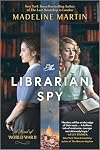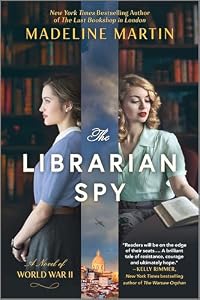
The Librarian Spy
by Madeline Martin
On This Page
Description
"Readers will be on the edge of their seats.... A brilliant tale of resistance, courage and ultimately hope." –Kelly Rimmer, New York Times bestselling author of The Warsaw OrphanFrom the New York Times bestselling author of The Last Bookshop in London comes a moving new novel inspired by the true history of America's library spies of World War II.
Ava thought her job as a librarian at the Library of Congress would mean a quiet, routine existence. But an unexpected offer from the US show more military has brought her to Lisbon with a new mission: posing as a librarian while working undercover as a spy gathering intelligence.
Meanwhile, in occupied France, Elaine has begun an apprenticeship at a printing press run by members of the Resistance. It's a job usually reserved for men, but in the war, those rules have been forgotten. Yet she knows that the Nazis are searching for the press and its printer in order to silence them.
As the battle in Europe rages, Ava and Elaine find themselves connecting through coded messages and discovering hope in the face of war.
"Uplifting, inspiring and suspenseful, this is one to savor!" –Natasha Lester, New York Times bestselling author of The Riviera House
"Madeline Martin is a fantastic author. The Librarian Spy is a stunning tour de force of historical fiction." –Karen Robards, author of The Black Swan of Paris
For more historical fiction from Madeline Martin, don't miss The Last Bookshop in London.
. show less
Tags
Recommendations
























Member Reviews
Recently, on Goodreads, casting about for something to read, I saw this book. Although not prone to women’s fiction (other than Austen, the Brontës, and Eliot I read as a youth), a World War II spy tale was appealing.
The main character, Ava Harper, is a DC government librarian doing her best to support the war effort; “she had complied [with rationing] long before it became law. She gave blood [as often as allowed].” “Rather than dance and drink at the Elk Club like her roommates “, she worked with the Red Cross, “repairing uniforms, rolling bandages”, and doing anything else asked of her.
Ava is reassigned to the American Embassy in Lisbon, Portugal, a neutral country free of the war strictures she’d known at home. Her show more job is to gather intelligence by acquiring newspapers and photographing them on microfilm that is regularly sent back to the states for analysis.
Chapter two introduces another main character, Helene Belanger, a member of the French underground in Lyon, who runs a partisan press, disseminating news of Nazi atrocities to their countrymen. Before joining the resistance, Helene acted within societal norms in the role of a housewife.
Early in the book Helene changes names (becoming Elaine), acquiring fake identity papers to avoid arrest. Other characters take on false names for the same reason, a necessity in the clandestine world of the French Resistance. The juxtaposition of identities could be confusing, but I kept it straight, taking notes.
Author Martin skillfully writes dual plots with each heroine’s story told in alternate chapters as the narrative threads gradually shift toward each other, becoming more entwined until the final chapters where the stories merge. The plots are based on the good hearted nature of the two main characters, both wanting to salvage lives from the suffering humanity they see around them every day.
Elaine, in occupied France, sees Jews rounded up for the death camps and members of the resistance detained and tortured. Ava, in Lisbon, sees throngs of refugees in ever growing lines at the embassy, many who have sold everything in an effort to get a visa and gain transit to America. Both women carry separate burdens, Ava worried about her brother, a U.S. soldier on the front lines, and Elaine, fearful for her husband, arrested by the gestapo. The author writes delicately of relationships strained by the uncertainties of war and with sensitivity for her character’s feelings.
Eventually, Elaine is detained and brought before German torture master Werner. In her mind she slips back into the role of housekeeper, becoming steadfast, claiming she is a “mere housewife”, stating her chores one by one.
Martin surprises us at every turn as the two heroines face setbacks and reversals in their individual quests to save lives and ease suffering. These events don’t feel contrived but rather have a sense of inevitability as the author skillfully resolves each reversal.
In one instance the story seems to rely on a deus ex machina for resolution but even here Martin’s use of language keeps the reader from feeling cheated. As the two plots steer toward one, both heroines go through emotionally wrenching events, suffering losses themselves and among friends and companions.
The author uses vivid prose to reveal the emotions of the two heroines, allowing the reader to feel what the characters are experiencing. In Ava and Elaine’s clandestine world, there are persons who may not be whom they appear to be. The possibility of deception is a constant worry for both women, especially Elaine who at any moment could be arrested and taken away to be tortured. The reader is right there, frayed nerves and all.
Martin artfully blends emotion with action, fulfilling Conrad’s dictum, “to make you hear, to make you feel – it is, before all, to make you see.” This is a modern day classic on more than one level. Reading Martin’s work gave me a better understanding of the female mind than John Gray’s pop psychology classic. show less
The main character, Ava Harper, is a DC government librarian doing her best to support the war effort; “she had complied [with rationing] long before it became law. She gave blood [as often as allowed].” “Rather than dance and drink at the Elk Club like her roommates “, she worked with the Red Cross, “repairing uniforms, rolling bandages”, and doing anything else asked of her.
Ava is reassigned to the American Embassy in Lisbon, Portugal, a neutral country free of the war strictures she’d known at home. Her show more job is to gather intelligence by acquiring newspapers and photographing them on microfilm that is regularly sent back to the states for analysis.
Chapter two introduces another main character, Helene Belanger, a member of the French underground in Lyon, who runs a partisan press, disseminating news of Nazi atrocities to their countrymen. Before joining the resistance, Helene acted within societal norms in the role of a housewife.
Early in the book Helene changes names (becoming Elaine), acquiring fake identity papers to avoid arrest. Other characters take on false names for the same reason, a necessity in the clandestine world of the French Resistance. The juxtaposition of identities could be confusing, but I kept it straight, taking notes.
Author Martin skillfully writes dual plots with each heroine’s story told in alternate chapters as the narrative threads gradually shift toward each other, becoming more entwined until the final chapters where the stories merge. The plots are based on the good hearted nature of the two main characters, both wanting to salvage lives from the suffering humanity they see around them every day.
Elaine, in occupied France, sees Jews rounded up for the death camps and members of the resistance detained and tortured. Ava, in Lisbon, sees throngs of refugees in ever growing lines at the embassy, many who have sold everything in an effort to get a visa and gain transit to America. Both women carry separate burdens, Ava worried about her brother, a U.S. soldier on the front lines, and Elaine, fearful for her husband, arrested by the gestapo. The author writes delicately of relationships strained by the uncertainties of war and with sensitivity for her character’s feelings.
Eventually, Elaine is detained and brought before German torture master Werner. In her mind she slips back into the role of housekeeper, becoming steadfast, claiming she is a “mere housewife”, stating her chores one by one.
Martin surprises us at every turn as the two heroines face setbacks and reversals in their individual quests to save lives and ease suffering. These events don’t feel contrived but rather have a sense of inevitability as the author skillfully resolves each reversal.
In one instance the story seems to rely on a deus ex machina for resolution but even here Martin’s use of language keeps the reader from feeling cheated. As the two plots steer toward one, both heroines go through emotionally wrenching events, suffering losses themselves and among friends and companions.
The author uses vivid prose to reveal the emotions of the two heroines, allowing the reader to feel what the characters are experiencing. In Ava and Elaine’s clandestine world, there are persons who may not be whom they appear to be. The possibility of deception is a constant worry for both women, especially Elaine who at any moment could be arrested and taken away to be tortured. The reader is right there, frayed nerves and all.
Martin artfully blends emotion with action, fulfilling Conrad’s dictum, “to make you hear, to make you feel – it is, before all, to make you see.” This is a modern day classic on more than one level. Reading Martin’s work gave me a better understanding of the female mind than John Gray’s pop psychology classic. show less
Ava is a librarian for the Library of Congress until she gets picked for a special assignment in Lisbon, Portugal. She knows very little about her assignment, other than she is working undercover as a spy gathering periodicals to send back to the US for intelligence. Meanwhile, Elaine is in occupied France, working with the Resistance at a printing facility. The Nazis are on the lookout for the press and it’s printers to stop them from getting the news out. These two women’s paths cross in coded messages and having hope that everything will be okay. I couldn’t put this book down - every page the knot in my stomach grew as I was anxious to find out what happened. Loved both Ava and Elaine’s stories and would highly recommend this show more book! show less
The Librarian Spy is set during World War II, and alternates between Ava and Elaine. Ava Harper is an American librarian recruited to work in Lisbon. She was recruited from the Library of Congress to gather information in Europe and send it back to America for evaluation. Elaine is a French revolutionary who works at a clandestine newspaper, helping those around her, all while avoiding detection from the Nazis. Throughout the story I sympathized most with Elaine, fighting against the Nazi oppression during French occupation, and losing friends along the way. But her courage grows when she meets Sarah and her son Noah, hoping to flee from the Nazis. This is a story of loss, love, friendship, and hope. Madeline Martin stated in the author show more note that the main characters were inspired by real people—with their bravery and courage—while maintaining the story itself is a work of fiction. I feel that Martin’s research was well done especially when writing about the locations, conditions, and overall fear surrounding wartime. show less
An emotional, tough read. It’s very well written, it almost feels like you’re there with these women as they struggle to survive, especially in France.
Madeline Martin writes historical fiction bringing to light little-known aspects of war. In The Librarian Spy, she shares the role of U.S. librarians working to gather publications in neutral Portugal to assist the war effort. It’s an interesting story, as Lisbon was a melting pot of many different nationalities, including refugees under the watch of the Portuguese secret police. There is also a concurrent plot of the French Resistance printing an underground newspaper in Lyon not only to share information, but to seek help.
Ava works at the U.S. Library of Congress and is recommended for the role in Lisbon to collect foreign publications due to her language skills. She’s reluctant at first, but goes to help the war effort. Once show more there, she enters an unexpected world. Not only is there no rationing in Lisbon, but it is a place where many foreigners combine. The British are there, collecting similar documents but so are the Germans. There are also many refugees from all parts of Europe, desperate to get visas to other countries and then a boat out of the country. Over all of them hangs the threat of the secret police. It takes Ava a little while to understand how everything works, but she makes friends with newsagents and James, who works for the British. She also volunteers with refugee organisations, where she makes friends and contacts, but wants to do more. Meanwhile, Elaine has had to change her name after her husband is arrested. She turns to work for the Resistance, working on delivering and later helping write and print an underground newspaper in Lyon. When a mother and son appear at the warehouse one night, Elaine does everything in her power to make sure that they can escape France for a new life in America. This includes writing a code in the newspaper, which Ava detects, and decodes with the help of British enigma James. But can they get Sarah and Noah out of France, then to America before time runs out?
I found The Librarian Spy a refreshing addition to World War II historical fiction. While I knew a bit about the French Resistance, Elaine’s experiences added a lot more detail. As for Ava and Lisbon, I really wasn’t aware of the role Portugal played in housing refugees and being a neutral site for information gathering. The story is rich in historical detail, as well as Portuguese life (think bica and custard tarts). Told in alternate chapters from Ava’s then Elaine’s point of view, I found I was never left wanting as each chapter ended. (Nor did I forget what was going on, which can sometimes happen when the two plot threads are separate, as they are here). Although it takes a while for the link between Ava and Elaine to become clear, the two women’s stories still feel connected. Perhaps this is because of the strong characterisation – each character has unique traits no matter whether they are major or minor characters. There is also never a dull moment or a part that drags. It’s all fascinating, necessary and eye opening. Overall, you can’t go past Madeline Martin’s historical fiction to shine a light on little known parts of history.
Thank you to Harlequin for the copy of this book. My review is honest.
http://samstillreading.wordpress.com show less
Ava works at the U.S. Library of Congress and is recommended for the role in Lisbon to collect foreign publications due to her language skills. She’s reluctant at first, but goes to help the war effort. Once show more there, she enters an unexpected world. Not only is there no rationing in Lisbon, but it is a place where many foreigners combine. The British are there, collecting similar documents but so are the Germans. There are also many refugees from all parts of Europe, desperate to get visas to other countries and then a boat out of the country. Over all of them hangs the threat of the secret police. It takes Ava a little while to understand how everything works, but she makes friends with newsagents and James, who works for the British. She also volunteers with refugee organisations, where she makes friends and contacts, but wants to do more. Meanwhile, Elaine has had to change her name after her husband is arrested. She turns to work for the Resistance, working on delivering and later helping write and print an underground newspaper in Lyon. When a mother and son appear at the warehouse one night, Elaine does everything in her power to make sure that they can escape France for a new life in America. This includes writing a code in the newspaper, which Ava detects, and decodes with the help of British enigma James. But can they get Sarah and Noah out of France, then to America before time runs out?
I found The Librarian Spy a refreshing addition to World War II historical fiction. While I knew a bit about the French Resistance, Elaine’s experiences added a lot more detail. As for Ava and Lisbon, I really wasn’t aware of the role Portugal played in housing refugees and being a neutral site for information gathering. The story is rich in historical detail, as well as Portuguese life (think bica and custard tarts). Told in alternate chapters from Ava’s then Elaine’s point of view, I found I was never left wanting as each chapter ended. (Nor did I forget what was going on, which can sometimes happen when the two plot threads are separate, as they are here). Although it takes a while for the link between Ava and Elaine to become clear, the two women’s stories still feel connected. Perhaps this is because of the strong characterisation – each character has unique traits no matter whether they are major or minor characters. There is also never a dull moment or a part that drags. It’s all fascinating, necessary and eye opening. Overall, you can’t go past Madeline Martin’s historical fiction to shine a light on little known parts of history.
Thank you to Harlequin for the copy of this book. My review is honest.
http://samstillreading.wordpress.com show less
Madeline Martin's terrific novel The Last Bookshop in London (my review here) told the story of a young woman who worked in a London bookshop during the Blitz of WWII. It was a fresh take on the popular WWII novels, and as someone who works in a bookstore, I enjoyed it.
Her new novel, The Librarian Spy, is also a unique WWII story. Martin sets this story in two cities- Lyon, France and Lisbon, Portugal. I can't recall reading a novel set in Lisbon, and didn't know anything about Portugal's role as a neutral country during WWII. I do now.
Ava Harper is a librarian working in the rare books room in the Library of Congress. She is recruited to help the United States war effort and is sent to Lisbon where she is tasked with purchasing show more magazines and newspapers from Germany, France, and elsewhere and microfilming them to send back to Washington DC to be studied by the War Department for intelligence that will help the war effort.
Elaine lives in Lyon, which is under the control of the Nazis and the Vichy government. When her husband disappears, Elaine is recruited by his friend to work undercover with the French Resistance. Elaine works with other women hiding and passing out undercover newspapers to others in the Resistance. Eventually she ends up working on the printing press that creates the newspapers.
The contrast between Ava's life in Lisbon and Elaine's in Lyon is stark. Ava is enjoying tasty Portuguese pastries like pastéis de nata and living in a small but comfortable apartment while Elaine is constantly hungry and moving from one cramped safehouse to another trying to avoid being captured by the cruel Nazis who would torture her for information.
Ava meets some British librarians, and catches the eye of one in particular, James. James takes Ava to fancy dinner parties, telling her it would aid the war effort, while Elaine anxiously searches for word about the whereabouts of her husband. Was he is prison, sent to a work camp, or dead?
There is a connection between Ava and Elaine that becomes apparent in the second half of the book as that revolves around a secret message that gets decoded and helps a woman escape.
At first I was more intrigued by Ava's story because I didn't know much about Lisbon (and I admire librarians, they are superheroes), but as the story progressed, Elaine's story captured me as well. Lisbon housed many refugees from the Nazi's, and was a point of departure for many who fled to the United States. The parallels to the refugees today fleeing war in Afghanistan and the Ukraine are significant.
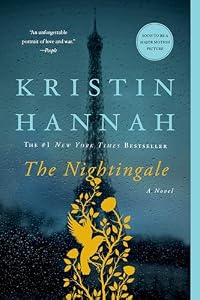
Madeline Martin doesn't shy away from the horrors of the Nazis cruelties, and it can often hard, but yet important, to read. As a world we cannot keep allowing this atrocities to happen. It put me in mind of Jessica Shattuck's novel The Women in the Castle and Kristin Hannah's The Nightingale from a few years ago.
As Eleanor Roosevelt said "A woman is like a teabag. You never know how strong it is until it's in hot water." Ava and Elaine personify that quite well in Madeline Martin's powerful novel The Librarian Spy. I highly recommend it. show less
Her new novel, The Librarian Spy, is also a unique WWII story. Martin sets this story in two cities- Lyon, France and Lisbon, Portugal. I can't recall reading a novel set in Lisbon, and didn't know anything about Portugal's role as a neutral country during WWII. I do now.
Ava Harper is a librarian working in the rare books room in the Library of Congress. She is recruited to help the United States war effort and is sent to Lisbon where she is tasked with purchasing show more magazines and newspapers from Germany, France, and elsewhere and microfilming them to send back to Washington DC to be studied by the War Department for intelligence that will help the war effort.
Elaine lives in Lyon, which is under the control of the Nazis and the Vichy government. When her husband disappears, Elaine is recruited by his friend to work undercover with the French Resistance. Elaine works with other women hiding and passing out undercover newspapers to others in the Resistance. Eventually she ends up working on the printing press that creates the newspapers.
The contrast between Ava's life in Lisbon and Elaine's in Lyon is stark. Ava is enjoying tasty Portuguese pastries like pastéis de nata and living in a small but comfortable apartment while Elaine is constantly hungry and moving from one cramped safehouse to another trying to avoid being captured by the cruel Nazis who would torture her for information.
Ava meets some British librarians, and catches the eye of one in particular, James. James takes Ava to fancy dinner parties, telling her it would aid the war effort, while Elaine anxiously searches for word about the whereabouts of her husband. Was he is prison, sent to a work camp, or dead?
There is a connection between Ava and Elaine that becomes apparent in the second half of the book as that revolves around a secret message that gets decoded and helps a woman escape.
At first I was more intrigued by Ava's story because I didn't know much about Lisbon (and I admire librarians, they are superheroes), but as the story progressed, Elaine's story captured me as well. Lisbon housed many refugees from the Nazi's, and was a point of departure for many who fled to the United States. The parallels to the refugees today fleeing war in Afghanistan and the Ukraine are significant.
Madeline Martin doesn't shy away from the horrors of the Nazis cruelties, and it can often hard, but yet important, to read. As a world we cannot keep allowing this atrocities to happen. It put me in mind of Jessica Shattuck's novel The Women in the Castle and Kristin Hannah's The Nightingale from a few years ago.
As Eleanor Roosevelt said "A woman is like a teabag. You never know how strong it is until it's in hot water." Ava and Elaine personify that quite well in Madeline Martin's powerful novel The Librarian Spy. I highly recommend it. show less
Ava works in the rare books department of the Library of Congress. Her only living relative, a brother, enlisted in the Army. When offered a job in Portugal microfilming newspapers and other documents to assist in the War effort, she decides to take the job. In Lyon, France, a woman's husband affiliated with the resistance is arrested by the Nazis. Although he did not want her to join because of the danger, Elaine (as she becomes known) goes to work helping put out an underground newspaper. The paths of the two women first cross when Ava spots code typed by Helene who is seeking to reunite a Jewish mother and child with the father who made it out to America earlier. This story as well as everything else is well-told and captivates the show more reader/listener to the end. The author described atrocities endured by members of the Resistance as well as reporting deaths when they occurred. I listened to the audiobook and would recommend it to others seeking a World War II story. show less
Members
- Recently Added By
Lists

Books Read in 2023
5,547 works; 145 members
Author Information

57+ Works 4,182 Members
Common Knowledge
- Canonical title
- The Librarian Spy
- People/Characters
- Klaus Barbie (Mentions of); Ava Harper; Helene Belanger; Elaine Rousseau
- Important places
- Lisbon, Portugal; Lyon, France
- Important events
- World War II
- First words
- There was nothing Ava Harper loved more than the smell of old books.
- Blurbers
- Rimmer, Kelly; Lester, Natasha; Robards, Karen
Classifications
Statistics
- Members
- 874
- Popularity
- 30,946
- Reviews
- 44
- Rating
- (3.93)
- Languages
- English, Norwegian
- Media
- Paper, Audiobook, Ebook
- ISBNs
- 13
- ASINs
- 6