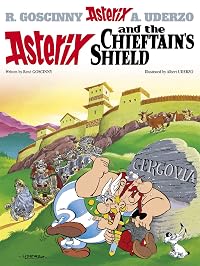
Asterix and the Chieftain's Shield
by René Goscinny (Author), Albert Uderzo (Author)
Asterix uff Meefränggisch (5), Asterix (11)
On This Page
Description
When the hero Vercingetorix was defeated he threw his arms at Julius Caesar's feet. Years later, Caesar plans to hold a triumph with his enemy's shield - but where is it? Romans and Gauls race to track it down, and Chief Vitalstatistix, dieting on a health farm, has a surprise to spring. Will Caesar defeat the Gauls again, or will the truimph go to Asterix?Tags
Recommendations



















Member Reviews
I didn't like this particular album as much as I did the others, though the story was still quite good, particularly with the rather interesting twist at the end. Actually there are a few twists in this story, and it does take time for the actually plot of the story, that is the quest for the shield of Vercingetorix, to come to fruition. Basically, after Vercingetorix threw his arms and armour at Ceaser's feet (which ended up being quite painful for Ceaser) the shield ended up going missing. However, it appears that a part of Gaul was beginning to revolt, namely because Asterix and Obelix were wondering through and decided to beat up the local Roman envoy. Actually, it wasn't because they decided to have some fun (which hadn't stopped show more them in the past) but rather that the Roman decided to throw his weight around, and Asterix and Obelix generally do not appreciate Romans doing that and tend to put them back into their place. Anyway, Ceaser decides that to remind the Gauls who's boss he wants to be paraded around the area on Vercingetorix's shield, however, as it turns out, the shield went missing shortly afterwards, so it ends up being a race between the Romans and Asterix and Obelix to get the shield first.
I guess the reason that I didn't really like this particular album is because I felt that the translation was not really all that good. I say that because some of the jokes simply did not make sense. It is not that I do not have a funny bone (we all have a funny bone, but I am not speaking anatomically here) but rather that the jokes simply did not make sense. Some of them, such as the Gaul's crying out that they do not know where Alesia is took some time to work out (Alesia is where Vercingetorix was eventually defeated by Ceaser) others of them (and I can't remember it quite clearly) simply did not come out all that well.
Anyway, I have sort of thought a bit more about the ideas behind the Asterix comics, and while some may suggest that there isn't anything deep in them, I would be inclined to disagree. Hey, even Superman has ideas behind it (that being the American's desire for a super hero to come down and save them from all the bad things, which may even have a connection to their Puritan heritage). Asterix has a similar idea though and I suspect that it stretches back to the writings of Rousseau, who suggested that technology and advancement were the main causes of humanity's ills, and as such a return to the ideal, that is the simple village life where everybody is self sufficient, is the answer. As such we see throughout the Asterix comics a continual battle between development, as represented by the Romans, and the idealistic life style, as represented by the village. While we do not see it as much here, we do get deeper exploration of the theme in some of the other albums.
Obviously the theme behind the story is one of control (as are many of them) and that it is the desire to finally remind the ideal that that time is long gone and that we now live in an age of progress. The shield of Vercingetorix symbolises the ideal, and obviously whoever holds onto the shield pretty much dictates where society is heading (which seems to also be the case with the Spear of Destiny). If the Romans have the shield then progress has won, however if the Gauls have the shield, progress many not necessarily have lost, but there is still hope for the ideal to exist and that progress can at least be halted. show less
I guess the reason that I didn't really like this particular album is because I felt that the translation was not really all that good. I say that because some of the jokes simply did not make sense. It is not that I do not have a funny bone (we all have a funny bone, but I am not speaking anatomically here) but rather that the jokes simply did not make sense. Some of them, such as the Gaul's crying out that they do not know where Alesia is took some time to work out (Alesia is where Vercingetorix was eventually defeated by Ceaser) others of them (and I can't remember it quite clearly) simply did not come out all that well.
Anyway, I have sort of thought a bit more about the ideas behind the Asterix comics, and while some may suggest that there isn't anything deep in them, I would be inclined to disagree. Hey, even Superman has ideas behind it (that being the American's desire for a super hero to come down and save them from all the bad things, which may even have a connection to their Puritan heritage). Asterix has a similar idea though and I suspect that it stretches back to the writings of Rousseau, who suggested that technology and advancement were the main causes of humanity's ills, and as such a return to the ideal, that is the simple village life where everybody is self sufficient, is the answer. As such we see throughout the Asterix comics a continual battle between development, as represented by the Romans, and the idealistic life style, as represented by the village. While we do not see it as much here, we do get deeper exploration of the theme in some of the other albums.
Obviously the theme behind the story is one of control (as are many of them) and that it is the desire to finally remind the ideal that that time is long gone and that we now live in an age of progress. The shield of Vercingetorix symbolises the ideal, and obviously whoever holds onto the shield pretty much dictates where society is heading (which seems to also be the case with the Spear of Destiny). If the Romans have the shield then progress has won, however if the Gauls have the shield, progress many not necessarily have lost, but there is still hope for the ideal to exist and that progress can at least be halted. show less
This review is written with a GPL 4.0 license and the rights contained therein shall supersede all TOS by any and all websites in regards to copying and sharing without proper authorization and permissions. Crossposted at WordPress, Blogspot, & Librarything by Bookstooge’s Exalted Permission
Title: Asterix & the Chieftain's Shield
Series: Asterix #11
Authors: Goscinny & Uderzo
Rating: 3 of 5 Stars
Genre: Comics
Pages: 53
Words: 3K
Synopsis:
From Wikipedia.org
The book begins with Vercingetorix conceding defeat to Julius Caesar. His surrendered weapons remain at Caesar's chair for several hours, until a Roman archer steals Vercingetorix's famous shield, which he loses in a game of dice to another legionary, who then loses it to a drunken show more centurion, in return for the centurion not reporting him for a military offence. The centurion himself uses the shield to pay for a jar of wine at a nearby Gaulish inn; later, the shield is given by the innkeeper to a survivor of the Battle of Alesia.
Following this prologue, Chief Vitalstatistix is made helpless by a sore liver, a consequence of overeating and drinking at his last banquet. Having demonstrated this, and temporarily eased the chief's pain, the druid Getafix sends Vitalstatistix to a hydrotherapeutic center in Arverne to be cured, with Asterix and Obelix (and Dogmatix) as his escort. On the way, they stop at various inns, where the heavy food revives the chief's sickness. At Arverne, the Gauls initially remain together; but because Asterix, Obelix, and Dogmatix are in no need of special diets, they feast on wild boar and beer while everyone else eats "boiled vegetables". When other patients complain, Vitalstatistix sends Asterix, Obelix, and Dogmatix to Gergovia.
Along the way, the Gauls are offended by Roman envoy Noxius Vapus, and vanquish his guards. In the aftermath, Asterix, Obelix, and Dogmatix befriend the local tavern-keeper Winesanspirix, who retains them thereafter as guests. When Noxius Vapus makes his report to Caesar in Rome, Caesar plans a triumph on Vercingetorix's shield to "show them who's boss", and orders Vapus to search Arverne for it. When the initial investigations fail, the Romans send a spy, Legionary Pusillanimus; but on drinking too much wine at Winesanspirix's tavern, the latter discloses Caesar's plan and reveals his own knowledge of the shield's history, whereupon Asterix, Obelix, and Dogmatix set off in search of the shield themselves. To that end, they interrogate the archer, Lucius Circumbendibus, who now owns a wheel manufacturing business; the second legionary, Marcus Carniverus, who worked at a health resort before opening a restaurant; and the drunken Centurion Crapulus. Vapus and his men in turn search in vain for both the shield and Asterix and Obelix, as a running gag dirtying themselves with charcoal dust while searching the coal heaps belonging to Winesanspirix and their neighbors.
The search eventually leads the two Gauls back to Winesanspirix, to whom Crapulus had given the shield in the prologue. Upon the protagonists' reunion with him, Winesanspirix confesses having given the shield to a dispirited Gaulish warrior, who is thereupon identified with the arrival of a newly cured and much slimmer Vitalstatistix. Vitalstatistix reveals he had the shield the whole time and it is the very one he is always carried upon. Upon Caesar's arrival at Gergovia, Asterix and the locals organize a triumph in which Vitalstatistix is carried on Vercingetorix's shield. Caesar then deports Vapus and his troops to Numidia, and Caesar promotes Centurion Crapulus to command of the garrison of Gergovia, and Legionary Pusillanimus to Centurion, on the grounds that they are the only "clean" legionaries present (despite both being visibly drunk). The Gauls return to their village (Vitalstatistix regaining his customary weight at the inns visited earlier in the story) to celebrate; but Vitalstatistix is forced into abstinence from the latter by his wife Impedimenta.
My Thoughts:
Hmm, this one was hard to get enthused about. The word plays seemed even worse than normal (or I just might be reaching the end of what I'll accept anymore), the plot was utter nonsense (not bonkers funny, but just nonsense) and no pirates were sunk.
This felt very dated, ie going to a health farm to lose weight. This was originally done in '68 and that kind of thing was way more prevalent then. It would have been like if Asterix and Obelix had made jokes about 8track tapes or something. It didn't help that the Chief was pretty much forced to do this by his wife and that the Druid wouldn't keep fixing him up. He was a middle aged man trying to still act like a 20 year old and it hit home, and not in a nice comfy way either!
With all of that complaining, this was still a good riotous story. Julius Caesaer wants a shield to hold a Triumph with and Asterix and Obelix have to find the shield first to prevent that from happening. So of course their Chief has the shield all along, sigh. While no pirates were sunk, plenty of romans were biffed and bammed and ol Julius Caesar himself shows up only to slink away when the boys parade their chief Vitalstatistix on the shield.
I was amused the whole time but just barely and if I feel this same way for the next book, I'm going to take it as a sign that I need to take a break. There can be too much of a good thing and my refined literary palate can only take so much cleansing after all.
★★★☆☆ show less
Title: Asterix & the Chieftain's Shield
Series: Asterix #11
Authors: Goscinny & Uderzo
Rating: 3 of 5 Stars
Genre: Comics
Pages: 53
Words: 3K
Synopsis:
From Wikipedia.org
The book begins with Vercingetorix conceding defeat to Julius Caesar. His surrendered weapons remain at Caesar's chair for several hours, until a Roman archer steals Vercingetorix's famous shield, which he loses in a game of dice to another legionary, who then loses it to a drunken show more centurion, in return for the centurion not reporting him for a military offence. The centurion himself uses the shield to pay for a jar of wine at a nearby Gaulish inn; later, the shield is given by the innkeeper to a survivor of the Battle of Alesia.
Following this prologue, Chief Vitalstatistix is made helpless by a sore liver, a consequence of overeating and drinking at his last banquet. Having demonstrated this, and temporarily eased the chief's pain, the druid Getafix sends Vitalstatistix to a hydrotherapeutic center in Arverne to be cured, with Asterix and Obelix (and Dogmatix) as his escort. On the way, they stop at various inns, where the heavy food revives the chief's sickness. At Arverne, the Gauls initially remain together; but because Asterix, Obelix, and Dogmatix are in no need of special diets, they feast on wild boar and beer while everyone else eats "boiled vegetables". When other patients complain, Vitalstatistix sends Asterix, Obelix, and Dogmatix to Gergovia.
Along the way, the Gauls are offended by Roman envoy Noxius Vapus, and vanquish his guards. In the aftermath, Asterix, Obelix, and Dogmatix befriend the local tavern-keeper Winesanspirix, who retains them thereafter as guests. When Noxius Vapus makes his report to Caesar in Rome, Caesar plans a triumph on Vercingetorix's shield to "show them who's boss", and orders Vapus to search Arverne for it. When the initial investigations fail, the Romans send a spy, Legionary Pusillanimus; but on drinking too much wine at Winesanspirix's tavern, the latter discloses Caesar's plan and reveals his own knowledge of the shield's history, whereupon Asterix, Obelix, and Dogmatix set off in search of the shield themselves. To that end, they interrogate the archer, Lucius Circumbendibus, who now owns a wheel manufacturing business; the second legionary, Marcus Carniverus, who worked at a health resort before opening a restaurant; and the drunken Centurion Crapulus. Vapus and his men in turn search in vain for both the shield and Asterix and Obelix, as a running gag dirtying themselves with charcoal dust while searching the coal heaps belonging to Winesanspirix and their neighbors.
The search eventually leads the two Gauls back to Winesanspirix, to whom Crapulus had given the shield in the prologue. Upon the protagonists' reunion with him, Winesanspirix confesses having given the shield to a dispirited Gaulish warrior, who is thereupon identified with the arrival of a newly cured and much slimmer Vitalstatistix. Vitalstatistix reveals he had the shield the whole time and it is the very one he is always carried upon. Upon Caesar's arrival at Gergovia, Asterix and the locals organize a triumph in which Vitalstatistix is carried on Vercingetorix's shield. Caesar then deports Vapus and his troops to Numidia, and Caesar promotes Centurion Crapulus to command of the garrison of Gergovia, and Legionary Pusillanimus to Centurion, on the grounds that they are the only "clean" legionaries present (despite both being visibly drunk). The Gauls return to their village (Vitalstatistix regaining his customary weight at the inns visited earlier in the story) to celebrate; but Vitalstatistix is forced into abstinence from the latter by his wife Impedimenta.
My Thoughts:
Hmm, this one was hard to get enthused about. The word plays seemed even worse than normal (or I just might be reaching the end of what I'll accept anymore), the plot was utter nonsense (not bonkers funny, but just nonsense) and no pirates were sunk.
This felt very dated, ie going to a health farm to lose weight. This was originally done in '68 and that kind of thing was way more prevalent then. It would have been like if Asterix and Obelix had made jokes about 8track tapes or something. It didn't help that the Chief was pretty much forced to do this by his wife and that the Druid wouldn't keep fixing him up. He was a middle aged man trying to still act like a 20 year old and it hit home, and not in a nice comfy way either!
With all of that complaining, this was still a good riotous story. Julius Caesaer wants a shield to hold a Triumph with and Asterix and Obelix have to find the shield first to prevent that from happening. So of course their Chief has the shield all along, sigh. While no pirates were sunk, plenty of romans were biffed and bammed and ol Julius Caesar himself shows up only to slink away when the boys parade their chief Vitalstatistix on the shield.
I was amused the whole time but just barely and if I feel this same way for the next book, I'm going to take it as a sign that I need to take a break. There can be too much of a good thing and my refined literary palate can only take so much cleansing after all.
★★★☆☆ show less
Same fun visual puns and verbal trickery, but a rather weak story, enjoyable, but definitly not the best of Asterix.
This volume (the 11th in the series) is notable for touching base on the Battle of Alesia ("I don't know where Alesia is?") which is somewhat ironic as the whereabouts of Alesia itself was not known until after this was printed.
It chronicles the story of how Chief Vitalstatistix came to obtain his well-known shield on which he is carried and the race between Asterix and Obelix to find it before Julius Caesar.
It is the first book to name Vitalstatistix's wife, Impedimenta, and is one of the only books to not have the bard, Cacofonix tied up at the end (in fact he is shown to be eating and getting merry at the tradtional book-ending banquet).
The Gaulish costline features as the backdrop to this story and makes references specifically to show more the heath spas and love for wine that dominate the area. Some of the classic characters that pop up are Winesandspiirix, the ROman Envoy Noxius Vapus, a lazy Legionnaire Pusillanimus, Lucius Corcumbendibus who is a whell manufacturer (loosely based on the Michellin factory) and Marcus Carniverus who owns a Wine and Boar inn.
Some good bits in this, not one of the best, but certainly not one of the worst. show less
It chronicles the story of how Chief Vitalstatistix came to obtain his well-known shield on which he is carried and the race between Asterix and Obelix to find it before Julius Caesar.
It is the first book to name Vitalstatistix's wife, Impedimenta, and is one of the only books to not have the bard, Cacofonix tied up at the end (in fact he is shown to be eating and getting merry at the tradtional book-ending banquet).
The Gaulish costline features as the backdrop to this story and makes references specifically to show more the heath spas and love for wine that dominate the area. Some of the classic characters that pop up are Winesandspiirix, the ROman Envoy Noxius Vapus, a lazy Legionnaire Pusillanimus, Lucius Corcumbendibus who is a whell manufacturer (loosely based on the Michellin factory) and Marcus Carniverus who owns a Wine and Boar inn.
Some good bits in this, not one of the best, but certainly not one of the worst. show less
The boys travel to find the Chieftain's Shield that Vercingetorix threw at the feet of Caesar when he surrendered, before Caesar can retrieve it. Along the way, they and their chief stop at a sanatorium for a dietary rest cure. Droll, but not a lot of rhyme or reason to the story.
Five out of ten. CBR format.
Caesar decides to show the Gauls who is boss by parading on an ancient Gaulish shield. But no-one knows where it is or who has it.
Members
- Recently Added By
Lists

Recommended Comics / Graphic Novels
595 works; 119 members

1960s, Best books published therein
254 works; 22 members

The Books I've Read 2018
143 works; 1 member

Books Read in 2018
4,360 works; 110 members

Books Read in 2024
4,727 works; 125 members
Author Information


Albert Uderzo was born on April 25, 1927 in Fismes, France as Alberto Aleondro Uderzo. In 1940, when he was just 13, he worked for Paris Publishing Society where he learned the basics for his profession - designing text and letters and editing photos. During World War II he worked on a farm and later as a furniture maker with his father. His show more drawing skills were put aside until 1945 when he entered a comic strip competition and later worked on a cartoon film titled Clic Clac. In the mean time he moved to Paris and worked on the magazine O.K. where he created several comics such as Arys Buck and Belloy. It was then that he met Rene Goscinny and the two worked on new comic book characters like Ompah-pah, Jehan Pistolet and Luc Junior. In 1959 they started a magazine called Pilote aimed at older children. It was the first issue that introduced the character Asterix and it was a big hit. By 1967 the comic became so popular that they decided to devote all their time to the series. Albert Uderzo was the illustator of all thirty Asterix adventures and the writer of the last eight adventures. show less
Some Editions
Series


Belongs to Publisher Series
Work Relationships
Is contained in
LES AVENTURES D'ASTERIX Tome 3 - Le bouclier arverne - Astérix aux Jeux Olympiques - Astérix -et le chaudron - Astérix en Hispanie - La zizanie by René Goscinny
Has the adaptation
Common Knowledge
- Canonical title
- Asterix and the Chieftain's Shield
- Original title
- Le bouclier arverne; Le bouclier Arverne
- Alternate titles*
- Asterix und der Arvernerschild
- Original publication date
- 1967
- People/Characters
- Asterix; Obelix; Dogmatix; Vitalstatistix; Julius Caesar; Getafix (show all 8); Fulliautomatix; Cacofonix
- Important places*
- Gallien
- Important events
- Schlacht um Alesia; Roman Empire
- First words*
- Nach der Niederlage bei Alesia schleuderte Vercingetorix seine Waffen Cäsar zu Füssen...
- Last words*
- (Click to show. Warning: May contain spoilers.)Gutemine! Du wirst doch nicht mit dem Schild auf mich losgehen?!?
- Original language
- French
- Disambiguation notice
- latin edition, do not combine with main work. See dead languages rule.
*Some information comes from Common Knowledge in other languages. Click "Edit" for more information.
Classifications
- Genre
- Graphic Novels & Comics
- DDC/MDS
- 741.5944 — Arts & recreation Drawing & decorative arts Drawing Comic books, graphic novels, fotonovelas, cartoons, caricatures, comic strips History, geographic treatment, biography European France & Monaco
- LCC
- PN6747 — Language and Literature Literature (General) Literature (General) Collections of general literature Comic books, strips, etc.
- BISAC
Statistics
- Members
- 1,703
- Popularity
- 13,102
- Reviews
- 15
- Rating
- (3.94)
- Languages
- 20 — Catalan, Czech, Danish, Dutch, English, Estonian, Finnish, French, German, Greek, Hungarian, Indonesian, Italian, Norwegian (Bokmål), Norwegian, Farsi/Persian, Polish, Spanish, Swedish, Portuguese (Brazil)
- Media
- Paper, Audiobook, Ebook
- ISBNs
- 89
- ASINs
- 31