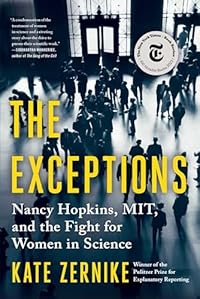
The Exceptions: Nancy Hopkins, MIT, and the Fight for Women in Science
by Kate Zernike
On This Page
Description
"In 1999, the Massachusetts Institute of Technology admitted to discriminating against its most senior female scientists. It was a seismic cultural event--one that forced institutions across the nation to reckon with the bias faced by girls and women in STEM. The Exceptions is the story of the women on MIT's faculty who started it all, centered on the life and career of their unlikely leader: Nancy Hopkins, a noted molecular geneticist and cancer researcher and protégée of James Watson, show more the codiscoverer of the structure of DNA." -- from dust jacket. show lessTags
Recommendations










































Member Reviews
The origin of this book was in 1999. A group of women scientists at MIT had gotten together to compare notes and discovered that their experiences of being undervalued and unequally treated by their male colleagues weren't just their individual problems, but a pattern that all of them had experienced. Or, in other words, they didn't just have dismissable anecdotes; they had data. They prevailed upon the university to create a committee, mostly but not exclusively consisting of women, to investigate the matter, ultimately leading to the president of the university acknowledging that the discrimination they'd been experiencing was in fact real. This led to some real changes at MIT and, when it became national news, other universities in show more the US as well.
The book, written by one of the journalists who covered that story, focuses largely on one of the most influential of those women, molecular biologist Nancy Hopkins. We learn about her as a person, about her scientific work, and about what it was like for her starting her career as a woman in science in the 1960s. But Zernike also provides a broader view of the history of women in science, at MIT specifically, and in the culture at large, complete with lots of (often very depressing) statistics. The result, among other things, is a chronicle of the history of the discrimination against women in fields that were traditionally considered men's work, from a period in which the discrimination was blatant and widely accepted -- of course you didn't want to hire women or pay them as much as men -- to a time when it had become subtle, insidious, and often largely unconscious, all of which, of course, just makes it much harder to address and change.
This is a really excellent book: informative, engrossing, well-written, and important. And yet, it's one that took me longer to read than it probably should have, as, despite its calm and even tone, it made me so infuriated that I kept feeling reluctant to pick it back up again.
What strikes me the most is how most of these women didn't want to be crusaders for feminism. They just wanted to be allowed to get on with their jobs and not make waves, until they realized where that was (or, more accurately wasn't) getting them, despite all their talents and accomplishments. More than that, though, most of them felt, at any given moment, that discrimination against women was a solved problem, a thing of the past and not something they needed to worry about... until it became unavoidably clear just how wrong they were. Something that was true even in the 1960s, when the bar for "discrimination is over" was simply that it was no longer impossible for women to get a job in the field at all, and never mind not being able to progress past the position of lab technician or that Nobel Laureate casually groping your breasts. And, sadly but unsurprisingly, while the story of MIT and these women climaxes on a triumphant and hopeful note, it becomes very, very clear in the end that it's still not remotely over yet. show less
The book, written by one of the journalists who covered that story, focuses largely on one of the most influential of those women, molecular biologist Nancy Hopkins. We learn about her as a person, about her scientific work, and about what it was like for her starting her career as a woman in science in the 1960s. But Zernike also provides a broader view of the history of women in science, at MIT specifically, and in the culture at large, complete with lots of (often very depressing) statistics. The result, among other things, is a chronicle of the history of the discrimination against women in fields that were traditionally considered men's work, from a period in which the discrimination was blatant and widely accepted -- of course you didn't want to hire women or pay them as much as men -- to a time when it had become subtle, insidious, and often largely unconscious, all of which, of course, just makes it much harder to address and change.
This is a really excellent book: informative, engrossing, well-written, and important. And yet, it's one that took me longer to read than it probably should have, as, despite its calm and even tone, it made me so infuriated that I kept feeling reluctant to pick it back up again.
What strikes me the most is how most of these women didn't want to be crusaders for feminism. They just wanted to be allowed to get on with their jobs and not make waves, until they realized where that was (or, more accurately wasn't) getting them, despite all their talents and accomplishments. More than that, though, most of them felt, at any given moment, that discrimination against women was a solved problem, a thing of the past and not something they needed to worry about... until it became unavoidably clear just how wrong they were. Something that was true even in the 1960s, when the bar for "discrimination is over" was simply that it was no longer impossible for women to get a job in the field at all, and never mind not being able to progress past the position of lab technician or that Nobel Laureate casually groping your breasts. And, sadly but unsurprisingly, while the story of MIT and these women climaxes on a triumphant and hopeful note, it becomes very, very clear in the end that it's still not remotely over yet. show less
This was truly one of the most infuriating books I’ve read, and I had to parse out my listening chunks in order not to be constantly seething with rage. The author really does an amazing job at telling Hopkins’s story along with many other women at MIT and their fight against sexism and discrimination. I’m not sure if it was the intention of the author, but what I most took away from this is the inherent distrust and lack of connection that these women seemed to have with each other (I almost lost my mind when Hopkins whiffled forever and finally decided not to go through with a lawsuit). I know that their community is what made changes happen, but it took decades for it which is mind boggling.
Although I got a Bachelor of Science in the 1970s I didn't consider pursuing a career in the sciences until the 1990s. By then, women in science were not an uncommon sight (although they weren't very common in public media; I remember in 1994 looking for a downloadable picture of a woman scientist to illustrate a talk I was giving and they were scarce) and I knew that I could find a good job.
Nancy Hopkins, who is featured in this book, was an undergraduate at Radcliffe College in 1963 when she heard James Watson give a lecture about DNA. Immediately she knew what she wanted to do with her life. She asked Dr. Watson if she could work in his lab and he agreed. He had two other Radcliffe students in his lab which was "an unusual show more concentration of women". Nancy was soon socializing with Watson but he was never physical in his interactions with her (unlike his fellow Nobel Laureate, Francis Crick, who put his hands on her breasts the first time he met her). Watson convinced Nancy to get her Ph. D. in molecular biology. This created rather a conundrum for Nancy as she had a long-time boyfriend, Brooke Hopkins, and they expected to get married when they graduated college. Nancy decided that she would do science until she turned 30 and then she would have children. It didn't seem possible to do both at the same time. So, during her 20s she continued to work in molecular biology often going to Woods Hole Biolabs in the summer with Watson and some of his graduate students. She was working in another scientist's lab as a technician and was instrumental in a breakthrough in his research. Yes, when he published his results she didn't get any credit. At the time, Nancy didn't think anything of it. However, as she progressed in her own research and started teaching at Woods Hole herself she was noticing more instances of women scientists not getting the credit they deserved. Meanwhile, she had married but found that her husband didn't take any interest in her work. Since work consumed so much of her time they grew apart. By the time she reached her self-imposed deadline of 30 her husband was having an affair and they separated. Nancy went on to teach and research at MIT, becoming well-known in the field of molecular biology. However, time and time again she found that men who were not achieving as much as she had were getting more space, more recognition and more money. Eventurally in 1994, after she got tenure, she and fifteen other tenured women scientists at MIT banded together to demand equality. MIT did address many of the issues in the science faculty and this went on to spread to other faculties and universities.
Kate Zernike had full access to Nancy Hopkins' files and also interviewed many others. She brings a journalist's eye to what makes a good story but I don't think she embroidered facts. She really didn't have to as the unvarnished truth is just as interesting as any fictional representation. After reading this I am glad that I didn't go on to work in academia which seems like one has to claw up the ladder every step instead of just letting good work speak for itself. show less
Nancy Hopkins, who is featured in this book, was an undergraduate at Radcliffe College in 1963 when she heard James Watson give a lecture about DNA. Immediately she knew what she wanted to do with her life. She asked Dr. Watson if she could work in his lab and he agreed. He had two other Radcliffe students in his lab which was "an unusual show more concentration of women". Nancy was soon socializing with Watson but he was never physical in his interactions with her (unlike his fellow Nobel Laureate, Francis Crick, who put his hands on her breasts the first time he met her). Watson convinced Nancy to get her Ph. D. in molecular biology. This created rather a conundrum for Nancy as she had a long-time boyfriend, Brooke Hopkins, and they expected to get married when they graduated college. Nancy decided that she would do science until she turned 30 and then she would have children. It didn't seem possible to do both at the same time. So, during her 20s she continued to work in molecular biology often going to Woods Hole Biolabs in the summer with Watson and some of his graduate students. She was working in another scientist's lab as a technician and was instrumental in a breakthrough in his research. Yes, when he published his results she didn't get any credit. At the time, Nancy didn't think anything of it. However, as she progressed in her own research and started teaching at Woods Hole herself she was noticing more instances of women scientists not getting the credit they deserved. Meanwhile, she had married but found that her husband didn't take any interest in her work. Since work consumed so much of her time they grew apart. By the time she reached her self-imposed deadline of 30 her husband was having an affair and they separated. Nancy went on to teach and research at MIT, becoming well-known in the field of molecular biology. However, time and time again she found that men who were not achieving as much as she had were getting more space, more recognition and more money. Eventurally in 1994, after she got tenure, she and fifteen other tenured women scientists at MIT banded together to demand equality. MIT did address many of the issues in the science faculty and this went on to spread to other faculties and universities.
Kate Zernike had full access to Nancy Hopkins' files and also interviewed many others. She brings a journalist's eye to what makes a good story but I don't think she embroidered facts. She really didn't have to as the unvarnished truth is just as interesting as any fictional representation. After reading this I am glad that I didn't go on to work in academia which seems like one has to claw up the ladder every step instead of just letting good work speak for itself. show less
This was great. I learned so much about Nancy Hopkins and the other molecular biologists. There was a lot in the book about molecular biology from about the 1950's through the early 2000's. Then there is also the story of how Nancy Hopkins finally realized how she'd been working against unrecognized discrimination in her department at MIT. She rounded up the other women in science and they made a compelling case for systemic bias, which (remarkably) the President and Dean acknowledged in public and did something about it.
Absolutely fantastic, must-read story. However, I was often tripped up by the writing and had often had to re-read some sentences many times, which is quite unusual. I was also bothered by some of the descriptions of the women (e.g. after talking about how women are/were often described more by their appearance than merits, continues to describe adult women as appearing girlish or non-girlish, etc.). Still recommend for the overall stories told and descriptions of historical and contemporary problems.
Ratings
Members
- Recently Added By
Lists

Science
28 works; 1 member

Feminism
167 works; 4 members

2024 Notable Books for Adults
26 works; 1 member
Author Information

2 Works 280 Members
Awards and Honors
Awards
Distinctions
Notable Lists
Common Knowledge
- Canonical title
- The Exceptions: Nancy Hopkins, MIT, and the Fight for Women in Science
- Original title
- The Exceptions: Nancy Hopkins, MIT, and the Fight for Women in Science
- Alternate titles
- The Exceptions: Nancy Hopkins and the Fight for Women in Science
- Original publication date
- 2023-02-28
- People/Characters
- Hopkins, Nancy
- Important places
- Massachusetts Institute of Technology, Cambridge, Massachusetts, USA
- Epigraph
- The thought could not be avoided that the best home for a feminist was in another person's lab. - James D. Watson, The Double Helix, 1968
As for women, God help them. - Barbara McClintock, letter to Nancy Hopkins, September 21, 1976 - Dedication
- For FZ and BBZ
Always in memory, especially here - First words
- (Prologue) In March 1999, a story above the fold on the front page of the Boston Sunday Globe reported that the Massachusetts Institute of Technology had acknowledged long-standing discrimination against women on its s... (show all)cience faculty.
It was hard to deny the promise. - Last words
- (Click to show. Warning: May contain spoilers.)The exceptions had been many.
(Click to show. Warning: May contain spoilers.)(Epilogue) Six decades later, what she once called the obsession of science still drives her; the next question, the serendipitous and often improbable thrill of the search. - Blurbers
- Nimura, Janice P.; Manning, Kenneth R.; Banaji, Mahzarin R.; Turkle, Sherry; Lightman, Alan; Okrent, Daniel (show all 7); Duckworth, Angela
- Original language
- English
Classifications
Statistics
- Members
- 229
- Popularity
- 141,574
- Reviews
- 5
- Rating
- (3.89)
- Languages
- English
- Media
- Paper, Audiobook, Ebook
- ISBNs
- 12
- ASINs
- 2