On This Page
Description
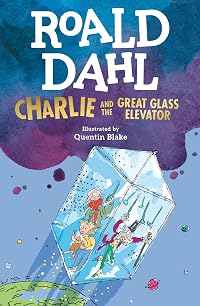
Taking up where Charlie and the Chocolate Factory leaves off, Charlie, his family, and Mr. Wonka find themselves launched into space in the great glass elevator.Tags
Recommendations





Member Reviews
Oddly, this is the Dahl book that I remember most vividly from childhood. Some of those memories are strongly negative, such as the scene in which the Knids eat a bunch of people and their screams are heard over the radio, so I don't think I necessarily liked the book, but it certainly stayed with me and I feel like I must have read it a few times, or at least dipped into it.
I don't have much positive to say for it as an adult. 2 stars is a bit of a harsh rating, but I can't possibly give it 3, because some almost decent books have been 3 stars, and this is not one of them. Dammit Goodreads, introduce half stars.
This is the sequel to Charlie and the Chocolate Factory, and I swear that Dahl made the plot up as he went along. So the show more Bucket family are in the glass lift on their way back to the factory, they accidentally go too high and end up in space, where a bunch of aliens attack. Then they go back to the factory and there is a whole roundabout sequence in which the grandparents get de-aged and then re-aged, making it all pretty pointless.
Charlie's family have no personalities. In fact, Charlie himself doesn't have a personality. Willy Wonka has a personality, Charlie and Grandpa Joe stand near him, Mr and Mrs Bucket do literally nothing at all, and the other three grandparents are annoying jerks. Clearly Dahl had nothing for these characters to do but was stuck with them because that was how the first book ended.
Some of what happens is really nasty and as usual Dahl's characters seem completely callous (not to mention Dahl's narration as well). Our 'heroes' run away from killer aliens, without warning the shuttle of humans behind them, they fly all the way around the Earth and when they get back to the shuttle, only then does Charlie suggest that they should help them. AFTER twenty people have been murdered. Meanwhile Wonka deploys his usual 'teach them a lesson' stance on Charlie's grandparents instead of helping them, which doesn't seem the right way to treat the family of someone he cares about.
There are so many songs and poems. Oh God. Make them stop.
The first half of the book (the science fiction section - the latter half being the fantasy section) is cut with these tediously not funny scenes of the President of the USA, which literally reads like a list of dad jokes.
So, so clear that Dahl just didn't have anything for the main characters to do (as well as the meandering non-plot). Also one scene is very clearly ripped off from Conan Doyle's The Horror Of The Heights (while one of the poems is suspiciously Lewis Carroll-like). I guess these may be homages, but still. There was not enough original, sensible and interesting plot to have written a sequel at all. show less
I don't have much positive to say for it as an adult. 2 stars is a bit of a harsh rating, but I can't possibly give it 3, because some almost decent books have been 3 stars, and this is not one of them. Dammit Goodreads, introduce half stars.
This is the sequel to Charlie and the Chocolate Factory, and I swear that Dahl made the plot up as he went along. So the show more Bucket family are in the glass lift on their way back to the factory, they accidentally go too high and end up in space, where a bunch of aliens attack. Then they go back to the factory and there is a whole roundabout sequence in which the grandparents get de-aged and then re-aged, making it all pretty pointless.
Charlie's family have no personalities. In fact, Charlie himself doesn't have a personality. Willy Wonka has a personality, Charlie and Grandpa Joe stand near him, Mr and Mrs Bucket do literally nothing at all, and the other three grandparents are annoying jerks. Clearly Dahl had nothing for these characters to do but was stuck with them because that was how the first book ended.
Some of what happens is really nasty and as usual Dahl's characters seem completely callous (not to mention Dahl's narration as well). Our 'heroes' run away from killer aliens, without warning the shuttle of humans behind them, they fly all the way around the Earth and when they get back to the shuttle, only then does Charlie suggest that they should help them. AFTER twenty people have been murdered. Meanwhile Wonka deploys his usual 'teach them a lesson' stance on Charlie's grandparents instead of helping them, which doesn't seem the right way to treat the family of someone he cares about.
There are so many songs and poems. Oh God. Make them stop.
The first half of the book (the science fiction section - the latter half being the fantasy section) is cut with these tediously not funny scenes of the President of the USA, which literally reads like a list of dad jokes.
So, so clear that Dahl just didn't have anything for the main characters to do (as well as the meandering non-plot). Also one scene is very clearly ripped off from Conan Doyle's The Horror Of The Heights (while one of the poems is suspiciously Lewis Carroll-like). I guess these may be homages, but still. There was not enough original, sensible and interesting plot to have written a sequel at all. show less
Sequel to 'Charlie and the Chocolate Factory', and best read after that as it would be very odd as a stand-alone. It's bizarre enough anyway - and, in my view, a bit disappointing in that it tells us very little about what happens to the Bucket family after Charlie's windfall at the end of the first book.
Instead, much of this book takes place in space, where some most unpleasant aliens are encountered. There's some humour, inevitably, and the pace is good; but once this section has passed, and the elevator returns the family to the chocolate factory, it goes downhill fast (in my view).
However my four-year-old grandson loves everything by Dahl, and although he's heard this at least twice before, asked me to read it to him after finishing show more 'Charlie and the Chocolate factory'. I'm sure quite a bit went over his head, but it didn't matter. show less
Instead, much of this book takes place in space, where some most unpleasant aliens are encountered. There's some humour, inevitably, and the pace is good; but once this section has passed, and the elevator returns the family to the chocolate factory, it goes downhill fast (in my view).
However my four-year-old grandson loves everything by Dahl, and although he's heard this at least twice before, asked me to read it to him after finishing show more 'Charlie and the Chocolate factory'. I'm sure quite a bit went over his head, but it didn't matter. show less
This review is written with a GPL 4.0 license and the rights contained therein shall supersede all TOS by any and all websites in regards to copying and sharing without proper authorization and permissions. Crossposted at WordPress, Blogspot, & Librarything by Bookstooge’s Exalted Permission
Title: Charlie and the Great Glass Elevator
Series: Charlie Bucket #2
Authors: Roald Dahl
Rating: 4 of 5 Stars
Genre: Childrens Fiction
Pages: 117
Words: 32K
Synopsis:
From Wikipedia.org
The story picks up where the previous book left off, with Charlie and family aboard the flying Great Glass Elevator after Willy Wonka has rewarded him with the ownership of his chocolate factory. The Elevator accidentally goes into orbit, and Mr. Wonka docks them at the show more Space Hotel USA. Their interception of the hotel is mistaken by approaching astronauts and hotel staff in a Commuter Capsule and listeners on Earth (including the President of the United States) as an act of space piracy and they are variously accused of being enemy agents, spies and aliens. Shortly after their arrival, they discover that the hotel has been overrun by dangerous, shape-changing alien monsters known as The Vermicious Knids. The Knids cannot resist showing off and reveal themselves by using the five hotel elevators (with one Knid in each of them) and spell out the word "SCRAM", giving the group time to evacuate. As the group leaves, a Knid follows the Great Glass Elevator and tries to break it open, but to no avail, which results in the Knid receiving a bruise on its backside and hungering for payback.
Meanwhile, with the Great Glass Elevator's passengers gone, the President allows the Commuter Capsule to dock with the Space Hotel. Upon entry by the astronauts and the Space Hotel staff, the Knids attack by eating fourteen of the staff, prompting an immediate evacuation by the rest of the group. The Great Glass Elevator comes back just in time to see the entire Knid infestation coming in on the attack, bashing the Commuter Capsule to the point where the retrorockets cannot be fired to initiate immediate reentry and the communication antenna cannot keep the astronauts in communication with the President. Charlie suggests towing the Commuter Capsule back to Earth, and, despite a last attempt by the Knids to tow the two craft away to their home planet Vermes, in the process the Knids are incinerated in Earth's atmosphere. Mr. Wonka releases the Commuter Capsule, while the Elevator crashes down through the roof of the chocolate factory.
Back in the chocolate factory, three of Charlie's grandparents refuse to leave their bed. Mr. Wonka gives them a rejuvenation formula called "Wonka-Vite". They take much more than they need (4 pills instead of 1 or 2), subtracting 80 years (which reduces their age by 20 years per pill). Two become babies, but 78-year-old Grandma Georgina vanishes, having become "−2". Charlie and Mr. Wonka journey to "Minusland", where they track down Grandma Georgina's spirit. As she has no physical presence, Mr. Wonka sprays her with the opposite of "Wonka-Vite" - "Vita-Wonk" - in order to age her again. Mr. Wonka admits that it is not an accurate way to age a person, but the spray is the only way to dose "minuses". Upon leaving Minusland, they discover that Grandma Georgina is now 358 years old. Using cautious doses of Wonka-Vite and Vita-Wonk, the three grandparents are restored to their original ages.
Finally, the President of the United States invites the family and Mr. Wonka to the White House to thank them for their space rescue. The family and Wonka accept the invitation (including the grandparents who finally agree to get out of their beds) and prepare to leave.
My Thoughts:
When I read the Charlie Bucket books back in elementary, middle and high school, I always enjoyed The Great Glass Elevator more than Chocolate Factory. Back then I think it was because of the SF elements (space, spaceships, aliens, negative land, etc) in Elevator that simply weren't in Factory. So when I read the duology this year (Chocolate Factory was read in January) I was expecting to like Elevator more once again. Imagine my surprise when I got done this book and realized that Chocolate Factory is not only the better book but also more enjoyable.
Part of that is that the premise to this book is beyond even ridiculous. It's hilarious and I still love it, but it just hit me that it WAS ridiculous this time around and so my enjoyment was lessened. I wasn't able to enter into the silliness like Dahl intended. The other thing that lessened my enjoyment was that the other 3 grandparents played a part in the story this time and they were stinkers. Made me shake my head and wonder how Charlie turned out so well.
Other than that, I enjoyed the ever living daylights out of this. Willy Wonka is a genius who is always in control no matter the circumstances and Charlie is a smart boy who THINKS before he reacts. More kids need examples like that in their entertainment.
★★★★☆ show less
Title: Charlie and the Great Glass Elevator
Series: Charlie Bucket #2
Authors: Roald Dahl
Rating: 4 of 5 Stars
Genre: Childrens Fiction
Pages: 117
Words: 32K
Synopsis:
From Wikipedia.org
The story picks up where the previous book left off, with Charlie and family aboard the flying Great Glass Elevator after Willy Wonka has rewarded him with the ownership of his chocolate factory. The Elevator accidentally goes into orbit, and Mr. Wonka docks them at the show more Space Hotel USA. Their interception of the hotel is mistaken by approaching astronauts and hotel staff in a Commuter Capsule and listeners on Earth (including the President of the United States) as an act of space piracy and they are variously accused of being enemy agents, spies and aliens. Shortly after their arrival, they discover that the hotel has been overrun by dangerous, shape-changing alien monsters known as The Vermicious Knids. The Knids cannot resist showing off and reveal themselves by using the five hotel elevators (with one Knid in each of them) and spell out the word "SCRAM", giving the group time to evacuate. As the group leaves, a Knid follows the Great Glass Elevator and tries to break it open, but to no avail, which results in the Knid receiving a bruise on its backside and hungering for payback.
Meanwhile, with the Great Glass Elevator's passengers gone, the President allows the Commuter Capsule to dock with the Space Hotel. Upon entry by the astronauts and the Space Hotel staff, the Knids attack by eating fourteen of the staff, prompting an immediate evacuation by the rest of the group. The Great Glass Elevator comes back just in time to see the entire Knid infestation coming in on the attack, bashing the Commuter Capsule to the point where the retrorockets cannot be fired to initiate immediate reentry and the communication antenna cannot keep the astronauts in communication with the President. Charlie suggests towing the Commuter Capsule back to Earth, and, despite a last attempt by the Knids to tow the two craft away to their home planet Vermes, in the process the Knids are incinerated in Earth's atmosphere. Mr. Wonka releases the Commuter Capsule, while the Elevator crashes down through the roof of the chocolate factory.
Back in the chocolate factory, three of Charlie's grandparents refuse to leave their bed. Mr. Wonka gives them a rejuvenation formula called "Wonka-Vite". They take much more than they need (4 pills instead of 1 or 2), subtracting 80 years (which reduces their age by 20 years per pill). Two become babies, but 78-year-old Grandma Georgina vanishes, having become "−2". Charlie and Mr. Wonka journey to "Minusland", where they track down Grandma Georgina's spirit. As she has no physical presence, Mr. Wonka sprays her with the opposite of "Wonka-Vite" - "Vita-Wonk" - in order to age her again. Mr. Wonka admits that it is not an accurate way to age a person, but the spray is the only way to dose "minuses". Upon leaving Minusland, they discover that Grandma Georgina is now 358 years old. Using cautious doses of Wonka-Vite and Vita-Wonk, the three grandparents are restored to their original ages.
Finally, the President of the United States invites the family and Mr. Wonka to the White House to thank them for their space rescue. The family and Wonka accept the invitation (including the grandparents who finally agree to get out of their beds) and prepare to leave.
My Thoughts:
When I read the Charlie Bucket books back in elementary, middle and high school, I always enjoyed The Great Glass Elevator more than Chocolate Factory. Back then I think it was because of the SF elements (space, spaceships, aliens, negative land, etc) in Elevator that simply weren't in Factory. So when I read the duology this year (Chocolate Factory was read in January) I was expecting to like Elevator more once again. Imagine my surprise when I got done this book and realized that Chocolate Factory is not only the better book but also more enjoyable.
Part of that is that the premise to this book is beyond even ridiculous. It's hilarious and I still love it, but it just hit me that it WAS ridiculous this time around and so my enjoyment was lessened. I wasn't able to enter into the silliness like Dahl intended. The other thing that lessened my enjoyment was that the other 3 grandparents played a part in the story this time and they were stinkers. Made me shake my head and wonder how Charlie turned out so well.
Other than that, I enjoyed the ever living daylights out of this. Willy Wonka is a genius who is always in control no matter the circumstances and Charlie is a smart boy who THINKS before he reacts. More kids need examples like that in their entertainment.
★★★★☆ show less
Look. It’s a great deal of fun and Willy Wonka is hilarious, but a big whack of nothing happens in this book. They go up into space, do one thing, then come back down and proceed to first sincerely screw up and then, with complicated science fiction frippery, undo the screw up, the end.
They return to essentially where they start and I’m not entirely sure anyone learns a damn thing from any of it?
My kid loved it though, so here we are.
They return to essentially where they start and I’m not entirely sure anyone learns a damn thing from any of it?
My kid loved it though, so here we are.
Fantastic story. The audio version has a special appeal due to the drama in the reader's voice and tone. This is a great book when you need a laugh at ridiculousness that sometimes is pretty close to real life (at least in August 2017).
In the sequel to Roald Dahl's fantasy classic, we are thrown right back into the action from where we were left off in the first book. Written in the same humorous and lighthearted style as its predecessor, The Great Glass Elevator suffers from too many characters with nothing to do and a plot so fast-paced and chaotic, it's difficult to keep up.
The first book is a magical fantasy tale with a strong moral point to reach out to children. This one, in contrast, is a larger-than-life science fiction adventure so similar to Doctor Who that it could have been a lost story by Douglas Adams. The only pity is it loses most of the mystery and magic surrounding Willy Wonka and his chocolate factory and puts too much focus on Charlie's boring show more parents and grandparents and a goofy American government.
After the space adventure, we are given another misadventure inside the factory, this time involving de-aging and aging grandparents. It's a gag that goes on for a bit too long before it segways into the outro and the planned intro for the unfinished third novel. The book ends abruptly on a cliffhanger that is sadly never resolved.
I don't find The Great Glass Elevator nearly as magical, iconic or educative as the first novel. There's too much going on, while most of the troubles the characters face have little relevance to anything else. New readers will do just fine reading the first one and ignoring this novel. show less
The first book is a magical fantasy tale with a strong moral point to reach out to children. This one, in contrast, is a larger-than-life science fiction adventure so similar to Doctor Who that it could have been a lost story by Douglas Adams. The only pity is it loses most of the mystery and magic surrounding Willy Wonka and his chocolate factory and puts too much focus on Charlie's boring show more parents and grandparents and a goofy American government.
After the space adventure, we are given another misadventure inside the factory, this time involving de-aging and aging grandparents. It's a gag that goes on for a bit too long before it segways into the outro and the planned intro for the unfinished third novel. The book ends abruptly on a cliffhanger that is sadly never resolved.
I don't find The Great Glass Elevator nearly as magical, iconic or educative as the first novel. There's too much going on, while most of the troubles the characters face have little relevance to anything else. New readers will do just fine reading the first one and ignoring this novel. show less
Although not as good as Charlie and the Chocolate Factory, the Great Glass Elevator still is entertaining and has much the same sensibility. It begins exactly where the Chocolate Factory ended, with Willy Wonka and the entire Bucket family in the great glass elevator--and three of the grandparents still in bed where they stay for most of this book as well. It begins with a science fiction adventure as the glass elevator goes into orbit, encounters deadly space creatures, and saves a bunch of astronauts. The second half centers around Wonka-vita and Vita-Wonk, drugs that can make you multiples of twenty years younger and twenty years older. In Chocolate Factory fashion the grandparents take various combinations of these, ignoring all show more directions and common decency, end up temporarily punished by bearing the consequences of their actions, but eventually all recover. As in the first book, Charlie is the decent enthusiastic one. It ends with them all heading off to meet the President of the United States.
What makes this book less special than Chocolate Factory is that it does not have the same timeless, mythical style but feels a little more dated in a time and place (especially with the many scenes with the U.S. President). And Charlie is a more static character, beginning and ending the book with much the same understanding and wonder but not really learning or discovering much along the way. And Grandpa Joe is more absent. So it is less a sequel in which everything develops further and more a spinoff that takes a bunch of familiar characters on a new adventure. But it is certainly a great adventure. show less
What makes this book less special than Chocolate Factory is that it does not have the same timeless, mythical style but feels a little more dated in a time and place (especially with the many scenes with the U.S. President). And Charlie is a more static character, beginning and ending the book with much the same understanding and wonder but not really learning or discovering much along the way. And Grandpa Joe is more absent. So it is less a sequel in which everything develops further and more a spinoff that takes a bunch of familiar characters on a new adventure. But it is certainly a great adventure. show less
Members
- Recently Added By
Lists

Favourite Roald Dahl
22 works; 18 members

Read the book and saw the movie
1,170 works; 195 members

CCE 1000 Good Books List
1,033 works; 12 members

Puffin Books 70th anniversary handbook recommendations
537 works; 10 members

Magic Realism
371 works; 52 members

Swinging Seventies
255 works; 18 members

Books Read in 2020
4,379 works; 124 members

Books Read in 2022
5,166 works; 114 members

um actually
76 works; 3 members

Books Read in 2016
4,666 works; 199 members

AR Level 4 in cloudLibrary
244 works; 1 member

Books We Loved As Children
603 works; 252 members

One Day
27 works; 2 members
Author Information

690+ Works 271,551 Members
Roald (pronounced "Roo-aal") was born in Llandaff, South Wales. He had a relatively uneventful childhood and was educated at Repton School. During World War II he served as a fighter pilot and for a time was stationed in Washington, D.C.. Prompted by an interviewer, he turned an account of one of his war experiences into a short story that was show more accepted by the Saturday Evening Post, which were eventually collected in Over to You (1946). Dahl's stories are often described as horror tales or fantasies, but neither description does them justice. He has the ability to treat the horrible and ghastly with a light touch, sometimes even with a humorous one. His tales never become merely shocking or gruesome. His purpose is not to shock but to entertain, and much of the entertainment comes from the unusual twists in his plots, rather than from grizzly details. Dahl has also become famous as a writer of children's stories. In some circles, these works have cased great controversy. Critics have charged that Dahl's work is anti-Semitic and degrades women. Nevertheless, his work continues to be read: Charlie and Chocolate Factory (1964) was made into a successful movie, The BFG was made into a movie in July 2017, and his books of rhymes for children continue to be very popular. (Bowker Author Biography) show less
Some Editions
Awards and Honors
Awards
Notable Lists
Series

Work Relationships
Is contained in
Roald Dahl 5-Book HC Box Set - Charlie/Chocolate Factory, Charlie/Great Glass Elevator, Danny Champion of the World, James/Giant Peach, Fantastic Mr. Fox by Roald Dahl
Roald Dahl Magical Gift Set (4 Books): Charlie and the Chocolate Factory, James and the Giant Peach, Fantastic Mr. Fox, Charlie and the Great Glass Elevator by Roald Dahl
Roald Dahl's Charlie and the Chocolate Factory PLUS Three More All-Time Favorites (Boxed Set) by Roald Dahl
The Best of Roald Dahl: James and the Giant Peach; Charlie and the Chocolate Factory; Charlie and the Great Glass Elevator; The BFG; The Witches; Matilda by Roald Dahl
The Puffin Roald Dahl Collection Volume 2: "James and the Giant Peach", "Charlie and the Chocolate Factory", "Charlie and the Great Glass Elevator" and "Danny the Champion of the World" by Roald Dahl
The Roald Dahl Collection, Box Set Including "George's Marvelous Medicine", "James and the Giant Peach", "The Twits", "The BFG", "Matilda", " Charlie and the Great Glass Elevator", "Charlie and the Chocolate Factory", and "The Fantastic Mr. Fox" by Roald Dahl
Common Knowledge
- Canonical title
- Charlie and the Great Glass Elevator
- Original title
- Charlie and the Great Glass Elevator
- Alternate titles*
- Il grande ascensore di cristallo
- Original publication date
- 1972
- People/Characters
- Charlie Bucket; Willy Wonka; Grandpa Joe; Grandpa George; Grandma Georgina; Grandma Josephine (show all 10); Mr Bucket; Mrs Bucket; Lancelot R. Gilligrass; Elvira Tibbs
- Important places
- Wonka Chocolate Factory
- Dedication
- For my daughters
Tessa Ophelia Lucy
and for my godson
Edmund Pollinger - First words
- The last time we saw Charlie, he was riding high above his home town in the Great Glass Elevator.
The last time we saw Charlie, he was riding high above his home town in the Great Glass Lift. (UK Puffin edition, 1986) - Last words
- (Click to show. Warning: May contain spoilers.)"It's not over yet," Charlie said, laughing. "It hasn't even begun."
- Publisher's editor
- Frances Foster
- Original language
- English
*Some information comes from Common Knowledge in other languages. Click "Edit" for more information.
Classifications
- Genres
- Children's Books, Fiction and Literature, Kids
- DDC/MDS
- 823.914 — Literature & rhetoric English & Old English literatures English fiction 1900- 1901-1999 1945-1999
- LCC
- PZ7 .C — Language and Literature Fiction and juvenile belles lettres Fiction and juvenile belles lettres Juvenile belles lettres
- BISAC
Statistics
- Members
- 12,838
- Popularity
- 627
- Reviews
- 94
- Rating
- (3.54)
- Languages
- 27 — Afrikaans, Arabic, Catalan, Chinese, Czech, Danish, Dutch, English, Estonian, Finnish, French, German, Galician, Greek, Hungarian, Indonesian, Italian, Korean, Norwegian (Bokmål), Norwegian, Polish, Portuguese, Slovak, Spanish, Swedish, Thai, Turkish
- Media
- Paper, Audiobook, Ebook
- ISBNs
- 191
- ASINs
- 60