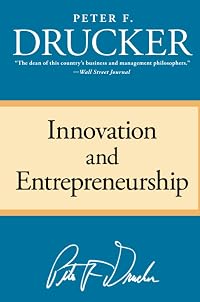
Innovation and Entrepreneurship
by Peter F. Drucker
On This Page
Description
This book presents innovation and entrepreneurship as a purposeful and systematic discipline that explains and analyzes the challenges and opportunities of America's new entrepreneurial economy. The author explains what established businesses, public service institutions, and new ventures need to know and do to succeed in today's economy.Tags
Recommendations











Member Reviews
Innovation and Entrepreneurship is one of the foundation stones of the world as we see it today. By no means novel, the book is slightly older than I am, it still has some sage wisdom even if the specific case studies have slipped from relevance. Drucker's object were threefold: he provides a more rigorous definition of entrepreneurship that reclaims the field from its obsession with the high-tech genius inventor. He uses entrepreneurship to explain the success of the American and Japanese economy after World War 2, particularly how millions of jobs were created for men and women even as traditional smoke stack industries cratered. Finally, he offers some advice for entrepreneurial organizations.
In order, for Drucker entrepreneurship is show more the profitable harnessing of change to move capital from an area of low productivity to one of higher productivity. New scientific knowledge is just one of seven possible sources of innovation, and is in actually the most expensive and uncertain. The most important skill of the entrepreneur is a keen eye for incongruities and unmet market needs. One of the more moving case studies is a New York department store which "knew" that appliance sales should only be 20% of its business. It spent the consumer boom of the 60s trying to knock down its appliance numbers, and eventually lost position to a competitor who found a market in the gadget hungry Betty Drapers of the era. Novelty is also tied to entrepreneurship. While opening any business is a venture, opening yet another franchise restaurant is not really entrepreneurial.
The best section is on what kills entrepreneurial ventures. Drucker sees an entrepreneurial venture as being like a child. In existing businesses, expecting the new to carry the weight of a mature unit is like asking a six year old to march with a 60 pound pack; neither will get very far. A focus on the profitability of the present business can hinder entrepreneurship. He sees Johnson & Johnson and 3M as companies with the best practices, where a specialized division handles new businesses, which are given a few years to succeed or fail on their own merits before being upgraded to stable parts of the business. Established companies should conduct a regular audit with the aim of killing products which are not succeeding (RIP Google reader) because the time and attention of your employees is the most valuable resource you have.
The other side of innovation is the start-up, though I don't recall Drucker using that specific term. A small and new business can capitalize on doing one thing supremely well to capture a major market, but rapid growth is fraught with pain. Startups invariable run into cashflow and founder problems, and often at the most critical point when they need to rapidly ramp up capacity to succeed. Getting a solid managerial team in place before the crisis is the way to survive it, but good teams are expensive.
Drucker is full of solid 'horse sense' about running a business, and the fundamental are the fundamentals, but his focus on economics renders him somewhat blind to other aspects of entrepreneurship. Entrepreneurship can also be read as cognitive, as a series of decisions which bring about a new state of the world. And change is hard because it runs up against allocations not only of money, but also power and prestige. Drucker's unstated bias, that concerns about power and prestige should melt away in the face of the capital enhancing power of new ways of doing things, ignores the realities of human psychology.
Innovation and Entrepreneurship is an older book, but well worth checking out. And on a personal note of bitterness, I spent six years earning a PhD in a school which branded itself as "studying innovation" and Drucker never came up once. I'm fully for raiding and pillaging those over-endowed jerks at the B-school, and we should take their ideas along with their nice colloquium room furniture! show less
In order, for Drucker entrepreneurship is show more the profitable harnessing of change to move capital from an area of low productivity to one of higher productivity. New scientific knowledge is just one of seven possible sources of innovation, and is in actually the most expensive and uncertain. The most important skill of the entrepreneur is a keen eye for incongruities and unmet market needs. One of the more moving case studies is a New York department store which "knew" that appliance sales should only be 20% of its business. It spent the consumer boom of the 60s trying to knock down its appliance numbers, and eventually lost position to a competitor who found a market in the gadget hungry Betty Drapers of the era. Novelty is also tied to entrepreneurship. While opening any business is a venture, opening yet another franchise restaurant is not really entrepreneurial.
The best section is on what kills entrepreneurial ventures. Drucker sees an entrepreneurial venture as being like a child. In existing businesses, expecting the new to carry the weight of a mature unit is like asking a six year old to march with a 60 pound pack; neither will get very far. A focus on the profitability of the present business can hinder entrepreneurship. He sees Johnson & Johnson and 3M as companies with the best practices, where a specialized division handles new businesses, which are given a few years to succeed or fail on their own merits before being upgraded to stable parts of the business. Established companies should conduct a regular audit with the aim of killing products which are not succeeding (RIP Google reader) because the time and attention of your employees is the most valuable resource you have.
The other side of innovation is the start-up, though I don't recall Drucker using that specific term. A small and new business can capitalize on doing one thing supremely well to capture a major market, but rapid growth is fraught with pain. Startups invariable run into cashflow and founder problems, and often at the most critical point when they need to rapidly ramp up capacity to succeed. Getting a solid managerial team in place before the crisis is the way to survive it, but good teams are expensive.
Drucker is full of solid 'horse sense' about running a business, and the fundamental are the fundamentals, but his focus on economics renders him somewhat blind to other aspects of entrepreneurship. Entrepreneurship can also be read as cognitive, as a series of decisions which bring about a new state of the world. And change is hard because it runs up against allocations not only of money, but also power and prestige. Drucker's unstated bias, that concerns about power and prestige should melt away in the face of the capital enhancing power of new ways of doing things, ignores the realities of human psychology.
Innovation and Entrepreneurship is an older book, but well worth checking out. And on a personal note of bitterness, I spent six years earning a PhD in a school which branded itself as "studying innovation" and Drucker never came up once. I'm fully for raiding and pillaging those over-endowed jerks at the B-school, and we should take their ideas along with their nice colloquium room furniture! show less
An entrepreneur classic. Tremendous insight from an innovative opportunity & entrepreneurial management standpoint. As always, I highly recommend all of Peter Drucker's books.
Compare Drucker's strategic and pragmatic practices, published in 1985, with the program outlined by Barack Obama when he was running for President after the economic collapse of 2008. Pragmatism for the entrepreneurs.
Interesting book on innovative process; recommended
El primer libro en la historia de los libros del management que se ocupa con profundidad y riqueza del por qué, cómo y para qué de la Innovación. Peter F. Drucker (fallecido el 11 de noviembre de 2005) no escatima argumentos, ilustración y expresividad para enseñarnos que el camino de la innovación es el único para la empresa líder. Y que es la fuente de riqueza de la sociedad, entendida ésta como el mejor aprovechamiento de los recursos (escasos), y la mayor satisfacción del ser humano. Hoy ya son muchos los que han publicado sobre innovación y desarrollo de producto, y mucho se ha investigado y reflexionado sobre el tema; Drucker lo hizo cuando ésta era la fruta de más difícil alcance para la organización, y más a la show more mano estaban las reingenierías, los downsizing, etc. Esa siempre fue la virtud de él: ser el primero en poner y exponer (se), los grandes temas show less
May 15, 2007Spanish
Ratings
Members
- Recently Added By
Lists

Alan Kay's Reading List
103 works; 3 members

My List
302 works; 1 member
Author Information

257+ Works 12,415 Members
Peter F. Drucker has been Clarke Professor of Social Science and Management at Claremont Graduate School in California since 1971.
Common Knowledge
- First words
- Since the mid-seventies, such slogans as "the no-growth economy," the deindustrialization of America," and a long-term "Kondratieff stagnation of the economy" have become popular and are invoked as if axioms. Yet the facts an... (show all)d figures belie every one of these slogans. What is happening in the United States is something quite different: a profound shift from a "managerial" to an "entrepreneurial" economy.
- Quotations
- For two hundred years, since the time of J.B. Say in France and of David Recardo in England in the early years of the nineteenth century, economists have known that the only way to get a higher profit margin, except through a... (show all) monopoly, is through lower costs. [228]
Innovation and entrepreneurship are thus needed in society as much as in the economy, in public service institutions as much as in businesses. It is precisely because innovation and entrepreneurship are not "root and branch" ... (show all)but "one step at a time," a product here, a policy there, a public service yonder; because they are not planned but focused on this opportunity and that need; because they are tentative and will disappear if they do not produce the expected and needed results; because, in other words, they are pragmatic rather than dogmatic and modest rather than grandiose --that they promise to keep any society, economy, industry, public service, or business flexible and self-renewing. [254]
The world's computer industry did not break even until the late seventies, that is, after thirty loss years. [256] - Last words
- (Click to show. Warning: May contain spoilers.)The emergence of the entrepreneurial society may be a major turning point in history.
A hundred years ago, the worldwide panic of 1873 terminated the Century of Laissez-Faire that had begun with the publication of Adam Smith's The Wealth of Nations in 1776. In the Panic of 1873 the modern welfare state was born. A hundred years later it had run its course, almost everyone now knows. It may survive despite the demographic challenges of an aging population and a shrinking birthrate. But it will survive only if the entrepreneurial economy succeeds in greatly raising productivities. We may even still make a few minor additioins to the welfare edifice, put on a room here or a new benefit there. But the welfare state is past rather than future--as even the old liberals now know.
Will its successor be the Entrepreneurial Society? [267]
Classifications
Statistics
- Members
- 885
- Popularity
- 30,445
- Reviews
- 5
- Rating
- (3.90)
- Languages
- 6 — Dutch, English, German, Korean, Portuguese, Spanish
- Media
- Paper, Audiobook, Ebook
- ISBNs
- 40
- ASINs
- 6