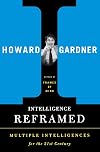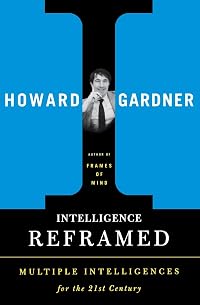
Intelligence Reframed: Multiple Intelligences for the 21st Century
by Howard Gardner
On This Page
Description
A brilliant state-of-the-art report on how the landmark theory of multiple intelligences is radically changing our understanding of education and human development.Tags
Recommendations
Member Reviews
This book was not an easy read, in fact, early on I was wondering whether to finish it. I'm glad that I persisted and finished it because, although the author tries hard not to force his opinions on us, it does turn out that he has an opinion. He just wants us to keep going beyond his ideas and find our own applications. He is also very clear that intelligence and morality should not be confounded. Intelligence can be used for moral or immoral purposes. The intelligence is indifferent to how it is applied. That alone makes the book worth reading. There are a few things from the book that are worth mentioning.
"But wisdom is not a predictable feature of aging; many old people do not show particular range in reaching their judgements, and show more certainly some young people are wise beyond their years. The historian George Kennan and the philosopher Isaiah Berlin did not suddenly become wise when they entered their eighth or ninth decade, and fortunately for them and us, their skill at synthesizing did not decline noticeably with age." (Page 133)
"A crucial point about wisdom is its modesty, its humility. Neither intelligence nor creativity nor leadership reserveds a place for silence, for quite, for resignation. ... The wise person knows when to say nothing, and when to step down and make room for someone else. The wise adult knows about the fraility of humanity and the difficulty of bringing about enduring changes." (Page 134)
"When someone hears or observes the responses of others, particularly those at a higher stage, their own thinking may become more complex and rich." (Page 189) This reminded me of Flow which emphasizes the importance of increasing levels of complexity for happiness.
And why is the author so modest about forcing his views on us: "Unfortunately, we don't know a lot about the personal intelligences." (Page 201) Ultimately, we all have a lot to learn, and this book emphasizes that the quick application of Multiple Intelligence theory is liable to be a misapplication. Gardner advocates avoiding simplistic application of what we only vaguely understand, and striving for a deeper understanding. show less
"But wisdom is not a predictable feature of aging; many old people do not show particular range in reaching their judgements, and show more certainly some young people are wise beyond their years. The historian George Kennan and the philosopher Isaiah Berlin did not suddenly become wise when they entered their eighth or ninth decade, and fortunately for them and us, their skill at synthesizing did not decline noticeably with age." (Page 133)
"A crucial point about wisdom is its modesty, its humility. Neither intelligence nor creativity nor leadership reserveds a place for silence, for quite, for resignation. ... The wise person knows when to say nothing, and when to step down and make room for someone else. The wise adult knows about the fraility of humanity and the difficulty of bringing about enduring changes." (Page 134)
"When someone hears or observes the responses of others, particularly those at a higher stage, their own thinking may become more complex and rich." (Page 189) This reminded me of Flow which emphasizes the importance of increasing levels of complexity for happiness.
And why is the author so modest about forcing his views on us: "Unfortunately, we don't know a lot about the personal intelligences." (Page 201) Ultimately, we all have a lot to learn, and this book emphasizes that the quick application of Multiple Intelligence theory is liable to be a misapplication. Gardner advocates avoiding simplistic application of what we only vaguely understand, and striving for a deeper understanding. show less
This is --- unfortunately --- not really a book about Gardner's theory of multiple intelligences (TIM), it's actually about Gardner's love of his own theorizing. I chose the book from our library (thank God I didn't buy it) because I wanted to learn more about his TIM. I have to say, I don't think the theory is that bad: it actually makes a lot of sense to think about intelligence in ways other than traditional psychometric approaches. However, only the 2nd and 3rd chapters are actually something like an introduction to TIM, afterwards it gets very repetitious, speculative and narcisstic (talk about intrapersonal intelligence, huh?). There's a lot of talk about empirical underpinnings, but just talk --- there aren't any references; show more instead, we get to here what the great Gardner muses about this and that, including spirituality, wisdom and leadership (I'm not kidding). Maybe this is what happens when a once-scientist is overtaken by a huge commercial success.
Taken together, I seriously discourage reading this book; maybe the first book ("Frames of mind") is better, and, if you want to stick to popular science, you should probably choose something written by a professional writer instead of by Gardner himself. show less
Taken together, I seriously discourage reading this book; maybe the first book ("Frames of mind") is better, and, if you want to stick to popular science, you should probably choose something written by a professional writer instead of by Gardner himself. show less
Ratings
Members
- Recently Added By
Author Information

53+ Works 7,448 Members
Howard Gardner is Hobbs Professor of Cognition and Education and Adjunct Professor of Psychology at Harvard University; Adjunct Professor of Neurology at the Boston University School of Medicine; and Codirector of Harvard Project Zero. He lives in Cambridge, Massachusetts. (Bowker Author Biography)
Common Knowledge
- Dedication
- FOR PATRICIA ALBJERG GRAHAM, INCOMPARABLE MENTOR, CHERISHED COLLEAGUE, VALUED FRIEND
Classifications
Statistics
- Members
- 382
- Popularity
- 82,117
- Reviews
- 2
- Rating
- (3.70)
- Languages
- 7 — Chinese, Dutch, English, German, Portuguese, Spanish, Swedish
- Media
- Paper, Ebook
- ISBNs
- 11
- ASINs
- 3