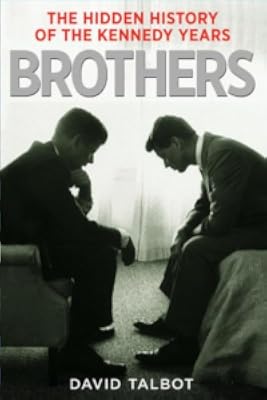
Brothers: The Hidden History of the Kennedy Years
by David Talbot
On This Page
Description
Journalist Talbot sheds a dramatic new light on the tumultuous inner life of the Kennedy presidency and its stunning aftermath. The book begins on the shattering afternoon of November 22, 1963, as a grief-stricken Robert Kennedy urgently demands answers about the assassination of his brother, then shifts back in time, revealing the shadowy conflicts that tore apart the Kennedy administration, pitting the young president and his even younger brother against their own national security show more apparatus. The Kennedy brothers and their small circle of trusted advisors repeatedly thwarted Washington's warriors, the hard-line generals and spymasters hell-bent on a showdown with the Communists--the Kennedys pushing instead for a peaceful resolution to the Cold War. The tensions within the Kennedy administration were heading for an explosive climax, when a burst of gunfire in Dallas terminated John F. Kennedy's presidency.--From publisher description. show lessTags
Recommendations













Member Reviews
It is unsettling to think that a lone crackpot, armed with a mail-order rifle, can kill the most powerful man in the world, the President of the United States, in the middle of an American city. It is even more troubling to think that the assassination of the President may have been the product of a conspiracy involving powerful elements within the U,S. government, yet this is the thesis explored in David Talbot's engrossing account of the conflict between the Kennedy brothers, John and Robert, and the militaristic and fanatic leadership of the Pentagon and the intelligence establishment.
Talbot also argues that President Kennedy and Attorney General Kennedy made powerful enemies in organzied crime, both within the Mafia and the corrupt show more Teamsters regime under Jimmy Hoffa, and in the rabidly anti-Castro Cuban exile community in Florida. He notes that Bobby Kennedy made himself the most-hated nemesis of the Mob in the 1950s with his zealous pursuit of racketeers within union leadership while serving as chief investigator for the Kefauver committee in the U.S. Senate. Joseph Kennedy, the family patriarch, had enjoyed a cordial relationship with bootleggers decades earlier during Prohibition, so part of the rage felt by mob bosses toward Robert Kennedy was a sense of betrayal.
Talbot examines the Bay of Pigs episode and the Cuban Missile Crisis, in which President Kennedy and his most trusted advisor, his brother the Attorney General, resisted the demands of the hawks clamoring for war against the Communist world. By refusing to order an invasion of Cuba or any other overt acts of war, aside from the naval "quarantine" of Cuba, the President and RFK earned the bitter enmity of Curtis LeMay, chief of the Stategic Air Command, and other devoted Cold Warriors who wanted a war of annihilation against the Soviet Union.
JFK and Attorney General Kennedy also offended right-wing and racist elements in the FBI and elsewhere in the Justice Department by their expressed sympathy for civil rights activists in the South and by their ordering of federal intervention to protect James Meredith against a howling mob when he enrolled at Ole MIss in 1962. J. Edgar Hoover clearly regarded his superior, Bobby Kennedy, as an uppity liberal do-gooder soft on Communism.
While Talbot does not argue that there definitely were conspiracies at work in the murders of John and Robert Kennedy, he questions why the CIA and other agencies continue to conceal evidence in their classified files and why the establishment press has passively accepted the Warren Commission report as the final word on JFK"s death. He notes that Robert Kennedy intended to re-open the investigation of his brother's murder, after winning the Presidency in 1968, but that his own murder insured that the events of November 22, 1963 in Dallas would remain shrouded in darkness. show less
Talbot also argues that President Kennedy and Attorney General Kennedy made powerful enemies in organzied crime, both within the Mafia and the corrupt show more Teamsters regime under Jimmy Hoffa, and in the rabidly anti-Castro Cuban exile community in Florida. He notes that Bobby Kennedy made himself the most-hated nemesis of the Mob in the 1950s with his zealous pursuit of racketeers within union leadership while serving as chief investigator for the Kefauver committee in the U.S. Senate. Joseph Kennedy, the family patriarch, had enjoyed a cordial relationship with bootleggers decades earlier during Prohibition, so part of the rage felt by mob bosses toward Robert Kennedy was a sense of betrayal.
Talbot examines the Bay of Pigs episode and the Cuban Missile Crisis, in which President Kennedy and his most trusted advisor, his brother the Attorney General, resisted the demands of the hawks clamoring for war against the Communist world. By refusing to order an invasion of Cuba or any other overt acts of war, aside from the naval "quarantine" of Cuba, the President and RFK earned the bitter enmity of Curtis LeMay, chief of the Stategic Air Command, and other devoted Cold Warriors who wanted a war of annihilation against the Soviet Union.
JFK and Attorney General Kennedy also offended right-wing and racist elements in the FBI and elsewhere in the Justice Department by their expressed sympathy for civil rights activists in the South and by their ordering of federal intervention to protect James Meredith against a howling mob when he enrolled at Ole MIss in 1962. J. Edgar Hoover clearly regarded his superior, Bobby Kennedy, as an uppity liberal do-gooder soft on Communism.
While Talbot does not argue that there definitely were conspiracies at work in the murders of John and Robert Kennedy, he questions why the CIA and other agencies continue to conceal evidence in their classified files and why the establishment press has passively accepted the Warren Commission report as the final word on JFK"s death. He notes that Robert Kennedy intended to re-open the investigation of his brother's murder, after winning the Presidency in 1968, but that his own murder insured that the events of November 22, 1963 in Dallas would remain shrouded in darkness. show less
Exhaustive and Oftentimes Exhausting
After watching the 2011 TV Mini-Series, "The Kennedys", I picked up Brothers: The Hidden History of the Kennedy Years by David Talbot, one of the books the show was based on. My husband and I began reading the book aloud to each other on a long car trip.
The first two chapters started off with promise, but we gradually found ourselves sinking into a mass of overwhelming detail as the author builds his case against the CIA, Military and anti-Castro groups. We were swamped by the tedious minute detail and tangential material.
Additionally, Talbot loves to write extraordinarily long sentences which add to the fatigue factor. There were times though, when Talbot's writing was exceptional, so we show more persevered.
At the 40% mark, we began skimming: first, paragraphs, then eventually skipping pages at a time. Soon after this, my husband, an amateur historian, threw in the towel and I continued reading Brothers on my own.
This skipping ahead caused me to miss the section on Mary Meyer, who I afterwards learned may have played a larger role in the Kennedy Story than I initially thought. I went back to reread the chapter. Finally, the pace picked up again with the chapter headed "Dallas", and it was relatively smooth sailing to the end.
Talbot's biases towards the Kennedy brothers is clear. He has a strong grasp of the subject matter. He obviously embraced JFK's New Frontier philosophy wholeheartedly. Throughout the book, the author's admiring POV often intrudes on, and detracts from, his engrossing narrative.
Talbot throws in as much first hand information from his impressive array of interviews as possible. These include many of the major participants of the Kennedy administration, JFK and RFK political cronies, the CIA, FBI, anti-Cubans, mobsters, journalists, members of the Washington social set and celebrity acquaintances. Each person adds their own assassination suspicions and those of their surviving families are often inserted as well. While most of the era's major players are represented, what is striking is the lack of information on Oswald, aside from the bare facts of his desertion to Russia, reinstatement in the US and minimal information of his actions prior to the shooting. This is a notable omission, in my opinion.
Talbot paints a vivid picture of the tortured RFK, forever haunted by, and in the shadow of, his dead brother.
We learn of the complexities of Bobby's relationship with LBJ and McNamara, of his opposition to the Vietnam War, his refusal to allow security and proper protection, and his extemporaneous speech in Indianapolis on the night of Martin Luther King's murder.
Talbot prepares you for the announcement of RFK's presidential campaign by highlighting his international visits where Bobby spoke out against racial and social injustices, framing RFK as an idealistic crusader for the downtrodden.
The main premise of the book is to provide RFK's perspective and motivation for his endorsement of the Warren Commission Report, and to consider why Bobby did not launch his own public investigation of his brother's assassination while he was still AG and afterwards. The author fails to provide credible evidence beyond hearsay or the suppositions of those he interviewed later to support his proposition that RFK was waiting for his election to the presidency before launching his own definitive public investigation into JKF's murder.
In the end, Talbot reaches no definite conclusions about the identity of JFK's assassin(s). Written from the point of view of Kennedy insiders, this book provides some new background information on potential suspects, but primarily summarizes the various conspiracy theories.
On the plus side, there are touches of brilliance in Talbot's prose; on the minus side, we found the sheer volume of detail mind-numbing, and occasionally boring.
Note: The Kindle edition ends at 76% followed by notes (13%) and bibliography. I especially enjoyed the photos in the last section. show less
After watching the 2011 TV Mini-Series, "The Kennedys", I picked up Brothers: The Hidden History of the Kennedy Years by David Talbot, one of the books the show was based on. My husband and I began reading the book aloud to each other on a long car trip.
The first two chapters started off with promise, but we gradually found ourselves sinking into a mass of overwhelming detail as the author builds his case against the CIA, Military and anti-Castro groups. We were swamped by the tedious minute detail and tangential material.
Additionally, Talbot loves to write extraordinarily long sentences which add to the fatigue factor. There were times though, when Talbot's writing was exceptional, so we show more persevered.
At the 40% mark, we began skimming: first, paragraphs, then eventually skipping pages at a time. Soon after this, my husband, an amateur historian, threw in the towel and I continued reading Brothers on my own.
This skipping ahead caused me to miss the section on Mary Meyer, who I afterwards learned may have played a larger role in the Kennedy Story than I initially thought. I went back to reread the chapter. Finally, the pace picked up again with the chapter headed "Dallas", and it was relatively smooth sailing to the end.
Talbot's biases towards the Kennedy brothers is clear. He has a strong grasp of the subject matter. He obviously embraced JFK's New Frontier philosophy wholeheartedly. Throughout the book, the author's admiring POV often intrudes on, and detracts from, his engrossing narrative.
Talbot throws in as much first hand information from his impressive array of interviews as possible. These include many of the major participants of the Kennedy administration, JFK and RFK political cronies, the CIA, FBI, anti-Cubans, mobsters, journalists, members of the Washington social set and celebrity acquaintances. Each person adds their own assassination suspicions and those of their surviving families are often inserted as well. While most of the era's major players are represented, what is striking is the lack of information on Oswald, aside from the bare facts of his desertion to Russia, reinstatement in the US and minimal information of his actions prior to the shooting. This is a notable omission, in my opinion.
Talbot paints a vivid picture of the tortured RFK, forever haunted by, and in the shadow of, his dead brother.
We learn of the complexities of Bobby's relationship with LBJ and McNamara, of his opposition to the Vietnam War, his refusal to allow security and proper protection, and his extemporaneous speech in Indianapolis on the night of Martin Luther King's murder.
Talbot prepares you for the announcement of RFK's presidential campaign by highlighting his international visits where Bobby spoke out against racial and social injustices, framing RFK as an idealistic crusader for the downtrodden.
The main premise of the book is to provide RFK's perspective and motivation for his endorsement of the Warren Commission Report, and to consider why Bobby did not launch his own public investigation of his brother's assassination while he was still AG and afterwards. The author fails to provide credible evidence beyond hearsay or the suppositions of those he interviewed later to support his proposition that RFK was waiting for his election to the presidency before launching his own definitive public investigation into JKF's murder.
In the end, Talbot reaches no definite conclusions about the identity of JFK's assassin(s). Written from the point of view of Kennedy insiders, this book provides some new background information on potential suspects, but primarily summarizes the various conspiracy theories.
On the plus side, there are touches of brilliance in Talbot's prose; on the minus side, we found the sheer volume of detail mind-numbing, and occasionally boring.
Note: The Kindle edition ends at 76% followed by notes (13%) and bibliography. I especially enjoyed the photos in the last section. show less
Although a bit dense in the conspiracy-theory department, this is still a great read. In my mind Talbot over-dramatises the extent to which the Kennedy brothers were 'at war' with the CIA, the military and the Mafia. It is of course true that the Kennedy brothers were the ones who kept things from boiling over during the Bay of Pigs Crisis and the Cuba Crisis, standing firm against the more bellicose military commanders. It is true that RFK had railed against the Mafia for years. And of course it is true that the Kennedy brothers had a difficult relationship with the CIA, particularly in regards to Cuba. But to make the leap from friction within government agencies and difference of opinion to an assassination plot is an embellishment. show more Talbot is sober enough not to make that mistake, but he certainly points in that direction. show less
This is an absorbing insight into who really runs America . The Kennedy`s constant fight against communist hating Generals in government and the secret service.Who is to say anything has changed ?
Bobby Kennedy`s deep despair when Jack gets asassinated is a particularly moving part of the book and it details the refusal of Bobby to accept proper protection from bodyguards so that he could be closer to the people , which inevitably leads to his own demise.A first class read , highly recommended .
Bobby Kennedy`s deep despair when Jack gets asassinated is a particularly moving part of the book and it details the refusal of Bobby to accept proper protection from bodyguards so that he could be closer to the people , which inevitably leads to his own demise.A first class read , highly recommended .
This is the story of the Kennedy family, in particular JF Kennedy and his assassination. Roberts makes it his mission to prove that the assassination was a CIA, big business and military plot as he was signalling many reforms and changes for America which would threaten businesses involved with the military and some big businesses. When JFK was shot there were three bullets coming from different directions and at the post mortem, junior doctors were employed who were supervised by the military. The opinion of the average American at the time was that the military were involved in the death.
This book took a long time to read but was well worth it as the theme has similarities to today’s America
This book took a long time to read but was well worth it as the theme has similarities to today’s America
Excelente. Favoravel a Familia. Impressionante a vida e atitude de Bobby.
Leia.
Leia.
Ratings
Members
- Recently Added By
Author Information

8+ Works 1,788 Members
David Talbot is Founder and Editor-in-Chief of Salon.com. He and his wife, Camille Peri, live with their two sons in San Francisco, California.
Awards and Honors
Distinctions
Common Knowledge
- People/Characters
- John F. Kennedy; Robert F. Kennedy
Classifications
- Genres
- History, Nonfiction, General Nonfiction, Biography & Memoir, Politics and Government
- DDC/MDS
- 973.922 — History & geography History of North America United States 1901- Cold War, Vietnam War, Digital Age (1953-2001) Dwight D. Eisenhower, 2nd Term (1953-1961) Sputnik Crisis, Little Rock Crisis, National Aeronautics and Space Act
- LCC
- E841 .T29 — History of the United States United States Later twentieth century, 1961-2000 Kennedy's administration, 1961-November 22, 1963
- BISAC
Statistics
- Members
- 506
- Popularity
- 59,574
- Reviews
- 6
- Rating
- (3.95)
- Languages
- English, Portuguese, Spanish
- Media
- Paper, Audiobook, Ebook
- ISBNs
- 16
- ASINs
- 4