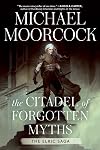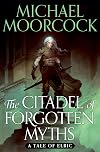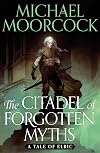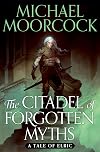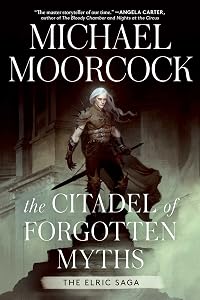
The Citadel of Forgotten Myths
by Michael Moorcock
Elric (novella collection◊), The Eternal Champion (Elric novella collection)
On This Page
Description
During the days of Elric's final wanderings, Elric and Moonglum must fight monsters, gods, and their own kind as they encounter a fresh history of Melnibone and her dragons, the powerful and mysterious Phoorn, in this exciting adventure.--Adapted from dust jacket.Tags
Recommendations













Member Reviews
While promotional copy insists that this latest addition to Moorcock's tales of the last Emperor of Melniboné "takes place between the first and second books of the Elric Saga," that refers to their current packaging in the Saga Press edition. For those of us more familiar with the old mass market paperbacks and their omnibus collections, that makes it fall between "The Weird of the White Wolf" and "The Vanishing Tower." Elric's peregrinations with Moonglum in the Young Kingdoms are interrupted with a trip to "the underside of the world," where the moody kinslayer traces the origins of the Melnibonéan race and their relationship to the dragons with whom their culture is in symbiosis.
The first half of the book consists of two novellas show more previously published under other titles. I had read "How Elric Pursued His Weird into the Far World" when it was called "Red Pearls" in the 2010 collection Swords & Dark Magic. I liked it then, but it was too long ago for me to assess how "substantially revised" (per the appended note) this new version is. The story here is interesting, but often told at a somewhat chilly level of abstraction. The second novella is "How Elric Discovered an Unpleasant Kinship," published before revision as "Black Petals," serialized in Weird Tales (2008-9) and collected in Elric: Swords and Roses. Despite owning the latter volume, I had never read this story. It felt very much like a return to form, with a mood that matched "The Stealer of Souls" from 1962.
The second half of The Citadel of Forgotten Myths is centered on the citadel of the title, the stronghold of Kirinmoir. This polity in the World Below compares to Elric's own Imryrr as an age-old capital of his race. It is matriarchal, however, with an apiary-centered economy. The story starts with some adventuring, and it builds to a great military conflict driven by Melnibonéan grudges and the scheming of gods of Chaos.
Particularly in the final part, this book has many "Easter eggs" for longtime readers of Moorcock, and not merely of the crossover variety that tie this story into his multiversal hyperwork of the Eternal Champion, Cosmic Balance, and moonbeam roads. For example, he alludes to his own song lyric in mentioning "veterans of those dreadful psychic wars" (184) and to his recent autobio-fantasy in "a whispering swarm constantly reminding him of his own mortality" (185).
Some contemporary political sarcasm is evident in naming a throwaway character G'nilwab Sirob--an anagram of "Bawling Boris" (205). (I suspect that I failed to catch yet other references built into character names.) Moorcock also has deranged Chaos Queen Xiombarg extol herself as "Goddess made Great Again" (284), and Elric expresses his resentment that his countrymen wanted him to "make Melniboné great again" (314).
The inhuman Elric is veritably the apotheosis of the sword & sorcery murder hobo. As an inversion of Robert E. Howard's Conan, the point that stands out in these particular tales is the ineluctable net of dependencies and obligations that bind Elric to his race, his cursed sword, and his patron demon. Where Conan prizes his freedom and independence, Elric seems unable even to conceive of such a condition. I don't think this book would make an especially effective point of entry for the Elric stories, let alone the larger Eternal Champion quilt. Still, I enjoyed it, and it fueled my appetite for re-reading Moorcock's prince of ruins. show less
The first half of the book consists of two novellas show more previously published under other titles. I had read "How Elric Pursued His Weird into the Far World" when it was called "Red Pearls" in the 2010 collection Swords & Dark Magic. I liked it then, but it was too long ago for me to assess how "substantially revised" (per the appended note) this new version is. The story here is interesting, but often told at a somewhat chilly level of abstraction. The second novella is "How Elric Discovered an Unpleasant Kinship," published before revision as "Black Petals," serialized in Weird Tales (2008-9) and collected in Elric: Swords and Roses. Despite owning the latter volume, I had never read this story. It felt very much like a return to form, with a mood that matched "The Stealer of Souls" from 1962.
The second half of The Citadel of Forgotten Myths is centered on the citadel of the title, the stronghold of Kirinmoir. This polity in the World Below compares to Elric's own Imryrr as an age-old capital of his race. It is matriarchal, however, with an apiary-centered economy. The story starts with some adventuring, and it builds to a great military conflict driven by Melnibonéan grudges and the scheming of gods of Chaos.
Particularly in the final part, this book has many "Easter eggs" for longtime readers of Moorcock, and not merely of the crossover variety that tie this story into his multiversal hyperwork of the Eternal Champion, Cosmic Balance, and moonbeam roads. For example, he alludes to his own song lyric in mentioning "veterans of those dreadful psychic wars" (184) and to his recent autobio-fantasy in "a whispering swarm constantly reminding him of his own mortality" (185).
Some contemporary political sarcasm is evident in naming a throwaway character G'nilwab Sirob--an anagram of "Bawling Boris" (205). (I suspect that I failed to catch yet other references built into character names.) Moorcock also has deranged Chaos Queen Xiombarg extol herself as "Goddess made Great Again" (284), and Elric expresses his resentment that his countrymen wanted him to "make Melniboné great again" (314).
The inhuman Elric is veritably the apotheosis of the sword & sorcery murder hobo. As an inversion of Robert E. Howard's Conan, the point that stands out in these particular tales is the ineluctable net of dependencies and obligations that bind Elric to his race, his cursed sword, and his patron demon. Where Conan prizes his freedom and independence, Elric seems unable even to conceive of such a condition. I don't think this book would make an especially effective point of entry for the Elric stories, let alone the larger Eternal Champion quilt. Still, I enjoyed it, and it fueled my appetite for re-reading Moorcock's prince of ruins. show less
This feels like a concluding book. Elric and Moonglum wander the 'World Below' - literally the other side of Elric's world, looking for the legendary origins of Elric's people and their Phroon dragon allies. Lots of musing, lots of wandering, lots of slaying. Moorcock has clearly changed his style a bit to fit the times, there are hints of social commentary. The strange 'egg shaped' world with one flat side, feels like a poke at Tolkien, possibly, or maybe just flat-earthers.
I look forward to the time where I can dive back into the works of Michael Moorcock. I know that the story will be well written. It will be easy to read and highly engrossing. I know that the story won't just be the typical sort of thing that many other writers try to imitate. So when the chance came to read a new Elric story it was a no-brainer that I would want to read it.
This book is really three stories rolled into one about Elrics adventure in whats essentially the inner world. In the end not everything comes together well but they weren't supposed to. This was more about connecting the other works of the author together with this story. In the end that is fine but it does point to the reader that there is a lot more going on then show more you may realize. That in turn speaks to one of the problems of the book. If you have not read or are at least familiar with the writers previous works that are not Elrc you will not grasp the importance of the references that are being made throughout the book. That said it's still a worthy addition to the canon of the writers works. It might seem contradictory at some parts to other works but that is easily dismissed when viewed as another part in the totality of his body of work.
I read this book via NetGalley> I thank them for this book. show less
This book is really three stories rolled into one about Elrics adventure in whats essentially the inner world. In the end not everything comes together well but they weren't supposed to. This was more about connecting the other works of the author together with this story. In the end that is fine but it does point to the reader that there is a lot more going on then show more you may realize. That in turn speaks to one of the problems of the book. If you have not read or are at least familiar with the writers previous works that are not Elrc you will not grasp the importance of the references that are being made throughout the book. That said it's still a worthy addition to the canon of the writers works. It might seem contradictory at some parts to other works but that is easily dismissed when viewed as another part in the totality of his body of work.
I read this book via NetGalley> I thank them for this book. show less
Ratings
Members
- Recently Added By
Lists

2023 Hugo Awards -- Eligible Works -- Novels
70 works; 21 members

Books Read in 2023
5,547 works; 145 members

al.vick-wishlist-next-in-series
110 works; 1 member

Top Five Books of 2023
767 works; 317 members
Author Information

659+ Works 65,135 Members
Michael Moorcock, 1939 - Writer Michael Moorcock was born December 18, 1939 in Mitcham, Surrey, England. Moorcock was the editor of the juvenile magazine Tarzan Adventures from 1956-58, an editor and writer for the Sexton Blake Library and for comic strips and children's annuals from 1959-61, an editor and pamphleteer for Liberal Party in 1962, show more and became editor and publisher for the science fiction magazine New Worlds in 1964. He has worked as a singer-guitarist, has worked with the rock bands Hawkwind and Blue Oyster Cult and is a member of the rock band Michael Moorcock and the Deep Fix. Moorcock's writing covers a wide range of science fiction and fantasy genres. "The Chronicles of Castle Brass" was a sword and sorcery novel, and "Breakfast in the Ruins: A Novel of Inhumanity" uses the character Karl Glogauer as a different person in different times. Karl participates in the political violence of the French Revolution, the Paris Commune, and a Nazi concentration camp. Moorcock also wrote books and stories that featured the character Jerry Cornelius, who had no consistent character or appearance. "The Condition of Muzak" completed the initial Jerry Cornelius tetralogy and won Guardian Literary Prize in 1977. "Byzantium Endures" and "The Laughter of Carthage" are two autobiographical novels of the Russian emigre Colonel Pyat and were the closest Moorcock came to conventional literary fiction. "Byzantium Endures" focuses on the first twenty years of Pyat's life and tells of his role in the Russian revolution. Pyat survives the revolution and the subsequent civil war by working first for one side and then another. "The Laughter of Carthage" covers Pyat's life from 1920-1924 telling of his escape from Communist Russia and his travels in Europe and America. It's a sweeping picture of the world during the 1920's because it takes the character from living in Constantinople to Hollywood. Moorcock returned to the New Wave style in "Blood: A Southern Fantasy" (1994) and combined mainstream fiction with fantasy in "The Brothel of Rosenstrasse," which is set in the imaginary city of Mirenburg. MoorCock won the 1967 Nebula Award for Behold the Man and the 1979 World Fantasy Award for his novel, Gloriana. (Bowker Author Biography) show less
Series


Work Relationships
Common Knowledge
- Canonical title
- The Citadel of Forgotten Myths
- Original publication date
- 2022-12
- People/Characters
- Elric of Melniboné; Moonglum of Elwher; Orlando Funk; Arioch; Xiombarg; Dyvim Marluc
- Important places
- Kirinmoir
- Original language
- English
- Disambiguation notice
- Novella collection, these novellas are included:
- a revised Red Pearls
- a revised Black Petals
- "...a Lost Past"
Classifications
Statistics
- Members
- 214
- Popularity
- 152,745
- Reviews
- 3
- Rating
- (3.62)
- Languages
- English
- Media
- Paper, Audiobook, Ebook
- ISBNs
- 10
- ASINs
- 6