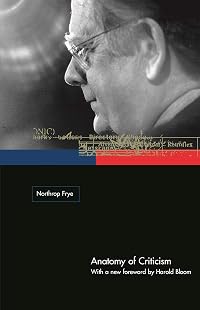
Anatomy of Criticism: Four Essays
by Northrop Frye
On This Page
Description
"Northrop Frye's Anatomy of Criticism is the magnum opus of one of the most important and influential literary theorists of the twentieth century. Breaking with the practice of close reading of individual texts, Frye seeks to describe a common basis for understanding the full range of literary forms by examining archetypes, genres, poetic language, and the relations among the text, the reader, and society. Using a dazzling array of examples, he argues that understanding 'the structure of show more literature as a total form' also allows us to see the profoundly liberating effect literature can have."-- show lessTags
Recommendations








Member Reviews
In this book, Northrop Frye sets out to further the practice of literary criticism, which has yet to progress very far, in his opinion, from Aristotle. His aim is not to eliminate various schools of criticism, whether historical and formal or what was in his day the New Criticism. Instead, he constructs a system of organization capable of containing them all, one whose orientation is not the individual literary work as much as literature as some sort of Platonic ideal (which is not simply the aggregate of all literary works).
The result is what Terry Eagleton calls “a mighty ‘totalization’ of all literary genres.” It is a structuralist approach, as reflected in his original title, Structural Poetics (which his editor insisted on show more changing). The intended title combined his debt to Aristotle’s enduring work on literary criticism, from whom he borrowed his organizing principles, and what Frye sought to bring to the discussion. The title adopted in its place also owes a telling debt: to Burton’s Anatomy of Melancholy, one of Frye’s favorite books.
However, Frye’s structure is not imposed a priori; he works inductively, based on seemingly omnivorous yet attentive reading.
Frye combats the notion that criticism is a parasitic endeavor by citing an analogy, physics. Physics, he writes, is “an organized body of knowledge about nature. A student of it says he is learning physics, not nature.” He envisages a similar relation of criticism to literature.
It’s easy to imagine how this approach might calcify in the hands of adepts, devolving into rigid classification. Frye, however, is not a slave to his system: “Once we have learned to distinguish the modes, however, we must learn to recombine them.” Many pleasurable works have elements of more than one mode. It seems that Frye offers a typology (or system of typologies), useful for coming to grips with any work of literature.
The value of this becomes apparent when he turns to literary works in prose, for which, he notes, Aristotle and the other Greeks did not provide us with a term, as they did for other genres. Frye notes the misunderstanding caused by the everyday use of the term fiction (the opposite of fact), as well as the widespread use of the term novel, which is but one of four chief strands of fiction he identifies (the others being confession, anatomy, and romance; as always, combinations are possible and do exist). Failure to recognize these strands results in judging Wuthering Heights a less successful novel than Pride and Prejudice when it is not a novel in Frye’s estimation but a romance.
Since Frye’s terminology abounds in transliterated Greek terms, neologisms, and words commonly used in another sense in everyday parlance, I found the Glossary at the end of the book helpful.
This book was a challenging read. Many passages were enjoyable and enlightening, while others were a slog. Yet the effort I expended to stay with it was amply rewarded. It helped that the text is peppered with memorable aphorisms such as, “The axiom of criticism must be, not that the poet does not know what he is talking about, but that he cannot talk about what he knows” and, “At the centre of liberal education, something surely ought to get liberated.”
That last sentiment alone might cause this book to be removed from the library shelf in some states, so read it while you can. show less
The result is what Terry Eagleton calls “a mighty ‘totalization’ of all literary genres.” It is a structuralist approach, as reflected in his original title, Structural Poetics (which his editor insisted on show more changing). The intended title combined his debt to Aristotle’s enduring work on literary criticism, from whom he borrowed his organizing principles, and what Frye sought to bring to the discussion. The title adopted in its place also owes a telling debt: to Burton’s Anatomy of Melancholy, one of Frye’s favorite books.
However, Frye’s structure is not imposed a priori; he works inductively, based on seemingly omnivorous yet attentive reading.
Frye combats the notion that criticism is a parasitic endeavor by citing an analogy, physics. Physics, he writes, is “an organized body of knowledge about nature. A student of it says he is learning physics, not nature.” He envisages a similar relation of criticism to literature.
It’s easy to imagine how this approach might calcify in the hands of adepts, devolving into rigid classification. Frye, however, is not a slave to his system: “Once we have learned to distinguish the modes, however, we must learn to recombine them.” Many pleasurable works have elements of more than one mode. It seems that Frye offers a typology (or system of typologies), useful for coming to grips with any work of literature.
The value of this becomes apparent when he turns to literary works in prose, for which, he notes, Aristotle and the other Greeks did not provide us with a term, as they did for other genres. Frye notes the misunderstanding caused by the everyday use of the term fiction (the opposite of fact), as well as the widespread use of the term novel, which is but one of four chief strands of fiction he identifies (the others being confession, anatomy, and romance; as always, combinations are possible and do exist). Failure to recognize these strands results in judging Wuthering Heights a less successful novel than Pride and Prejudice when it is not a novel in Frye’s estimation but a romance.
Since Frye’s terminology abounds in transliterated Greek terms, neologisms, and words commonly used in another sense in everyday parlance, I found the Glossary at the end of the book helpful.
This book was a challenging read. Many passages were enjoyable and enlightening, while others were a slog. Yet the effort I expended to stay with it was amply rewarded. It helped that the text is peppered with memorable aphorisms such as, “The axiom of criticism must be, not that the poet does not know what he is talking about, but that he cannot talk about what he knows” and, “At the centre of liberal education, something surely ought to get liberated.”
That last sentiment alone might cause this book to be removed from the library shelf in some states, so read it while you can. show less
On trying to read Northrop Frye 30 years after European critical theory stormed the gates of the academy, leaving the humanities, which were retrospectively ripe for collapse, in a kind of fall-of-Rome state of confusion and disillusionment, I was actually reminded (again - it comes up often for me these days) of Shelley’s poem:
My name is Ozymandias, king of kings
Look on my works, ye mighty, and despair!
Nothing beside remains – round the decay
Of that colossal wreck, boundless and bare
The lone and level sands stretch far away.
The Classically-descended celestial clockwork world Frye created his magisterial critical system from and for is vanishing before our eyes, like Newton’s universe did after Einstein. Like many elaborate show more attempts to model some aspect of the world in a system, this one’s biggest, most ironic flaw is its failure to take the defining reality of time into account. But maybe actually a Copernican metaphor is better here – Frye, like Harold Bloom, and then a bevy of less intelligent and more reactionary late 20th century culture warriors, saw Western literature at the center of something that has been revealed to have no permanent center – human history.
There’s no bringing back the past, but Frye’s system does offer anybody who has more than a beach reader’s interest in Western literature some clever and useful ways to think about the forms it has taken and the techniques that have been applied in it from pre-history to the 20th century modernists, anyway. (Whether Frye’s project has any relevance to other literary traditions I can’t say.) Thank goodness Anatomy of Criticism has a good Wikipedia page. I'd recommend that. You get the gist of the system without every tedious example or obsolete hypothesis. That’s enough. show less
My name is Ozymandias, king of kings
Look on my works, ye mighty, and despair!
Nothing beside remains – round the decay
Of that colossal wreck, boundless and bare
The lone and level sands stretch far away.
The Classically-descended celestial clockwork world Frye created his magisterial critical system from and for is vanishing before our eyes, like Newton’s universe did after Einstein. Like many elaborate show more attempts to model some aspect of the world in a system, this one’s biggest, most ironic flaw is its failure to take the defining reality of time into account. But maybe actually a Copernican metaphor is better here – Frye, like Harold Bloom, and then a bevy of less intelligent and more reactionary late 20th century culture warriors, saw Western literature at the center of something that has been revealed to have no permanent center – human history.
There’s no bringing back the past, but Frye’s system does offer anybody who has more than a beach reader’s interest in Western literature some clever and useful ways to think about the forms it has taken and the techniques that have been applied in it from pre-history to the 20th century modernists, anyway. (Whether Frye’s project has any relevance to other literary traditions I can’t say.) Thank goodness Anatomy of Criticism has a good Wikipedia page. I'd recommend that. You get the gist of the system without every tedious example or obsolete hypothesis. That’s enough. show less
This is a massively well-informed, highly readable work. Frye intended to follow in the footsteps of Aristotle's Poetics and expand its coverage of tragedy to cover all the major forms of (Western) literature with a general theory of its various forms and major themes. It is a major achievement and well worth reading.
However... as a tool of a critic it's nearly useless: it may say something about a book that you can slot it in as a Fryeian Romance, but most of the interesting things to say about a work are about its particularities rather than its generalities, and the Anatomy (like many works of theory) is all about generalities, commonalities which connect works together, so at best it can provide only a context for the actual work of show more criticism. In this sense it (unavoidably) failed at Frye's ultimate goal, which was to establish Literary Criticism as its own independent discipline.
In many ways it's the opposite of New Historicism: the latter tends to absorb the study of the work into the study of its historical background, using the work as an illumination on social history, whereas the Fryeian project was to extract a taxonomy of works which was independent of "local" cultures but held up across the 2,800 years of western literary genres. Nor can Frye's work be considered a branch of Structuralism: it antedates by 15 years Levi-Strauss' Structuralism and Ecology and it betrays no visible influence of Saussure. show less
However... as a tool of a critic it's nearly useless: it may say something about a book that you can slot it in as a Fryeian Romance, but most of the interesting things to say about a work are about its particularities rather than its generalities, and the Anatomy (like many works of theory) is all about generalities, commonalities which connect works together, so at best it can provide only a context for the actual work of show more criticism. In this sense it (unavoidably) failed at Frye's ultimate goal, which was to establish Literary Criticism as its own independent discipline.
In many ways it's the opposite of New Historicism: the latter tends to absorb the study of the work into the study of its historical background, using the work as an illumination on social history, whereas the Fryeian project was to extract a taxonomy of works which was independent of "local" cultures but held up across the 2,800 years of western literary genres. Nor can Frye's work be considered a branch of Structuralism: it antedates by 15 years Levi-Strauss' Structuralism and Ecology and it betrays no visible influence of Saussure. show less
Sure, I guess, it's an oversimplified model ...? But read it, because it might give you insights ... plus it hearkens back to a time when criticism was written to be consumed and understood by mortals & meaning wasn't willfully obscured because ... well, because the author *could*.
It's no exaggeration to say that this is one of the books of criticism that changed my (intellectual) life. Though its vein of Structuralism has largely been supplanted by Deconstruction (as have other veins of Structuralism), and though its theories are no longer fashionable, the Anatomy of Criticism stands out as being one of the finest overarching theories of literary genres ever.
Frye is different from most Structuralists, in a chicken and the egg sense. The founders of Structuralism believed in a Jungian collective unconcious which served to generate certain literary and narrative modes across all cultures at all times. Frye believed the reverse: that initial narrative modes had impressed themselves upon the literary unconcious, show more thereby causing themselves to be replicated. So which came first, the narrative forms or the unconcious drives? That question lies at the heart of the divide between the Canadian Frye and the French.
But it hardly matters, in a practical sense. What Frye proposes, over four long essays, is a massive expansion of Aristotle's Poetics, ranging from the mythical to the absurd, from tragedy and comedy to satire, and everywhere in between.
Though his schemes are a bit too schematic at times, and though it feels at certain moments that he is trying to fit a square peg into a round hole (especially in the essay on narrative arcs), his overall theory is if not entirely persuasive then at least an excellent way to begin thinking about literary genres, to see the continuities in literature. And once the continuities can be seen more clearly, the differences can more easily be brought into relief. show less
Frye is different from most Structuralists, in a chicken and the egg sense. The founders of Structuralism believed in a Jungian collective unconcious which served to generate certain literary and narrative modes across all cultures at all times. Frye believed the reverse: that initial narrative modes had impressed themselves upon the literary unconcious, show more thereby causing themselves to be replicated. So which came first, the narrative forms or the unconcious drives? That question lies at the heart of the divide between the Canadian Frye and the French.
But it hardly matters, in a practical sense. What Frye proposes, over four long essays, is a massive expansion of Aristotle's Poetics, ranging from the mythical to the absurd, from tragedy and comedy to satire, and everywhere in between.
Though his schemes are a bit too schematic at times, and though it feels at certain moments that he is trying to fit a square peg into a round hole (especially in the essay on narrative arcs), his overall theory is if not entirely persuasive then at least an excellent way to begin thinking about literary genres, to see the continuities in literature. And once the continuities can be seen more clearly, the differences can more easily be brought into relief. show less
Well, this is pretty dense in a way that books usually aren't these days. Not dense in a Frenchified theory way, and not dense in a flowery language kind of way. Just conceptually dense. Which is fine, but not all of the concepts are useful. Density aside, the first two essays - on historical criticism and 'symbols,' (which for Frye doesn't really mean, well, symbol) - are pretty good, if overly schematic. The third essay is horrific. Really, you just need a diagram for it, but we get over 100 pages instead. The fourth essay, on genres, is occasionally interesting but also too schematic and way too long. I'd stick to the introduction and first two essays, and skim the rest.
One thing that's odd is that people say this seems 'dated' show more thanks to Marxist or feminist or postcolonial theory, or deconstruction. Not really, though. Frye's aware of all those trends already in 1957 (not counting postco, I guess); and his work isn't dated by deconstruction. It's just the opposite side, handily summarised in Harold Bloom's (awful) foreword: for Bloom and his ilk, literature is all about indeterminacy, and more or less a brawl among self-loathing geniuses. For Frye, literature is a "cooperative enterprise," part of the attempt to make life better for ourselves. Not dated, then, but one side of an ongoing argument. Frankly, I hope Frye's side wins. Then there'll be no need to re-read this book. show less
One thing that's odd is that people say this seems 'dated' show more thanks to Marxist or feminist or postcolonial theory, or deconstruction. Not really, though. Frye's aware of all those trends already in 1957 (not counting postco, I guess); and his work isn't dated by deconstruction. It's just the opposite side, handily summarised in Harold Bloom's (awful) foreword: for Bloom and his ilk, literature is all about indeterminacy, and more or less a brawl among self-loathing geniuses. For Frye, literature is a "cooperative enterprise," part of the attempt to make life better for ourselves. Not dated, then, but one side of an ongoing argument. Frankly, I hope Frye's side wins. Then there'll be no need to re-read this book. show less
"Evil may yet be good to have been and yet remain evil." That's how I feel about having read this book.
If you hover over the stars of Goodread's rating system, each rating is described in terms of how much one "likes" a given book. These descriptions are inadequate. I chose 3 stars for this book not because I liked it – in truth, much of it I despised while reading it, insofar as it evoked any emotion from me – but because I did find some useful portions within the somewhat absurdly complex system ... ahem, "anatomy" ... that Frye creates.
As has been my wont with works upon which I don't feel wholly equipped to offer meaningful commentary, I will simply provide below some enjoyable, or at least useful, quotes from the book itself.
p. show more 33: In literary fictions the plot consists of somebody doing something. The somebody, if an individual, is the hero, and the something he does or fails to do is what he can do, or could have done, on the level of the postulates made about him by the author and the consequent expectations of the audience. Fictions, therefore, may be classified, not morally, but by the hero's power of action, which may be greater than ours, less, or roughly the same.
p. 74: Literary meaning may best be described, perhaps, as hypothetical, and a hypothetical or assumed relation to the external world is part of what is usually meant by the word "imaginative."
p. 82: Aristotle speaks of mimesis praxeos, an imitation of action, and it appears that he identifies this mimesis praxeos with mythos.... Human action (praxis) is primarily imitated by histories, or verbal structures that describes specific and particular actions. A mythos is a secondary imitation of an action, which means, not that it is at two removes from reality, but that it describes typical actions, being more philosophical than history. Human thought (theoria) is primarily imitated by discursive writing, which makes specific and particular predictions. A dianoia is a secondary imitation of thought, a mimesis logos, concerned with typical thought, with the images, metaphors, diagrams, and verbal ambiguities out of which specific ideas develop.
p. 243: The present book employs a diagrammatic framework that has been used in poetics ever since Plato's time. This is the division of "the good" into three main areas, of which the world of art, beauty, feeling, and taste is the central one, and is flanked by two other worlds. One is the world of social action and events, the other the world of individual thought and ideas. Reading from left to right, this threefold structure divides human faculties into will, feeling, and reason. It divides the mental constructs which these faculties produce into history, art, and science and philosophy. It divides the ideals which form compulsions or obligations on these faculties into law, beauty, and truth. Poe gives his version of the diagram (right to left) as Pure Intellect, Taste, and the Moral Sense.... Similarly, we have portrayed the poetic symbol as intermediate between event and idea, example and precept, ritual and dream, and have finally displayed it as Aristotle's ethos, human nature and the human situation, between and made up of mythos and dianoia, which are verbal imitations of action and thought respectively.
p. 347: The ethical purpose of a liberal education is to liberate, which can only mean to make one capable of conceiving society as free, classless, and urbane. No such society exists, which is one reason why a liberal education must be deeply concerned with works of imagination. The imaginative element in works of art, again, lifts them clear of the bondage of history. show less
If you hover over the stars of Goodread's rating system, each rating is described in terms of how much one "likes" a given book. These descriptions are inadequate. I chose 3 stars for this book not because I liked it – in truth, much of it I despised while reading it, insofar as it evoked any emotion from me – but because I did find some useful portions within the somewhat absurdly complex system ... ahem, "anatomy" ... that Frye creates.
As has been my wont with works upon which I don't feel wholly equipped to offer meaningful commentary, I will simply provide below some enjoyable, or at least useful, quotes from the book itself.
p. show more 33: In literary fictions the plot consists of somebody doing something. The somebody, if an individual, is the hero, and the something he does or fails to do is what he can do, or could have done, on the level of the postulates made about him by the author and the consequent expectations of the audience. Fictions, therefore, may be classified, not morally, but by the hero's power of action, which may be greater than ours, less, or roughly the same.
p. 74: Literary meaning may best be described, perhaps, as hypothetical, and a hypothetical or assumed relation to the external world is part of what is usually meant by the word "imaginative."
p. 82: Aristotle speaks of mimesis praxeos, an imitation of action, and it appears that he identifies this mimesis praxeos with mythos.... Human action (praxis) is primarily imitated by histories, or verbal structures that describes specific and particular actions. A mythos is a secondary imitation of an action, which means, not that it is at two removes from reality, but that it describes typical actions, being more philosophical than history. Human thought (theoria) is primarily imitated by discursive writing, which makes specific and particular predictions. A dianoia is a secondary imitation of thought, a mimesis logos, concerned with typical thought, with the images, metaphors, diagrams, and verbal ambiguities out of which specific ideas develop.
p. 243: The present book employs a diagrammatic framework that has been used in poetics ever since Plato's time. This is the division of "the good" into three main areas, of which the world of art, beauty, feeling, and taste is the central one, and is flanked by two other worlds. One is the world of social action and events, the other the world of individual thought and ideas. Reading from left to right, this threefold structure divides human faculties into will, feeling, and reason. It divides the mental constructs which these faculties produce into history, art, and science and philosophy. It divides the ideals which form compulsions or obligations on these faculties into law, beauty, and truth. Poe gives his version of the diagram (right to left) as Pure Intellect, Taste, and the Moral Sense.... Similarly, we have portrayed the poetic symbol as intermediate between event and idea, example and precept, ritual and dream, and have finally displayed it as Aristotle's ethos, human nature and the human situation, between and made up of mythos and dianoia, which are verbal imitations of action and thought respectively.
p. 347: The ethical purpose of a liberal education is to liberate, which can only mean to make one capable of conceiving society as free, classless, and urbane. No such society exists, which is one reason why a liberal education must be deeply concerned with works of imagination. The imaginative element in works of art, again, lifts them clear of the bondage of history. show less
Members
- Recently Added By
Lists

Literary Theory and Criticism: What Happens and Why
37 works; 5 members

The Best of Canadian Literature
235 works; 33 members

CBC's 100 True Stories
100 works; 6 members

the preppy handbook
36 works; 1 member

readingList
38 works; 1 member
Author Information

Herman Northrop Frye was born in 1912 in Quebec, Canada. His mother educated him at home until the fourth grade. After graduating from the University of Toronto, he studied theology at Emmanuel College for several years and actually worked as a pastor before deciding he preferred the academic life. He eventually obtained his master's degree from show more Oxford, and taught English at the University of Toronto for more than four decades. Frye's first two books, Fearful Symmetry (1947) and Anatomy of Criticism (1957) set forth the influential literary principles upon which he continued to elaborate in his numerous later works. These include Fables of Identity: Studies in Poetic Mythology, The Well-Tempered Critic, and The Great Code: The Bible and Literature. Frye died in 1991. (Bowker Author Biography) show less
Some Editions
Awards and Honors
Common Knowledge
- Original publication date
- 1957
- People/Characters
- Aristophanes; Aristotle; Robert Browning; Geoffrey Chaucer; Dante Alighieri; Charles Dickens (show all 23); T. S. Eliot; Thomas Hardy; Nathaniel Hawthorne; Homer; Henrik Ibsen; Henry James; James Joyce; John Milton; Plato; Alexander Pope; William Shakespeare; George Bernard Shaw; Percy Bysshe Shelley; Sophocles; Edmund Spenser; Jonathan Swift; William Butler Yeats
- Dedication
- HELENAE UXORI
- First words
- Polemical Introduction
This book consists of "essays," in the word's original sense of a trial or incomplete attempt, on the possibility of a synoptic view of the scope theory, principles, and techniques of literary... (show all) criticism.
First Essay
HISTORICAL CRITICISM: THEORY OF MODES
FICTIONAL MODES: INTRODUCTION
In the second paragraph of the Poetics Aristotle speaks of the differences in works of fiction which are caused by the dif... (show all)ferent elevations of the characters in them.
Foreword by Harold Bloom to the 2000 edition
NORTHROP FRYE IN RETROSPECT
The publication of Northrop Frye's Notebooks troubled some of his old admirers, myself included. - Last words
- (Click to show. Warning: May contain spoilers.)I mean only that if critics go on with their own business, this will appear to be, with increasing obviousness, the social and practical result of their labors.
Classifications
Statistics
- Members
- 1,704
- Popularity
- 13,058
- Reviews
- 13
- Rating
- (4.02)
- Languages
- 8 — Chinese, English, French, Hungarian, Italian, Portuguese, Croatian, Spanish
- Media
- Paper, Ebook
- ISBNs
- 19
- ASINs
- 21